Peace Homes Aluva

Simplify Building Your Dream Home

Archives January 2009

Gaza massacres (27 December 2008 – )

Gaza massacres (27 December 2008 – )
 

Hundreds of Palestinians have been killed and thousand more injured as Israel continues to assault the 1.5 million Palestinians in Gaza — the majority of them children and refugees — from the air, sea and sky.


On 27 December, Israel began its bombardment on Gaza and then on 3 January began its ground offensive. At the end of 8 January in Gaza, at least 763 Gazans had been killed, including more than 200 children, and more than 3,000 injured since 27 December, according to Al Jazeera.

Israel claims that it is targeting Hamas armed fighters and infrastructure, ostensibly in response to the firing of homemade rockets from Gaza into Israel. However, field investigations by the Gaza-based human rights organization Al Mezanshow that United Nations-administered schools, mosques, universities, emergency medical crews, private homes and other civilian objects have all been in Israel’s sights.

Among those killed on the first day of bombing, when more than 100 tons of bombs were dropped on the tiny coastal enclave, included police officers who were attending a graduation ceremony, school children heading home after a day of study, and other Gazans killed without warning as they were conducting their normal business.

Entire families have been wiped out during the air strikes and shelling, including that of Hamas leader Nizar Rayyan who was extrajudicially executed along with his family in their home in a Gaza refugee camp. More than 40 were killed on 6 January when Israeli forces shelled the United Nations-administered Fakhoura school in the Jabalia refugee camp, where families who had been displaced by the bombing were seeking shelter. The UN has demanded an independent investigation and its spokespersons assert that GPS coordinates of all UN locations were given to Israel to prevent such an atrocity. Israel recanted its claim that resistance fighters released fire on Israeli soldiers from the school, which has been categorically denied by UN officials.

The death toll will most likely rise as corpses are recovered from the rubble of destroyed buildings and the critically injured die of their wounds. The International Committee of the Red Cross has protested Israeli forces preventing them from evacuating casualties. Many will likely die because Gaza’s hospitals — already chronically short of medicines and supplies due to the Israeli siege — are unable to cope with the scale of the catastrophe. Medical workers face grave danger as they respond to the sites of Israeli strikes; according to the World Health Organization, as of 8 January, 21 medical workers had been killed and more than 30 injured since 27 December.

The bloody operation in Gaza comes after the expiration of a six-month-long ceasefire between Israel and resistance groups in Gaza, including Hamas. Israel had broken the ceasefire on 4 November, when it extrajudicially executed six Palestinians in Gaza whom it said was digging tunnels to Israel. During the five previous months of the ceasefire, Hamas had refrained from firing rockets and prevented other groups from doing so. However, Israel failed to ease the nearly two-year-long embargo on the Gaza Strip that has crippled economic life and brought the area to the brink of a humanitarian crisis — one of Israel’s obligations under the ceasefire.

Instead, in Israel, where the fate of the Gaza Strip has become part of politicking as the country gears up for an election, leaders blamed Hamas for the carnage and Prime Minister Ehud Olmert cynically appealed, “to the people of Gaza, you are not our enemy.” While the other three members of the so-called International Quartet for Middle East Peace criticized what they called Israel’s “excessive” use of force, the US refrained from doing so. White House spokesperson Gordon Johndroe stated from Texas, where President George W. Bush was presently vacationing: “Hamas’ continued rocket attacks into Israel must cease if the violence is to stop.”

The ongoing assault on Gaza is the largest Israeli military operation in the territory occupied during the 1967 War. Although Israel unilaterally withdrew its illegal settler population from the Gaza Strip in 2005, it remained the occupying power as it controlled the borders, sea and airspace, as well as the population registry, and regularly carried out sonic booms over the area, terrorizing the population. Israeli forces have also frequently carried out extrajudicial executions of Palestinian activists in Gaza, killing scores of bystanders as well.

Gaza hospitals were unable to cope with the situation as Israel’s closure of the Gaza Strip for a year and a half has prevented the importing of medical supplies and equipment. As the morgues filled to capacity, corpses lined the hallways of Gaza hospitals. Hospitals were forced to turn away many of the injured due to the lack of space and supplies.

The massive air strikes came after a food crisis broke out in Gaza, as Israel’s banning of imports into the Strip have depleted stocks of flour and cooking gas, causing some bakeries — the few still in operation — to resort to baking bread made out of animal feed. On 18 December, the United Nations agency for Palestine refugees (UNRWA) was forced to stop its food aid delivery to 750,000 refugees in the Gaza Strip. Though it briefly resumed services in January 2009 after a “humanitarian corridor” was established, and a daily three-hour ceasefire was declared, the United Nations announced it was ceasing all services after Israeli forces targeted and killed a UN aid worker and wounded others on 8 January.

Israel’s measures of collective punishment on the Gaza Strip are resulting in “the breakdown of an entire society,” according to economist Sara Roy, who asks in a commentary published recently by The London Review of Books, “How can keeping food and medicine from the people of Gaza protect the people of Israel?”

The devastating attack on Gaza was described as “willful killing” by leading Palestinian human rights and civil society organizations, and therefore constitute “a war crime.” The organizations stated: “Both the time and location of these attacks also indicate a malicious intent to inflict as many casualties as possible with many of the police stations located in civilian population centers and the time of the attacks coinciding with the end of the school day resulting in the deaths of numerous children.”

The assault was met with loud calls for a boycott of Israel, including a boycott appeal from by the Palestinian Boycott, Divestment and Sanctions National Committee, which stated on the day of the massacres: “Israel seems intent to mark the end of its 60th year of existence the same way it has established itself — perpetrating massacres against the Palestinian people. In 1948, the majority of the indigenous Palestinian people were ethnically cleansed from their homes and land, partly through massacres like Deir Yassin; today, the Palestinians in Gaza, most of whom are refugees, do not even have the choice to seek refuge elsewhere. Incarcerated behind ghetto walls and brought to the brink of starvation by the siege, they are easy targets for Israel’s indiscriminate bombing.”

And while government leaders and the US president-elect remain resoundingly silent over the ongoing massacres in Gaza (with the exception of Hugo Chavez in Venezuela, which removed Israel’s ambassador from the country), millions of people around the world have taken to the streets to express their solidarity with Palestinians under siege. Analysts say that Arab regimes seen as being in collusion or supporting the siege and massacres, such as the Ramallah-based Palestinian Authority, Egypt, Jordan and Saudi Arabia, will not be unscathed by the popular anger towards these policies.

Palestinian firemen try to extinguish a fire following an Israeli strike in Rafah, southern Gaza Strip, 27 December 2008. (Hatem Omar/MaanImages)

Diaries and voices from Gaza

Humanitarian updates, action and advocacy

via Twitter


  • Rt @AJEnglish Israeli jets strike Rafah tunnels: Raids test fragile Gaza ceasefires as US envoy visits region – http://tinyurl.com/dgzjyy about 11 hours ago
  • VIDEO: Cairo hospitals treat Gaza’s war-scarred children (Warning: Images may disturb or offend some viewers) – http://tinyurl.com/bapg9h 3 days ago
  • Blair said that without Palestinian reconciliation, #Gaza reconstruction would be “harder” to achieve 3 days ago
  • Quartet Envoy Tony Blair met Palestinian PM Salam Fayadh in Ramallah, discusses #Gaza humanitarian needs, reconstruction and reconciliation 3 days ago
  • Retweet @AJEnglish Hamas to pay victims of #Gaza war: Palestinian group promises money to families of the dead… http://tinyurl.com/ddhya2 3 days ago
  • Retweet @AJEnglish #Gaza ceasefire talks due in Cairo: Hamas and other factions to meet Egypt, EU mediators… http://tinyurl.com/bpqmt7 3 days ago
  • Hamas says families who lost their homes in the #Gaza war will receive $5,190 in emergency aid, partially damaged homes get $2,595 3 days ago
  • Families will receive about $1,300 for each member killed in the #Gaza war, $650 would be paid out to those injured, a Hamas spokesman said 3 days ago
  • Hamas administration in #Gaza begins distribution of $52 million in emergency aid 3 days ago
  • Bashar al-Assad, the Syrian president, congratulates Khaled Meshaal, the Hamas leader, on the group’s “victory” against Israel. 3 days ago
  • Hamas-run government in Gaza says it will create a committee of senior officials to oversee all relief efforts in the territory. 3 days ago
  • France has decided to deploy a frigate off the coast of the #Gaza Strip to fight arms smuggling “in full co-operation with Egypt and Israel” 4 days ago
  • #Gaza children return to UN schools, teachers forced to tackle psychological trauma of pupils – http://tinyurl.com/bu3fys 4 days ago
  • Palestinian children in the #Gaza Strip have gone back to school for the first time since the 22-day Israeli offensive 4 days ago
  • VIDEO: United Nations struggles to house tens of thousands of people displaced by war in #Gaza – http://tinyurl.com/b3bv5r 4 days ago
  • Stay up to date with features, analysis and video from the aftermath of the #Gaza war with our special report – http://tinyurl.com/warongaza 4 days ago
  • Israel forms defence team, withholds names of soldiers who conducted #Gaza war amid potential war crime charges – http://tinyurl.com/c9r7gh 4 days ago
  • VIDEO: BBC spurns #Gaza appeal, defends decision not to air a fund-raising appeal for the victims of the war – http://tinyurl.com/b95uyw 4 days ago
  • VIDEO: Doctors believe that illegal chemical weapons were used in #Gaza, as Al Jazeera’s Todd Baer reports – http://tinyurl.com/b79tvy 4 days ago
  • United Nations aid chief John Holmes has condemned Israel’s alleged use of white phosphorous during its offensive on #Gaza 4 days ago

Gaza blogs:

The shortcut to peace

The shortcut to peace
Hasan Abu Nimah, The Electronic Intifada, 28 January 2009

Palestinians in Jabaliya in the northern Gaza Strip huddle around a fire next to their home destroyed during Israel’s 22 days of attacks on Gaza. (Wissam Nassar/MaanImages)

Because it is generally accepted by the so-called “international community” that Hamas is a major threat to Israel, and therefore to world peace and security, France has dispatched a frigate to participate in a new blockade of the Gaza Strip. The Sunday Times reported that United States naval ships hunting pirates in the Gulf of Aden have been instructed to track down Iranian arms shipments (25 January). Many other European states offered their navies to assist. Indeed, United Nations Security Council resolution 1860 emphasized the need to prevent illicit trafficking in arms and ammunition.

Unfortunately not one European country offered to send its navy to render humanitarian assistance to the thousands of injured, hungry, cold and homeless people in Gaza rendered so as a result of Israel’s attack. Perhaps helping children dying from white phosphorus burns, or just lack of clean water, would be seen as supporting “terrorism.”

The perverse assumption behind all the offers of help to Israel seems to be that Hamas and other resistance groups in Gaza fired rockets at Israel merely because rockets were available. Therefore, the logic goes, peace would prevail if the supply of rockets were curtailed.

Another strange assumption is that Hamas was freely importing rockets from Iran or elsewhere because Gaza’s borders were open and free of any control.

This ignores the fact that since Israel “disengaged” from Gaza in the summer of 2005, the coastal territory was never allowed any free access to the outside world. Gaza has been under varied forms of siege and blockade by land, sea and air. Fishermen were not even free to fish without constant attacks by the Israeli navy.

The Rafah crossing linking Gaza to Egypt was kept closed on Israeli insistence until a regime for strict Israeli proxy surveillance, with European monitors acting on Israel’s behalf, was established for it.

If Hamas, despite the blockade and total financial and diplomatic boycott managed to import so many rockets or the materials to make them, what level of further siege would guarantee an end to arms importation now?

But the glaring moral and legal question is why the “international community” is mobilizing its navies and political efforts to protect the aggressor, preserve the occupation, and deny the victims any means to defend themselves? If they do not want Palestinians to resist, why do they not themselves confront the aggressor and force an end to the occupation, the siege and dispossession?

In the better past when war broke out in a region the immediate response was often to impose an arms embargo on all sides. But when the defenseless population in Gaza were under attack from the region’s strongest army all calls were to prevent the victims from defending themselves. Meanwhile, endless supplies of sophisticated weaponry were sent to the occupier despite its already massive dominance and indiscriminate and criminal attacks on civilians.

Without objective and daring diagnosis of the conflict’s root causes there is no chance of any effective treatment. Sadly this lesson has never been learned, although it has been written repeatedly with much innocent blood.

When Palestinians started their first unarmed uprising in 1987, 40 years after their expulsion from their homes and 20 years after the brutal occupation of the West Bank and Gaza Strip began, they had no rockets; they had only stones to confront heavily armed occupation forces. Israel used its guns and deliberate, sadistic bone-breaking against unarmed demonstrators killing almost 1,500 and injuring tens of thousands in its failed efforts to crush that uprising. Only with the 1993 Oslo accords was it possible to put an end to the uprising.

Hamas, as a resistance movement, was born in 1988. Israel, desperate to break the political monopoly of the Palestine Liberation Organization as the sole legitimate representative of the Palestinian people, tacitly allowed Hamas to flourish.

Before any Palestinian fired a single shot at the start of the second uprising, in September 2000, Israel had already gunned down dozens of unarmed demonstrators. Palestinians learned these lessons well: Israel will meet any peaceful challenge with lethal force so one had better be prepared to fight back.

We need to recall these facts to understand the pure folly and detachment from reality of international politics today. The tendency has been to choose as the “cause” of the conflict to be addressed only what is politically expedient and easy, whether it is wrong or right, just or unjust, legal or illegal. The starting point of history is chosen not from the origins of the problem, but from whatever point suits the narrative of the strong.

It is utterly misleading and dishonest to pretend — as so many now do — that the sum total of the Palestinian-Israeli conflict is a confrontation over what expired Palestinian Authority President and Israeli puppet Mahmoud Abbas himself referred to as “silly rockets.” To pretend that stopping the supply of rockets will make any difference to the course of a conflict that results from the historic dispossession — the Nakba — of an entire nation, and its replacement with a racist rogue state that has exiled, occupied and massacred the survivors for 61 years is the height of delusion.

It is convenient for the occupier and aggressor to forget all these things and talk only of rockets. And it is convenient for the cowards who dress themselves in diplomats’ suits and don’t dare utter the truth.

Should we not acknowledge — if there is any real desire to resolve this conflict — that the resistance did not fire rockets just because they had them, and Israel did not carry out its barbarous massacres in Gaza just because it wanted to stop them? Should we not acknowledge the indisputable truth that Hamas did not break the truce, but Israel did when it attacked across the border on 4 November killing six Palestinians? Hamas did not refuse to renew the truce — as Abbas and Egyptian officials confirmed. All they asked was that the halt to killing be extended to the West Bank (which Israel refused) and that the starvation siege that was quietly killing Palestinians in Gaza be lifted. Have we not been all along taught that blockade is an act of aggression and that occupation legitimizes resistance?

The gunboats that Europe is sending to police the inmates of the Gaza Ghetto are not manifestations of strength, neither are they — or the recent shocking statements of European Union Humanitarian chief Louis Michel in Gaza blaming Hamas for Israel’s crimes on 26 January — acts of responsible diplomacy in pursuit of peace and stability; they are a new prescription, if not a clear endorsement, for further bloodshed and war crimes. They are signs of a moral weakness and corruption unparalleled since Europeans stood by silently at stations and watched as their compatriots were loaded onto Nazi trains. Who could have thought that in the 21st century such things would need to be said — and to those we thought had overcome their terrible history? But silence is not, and should not be an option any more. For years we have been told we should learn from the darkest episode in Europe’s history, but never make comparisons to it lest we diminish its enormity. But the horrifying atrocities in Gaza which an Israeli official proudly predicted last March would be a “bigger holocaust” compel us to cast our reservations aside.

There is a shortcut to calm, the elimination of violence and eventually peace. It is a lesson that should have been learned many years, and countless thousands of lives ago: justice.

Hasan Abu Nimah is the former permanent representative of Jordan at the United Nations. This essay first appeared in The Jordan Times and is republished with the author’s permission.

Related Links

Latest articles on EI:

Palestine : Activism News: Surge of direct action at UK universities in support of Palestine (28 January 2009)
Palestine : Multimedia: Ali Abunimah discusses Obama’s presidency with “progressives” (28 January 2009)
Palestine : Opinion/Editorial: The shortcut to peace (28 January 2009)
Palestine : Business & Economy: Palestinian economy: Foundation of a state or common burden? (27 January 2009)
Palestine : Human Rights: Ceasefire broken from day one (27 January 2009)
Palestine : Opinion/Editorial: The Indian example (26 January 2009)
Palestine : Diaries: Live from Palestine: “May God take revenge on those who did this!” (26 January 2009)
Palestine : Art, Music & Culture: Book review: “Cycles of violence,” US media and Palestine (26 January 2009)
Palestine : Diaries: Live from Palestine: “Let me tell you about Palestine, the way it used to be” (26 January 2009)
Palestine : Role of the Media: BBC violates its own principles by not airing Gaza appeal (26 January 2009)


RSS Help | EI RSS Feeds

EDITOR’S PICKS


NEWS & ANALYSIS

THE MEDIA

ACTION & ACTIVISM

EI EXTRA

Buy EI Merchandise

KEY RESOURCES


RECENT EDITORIALS FROM ELECTRONIC IRAQ

<a href=”http://feed2js.electronicintifada.net//feed2js.php?src=http%3A%2F%2Felectroniciraq.net%2Fnews%2Fopeds%2Frss.xml&amp;num=5&amp;date=y&amp;utf=y&amp;html=y”>View RSS feed</a>

Israeli settlers steal land, distort truth

17/11/2008 04:00:00 PM GMT Comments (show_art_comments_count(‘183623’);51) Add a comment Print E-mail to friend
(electronicintifada.net) The establishment of Israeli settlements on the West Bank violates international humanitarian law.

<!–
if (!document.phpAds_used) document.phpAds_used = ‘,’;
phpAds_random = new String (Math.random()); phpAds_random = phpAds_random.substring(2,11);

document.write (“<” + “script language=’JavaScript’ type=’text/javascript’ src='”);
document.write (“http://admin.alclick.com/adjs.php?n=” + phpAds_random);
document.write (“&amp;what=zone:2141”);
document.write (“&amp;exclude=” + document.phpAds_used);
if (document.referrer)
document.write (“&amp;referer=” + escape(document.referrer));
document.write (“‘><” + “/script>”);
//–>

<a target=’_blank’ href=”http://admin.alclick.com/adclick.php?bannerid=1725&amp;zoneid=2141&amp;source=&amp;dest=http%3A%2F%2Fclk.atdmt.com%2FWGR%2Fgo%2F129342649%2Fdirect%2F01%2F&amp;ismap=” ><img border=”0″ src=”http://view.atdmt.com/WGR/view/129342649/direct/01/” /></a>

<a href=’http://admin.alclick.com/adclick.php?n=a290519d’ target=’_blank’><img src=’http://admin.alclick.com/adview.php?what=zone:2141&amp;n=a290519d’ border=’0′ alt=”></a>

<!–The establishment of Israeli settlements on the West Bank violates international humanitarian law.

–>

By Paul J. Balles

In April 2008, Jeremy Ben-Ami wrote in Forward about Israeli settlements in occupied Palestine:

Somehow, for American politicians or activists to express opposition to settlement expansion – or support for active American diplomacy, dialogue with Syria or engagement with Iran – has become subversive and radical, inviting vile, hateful emails and a place on public lists of Israel-haters and anti-Semites. For the particularly unlucky, it leads to public, personal attacks on one’s family and heritage.

My own experience bore out Jeremy’s. In one article, I had referred to the settlers as “land thieves”. A reader complained, saying the label was “a racial slur, and textbook anti-Semitic”. While it was a slur against illegal settlers in Palestine, and critical of Israeli occupation and settlement behaviour, it could not qualify as anti-Semitic, textbook or otherwise.

In 2005, Stephanie Khoury observed:

From the outset of its occupation, the government of Israel has deliberately settled its citizens in the West Bank and the Gaza Strip despite the clear prohibition of this action under the Fourth Geneva Convention, to which Israel is a party. Israel has constructed a legal shroud to shield its settlement policy from criticism by maintaining that these territories are not occupied but were “liberated” or are “disputed,” despite international consensus and decisions by Israel’s High Court to the contrary.

Does this mean that “international consensus” and Israel’s High Court have been anti-Semitic?

B’tselem, an Israeli organization, has noted that the establishment of settlements on the West Bank violates international humanitarian law, which establishes the principles applying during war and occupation. Moreover, the settlements lead to the infringement of international human rights law. Could that make B’tselem guilty of racial slurs?

On 1 November 2008, the Israeli newspaper Haaretz reported: “Israel will reduce government services to illegal outposts in the West Bank in a bid to combat settler violence, the government decided on Wednesday during a meeting headed by Defence Minister Ehud Barak and attended by the country’s top military and legal brass.”

The British foreign minister, David Miliband, said: “Britain considers that Israeli settlement building anywhere in the occupied Palestinian territories is illegal under international law. This includes settlements in both East Jerusalem and the West Bank.”

Reporting in Britain’s Guardian newspaper (29 October 2008), Josh Freedman Berthoud writes: “Oscillating between covert support and active encouragement, left- and right wing- governments alike have looked the settlers in one eye and told them to sit still, while, with a wink of the other, they have facilitated their expansion.” Admittedly, “settlers’ expansion” sounds friendlier than “land thieves” but it’s somewhat less accurate.

Finally, from Al-Haq, an independent Palestinian non-governmental human rights organization:

The settlements in the OPT [occupied Palestinian territories] violate a number of international legal norms, and their illegality has been recognized by the International Court of Justice (ICJ) and several United Nations (UN) resolutions. They are a flagrant violation of Article 49(6) of the Fourth Geneva Convention, which prohibits an occupying power from transferring parts of its civilian population into occupied territory.

Now, if my use of a phrase like “land thieves” is “very close to being a racial slur, and textbook anti-Semitic”, then I’m in good company. The accolade should also be accorded to other Semites – both Arab and Israeli – to the International Court of Justice, to B’tselem and several other organizations and prominent Israelis who have testified to the illegality of the settlements.

What is it that makes the settlements illegal? They have been built on stolen land. Who else steals land but land thieves? Be careful of mistaking legitimate criticism of Israel for racial slurs or anti-Semitism. It’s not only counter-productive, it’s nasty.

— Paul J. Balles is a retired American university professor and freelance writer who has lived in the Middle East for many years. For more information, see pballes.com. This article appeared in Redress Information & Analysis.

Source: Middle East Online

‘s “Near East Report”

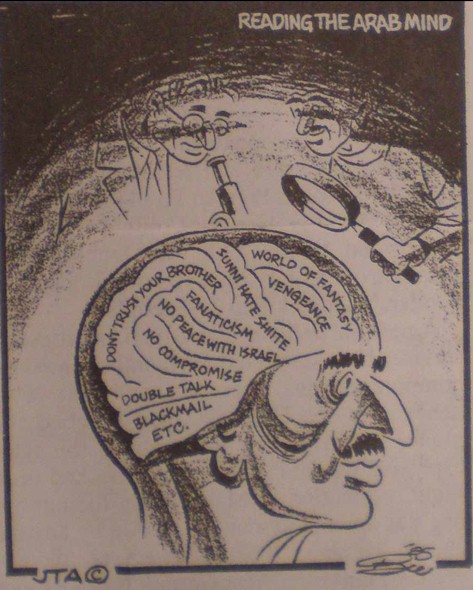
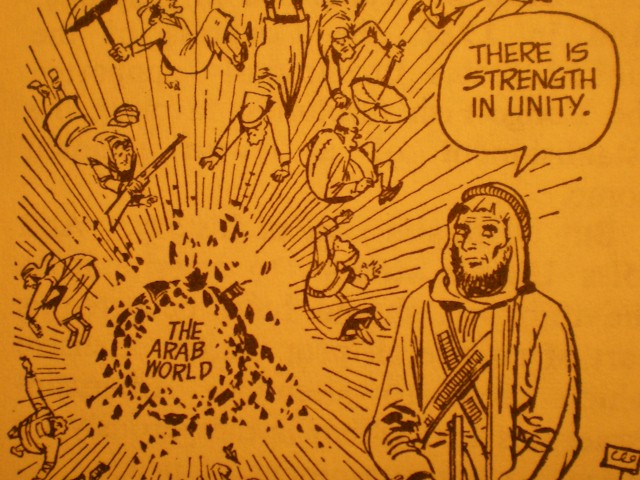
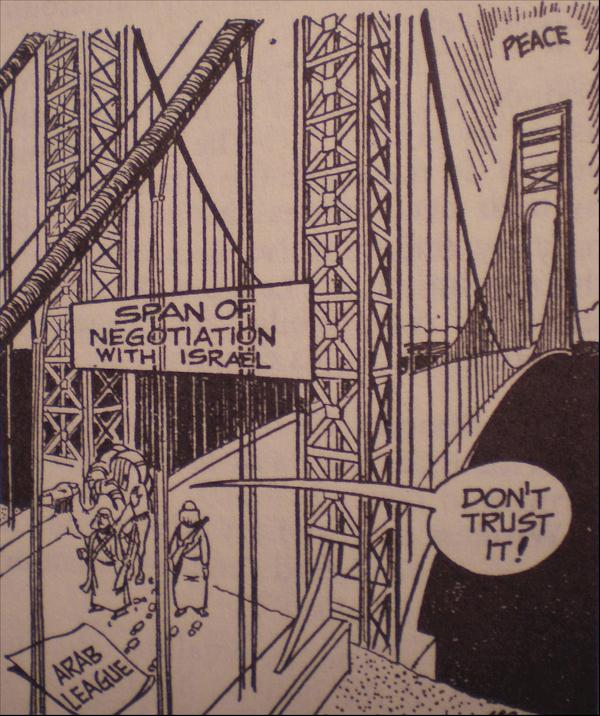
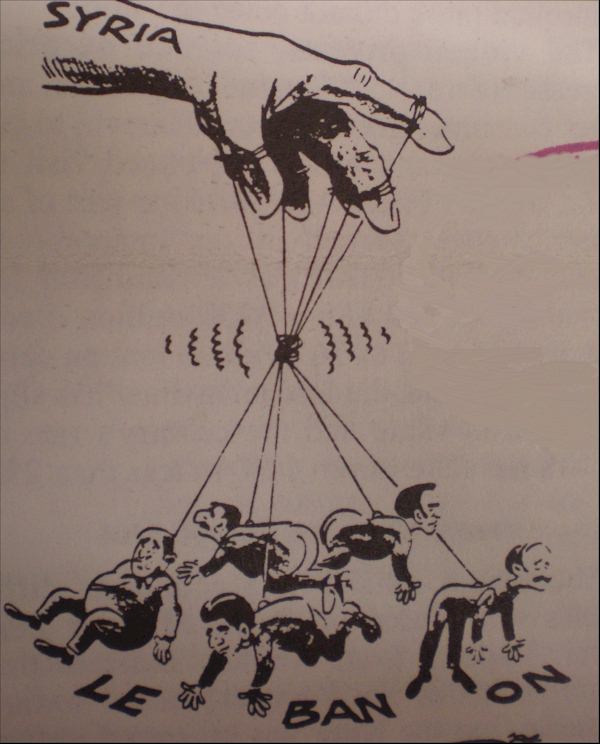
Cartoons from AIPAC’s “Near East Report”

Documents

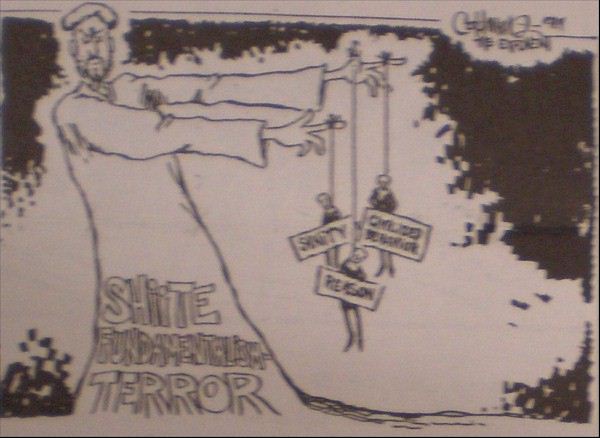
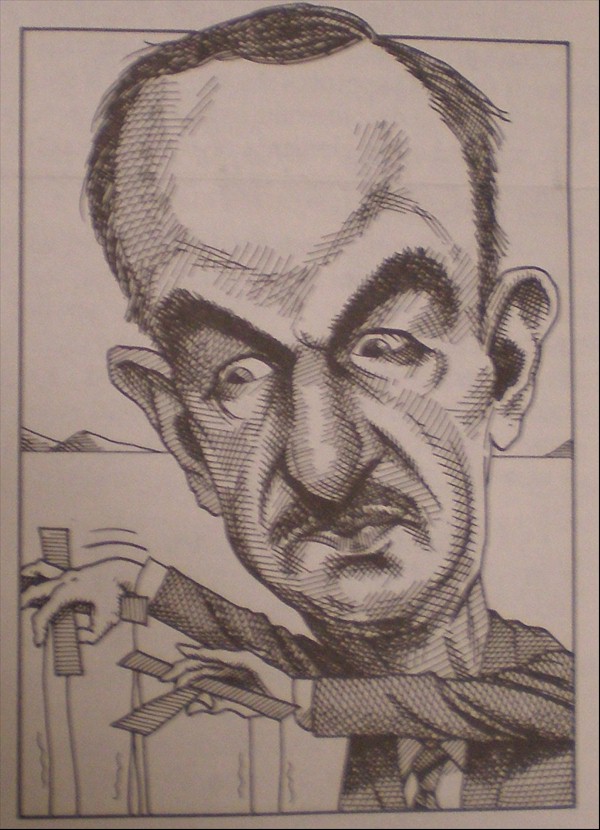
The following cartoons appeared in the “Near East Report” the lobbying newsletter founded by Isaiah L. Kenen and currently published by the American Israel Public Affairs Committee or AIPAC.

A Sine on the Road to Mecca

American Scientist Online. The Magazine of Sigma Xi, the Scientific Research Society
For more information on OriginLab, click here!
Home Current Issue Archives Bookshelf Online Features Marketplace Subscribe
In This Section
Visitor Login
Username
Password

SCIENCE OBSERVER

A Sine on the Road to Mecca

Ancient Muslim methods for finding the “sacred direction” for prayer

Turn then thy face towards the Sacred Mosque: wherever ye are, turn your faces towards it….

For centuries, Muslims all over the world have obeyed this command from the Koran, facing Mecca five times a day for prayer. But for a Muslim who is thousands of miles from Mecca, finding the right direction to pray—the qibla, or “sacred direction”—is not so easy. It has even been a source of controversy. Some of the mosques in Cairo reflect two different qibla values at 10 degrees from each other, with the outside walls aligned to one and the inside walls to the other. In North America, some Muslims pray to the northeast, in the direction of the great-circle route (the shortest path along the planet’s surface) to Mecca, whereas others pray to the southeast.

Medieval Muslims were using sophisticated mathematics to solve this problem centuries before the equivalent discoveries were made in Europe. At a time when Europeans believed that the Earth was flat, Muslim scientists knew how to correct for the Earth’s curvature. Two recently discovered instruments have proved that Islamic mathematicians were even further ahead of their time than anyone knew. These Mecca-centered world maps, cast in brass, indicate the direction and distance to Mecca from any point in the medieval Muslim world, and they do so with a type of map projection that was unknown in the West until the 20th century.

click for full image and caption
Cartographic grid

“I had been working on the subject [of the qibla] for 20 years, and the discovery of these maps took me by surprise,” says David King, a historian of science at the Johann Wolfgang Goethe University in Frankfurt, Germany. For the last decade King has been working to discover who made the maps and, more important, who designed them. All the evidence suggests that they were fabricated near Isfahan, in present-day Iran, during the Safavid dynasty (which began in 1502 and ended in 1722). However, King believes that the grid that is the maps’ most distinctive feature must have been discovered centuries earlier.

The first of the two maps surfaced in 1989, when it was auctioned at Sotheby’s of London. An anonymous collector discovered the second one at a Parisian antique dealership in 1995. The two instruments are so similar that they may have come from the same workshop. They are about 9 inches wide and originally came with three attachments: a compass, a sundial, and a rotating pointer that indicates both the direction and distance to Mecca. The base contains a curved grid of latitudes and longitudes, with the latitudes represented by circles and the longitudes by vertical lines; more than 100 holes are punched into the bronze to indicate various locations. (Mecca is, of course, at the center.) Because the instrument was not meant for navigation, it looks like no map you have ever seen: There are no land forms, no rivers, no oceans.

“It’s not surprising that they had the data to enter onto the grid, and the motivation [to find the qibla],” says Len Berggren, a historian of mathematics at Simon Fraser University in Vancouver. “What is surprising is that someone discovered the map projection to do it.” Not only are the lines of latitude curved and the lines of longitude unevenly spaced—both unprecedented innovations in the Islamic world—but the spacing is precisely calibrated so that the distance to Mecca on the pointer is the sine of angular distance to Mecca in the real world. If the lines had been evenly spaced, the instrument would not have worked.

According to King, the artisans of Isfahan could never have come up with such a grid themselves; they were accomplished astrolabe makers, but not mathematicians. Therefore, they had to be copying an earlier model.

Where did the original model come from? King has some intriguing speculations. As early as the 9th century, Islamic astronomers had devised a method for computing the qibla that happened to produce, as an intermediate step, the sine of the distance to Mecca. The map projections might have been discovered at the same time. Indeed, King’s colleague Francois Charette has shown that the grids are, in a sense, a translation of the equations into cartographic form. Alternatively, a later scholar who was familiar with the trigonometric method might have devised the map as an ingenious simplification. King suspects Abu ‘l-Rayhan al-Biruni (973–1048), considered the leading scientist of medieval Islam, who lived in Ghazna (now Afghanistan) and wrote an influential and original treatise on the qibla.

Inevitably, less romantic possibilities have been suggested. The catalogue that Sotheby’s printed when the first instrument went up for auction states: “The projection is of western European inspiration … and this unusual instrument is interesting as evidence of the assimilation of European science and technology in Persia in the 18th century.” King strongly disagrees with that interpretation, citing both physical and historical evidence. Even if European mathematicians had worked on the qibla-finding problem, he argues, they would not have stumbled on a solution that was directly inspired by a 9th-century Islamic formula. “The fact that the instrument uses the sine of the distance is, to me, the most compelling argument” for its early Islamic origin, King says. There is also no evidence that the European scholars who were in Persia at the time brought with them anything like a Mecca-centered world map. Even if they could have, they would not have wanted to: They were in Persia to convert Muslims, not to make it easier for them to practice their religion.

More clues to the origin of these instruments may yet come to light. “So many Arabic manuscripts lie not only unstudied but uncatalogued in the libraries of the world,” Berggren says. They may contain descriptions of similar qibla-finding world maps, which went unrecognized before because historians didn’t know what they were reading about. Says Berggren, “Not only do we know what to look for now, but we know it’s worth looking.”—Dana Mackenzie

Of Possible Interest

Related Sigma Xi Links

For more information on OriginLab, click here!
About American Scientist Site Map Text Archive Advertise Policies Sigma Xi Contact Us
© Sigma Xi, The Scientific Research Society

‘s Deadly Ordeal

At a Flash Point in Gaza, A Family’s Deadly Ordeal

Renewed clashes threaten tenuous cease-fire between Israel and Hamas after a 22-day conflict in the Gaza Strip.
initHotContentContentColumn() dl#hotcontent-results { display:block; } #hotcontent-box-content_column { display:none; }

hideContentColumnTools()


<!–
var COMMENTS_ALLOWED = false ;
var COMMENTS_ACTIVE = false ;

var comments_period = ( typeof wp_article != “undefined” && typeof wp_article.comments_period != “undefined” && ( wp_article.comments_period != “” || wp_article.comments_period == “0” ) && wp_article.comments_period >= 0 ) ? wp_article.comments_period : 3 ;

if ( typeof thisNode == ‘undefined’ )
thisNode = ‘admin’ ;

// (wp_article.allow_comments) && !(black list) && (white list) of ancestors and sections goes here
if ( SITELIFE_ENABLED
&&
( typeof wp_article != “undefined” && typeof wp_article.allow_comments != “undefined” && wp_article.allow_comments != “no” )
&&
!( thisNode.match(//wires$/) || thisNode.match(/^artsandliving/(entertainmentguide|entertainmentnews|travel/index)($|/)/) || thisNode.match(/^business/(portfolio)($|/)/) || thisNode.match(/^metro/(obituaries)($|/)/) )
&&
( thisNode.match(/^(artsandliving|business|cars|education|health|jobs|liveonline|metro|nation|opinions?|realestate|religion|politics|sports|technology|world|kidspost|media)($|/)/) || thisNode.match(/^print/(washpostmagazine|style|sundayarts|sundaysource|weekend)($|/)/) ))
{
COMMENTS_ALLOWED = true ;
document.write(“<style>#ArticleCommentsWrapper {display:block};</style>”); if(! checkDaysOld(comments_period) ) { COMMENTS_ACTIVE = true ; } else { COMMENTS_ACTIVE = false ; } } else { document.write(”); } // –> #ArticleCommentsWrapper {display:block};
<!–
if (SITELIFE_ENABLED) {
// Include the WPNI functions to display SiteLife content on the page.
document.write(“<scr” + “ipt type=”text/javascript” src=”” + “/wp-srv/javascript/community/sldisplay_new.js” + “”></scr” + “ipt>n”);
}
// –>

Discussion Policy
Comments that include profanity or personal attacks or other inappropriate comments or material will be removed from the site. Additionally, entries that are unsigned or contain “signatures” by someone other than the actual author will be removed. Finally, we will take steps to block users who violate any of our posting standards, terms of use or privacy policies or any other policies governing this site. Please review the full rules governing commentaries and discussions. You are fully responsible for the content that you post.

<!–
function findPosY(obj){
var curtop = 0;
if(obj.offsetParent){
while(obj.offsetParent){
curtop += obj.offsetTop
obj = obj.offsetParent;
}
} else if(obj.y){
curtop += obj.y;
}
return curtop;
}
function findPosX(obj){
var curleft = 0;
if(obj.offsetParent){
while(obj.offsetParent){
curleft += obj.offsetLeft
obj = obj.offsetParent;
}
} else if(obj.x){
curleft += obj.x;
}
return curleft;
}
// –>

Washington Post Foreign Service
Tuesday, January 27, 2009; Page A01

ZAYTOUN, Gaza Strip — Just before dawn on Jan. 4, a sledgehammer crashed through the living-room wall of the home of Almaz al-Samuni in this southern enclave of Gaza City, pounding a hole wide enough for someone to poke a rifle through while shouting in a language she didn’t understand.

This Story
View All Items in This Story
View Only Top Items in This Story

<!–
var rn = ( Math.round( Math.random()*10000000000 ) );
document.write(‘<script src=”http://www.washingtonpost.com/wp-dyn/content/article/2009/01/26/AR2009012602481_StoryJs.js?’+rn+'”></script>’) ;
// –>

“Get out of the house now,” an Israeli soldier ordered, this time in accented Arabic, she recalled. Almaz, small for her age of 13, and her family quickly did as they were told, heading for her uncle Wael’s house nearby, where by daybreak 92 family members had packed in thigh-to-thigh. It was a week into Israel’s 22-day war with Hamas.

At least 29 members of the Samuni family died over the next two weeks — including Almaz’s mother and two brothers. Sixteen or more were killed Jan. 5 when at least two Israeli shells smashed Wael al-Samuni’s crowded house. At least six others wounded in that attack died more slowly, over more than three days when the Israeli army kept emergency vehicles from entering the neighborhood, according to another teenager who had been stranded and later rescued from the house.

The shelling of Zaytoun has become a flash point in the debate over whether Israel did enough to prevent the loss of civilian life while targeting fighters from Hamas, the Islamist movement that controls the Gaza Strip. Hamas fighters operated in residential areas throughout the conflict and targeted Israeli civilians with rockets, killing three during Israel’s offensive.

The shelling cut a devastating swath through the Samuni family, which for many years has farmed the rocky fields along an unpaved cul-de-sac here.

ad_icon

if ( show_doubleclick_ad && ( adTemplate & INLINE_ARTICLE_AD ) == INLINE_ARTICLE_AD && inlineAdGraf )
{
placeAd(‘ARTICLE’,commercialNode,20,’inline=y;’,true) ;
}

<!–
if ( show_doubleclick_ad && ( adTemplate & INLINE_ARTICLE_AD ) == INLINE_ARTICLE_AD && inlineAdGraf )
{
document.write(‘</div>’) ;
}
// –>

This account of the Zaytoun attack and its aftermath was taken primarily from interviews with a dozen members of the Samuni family who survived the assault, as well as statements and patient logs from Gaza City’s Shifa and al-Quds hospitals. The information largely parallels an earlier account given by the International Committee of the Red Cross, which concluded that by thwarting rescue efforts for four days Israel had “failed to meet its obligation under international humanitarian law.”

Survivors said that Israeli soldiers were aware of the many dead and wounded who were stranded and that the Israelis ignored or rebuffed pleas from fleeing relatives to help the injured.

An Israeli government official declined to answer any specific questions about the incident, saying it was still under investigation. “What is clear is that Hamas militants in that area were engaging us with combat,” said Maj. Avital Leibovich, a military spokeswoman. “Many of the civilian areas were turned into military compounds of Hamas.”

On Sunday, Israel appointed a team of experts in international law, headed by the justice minister, to defend its troops against possible war crimes charges arising from the offensive.

“Officers and soldiers sent on the mission in Gaza must know that they are safe from various tribunals and that Israel will help and defend them, just as they protected us with their bodies during the military operation,” Prime Minister Ehud Olmert said in remarks before the weekly cabinet meeting Sunday.

Israel largely barred foreign reporters from Gaza during the fighting, though some eventually entered through Egypt. Israel permitted entry late last week.

A Place of Strategic Value

Israeli soldiers rumbled into Zaytoun before midnight Jan. 3 in armored vehicles and descended by rope onto rooftops from helicopters. Israeli military and Red Cross officials said there were heavy clashes in the area. Local residents denied that any Palestinian fighters were present but described hearing constant shooting and having to dodge “crossfire” as they moved from house to house seeking shelter.

At a slight elevation, the neighborhood offered a vantage point over the breadth of the Gaza Strip.

“It was a place with strategic value,” said Arafat al-Samuni, who lives in Zaytoun. “There is no other reason to come here. None of us is Hamas.”

On the morning of Jan. 4, after clearing out Almaz Samuni’s house, Israeli troops moved to the next home and used their rifle butts to break down the door of her cousin, Moussa al-Samuni, 19, he recalled. They forced Moussa’s family to leave, and the troops set up a command post inside the home, he said. Then they set about clearing remaining families from the neighborhood.

While his younger brother Waleed, 17, sneaked out the back door into tall grass, Moussa and 13 other members of his family quickly fled out the front door. As the family exited, Moussa said, soldiers lifted the men’s shirts and pulled down their trousers, ostensibly to check for explosives.

The family ended up next door in Talal al-Samuni’s home. After a few hours, with bullets occasionally smacking the stone walls, the group, now numbering more than 40, moved again, this time across the street to the larger home of Wael Samuni. Soon nearly the entire family had congregated there.

“We were so nervous because we knew something bad could happen at any minute, but we had nowhere else to go,” said Moussa, who is slender, with short, wavy hair. “We wanted to be together.”

For the Wounded, No Aid

Down the street, Arafat Samuni, 36, was having coffee with his cousin Nadal, 30. When shooting erupted and grew closer, Nadal decided to return to his house, about 20 yards away, to make sure his family was safe. He never made it.

“Fifteen minutes after he left, I got a call saying Nadal was wounded. I ran out and found him near his front door,” Arafat said. “He was bleeding from his abdomen and told me to go home. I pulled him inside his house. I called friends and begged them to get any car, any vehicle, any ambulance.”

Nadal died six hours later, about 3 p.m., Arafat said.

Meanwhile, for more than 24 hours, the people gathered in Wael Samuni’s house waited for a lull in the fighting that did not come. They called relatives and for ambulances to evacuate them. Salah al-Samuni, 30, received a text message around midnight saying, “Ambulances are on the way.” They never came.

Finally, when things seemed a bit quieter, Moussa and two cousins crept outside to gather wood and trash to make a fire, for warmth and to bake some bread. It was before 6 a.m. on Jan. 5, he said.

“I heard an Israeli drone overhead, and about a second later something crashed into the doorway of the house,” Moussa said. “I could see that my nephew Mohammad was dead — his body was torn in pieces. My cousin Rashed was bleeding from his arm, so I ripped his shirt into a bandage and tried to tie it around.” Then another shell hit the roof, he said.

Several Samuni family members who were inside said that they never heard the impact of the second shell but that suddenly the ceiling of the one-story building came crashing down on top of them.

“You couldn’t see or hear anything. The air was filled with smoke and pressure and my ears felt like they were shaking,” said Salah Samuni. Part of the roof collapsed on his head, leaving a bloody gash. His 2-year-old daughter, Azza, died instantly, as did his grandmother. His 6-month-old daughter, Shifa, was unscathed.

“Out of the tragedy, that is a miracle,” he said.

Survivors began to panic.

“I screamed at everyone who could move to get out of there,” said Salah, who has a slight build and a wispy, graying beard. “I could see across the room that my father was still breathing, but by the time I got to him, he was gone. We grabbed whoever we could carry and ran.”

Just after 6 a.m., the sun was rising as dozens of Samunis poured out of the shattered house and made their way up Salahaddin Road, the nearest main route to the hospitals of Gaza City. All around them, the shooting continued.

“We had walked about a kilometer when I saw some Israeli soldiers and an ambulance driver,” Salah said. The ambulance driver apologized profusely, he said, but told him: “It is too dangerous. I can’t go in until the fighting stops.”

Salah recalled telling the soldiers, “We need first aid, and there are many dead back in Zaytoun. You hit us, and we need help.”

“Go back to your death,” the soldier replied, according to Salah. “You can’t go up this road.”

Moussa also tried to make it up the street and was intercepted by Israeli soldiers. “I told them there were wounded people, but they told me to shut up,” he said. They detained him in a nearby house for the rest of the day before releasing him, he said.

The Red Cross report also said that Israeli troops “must have been aware” that there were wounded civilians in need of medical care. Salah and others said some Israeli soldiers shot at the fleeing Samuni family members, to try to direct them back to Zaytoun.

“All the time they were shooting at the road or above our heads,” said Sobhi Mahmoud Samuni, 55. “But we kept running toward the hospitals.”

That day, Jan. 5, the logbook at Shifa Hospital recorded that at least 39 Samunis came to the emergency room with various injuries.

“It was shocking to see so many from one family,” said Ramiz Ziyara, 33, a general-surgery resident who said he treated a young girl with shrapnel lodged in her brain. “She was okay. She was lucky.”

Fifteen wounded people remained inside Wael’s house, along with at least 16 bodies.

“I couldn’t walk,” said Ahmad al-Samuni, 16. “My feet and legs hurt too much, so I just tried to lie still to escape the pain.” His two brothers, Ismail, 14, and Isaac, 13, lay bleeding beside him, in far worse condition.

For hours, he said, he held Ismail’s hand while the boy faded in and out of consciousness from a large head wound. At the urging of his grandmother, who also remained in the house with a broken leg, they prayed, reciting over and over, “I bear witness that there is no god but God, and Muhammad is his prophet.” By nightfall, Ismail had died.

The next morning, still unable to walk, Ahmad said, he gathered bits of a shattered door frame and with a lighter managed to make a small fire in one room. He found a pot and the only food left in the house, uncooked spaghetti and tomatoes, and heated it for his brothers.

“We were so thirsty, we were cutting open a hose and sucking as hard as we could to get water out,” he said, frequently losing his concentration, and once, briefly, his temper, as he recounted the story. “It only wet our lips.”

That evening, Isaac, who had shrapnel in his abdomen, died, too. “He was bleeding for two days, and no one came to help,” said Ahmad. At least four others, his uncle Tawfik and aunt Rabab and two of their children, Rashad and Waleed, also died within 48 hours of the shell striking the roof, he said.

“I sat in there for four days, and all we could do was pray,” said Ahmad, whose head was later shaved in the hospital so a wound could be cleaned. “I was sure I was going to die.”

Frustration for Rescuers

Two days before the shell struck Wael Samuni’s house, the Red Cross had begun negotiating with the Israeli army to get ambulances into Zaytoun to evacuate civilians. “For the first two days, people were calling and literally begging us to come get them,’ ” said Antoine Grand, head of the Red Cross in Gaza, who declined to allow the ambulance teams working those days to be interviewed.

“We said: ‘We’re doing our best. Hang on,’ ” Grand said. “Then their mobile phone batteries died.”

“We normally have good coordination about these things,” he added. “But for days we asked for a green light to get in there, and it wasn’t granted. I don’t know why. It is extremely frustrating.”

Leibovich, the Israeli army spokeswoman, declined to comment on why the army had not allowed the Red Cross into Zaytoun. Grand corroborated Leibovich’s assertion that there were clashes in the neighborhood but said that should not have prevented emergency workers from being given access.

“Look, on the one hand, we don’t want to go in while the fighting is going on. But they weren’t fighting 24 hours a day for all those days,” Grand said, adding that there was an Israeli army post 100 yards from where the Samuni house was struck. “Permission could have been granted earlier.”

On Jan. 7, the Red Cross was finally permitted to enter Zaytoun, during a three-hour pause in combat operations to allow for humanitarian relief. The wounded had to be evacuated by donkey cart, because the Israeli army would not move earthen barricades it had placed in the road, according to the Red Cross’s report. There was not enough time to retrieve the dead until Jan. 18, when at least 21 bodies were removed from the site, Grand said. The Red Cross’s investigation of the events will be completed in the next few months, he added, and will be “shared privately” with the Israeli government.

Residents said there were 22 bodies in and around the Samuni home, and Shifa Hospital logged the arrival that day of 22 dead. The explanation for the discrepancy with the Red Cross figure is unclear. The Red Cross said the bodies were found in at least two houses, while survivors said all of the dead had been killed in Wael’s home. Again, the variation in accounts remains unexplained.

Six other people, including Nadal and some of those who escaped from Wael’s house, died elsewhere, Samuni family members said.

Moussa Samuni found a final body Jan. 19, in a field just north of the neighborhood. It was his younger brother Waleed, who had run out the back when the soldiers appeared. He had been shot in the head, leg and stomach. He was unarmed and not a fighter, his brother said.

‘No Fighters Here’

For three days after the last of the bodies were recovered and buried, the Samunis mourned in a large tent erected amid the wreckage of their neighborhood by the Fatah movement, the political party of Palestinian Authority President Mahmoud Abbas.

Large posters displayed color photographs and names of the dead, as well as a few snapshots of Palestinian leader Yasser Arafat, who died in 2004. Aid groups brought chicken and rice for lunch every day around noon. Dozens of dead birds were scattered about the property, filling the air with a sweet, acrid smell when the wind changed.

“There were no fighters here. That is why I do not understand why this happened,” Arafat Samuni said, disputing the Israeli military’s statement about combat in the area. “We are farmers. We are not political. We are not resistance.”

All but three of the houses on the street were demolished. The remnants of the various families that make up the Samuni clan sat all day, each day, on the rubble of their destroyed homes and met with well-wishers, aid workers and journalists. Most answered questions politely but without emotion.

Some broke down when telling their story. On Friday, the tent was rolled up and trucked away, but the Samunis stayed behind.

“I am supposed to be back in school,” said Moussa, an accounting student, staring at the ground. “But my father is gone. My mother is gone. My brother is gone. All I have left is my 2-year-old sister, and now I am the head of the family.”

Staff researcher Robert E. Thomason in Washington contributed to this report.

” in Gaza

Israeli soldiers walk on the Israeli side of the border with Gaza Strip
©2009 Google – Map data ©2009 LeadDog Consulting, AND, Tele Atlas, Europa Technologies – Terms of Use

Rabbi told Israeli troops ‘to show no mercy’ in Gaza

JERUSALEM (AFP) — An Israeli human rights group on Monday called for the immediate dismissal of the chief military rabbi, claiming he gave soldiers fighting in Gaza pamphlets urging them to show no mercy.

Yesh Din said it had written to both Defence Minister Ehud Barak and Chief of Staff Gabi Ashkenazi, urging them to “take this incitement seriously and fire Chief Military Rabbi” Brigadier General Avi Ronzki.

It said a pamphlet distributed to soldiers taking part in Operation Cast Lead stressed that the troops should show no mercy to their enemies, and that the pamphlet borders “on incitement and racism against the Palestinian people.”

“When you show mercy to a cruel enemy you are being cruel to pure and honest soldiers. These are not games at the amusement park where sportsmanship teaches one to make concessions. This is a war on murderers,” Yesh Din quoted t

Eyewitness in Gaza: Yesterday and Tomorrow

News
Israel Admits White Phosphorous Use in Gaza
War-scarred Gaza Children Back to School
BBC Under Fire Over Gaza Appeal Ban
Hamas Sees New Bush in Barack Obama
George Mitchell from N.Ireland to Mideast
Israel Hires Minister to Fight War Crimes Claims
Image Gallery
Calisthenics
Jabalia Prep C
Walking Home
Art
Talks
Support Our Work

With scores of thousands of readers daily, Palestine Chronicle has become a leading authority regarding news, commentary and information about Palestine worldwide. To continue this critical task, we need your help today. Please click here to to lend your support.

The Giftshop

Visit our giftshop.

A Taste of Palestine

Palestinian olive oil. From the West Bank to your doorstep. Click here.

Main Story
15:21 01/24/2009
Eyewitness in Gaza: Yesterday and Tomorrow
‘Whatever they do to us, we are still here and we will still be here.’ (UNRWA/AFP)
By Ewa Jasiewicz – Gaza

We’re like trees, we have our roots and they allow us to grow, little by little, we grow up and then they cut us down. But, whatever they throw at us, whatever they do to us, we are still here and we will still be here – Om Bassim, Jabaliya Camp, January 2009.

‘Our Home’

At the beginning of this war, when the bombs first started falling intensively, I remember lying on a mattress, late at night, I don’t remember where, maybe in Beit Hanoun hospital, maybe in Beit Lahiya. As I slipped into sleep, I could hear explosions, thuds, one after the other, some near, some distant, some to our east, to our west, again and again. In my semi-consciousness I felt they were all going off in my house, in my home, that the bombs were exploding in different rooms, upstairs, downstairs, next door, under me, over me. I didn’t feel fear, I felt a closeness, a holding together. Maybe it was a consequence of Gaza being an incarcerated space, a walled camp, so small and close-knit, a prison, but also, a house, a home, with families in every part, every corner, every room, a community of relatives from north to south, every explosion and massacre felt acutely, felt intimately as if it had happened to ones own family, in the home, this home.

The war was felt and heard in every home, it invaded some homes, soldiers occupied and destroyed peoples homes, tank shells, burning white phosphorous and bulldozers smashed homes, some people were buried under their homes, some are still entombed in their homes. Where is this home now? 50,000 people are homless according to the UN. Living in tents, classrooms, crowded rooms in the homes of relatives, under tarpaulin stretched over roofless rooms on family land, still standing. If the bombing resumes, and the attacks resume, this will still be a home to the people of Gaza, each bomb, and each hit, acutely felt, shuddered and shouldered by each community and family. My friend Om Bassem, mother of nine, living in Jabaliya explained calmly yesterday, ‘They besiege us and take away our electricity, ok, we carry it, they take away our gas, our flour, our food, ok, take it, we can take it, they take away our drinking water, take it. And our children, a mother grows her son until adulthood, focusing on nothing but bringing up her children, and then he is taken away, and we take it. We spend our whole lives working, saving, building, our homes for us and our children and our children’s children, and then they destroy it, bomb it to the ground, and we take it. We’re like trees, we have our roots and they allow us to grow, little by little, we grow up and then they cut us down. But, whatever they throw at us, whatever they do to us, we are still here and we will still be here, we can take anything they do to us. God is big, God is bigger. And thanks be to God for all of this. We are steadfast’. And she smiles.

To the Dead Zone

We got the call early Sunday morning. We finally had ‘co-ordination’ to get into the closed military zones that Israeli forces had been occupying for the past three weeks. These were the ‘closed military zones’ in which ambulance staff, the Red Cross and UN had been fired upon and rescuers killed trying to enter.

These ‘closed areas’, these blind spots and dead zones, are Towam, Zaiytoun, Atatra, Ezbit Abed Rubbu, Toffah. These are communities, neighbourhoods, with schools and shops and homes that people would sit out in front of, on plastic chairs drinking tea, fingering prayer beads, staring at the sparkling blue sea, communities with farmland, orange orchards and strawberry fields. All locked down. The medics from the Red Crescent would come back by turns stunned and weary eyed. An old man with a gunshot wound to his head clasping a white flag from Atatra, bodies trameled by tanks – unidentifiable – and the girl, the famous, red, half eaten girl, Shahed Abu Halim, aged one and a half according to paramedics, left to die and half eaten by dogs, her body a beacon of horror for everyone who saw her being brought in to Kamal Odwan hospital in Jabaliya.

So many times, our ambulances skimmed the edges of these dead zones, where families were imprisoned, snipers holding them effectively hostage, the dead lying in the street unclaimed, witnessed daily by neighbours and loved ones. On occasion we managed to grab bodies on the periphery, mangled by missiles shot from surveillance drones. With the Ministry of Health ambulances, we rode to Karama – Dignity – where two men were reportedly found dead by rescue workers having bled to an undignified death from treatable injuries. Unreachable.

These were the areas that civilians had been shot dead trying to exit, some gunned down whilst holding white flags such as Ibtisam Ahmad Kanoon, 40, from Atatrah, who lay dying from 11.30am until 2pm the next day until relatives could carry her out. Her husband, son and mother all walking with her – her son Mohammad Bassam Mohammad al Kanoora, 23, injured by shrapnel to the head and Zahiye Mohammad Ahmad al Kanoora, 60, injured in the back.

Like the family of Musbah Ayoub, 64, from Izbet Abed Rubbu, who bled to death from shrapnel injuries to his legs, as relatives frantically called the Red Crescent and Red Cross for three days.

Like Wael Yusef Abu Jerahd, 21, from Zeitoun who was hit by tank shell shrapnel as he went to get a drink of water in his home. He lay dying for four hours, his family calling for help and appealing to Israeli occupation soldiers to enable his evacuation. Instead Israeli forces killed two paramedics traveling in a Libyan Red Crescent jeep attempting to get to him, and occupied the family’s home, imprisoning the family, 12 people, in a small kitchen along with their dead son, for three days. When the family were finally allowed to leave, they had two members to carry for over a kilometer over broken ground and trashed industrial sites; their son Wael, and his 64-year old mother, who couldn’t walk because of her diabetic condition and fresh nervous break-down over the killing of her son and her days and nights by his dead side, as Israeli occupation soldiers shot from her house.

The stories of those who bled to death because Israeli forces would not allow ambulance access to collect them, and the families who had to witness their demise and live with their bodies, run the length and breadth of the Gaza Strip. When ambulances could finally enter some areas, they were stoned by desperate and abandoned relatives. It is a war crime, under the Geneva Conventions, to prevent the passage of or target emergency staff who are trying to collect the injured.

The Walking Living

We made out at the break of dawn, red lights rotating into action, speeding towards Towam, close to Atatrah. Drizzle mixed with a haze of white phosphoric smoke, like a thin grey gauze over our eyes. Above us, surprisingly, and awesomely, soared a rainbow, high, wide and perfect, arching over the grey broken streets of Jabaliya and the freshly bombed Taha mosque with its’ insides spilled over the road, the knocked down houses like knocked out teeth, downed power lines, blown out and blackened apartment blocks, grey all around us, but if we looked up, a beautiful technicolour arch.

The first body was that of a young man, face down and crumpled outside the doors of the Noor Al Hooda mosque, his navy jumper singed from shrapnel injuries.

Behind us was a wasteland. Where houses had been, just days earlier, there were jagged edges of crushed walls, mangled with clothes, glass, books, furniture; houses turned into a lumpy sea of lost belongings, bombed and bulldozed into the ground. Amidst all this, was the crumpled body of Miriam Abdul Rahman Shaker Abu Daher, aged 87. It was her arm that we saw first, sticking out of a dusty blanket, trapped under rubble. We managed to hoist her onto a stretcher, paramedics took her away and I was left standing next to a man. ‘That was my mother’ he said to me. He explained what happened: ‘We left three days ago (15th January) with our children and we came back for her, but we couldn’t get to her, we called the Red Cross, they couldn’t help. They bulldozed everything here, maybe more than 20 houses. We thought we could return, we didn’t think they would do all this We couldn’t come back for three days so we don’t know how she died, maybe she died of the cold? After a few hours we had come back and planes were shooting at us, we were just meters away from our house, but the shooting was too much. We thought if the soldiers came they wouldn’t harm her because she’s so old, we thought maybe they would give her food or look after her. We didn’t expect them to bulldoze the whole area’, explained Awad Abdullah Mustapha Abu Daher, 45 years old. We took four dead into our ambulance. The Red Crescent would take another 32 before the day was over.

A column of people was walking slowly, some with donkey carts, some rumbling over the clod ground on motorbikes. All making their way home, for the first time, to Atatrah. Atatrah, with its new blasted out school, holes big enough to drive through, a crippled mosque, and burnt houses smoked above us, sloped up on a hill, with rolling strawberry fields and palm trees and the beach behind it, such a beautiful place to live, lush and alive and green. Now, according to locals, its almost unidentifiable, residents  are disorientated by the missing houses, confused between the lost streets and new ‘streets’ – tracts bulldozed between houses, gaping holes in half buildings and land churned into sand. I followed the column. Walking behind it was reminiscent of so many funeral processions that have trod the streets of Gaza and Palestine as a whole. A slow column, a long walk, an intergenerational walk, a thousand backs in front of us, for the dead, for the living, for the jailed, a return after eviction, a return after each invasion, The Walk, after being released from every imprisonment in every temporary prison by Israeli soldiers, the Beit Lahiya High School, a neighbour’s home, The Walk back all the time and through time, to overcome grief, dispossession, humiliation, a collective walk. I wanted to accompany that walk.

Climbing up the main road, pulverized and impassable by car, a group of 10 men come walking towards us carrying their heavy dead wrapped in blankets, struggling to find their footing on their descent. We spend the rest of the day searching for the dead, along with everybody else, another collective walk, a collective search, ‘Where are the martyrs? Are there martyrs here?’ and to everyone, the Arabic Islamic expressions of condolences and goodwill, ‘Thanks be to God for your peace’, ‘God will give’, ‘God protect you’. We are following the scent of rotting corpses, the scent sometimes of already decayed flesh, or decaying animals – a donkey, a goat, dogs, a horse. One man we bring from Toam, Moayan Abu Hussain, 37, is brought to us by donkey cart, his badly decomposed and bloated body wrapped in two blankets. He fills the white zip up heavy plastic body bag.

The following day, again, in the morning, bodies are being brought out of the ground, from crushed homes, and from tunnels. At the top of Ezbet Abed-Rubbu, early in the morning, we ride to retrieve three bodies, three men, fighters, from the Sobuh family. Locals say they were trapped in their tunnel when collaborators told the Israeli army they were there and the tunnel was collapsed from both ends, starving them of oxygen and entombing them in a slow death. What does resistance mean when sea, air and land are controlled by the occupier? Going underground is literal. The walk now is becoming a crawl. F16s soar low above our heads, and continue to in the intervening days, a reminder of who dominates here. As local men dig up their dead, the stench overwhelming, spitting out death as they work, digging, the men finally surface, to be wrapped immediately in blankets, in front of an audience, the perpetual witnesses here to every crime, every death, every aftermath.

The crowd of perhaps one hundred, strives to pack into the ambulance along with their loved ones, crying, keening, clamoring at the white plastic bags. A boy of maybe 8, with a face etched older with trauma, shouts in a voice of a man, ‘Hasby Allah wa Naeme al Wakee!” – ‘God will judge them!’ But who will judge the Israeli occupation forces and their leaders, political and military, who have perpetrated war crime after war crime here in Gaza? It has to be us. We need to take up our consciences and humanity and translate judgment into action.

Yesterday was a fast-forward blur of destruction, mass pain, broken bodies, lifeless beings, terror on the streets, in homes, in mosques, in ambulances, in hospitals. Yesterday, people were being physically dismembered and today remain so, many still recovering on intensive care units in France, Egypt, Israel. The same states that stayed silent and complicit in this massacre, now take the broken into their bellies and return them patched up, back into a killing zone, a prison where the guards can shoot back in, plough back in and break them all over again at any given moment.

Torture and Relief

Under the dictatorship of Saddam Hussein in Iraq, people were tortured underneath hospitals, burnt, fractured, torn up, and then taken upstairs to be repaired, in the full knowledge, that one they were whole again, skin growing back together again, the same awaited them, they would be taken back down, to be tortured again, the healing a mocking, a thwarted, negated process in itself because of the looming knowledge that it was only to be followed by a repetition of the breaking. This type of collective torture is being practiced here and the complicit are those who allow it to happen, and that do not create the conditions to stop this cycle of devastation. People keep being recycled through this trauma, generation after generation, through fresh weapons, new chemicals, new prisons and new ways of the international community maintaining silence, complicity and support for Israeli occupation.

Families are familiar now with the trawling delegations and caseworkers, notebooks in hand, I include myself in this walk, the walk of the hundreds of journalists, human rights workers, Red Crescent, Red Cross, United Nations workers, asking the same questions, noting the same details, preparing families for temporary shelters, giving out plastic sheeting for broken windows and replacement doors, blankets, emergency food packages, tents, cooking stoves, everyone expects them and expects us; the same donor agencies and charities, rolling up their sleaves to issue fresh appeals and re-build the same community centers, police stations, hospitals, that were rebuilt after the last annihilation; a rewound and fast-forwarded cycle of destruction and reconstruction, yesterday and tomorrow being blurred together into a circle of a collectively expected return to ruins and a slow rebuilding, again and again. It is no wonder that ‘human rights’ workers and the notes and testimonies frantically taken down with shock and condolence, time after time, year after year are met with replies of ‘Its all empty, write it down but what will it change? It’s all empty’. There is no post-traumatic stress disorder here because there is no real ‘post’ to the traumatic stress. Traumatic events keep on happening again and again, relief un-processed, grief unprocessed, as people watch and wait and brace themselves for the next attack.

Pieces

People are left with snippets, fragments, of their loved ones, literally and in memory. Nuggets of film shot on mobile phones pass through multiple hands, of the last of their loved ones, wrapped in white sheets, with hands and tears pouring over them, screaming and screaming, to be shown and shared with fresh tears in real time, again. Like the five from the Abu Sultan, Abbas and Soosa families, demolished by a tank shell shot into their home as they were drinking morning tea on their doorstep in Shaimaa, Beit Lahiya. Paramedics could not reach them for half an hour as they lay bleeding in pieces outside their home. Asma Abu Sultan, 22, watched her father, brother and uncle bleed to death, ‘It was 10.30am and we were drinking tea together in our home when we heard this gigantic bang, I saw my uncle at the door, injured, we went inside, I saw they had no chests, no hand, one was still breathing, I said ‘get up my brother’ I was telling him please, get up, please don’t die, he started to bear witness to God, then he said your father has died. He was draining of life, the blood draining from his face, but he was still alive, and then we couldn’t get an ambulance because they kept getting bombed, we kept asking everyone to help us, after half an hour he died from shrapnel wounds to the heart’.

Pieces. One afternoon, in the yesterdays of this war, we were called out to respond to a car bombing in Gaza City. We arrived on the scene, in bright light, to Palestine square, close to the Ahly al Arabi Hospital. Two injured had already been taken away. The car was a mangled sliced heap. Somehow there was no burning. We picked up a large, headless, man, still bleeding. Nobody wanted to touch him, they were terrified of him. Before we left the scene, someone put a small plastic ID card in my hand, Arabic script and his head, his face, bearded, in his late 30s, taken alive, he looked strong. I couldn’t let go of it, as the ambulance bounced along the broken streets, he behind us, handless, legs torn open, on a rickety stretcher, I held it in both hands, and couldn’t let go of it, keeping it in my hand wrapped round one end of the stretcher, pressed together, trying to keep it together somehow, close to his body.

A few nights ago, I sat by candlelight with my friend and his 9-year-old son Abed, in Beit Lahiya. I had bought him stickers depicting the human body, the brain, illustrated piece by piece, the human intestinal system, muscular network, the insides of the human eye, the heart, its valves and arteries. Abed fingered them, spread out over the kitchen table in the candlelight, these pieces, pieces Id seen outside bodies, spilled onto the streets of Gaza. Here they were in his hands, on the table in front of us, in one dimensional colour. He began to sing, ‘We’re steadfast, steadfast we remain, during this siege, and we remain steadfast’. He sang the words over and over again, fingering the stickers flickering in the candlelight until he sang himself into drowsiness. ‘Get up and go to sleep’, his father said and we kissed him and he left.

Everyone is trying to pick up the pieces of their invaded lives here, yesterday’s attacks and the severing of families from one another, will take years to reconnect, and rebuild, bring together again.

Yesterday can happen again. People expect a tomorrow when Israel will escalate its attacks and go further, casting more lead. Some believe this was a rehearsal for a deeper war, a litmus test that Israel won, because in 21 days of attacks, the international community kept shining a green light for Israel to continue to bomb and kill without restraint. The endgame being a pacified, acquiescent Gaza, with a weak Palestinian Authority, under the control of Israel or, if unrealized, an evicted Gaza, realized through provocations from Israel, extra judicial killings and surprise incursions, eventually responded to with rocket fire from the resistance and then a massive attack and push southward of the population into the Sinai and an Egyptian protectorate, new camps, and a new redrawing of a map already redrawn so many times through exile and empire.

Yesterday can happen again, a tomorrow that people here have been struggling for over sixty years, still dim, still distant, still carried but harder to imagine in the midst of the grief endured under siege here. The difference we can make is to seize today. The difference between yesterday and the horror, and dispossession and shock all here are still reeling from, and the tomorrow that could bring more of the same, reproducing, re-cycling, the same terrorization and cutting down of people as they pray, walk, sit, stand, heal, fight, the difference between yesterday and tomorrow is our today.

Today

I told many people, friends, taxi drivers, doctors, policemen, about the peoples’ strike on EDO-MBM Technologies in Brighton, UK this month. EDO manufactures the bomb release mechanism for F16s. Activists filmed themselves explaining to camera that they were decommissioning the facility in protest at the company’s complicity in the war on the Palestinian people, and specifically the killing of the people of Gaza. Over a quarter of a million pounds worth of damage was caused as activists threw computers out of windows and smashed equipment. They had taken their resistance out of the powerful but symbolic realm of the streets and into the offices of those responsible for arming Israel, physically imobilising their business. Three remain on remand in prison.

When I recounted this action to people, I saw an expression come over their faces that I hadn’t encountered before when talking about international solidarity. It was a kind of respect, a dawning smile, a sense of surprised pride, a tiny move towards a leveling between the blood sacrifices and living hell of so many here, and sacrifices made by people on comparative comfort zones on the other side of the world – for them. What would the parents of the children blown up by F16s here do if they could? What would we do if our children were being cut down by war planes and we knew where these weapons were being manufactured and we could confront these arms dealers and stop them arming those responsible for killing our children? Would we not stop them, would we not make the move from the streets to the factories, offices and facilities where these deaths, tomorrow’s deaths are in the making, and disarm them, save lives at the physical root of the production of the means of killing? Save lives there so that exhausted and besieged doctors here do not have to try to, under appalling conditions and against all odds; enforce international law outside ourselves, because noone else will do it for us. People here are expecting solidarity activism to go further, and needing it to go much much further.

A friend here, a well-respected intellectual and activist, run ragged through the war participating in interview after interview, writing piece after piece, pieces of resistance writing, expressed his sense of failure last night, that he didn’t do enough. That the resistance was dying for all of us, sacrificing for all of us, paying the ultimate price, and what was he doing? Sitting in his comfort zone, his writing a relief, for himself, to himself, making him feel better and stronger but where were his words going? What was the relationship between the words he was writing and speaking and stopping the death, stopping the invading occupation forces? Look at the completeness of Che Guevara, a doctor, a writer, a fighter, a complete man, and what was he, a writer, an academic, activist, but unable to pick up a gun or a body? Crucially, what was ‘enough’ and when have we done ‘enough’?

Our Lines and ‘Enough’

‘Enough’ is relative, and ‘enough’ is subjective and incredibly personal, but, a tentative attempt to unpick the crushing pressure of guilt – guilt on all our backs, all over the world, of an impotence and a sense of failure to influence, and a struggle build the means and the movements, to influence change – I think a tentative definition of enough could be, to transgress, to cross our own lines of possibility.

Our own lines of what we believe we can and cannot do have been authored by others and adopted by ourselves. Lines drawn by authorities, re-inscribed with violence and drawn thick with the threat of detention, imprisonment, the denial of everything that makes life worth living; contact with loved ones, freedom of movement, a natural stimulation of our senses through interaction with our natural environment, our sense of identity, all radically curtailed and undermined through incarceration. And death, the final line, the full stop imposed by absolute power onto the living bodies of those daring to resist, armed or unarmed, lives slammed shut by surveillance plane missiles zapped them into the ground. F16s exploding houses full of people. Ended. All ended. A line drawn under their lives. But where are our lines? ‘Enough’ will be an ever extending horizon, the edge always ahead of us, but we will never get close to where we need to be as a critical mass to effect change unless we cross our own lines of fear.

‘Enough’ is when you know you can do more, and you know you can take a step forward into a space of activism that you have never entered before and you do it. ‘Enough’ is when you know, you have pushed yourself, when you took risks and made sacrifices that you knew would be painful, knew could weigh heavy, could change your life forever, but you did it. When you knew the potential consequences of your actions but you confronted your fears and took the step forward, stepping over your own line. From stepping out into the streets for the first time to demonstrate, to picking up a chair and barricading yourself into your university, to telling the world you’re going to decommission an arms factory or war plane or settlement produce facility and doing it, we need to cross our own lines of fear, hesitation, and apprehension. We can push our movements forward, person by person, group by group, party by party, network by network, by crossing our lines and making sacrifices, small compared to the intensive blood letting, loss and devastation here.

Direct action, strike action, popular occupations, tactics used by Palestinians in the first intifada, and smashed by Israeli counter-tactics of siege, intensified occupation and massive military onslaught, all legitimized by our international governments. The counter-onslaught shows no signs of abatement.

We need to redraw our own battle lines and go further, to do the ‘enough’ we want to do and be the ‘enough’ we want to be. Our consciences and history demands this. It’s not enough and it will be too late for a new history, authored by others, to judge us, we have to make our own. It is not God that will judge us, it will be our brothers and sisters here in Palestine and in our international community, the widows, the orphans, the childless parents, the living left behind after the dead.

We can’t afford yesterday to repeat itself. We cannot wait until tomorrow happens to us. Between yesterday and tomorrow is today and we need to build our intifada today. Our intifada of solidarity needs to grow beyond demonstrations, and to put Boycott, Divestment and Sanctions (BDS) politics into practice through direct action. The BDS campaign was initiated and called for by over 135 Palestinian grassroots organizations in 2005, a call that needs to be amplified and spread internationally, targeting the corporations and institutions enabling Israel to keep violating international law and destroying peoples lives. Through direct action, popular disarmament of Israel, and a real grassroots democracy movement, we can collectively come into our ‘enough’. We can affect that which hasn’t happened yet, we can change what happens tomorrow. This is our intifada, this is our today.

– Ewa Jasiewicz is an experienced journalist, community and union organizer, and solidarity worker. She is currently Gaza Project Co-coordinator for the Free Gaza Movement (www.FreeGaza.org).

If you like this article, please consider making a contribution to the Palestine Chronicle.
Featured Articles
Uri Avnery
Obama’s Message: The Wrong Side of History
Haidar Eid
Uncle Subhi’s Puzzling Questions in Gaza
Ewa Jasiewicz
Eyewitness in Gaza: Yesterday and Tomorrow
Philip Rizk
Renewed Rafah Breach?
Kenneth Roth
‘The Incendiary IDF’
Mona El-Farra
Gaza Needs Many Years to Heal
Hatim Kanaaneh
Gaza on My Mind
Joshua Frank
The Curious Case of Richard Holbrooke
Mazin Qumsiyeh
Did Obama Set-up Mitchell to Fail in the Middle East?
Ola Attallah
‘I Will Never Walk Again’
Articles
James Zogby
Zionist Propaganda Machine
Ramzy Baroud
Breaking Gaza’s Will: Israel’s Enduring Fantasy
Aijaz Zaka Syed
Standing with the Aggressor, Yet Again
Mohannad El-Khairy
Deadly Gas in Gaza
Various Authors
Palestine and Sweden’s Third States Responsibility
Kathy Kelly
Worse Than an Earthquake
Fr. Manuel Mussallam
Message from the Church of God in Gaza
Kathy Kelly
Respite in Gaza
Hasan Afif El-Hasan
Israel Killed the Prospects of Peace
Ola Attallah
Gaza Rises from Ashes
Gilad Atzmon
PM Brown, Here is My Shopping List – Satire
Stephen Lendman
Al Nakba Redux
Elias Akleh
Gaza and the Franco-Egyptian Proposal
Jonathan Cook
Israel’s Doctrine of Destruction
Jeremy Salt
Sacrosanct State and Complacent West
Chris Gelken
Outrage and Impotence as Gaza Burned
Jim Miles
Not to Remain Silent
Piccolo, Groffy & Ransel
Gotterdammerung and Other Poems
Kathy Kelly
Strongest Weapon of All
Juan Santos
Lessons of Gaza: Apocalypse No! Part 8
Mats Svensson
For Fatima in Gaza: Ear Infections and a Massacre
Four Poets
Unilateral People and Other Poems
Max Kantar
From Lebanon to Gaza: Israel’s Déjà Vu
Alex Whisson
Gaza: The Beginning of the End of Israel?
Hammam Farah
Solidarity with Gaza: Just the Beginning
Disclaimer © Copyright 1999-2009 PalestineChronicle.com. All rights reserved RSS feed

Time Running Out For A Two-State Solution?

60 Minutes: Growing Number Of Israelis, Palestinians Say Two-State Solution Is No Longer Possible

videoSetActiveVideo(‘videoPlayer’, ‘4752349’);

var embeddedVideos = {

‘v4752349’: {videoId: ‘4752349’, flashId: ‘F9TH9ZGJqzVrSiJCp9NrVa23J03p4_M0’, videoImage: ‘http://wwwimage.cbsnews.com/CBS_Production_News/966/879/60_Peace_0125_244x183.jpg’, cropClass: ”, videoContainerId: ‘videoPlayer’, videoObjectContainer: ‘videoObject’, ‘title’: ‘Is Peace Out Of Reach?’, ‘description’: ‘Has peace in the Middle East become nothing more than a pipe dream? As Bob Simon reports, a growing number of Israelis and Palestinians feel that a two-state solution is no longer possible. | <a href=”#” onclick=”launch(‘ShareVideo’, 540, 485, ‘/htdocs/emailtoafriend/videoplayer_share.html?id=4752349n&title=Is Peace Out Of Reach?&section=60 Minutes’);return false” class=”linksmall”><b>Share/Embed</b></a> ‘ },

‘v4750357’: {videoId: ‘4750357’, flashId: ‘qDUEGdVeto0ZtR4ZWMV65sx78oSH5Dpt’, videoImage: ‘http://wwwimage.cbsnews.com/CBS_Production_News/965/445/60_1272002part1_244x183.jpg’, cropClass: ”, videoContainerId: ‘videoPlayer’, videoObjectContainer: ‘videoObject’, ‘title’: ‘Hamas’, ‘description’: ‘Hamas political leader Moussa Abu Marzuk explained to Steve Kroft, in 2002, that the terrorist organization was developing missiles to escalate the conflict with Israel beyond suicide bombings. | <a href=”#” onclick=”launch(‘ShareVideo’, 540, 485, ‘/htdocs/emailtoafriend/videoplayer_share.html?id=4750357n&title=Hamas&section=60 Minutes’);return false” class=”linksmall”><b>Share/Embed</b></a> ‘ },

‘v4750368’: {videoId: ‘4750368’, flashId: ‘H3WfRutNo02CLs41gnU72kSBRO69GvVO’, videoImage: ‘http://wwwimage.cbsnews.com/CBS_Production_News/965/470/60_thefence_12309_244x183.jpg’, cropClass: ”, videoContainerId: ‘videoPlayer’, videoObjectContainer: ‘videoObject’, ‘title’: ‘The Fence’, ‘description’: ‘Bob Simon reported from Israel and the West Bank in 2003, where the construction of a fence to block Palestinian suicide bombers had received international opposition. | <a href=”#” onclick=”launch(‘ShareVideo’, 540, 485, ‘/htdocs/emailtoafriend/videoplayer_share.html?id=4750368n&title=The Fence&section=60 Minutes’);return false” class=”linksmall”><b>Share/Embed</b></a> ‘ }
};

Play Video
PlayVideo

Is Peace Out Of Reach?

Has peace in the Middle East become nothing more than a pipe dream? As Bob Simon reports, a growing number of Israelis and Palestinians feel that a two-state solution is no longer possible. | Share/Embed

<!– OLD .hideit {display:none} if (!ANSW.Trigger) ANSW.Trigger= new Object();ANSW.Trigger.trigger = “dblclick”;ANSW.Trigger.triggerModKey=” “; ANSW.cobrand=”cbs”; if (ANSW.Trigger.altClickSupported()) { if (document.getElementById(‘hideit’))document.getElementById(‘hideit’).disabled=true; } –>

.hideit {display:none} if (ANSW.Trigger.altClickSupported()) {
if (document.getElementById(‘hideit’))document.getElementById(‘hideit’).disabled=true;
}

Answers.com

(CBS) Getting a peace deal in the Middle East is such a priority to President Obama that his first foreign calls on his first day in office were to Arab and Israeli leaders. And on day two, the president made former Senator George Mitchell his special envoy for Middle East peace. Mr. Obama wants to shore up the ceasefire in Gaza, but a lasting peace really depends on the West Bank where Palestinians had hoped to create their state. The problem is, even before Israel invaded Gaza, a growing number of Israelis and Palestinians had concluded that peace between them was no longer possible, that history had passed it by. For peace to have a chance, Israel would have to withdraw from the West Bank, which would then become the Palestinian state.

It’s known as the “two-state” solution. But, while negotiations have been going on for 15 years, hundreds of thousands of Jewish settlers have moved in to occupy the West Bank. Palestinians say they can’t have a state with Israeli settlers all over it, which the settlers say is precisely the idea.


Daniella Weiss moved from Israel to the West Bank 33 years ago. She has been the mayor of a large settlement.

“I think that settlements prevent the establishment of a Palestinian state in the land of Israel. This is the goal. And this is the reality,” Weiss told 60 Minutes correspondent Bob Simon.

Though settlers and Palestinians don’t agree on anything, most do agree now that a peace deal has been overtaken by events.

“While my heart still wants to believe that the two-state solution is possible, my brain keeps telling me the opposite because of what I see in terms of the building of settlements. So, these settlers are destroying the potential peace for both people that would have been created if we had a two-state solution,” Dr. Mustafa Barghouti, once a former candidate for Palestinian president, told Simon.

And he told 60 Minutes Israel’s invasion of Gaza – all the death and destruction in response to rockets from Hamas – convinces him that Israel does not want a two-state solution. “My heart is deeply broken, and I am very worried that what Israel has done has furthered us much further from the possibility of [a] two-state solution.”

Palestinians had hoped to establish their state on the West Bank, an area the size of Delaware. But Israelis have split it up with scores of settlements, and hundreds of miles of new highways that only settlers can use. Palestinians have to drive – or ride – on the older roads.

When they want to travel from one town to another, they have to submit to humiliating delays at checkpoints and roadblocks. There are more than 600 of them on the West Bank.

Asked why there are so many checkpoints, Dr. Barghouti said, “I think the main goal is to fragment the West Bank. Maybe a little bit of them can be justified because they say it’s for security. But I think the vast majority of them are basically to block the movement of people from one place to another.”

Here’s how they block Barghouti: he was born in Jerusalem, grew up in Jerusalem and worked in a hospital there for 14 years. Four years ago he moved to a town just 10 miles away, but now, because he no longer lives in Jerusalem, he can’t get back in – ever.

He says he can’t get a permit to go. “I asked for a permit to go to Jerusalem during the last year, the last years about 16 times. And 16 times they were rejected. Like most Palestinians, I don’t have a permit to go to the city I was born in, to the city I used to work in, to the city where my sister lives.”

What he’s up against are scores of Israeli settlements dominating the lowlands like crusader fortresses. Many are little cities, and none of them existed 40 years ago. The Israelis always take the high ground, sometimes the hills, and sometimes the homes. And sometimes Arabs are occupied inside their own homes.

One house for example is the highest house on the highest hill overlooking the town of Nablus. 60 Minutes learned that Israeli soldiers often corral the four families who live there and take over the house to monitor movement down below.

Simon and the 60 Minutes team went to an apartment owned by a Mr. Nassif. That morning, Israeli soldiers had apparently entered the apartment, without notice, and remained there when Simon knocked on the door.

“We cannot speak with you, there are soldiers,” Nassif told Simon. “We are in prison here.”

Asked what was happening, Nassif says, “They are keeping us here and the soldiers are upstairs, we cannot move. We cannot speak with you.”

Nassif said he couldn’t leave the house and didn’t know how long he’d have to stay in place. Asked if they were paying him any money, he told Simon, “You are kidding?”

Abdul Nassif, a bank manager said he had to get to his bank to open the safe, but one of the soldiers wouldn’t let him go. He told 60 Minutes whenever the soldiers come they wake everybody up, and herd them into a kitchen for hours while soldiers sleep in their beds. They can’t leave or use the phone, or let 60 Minutes in.

Continued

1  |   2 |   3 |   4 >

Eyewitness in Gaza: Yesterday and Tomorrow


News  
Israel Admits White Phosphorous Use in Gaza
War-scarred Gaza Children Back to School
BBC Under Fire Over Gaza Appeal Ban
Hamas Sees New Bush in Barack Obama
George Mitchell from N.Ireland to Mideast
Israel Hires Minister to Fight War Crimes Claims
Image Gallery  
Calisthenics
Jabalia Prep C
Walking Home
Art  
Talks
Support Our Work

With scores of thousands of readers daily, Palestine Chronicle has become a leading authority regarding news, commentary and information about Palestine worldwide. To continue this critical task, we need your help today. Please click here to to lend your support.

The Giftshop

Visit our giftshop.

A Taste of Palestine

Palestinian olive oil. From the West Bank to your doorstep. Click here.

Main Story
 
  
15:21 01/24/2009
Eyewitness in Gaza: Yesterday and Tomorrow
‘Whatever they do to us, we are still here and we will still be here.’ (UNRWA/AFP)
By Ewa Jasiewicz – Gaza

We’re like trees, we have our roots and they allow us to grow, little by little, we grow up and then they cut us down. But, whatever they throw at us, whatever they do to us, we are still here and we will still be here – Om Bassim, Jabaliya Camp, January 2009.

‘Our Home’

At the beginning of this war, when the bombs first started falling intensively, I remember lying on a mattress, late at night, I don’t remember where, maybe in Beit Hanoun hospital, maybe in Beit Lahiya. As I slipped into sleep, I could hear explosions, thuds, one after the other, some near, some distant, some to our east, to our west, again and again. In my semi-consciousness I felt they were all going off in my house, in my home, that the bombs were exploding in different rooms, upstairs, downstairs, next door, under me, over me. I didn’t feel fear, I felt a closeness, a holding together. Maybe it was a consequence of Gaza being an incarcerated space, a walled camp, so small and close-knit, a prison, but also, a house, a home, with families in every part, every corner, every room, a community of relatives from north to south, every explosion and massacre felt acutely, felt intimately as if it had happened to ones own family, in the home, this home.

The war was felt and heard in every home, it invaded some homes, soldiers occupied and destroyed peoples homes, tank shells, burning white phosphorous and bulldozers smashed homes, some people were buried under their homes, some are still entombed in their homes. Where is this home now? 50,000 people are homless according to the UN. Living in tents, classrooms, crowded rooms in the homes of relatives, under tarpaulin stretched over roofless rooms on family land, still standing. If the bombing resumes, and the attacks resume, this will still be a home to the people of Gaza, each bomb, and each hit, acutely felt, shuddered and shouldered by each community and family. My friend Om Bassem, mother of nine, living in Jabaliya explained calmly yesterday, ‘They besiege us and take away our electricity, ok, we carry it, they take away our gas, our flour, our food, ok, take it, we can take it, they take away our drinking water, take it. And our children, a mother grows her son until adulthood, focusing on nothing but bringing up her children, and then he is taken away, and we take it. We spend our whole lives working, saving, building, our homes for us and our children and our children’s children, and then they destroy it, bomb it to the ground, and we take it. We’re like trees, we have our roots and they allow us to grow, little by little, we grow up and then they cut us down. But, whatever they throw at us, whatever they do to us, we are still here and we will still be here, we can take anything they do to us. God is big, God is bigger. And thanks be to God for all of this. We are steadfast’. And she smiles.

To the Dead Zone

We got the call early Sunday morning. We finally had ‘co-ordination’ to get into the closed military zones that Israeli forces had been occupying for the past three weeks. These were the ‘closed military zones’ in which ambulance staff, the Red Cross and UN had been fired upon and rescuers killed trying to enter.

These ‘closed areas’, these blind spots and dead zones, are Towam, Zaiytoun, Atatra, Ezbit Abed Rubbu, Toffah. These are communities, neighbourhoods, with schools and shops and homes that people would sit out in front of, on plastic chairs drinking tea, fingering prayer beads, staring at the sparkling blue sea, communities with farmland, orange orchards and strawberry fields. All locked down. The medics from the Red Crescent would come back by turns stunned and weary eyed. An old man with a gunshot wound to his head clasping a white flag from Atatra, bodies trameled by tanks – unidentifiable – and the girl, the famous, red, half eaten girl, Shahed Abu Halim, aged one and a half according to paramedics, left to die and half eaten by dogs, her body a beacon of horror for everyone who saw her being brought in to Kamal Odwan hospital in Jabaliya.

So many times, our ambulances skimmed the edges of these dead zones, where families were imprisoned, snipers holding them effectively hostage, the dead lying in the street unclaimed, witnessed daily by neighbours and loved ones. On occasion we managed to grab bodies on the periphery, mangled by missiles shot from surveillance drones. With the Ministry of Health ambulances, we rode to Karama – Dignity – where two men were reportedly found dead by rescue workers having bled to an undignified death from treatable injuries. Unreachable.

These were the areas that civilians had been shot dead trying to exit, some gunned down whilst holding white flags such as Ibtisam Ahmad Kanoon, 40, from Atatrah, who lay dying from 11.30am until 2pm the next day until relatives could carry her out. Her husband, son and mother all walking with her – her son Mohammad Bassam Mohammad al Kanoora, 23, injured by shrapnel to the head and Zahiye Mohammad Ahmad al Kanoora, 60, injured in the back.

Like the family of Musbah Ayoub, 64, from Izbet Abed Rubbu, who bled to death from shrapnel injuries to his legs, as relatives frantically called the Red Crescent and Red Cross for three days.

Like Wael Yusef Abu Jerahd, 21, from Zeitoun who was hit by tank shell shrapnel as he went to get a drink of water in his home. He lay dying for four hours, his family calling for help and appealing to Israeli occupation soldiers to enable his evacuation. Instead Israeli forces killed two paramedics traveling in a Libyan Red Crescent jeep attempting to get to him, and occupied the family’s home, imprisoning the family, 12 people, in a small kitchen along with their dead son, for three days. When the family were finally allowed to leave, they had two members to carry for over a kilometer over broken ground and trashed industrial sites; their son Wael, and his 64-year old mother, who couldn’t walk because of her diabetic condition and fresh nervous break-down over the killing of her son and her days and nights by his dead side, as Israeli occupation soldiers shot from her house.

The stories of those who bled to death because Israeli forces would not allow ambulance access to collect them, and the families who had to witness their demise and live with their bodies, run the length and breadth of the Gaza Strip. When ambulances could finally enter some areas, they were stoned by desperate and abandoned relatives. It is a war crime, under the Geneva Conventions, to prevent the passage of or target emergency staff who are trying to collect the injured.

The Walking Living

We made out at the break of dawn, red lights rotating into action, speeding towards Towam, close to Atatrah. Drizzle mixed with a haze of white phosphoric smoke, like a thin grey gauze over our eyes. Above us, surprisingly, and awesomely, soared a rainbow, high, wide and perfect, arching over the grey broken streets of Jabaliya and the freshly bombed Taha mosque with its’ insides spilled over the road, the knocked down houses like knocked out teeth, downed power lines, blown out and blackened apartment blocks, grey all around us, but if we looked up, a beautiful technicolour arch.

The first body was that of a young man, face down and crumpled outside the doors of the Noor Al Hooda mosque, his navy jumper singed from shrapnel injuries.

Behind us was a wasteland. Where houses had been, just days earlier, there were jagged edges of crushed walls, mangled with clothes, glass, books, furniture; houses turned into a lumpy sea of lost belongings, bombed and bulldozed into the ground. Amidst all this, was the crumpled body of Miriam Abdul Rahman Shaker Abu Daher, aged 87. It was her arm that we saw first, sticking out of a dusty blanket, trapped under rubble. We managed to hoist her onto a stretcher, paramedics took her away and I was left standing next to a man. ‘That was my mother’ he said to me. He explained what happened: ‘We left three days ago (15th January) with our children and we came back for her, but we couldn’t get to her, we called the Red Cross, they couldn’t help. They bulldozed everything here, maybe more than 20 houses. We thought we could return, we didn’t think they would do all this We couldn’t come back for three days so we don’t know how she died, maybe she died of the cold? After a few hours we had come back and planes were shooting at us, we were just meters away from our house, but the shooting was too much. We thought if the soldiers came they wouldn’t harm her because she’s so old, we thought maybe they would give her food or look after her. We didn’t expect them to bulldoze the whole area’, explained Awad Abdullah Mustapha Abu Daher, 45 years old. We took four dead into our ambulance. The Red Crescent would take another 32 before the day was over.

A column of people was walking slowly, some with donkey carts, some rumbling over the clod ground on motorbikes. All making their way home, for the first time, to Atatrah. Atatrah, with its new blasted out school, holes big enough to drive through, a crippled mosque, and burnt houses smoked above us, sloped up on a hill, with rolling strawberry fields and palm trees and the beach behind it, such a beautiful place to live, lush and alive and green. Now, according to locals, its almost unidentifiable, residents  are disorientated by the missing houses, confused between the lost streets and new ‘streets’ – tracts bulldozed between houses, gaping holes in half buildings and land churned into sand. I followed the column. Walking behind it was reminiscent of so many funeral processions that have trod the streets of Gaza and Palestine as a whole. A slow column, a long walk, an intergenerational walk, a thousand backs in front of us, for the dead, for the living, for the jailed, a return after eviction, a return after each invasion, The Walk, after being released from every imprisonment in every temporary prison by Israeli soldiers, the Beit Lahiya High School, a neighbour’s home, The Walk back all the time and through time, to overcome grief, dispossession, humiliation, a collective walk. I wanted to accompany that walk.

Climbing up the main road, pulverized and impassable by car, a group of 10 men come walking towards us carrying their heavy dead wrapped in blankets, struggling to find their footing on their descent. We spend the rest of the day searching for the dead, along with everybody else, another collective walk, a collective search, ‘Where are the martyrs? Are there martyrs here?’ and to everyone, the Arabic Islamic expressions of condolences and goodwill, ‘Thanks be to God for your peace’, ‘God will give’, ‘God protect you’. We are following the scent of rotting corpses, the scent sometimes of already decayed flesh, or decaying animals – a donkey, a goat, dogs, a horse. One man we bring from Toam, Moayan Abu Hussain, 37, is brought to us by donkey cart, his badly decomposed and bloated body wrapped in two blankets. He fills the white zip up heavy plastic body bag.

The following day, again, in the morning, bodies are being brought out of the ground, from crushed homes, and from tunnels. At the top of Ezbet Abed-Rubbu, early in the morning, we ride to retrieve three bodies, three men, fighters, from the Sobuh family. Locals say they were trapped in their tunnel when collaborators told the Israeli army they were there and the tunnel was collapsed from both ends, starving them of oxygen and entombing them in a slow death. What does resistance mean when sea, air and land are controlled by the occupier? Going underground is literal. The walk now is becoming a crawl. F16s soar low above our heads, and continue to in the intervening days, a reminder of who dominates here. As local men dig up their dead, the stench overwhelming, spitting out death as they work, digging, the men finally surface, to be wrapped immediately in blankets, in front of an audience, the perpetual witnesses here to every crime, every death, every aftermath.

The crowd of perhaps one hundred, strives to pack into the ambulance along with their loved ones, crying, keening, clamoring at the white plastic bags. A boy of maybe 8, with a face etched older with trauma, shouts in a voice of a man, ‘Hasby Allah wa Naeme al Wakee!” – ‘God will judge them!’ But who will judge the Israeli occupation forces and their leaders, political and military, who have perpetrated war crime after war crime here in Gaza? It has to be us. We need to take up our consciences and humanity and translate judgment into action.

Yesterday was a fast-forward blur of destruction, mass pain, broken bodies, lifeless beings, terror on the streets, in homes, in mosques, in ambulances, in hospitals. Yesterday, people were being physically dismembered and today remain so, many still recovering on intensive care units in France, Egypt, Israel. The same states that stayed silent and complicit in this massacre, now take the broken into their bellies and return them patched up, back into a killing zone, a prison where the guards can shoot back in, plough back in and break them all over again at any given moment.

Torture and Relief

Under the dictatorship of Saddam Hussein in Iraq, people were tortured underneath hospitals, burnt, fractured, torn up, and then taken upstairs to be repaired, in the full knowledge, that one they were whole again, skin growing back together again, the same awaited them, they would be taken back down, to be tortured again, the healing a mocking, a thwarted, negated process in itself because of the looming knowledge that it was only to be followed by a repetition of the breaking. This type of collective torture is being practiced here and the complicit are those who allow it to happen, and that do not create the conditions to stop this cycle of devastation. People keep being recycled through this trauma, generation after generation, through fresh weapons, new chemicals, new prisons and new ways of the international community maintaining silence, complicity and support for Israeli occupation.

Families are familiar now with the trawling delegations and caseworkers, notebooks in hand, I include myself in this walk, the walk of the hundreds of journalists, human rights workers, Red Crescent, Red Cross, United Nations workers, asking the same questions, noting the same details, preparing families for temporary shelters, giving out plastic sheeting for broken windows and replacement doors, blankets, emergency food packages, tents, cooking stoves, everyone expects them and expects us; the same donor agencies and charities, rolling up their sleaves to issue fresh appeals and re-build the same community centers, police stations, hospitals, that were rebuilt after the last annihilation; a rewound and fast-forwarded cycle of destruction and reconstruction, yesterday and tomorrow being blurred together into a circle of a collectively expected return to ruins and a slow rebuilding, again and again. It is no wonder that ‘human rights’ workers and the notes and testimonies frantically taken down with shock and condolence, time after time, year after year are met with replies of ‘Its all empty, write it down but what will it change? It’s all empty’. There is no post-traumatic stress disorder here because there is no real ‘post’ to the traumatic stress. Traumatic events keep on happening again and again, relief un-processed, grief unprocessed, as people watch and wait and brace themselves for the next attack.

Pieces

People are left with snippets, fragments, of their loved ones, literally and in memory. Nuggets of film shot on mobile phones pass through multiple hands, of the last of their loved ones, wrapped in white sheets, with hands and tears pouring over them, screaming and screaming, to be shown and shared with fresh tears in real time, again. Like the five from the Abu Sultan, Abbas and Soosa families, demolished by a tank shell shot into their home as they were drinking morning tea on their doorstep in Shaimaa, Beit Lahiya. Paramedics could not reach them for half an hour as they lay bleeding in pieces outside their home. Asma Abu Sultan, 22, watched her father, brother and uncle bleed to death, ‘It was 10.30am and we were drinking tea together in our home when we heard this gigantic bang, I saw my uncle at the door, injured, we went inside, I saw they had no chests, no hand, one was still breathing, I said ‘get up my brother’ I was telling him please, get up, please don’t die, he started to bear witness to God, then he said your father has died. He was draining of life, the blood draining from his face, but he was still alive, and then we couldn’t get an ambulance because they kept getting bombed, we kept asking everyone to help us, after half an hour he died from shrapnel wounds to the heart’.

Pieces. One afternoon, in the yesterdays of this war, we were called out to respond to a car bombing in Gaza City. We arrived on the scene, in bright light, to Palestine square, close to the Ahly al Arabi Hospital. Two injured had already been taken away. The car was a mangled sliced heap. Somehow there was no burning. We picked up a large, headless, man, still bleeding. Nobody wanted to touch him, they were terrified of him. Before we left the scene, someone put a small plastic ID card in my hand, Arabic script and his head, his face, bearded, in his late 30s, taken alive, he looked strong. I couldn’t let go of it, as the ambulance bounced along the broken streets, he behind us, handless, legs torn open, on a rickety stretcher, I held it in both hands, and couldn’t let go of it, keeping it in my hand wrapped round one end of the stretcher, pressed together, trying to keep it together somehow, close to his body.

A few nights ago, I sat by candlelight with my friend and his 9-year-old son Abed, in Beit Lahiya. I had bought him stickers depicting the human body, the brain, illustrated piece by piece, the human intestinal system, muscular network, the insides of the human eye, the heart, its valves and arteries. Abed fingered them, spread out over the kitchen table in the candlelight, these pieces, pieces Id seen outside bodies, spilled onto the streets of Gaza. Here they were in his hands, on the table in front of us, in one dimensional colour. He began to sing, ‘We’re steadfast, steadfast we remain, during this siege, and we remain steadfast’. He sang the words over and over again, fingering the stickers flickering in the candlelight until he sang himself into drowsiness. ‘Get up and go to sleep’, his father said and we kissed him and he left.

Everyone is trying to pick up the pieces of their invaded lives here, yesterday’s attacks and the severing of families from one another, will take years to reconnect, and rebuild, bring together again.

Yesterday can happen again. People expect a tomorrow when Israel will escalate its attacks and go further, casting more lead. Some believe this was a rehearsal for a deeper war, a litmus test that Israel won, because in 21 days of attacks, the international community kept shining a green light for Israel to continue to bomb and kill without restraint. The endgame being a pacified, acquiescent Gaza, with a weak Palestinian Authority, under the control of Israel or, if unrealized, an evicted Gaza, realized through provocations from Israel, extra judicial killings and surprise incursions, eventually responded to with rocket fire from the resistance and then a massive attack and push southward of the population into the Sinai and an Egyptian protectorate, new camps, and a new redrawing of a map already redrawn so many times through exile and empire.

Yesterday can happen again, a tomorrow that people here have been struggling for over sixty years, still dim, still distant, still carried but harder to imagine in the midst of the grief endured under siege here. The difference we can make is to seize today. The difference between yesterday and the horror, and dispossession and shock all here are still reeling from, and the tomorrow that could bring more of the same, reproducing, re-cycling, the same terrorization and cutting down of people as they pray, walk, sit, stand, heal, fight, the difference between yesterday and tomorrow is our today.

Today

I told many people, friends, taxi drivers, doctors, policemen, about the peoples’ strike on EDO-MBM Technologies in Brighton, UK this month. EDO manufactures the bomb release mechanism for F16s. Activists filmed themselves explaining to camera that they were decommissioning the facility in protest at the company’s complicity in the war on the Palestinian people, and specifically the killing of the people of Gaza. Over a quarter of a million pounds worth of damage was caused as activists threw computers out of windows and smashed equipment. They had taken their resistance out of the powerful but symbolic realm of the streets and into the offices of those responsible for arming Israel, physically imobilising their business. Three remain on remand in prison.

When I recounted this action to people, I saw an expression come over their faces that I hadn’t encountered before when talking about international solidarity. It was a kind of respect, a dawning smile, a sense of surprised pride, a tiny move towards a leveling between the blood sacrifices and living hell of so many here, and sacrifices made by people on comparative comfort zones on the other side of the world – for them. What would the parents of the children blown up by F16s here do if they could? What would we do if our children were being cut down by war planes and we knew where these weapons were being manufactured and we could confront these arms dealers and stop them arming those responsible for killing our children? Would we not stop them, would we not make the move from the streets to the factories, offices and facilities where these deaths, tomorrow’s deaths are in the making, and disarm them, save lives at the physical root of the production of the means of killing? Save lives there so that exhausted and besieged doctors here do not have to try to, under appalling conditions and against all odds; enforce international law outside ourselves, because noone else will do it for us. People here are expecting solidarity activism to go further, and needing it to go much much further.

A friend here, a well-respected intellectual and activist, run ragged through the war participating in interview after interview, writing piece after piece, pieces of resistance writing, expressed his sense of failure last night, that he didn’t do enough. That the resistance was dying for all of us, sacrificing for all of us, paying the ultimate price, and what was he doing? Sitting in his comfort zone, his writing a relief, for himself, to himself, making him feel better and stronger but where were his words going? What was the relationship between the words he was writing and speaking and stopping the death, stopping the invading occupation forces? Look at the completeness of Che Guevara, a doctor, a writer, a fighter, a complete man, and what was he, a writer, an academic, activist, but unable to pick up a gun or a body? Crucially, what was ‘enough’ and when have we done ‘enough’?

Our Lines and ‘Enough’

‘Enough’ is relative, and ‘enough’ is subjective and incredibly personal, but, a tentative attempt to unpick the crushing pressure of guilt – guilt on all our backs, all over the world, of an impotence and a sense of failure to influence, and a struggle build the means and the movements, to influence change – I think a tentative definition of enough could be, to transgress, to cross our own lines of possibility.

Our own lines of what we believe we can and cannot do have been authored by others and adopted by ourselves. Lines drawn by authorities, re-inscribed with violence and drawn thick with the threat of detention, imprisonment, the denial of everything that makes life worth living; contact with loved ones, freedom of movement, a natural stimulation of our senses through interaction with our natural environment, our sense of identity, all radically curtailed and undermined through incarceration. And death, the final line, the full stop imposed by absolute power onto the living bodies of those daring to resist, armed or unarmed, lives slammed shut by surveillance plane missiles zapped them into the ground. F16s exploding houses full of people. Ended. All ended. A line drawn under their lives. But where are our lines? ‘Enough’ will be an ever extending horizon, the edge always ahead of us, but we will never get close to where we need to be as a critical mass to effect change unless we cross our own lines of fear.

‘Enough’ is when you know you can do more, and you know you can take a step forward into a space of activism that you have never entered before and you do it. ‘Enough’ is when you know, you have pushed yourself, when you took risks and made sacrifices that you knew would be painful, knew could weigh heavy, could change your life forever, but you did it. When you knew the potential consequences of your actions but you confronted your fears and took the step forward, stepping over your own line. From stepping out into the streets for the first time to demonstrate, to picking up a chair and barricading yourself into your university, to telling the world you’re going to decommission an arms factory or war plane or settlement produce facility and doing it, we need to cross our own lines of fear, hesitation, and apprehension. We can push our movements forward, person by person, group by group, party by party, network by network, by crossing our lines and making sacrifices, small compared to the intensive blood letting, loss and devastation here.

Direct action, strike action, popular occupations, tactics used by Palestinians in the first intifada, and smashed by Israeli counter-tactics of siege, intensified occupation and massive military onslaught, all legitimized by our international governments. The counter-onslaught shows no signs of abatement.

We need to redraw our own battle lines and go further, to do the ‘enough’ we want to do and be the ‘enough’ we want to be. Our consciences and history demands this. It’s not enough and it will be too late for a new history, authored by others, to judge us, we have to make our own. It is not God that will judge us, it will be our brothers and sisters here in Palestine and in our international community, the widows, the orphans, the childless parents, the living left behind after the dead.

We can’t afford yesterday to repeat itself. We cannot wait until tomorrow happens to us. Between yesterday and tomorrow is today and we need to build our intifada today. Our intifada of solidarity needs to grow beyond demonstrations, and to put Boycott, Divestment and Sanctions (BDS) politics into practice through direct action. The BDS campaign was initiated and called for by over 135 Palestinian grassroots organizations in 2005, a call that needs to be amplified and spread internationally, targeting the corporations and institutions enabling Israel to keep violating international law and destroying peoples lives. Through direct action, popular disarmament of Israel, and a real grassroots democracy movement, we can collectively come into our ‘enough’. We can affect that which hasn’t happened yet, we can change what happens tomorrow. This is our intifada, this is our today.

– Ewa Jasiewicz is an experienced journalist, community and union organizer, and solidarity worker. She is currently Gaza Project Co-coordinator for the Free Gaza Movement (www.FreeGaza.org).

If you like this article, please consider making a contribution to the Palestine Chronicle.
Featured Articles  
Uri Avnery
Obama’s Message: The Wrong Side of History
Haidar Eid
Uncle Subhi’s Puzzling Questions in Gaza
Ewa Jasiewicz
Eyewitness in Gaza: Yesterday and Tomorrow
Philip Rizk
Renewed Rafah Breach?
Kenneth Roth
‘The Incendiary IDF’
Mona El-Farra
Gaza Needs Many Years to Heal
Hatim Kanaaneh
Gaza on My Mind
Joshua Frank
The Curious Case of Richard Holbrooke
Mazin Qumsiyeh
Did Obama Set-up Mitchell to Fail in the Middle East?
Ola Attallah
‘I Will Never Walk Again’
Articles  
James Zogby
Zionist Propaganda Machine
Ramzy Baroud
Breaking Gaza’s Will: Israel’s Enduring Fantasy
Aijaz Zaka Syed
Standing with the Aggressor, Yet Again
Mohannad El-Khairy
Deadly Gas in Gaza
Various Authors
Palestine and Sweden’s Third States Responsibility
Kathy Kelly
Worse Than an Earthquake
Fr. Manuel Mussallam
Message from the Church of God in Gaza
Kathy Kelly
Respite in Gaza
Hasan Afif El-Hasan
Israel Killed the Prospects of Peace
Ola Attallah
Gaza Rises from Ashes
Gilad Atzmon
PM Brown, Here is My Shopping List – Satire
Stephen Lendman
Al Nakba Redux
Elias Akleh
Gaza and the Franco-Egyptian Proposal
Jonathan Cook
Israel’s Doctrine of Destruction
Jeremy Salt
Sacrosanct State and Complacent West
Chris Gelken
Outrage and Impotence as Gaza Burned
Jim Miles
Not to Remain Silent
Piccolo, Groffy & Ransel
Gotterdammerung and Other Poems
Kathy Kelly
Strongest Weapon of All
Juan Santos
Lessons of Gaza: Apocalypse No! Part 8
Mats Svensson
For Fatima in Gaza: Ear Infections and a Massacre
Four Poets
Unilateral People and Other Poems
Max Kantar
From Lebanon to Gaza: Israel’s Déjà Vu
Alex Whisson
Gaza: The Beginning of the End of Israel?
Hammam Farah
Solidarity with Gaza: Just the Beginning
Disclaimer © Copyright 1999-2009 PalestineChronicle.com. All rights reserved RSS feed