Peace Homes Aluva

Simplify Building Your Dream Home

Archives January 2009

Pamuk: Islam not irreconcilable with West

The Yomiuri Shimbun

This is the fifth installment in a series of interviews with leading intellectuals both at home and abroad about the present state of world affairs and potential solutions to challenges that face the world in 2009. The following is excerpted from an interview with author Orhan Pamuk, 56, winner of the 2006 Nobel Prize in Literature.


The Yomiuri Shimbun: Some say the 21st century will be a century of confrontation, namely, a “clash of civilizations.” Do you agree with that?

Orhan Pamuk: In a Harvard classroom, Samuel Huntington’s thought [of a “clash of civilizations”] is an interesting idea. There is some truth in it. But as it is represented by the international media, it has become an idea that only paves the way to more fights and more killings. The West kills more Muslims they are afraid of or embarrassed by and say, “It’s a clash of civilizations.” It is not a clash of civilizations. It is just killing people.

People with different origins, ethnic backgrounds, opinions, races, religions, even with a history of fighting each other, should and can live together. This is an ideal I believe in. You may say, “Oh, naive Orhan, they can only kill each other.” But I don’t want to believe that humanity is that bad.

I don’t think Palestinians and Israelis can live happily in the same street and kiss each other for at least another 50 years. But Kurds and Turks have been living [alongside each other]. If the Turkish government is wise, they can continue to live [side by side] for quite a long time. So what I believe sometimes may contradict what happened in history. Cynics do not have ideals. I have ideals. I believe that this is possible and that’s why I want Turkey to join the European Union, which has higher standards of respect for different cultures and multiculturalism.

You may say, “You are naive–look at your book ‘Snow.'” I have a character who lives through all these dilemmas. He naively believes, like me, in all these things and falls into politically bad situations. But I don’t want a cynic’s life.

The Ottoman Empire realized coexistence to some extent.

You can only run an empire with a sort of tolerance. Do not think that they were multicultural, like EU or American tolerance. They were totally different. It was inevitable. If you are running an empire, you have to be tolerant to minorities. What I respect most in the Ottoman Empire was that they did not impose Islam too much. They imposed Islam, but compared with [the extent that] the West [imposes its values], relatively less. An empire is always multiethnic.

There has been a long history of confrontation between Western and Eastern cultures. Istanbul has been a powerful symbol of that confrontation and coexistence.

Some people only point out the confrontations of cultures in their lives, give their energy to focus on confrontations. I always point out how harmoniously they come together. Some people go out and only see head-scarved girls and mini-skirted girls and the conflict. Some people go out and see how they do not notice each other and live in peace in the streets of Istanbul. It depends on what you want to see. But, yes, this is a country where all the contradictions are abundantly available and visible. Is that a bad thing or a good thing? Politicians, groups who want to get people’s attention through cultural difference, through secularism and conservatism, dramatize these things.

Turkey is more politically troubled than socially troubled. If there is a social problem, that is poverty–class distinction between the rich and the poor. But politically, the representatives of the secularists, who are heavily embedded in the state apparatus, secularists and the army, are clashing with the popular Islamic voters. And this clash is really harming the country. Both sides are responsible for it. And most of the time lower classes and women suffer from it. Islamic boys can go to universities, but women cannot if they wear head scarves. Islamist politicians go into the parliament and enjoy life, but women cannot if they wear head scarves. The suffering of lower classes is not represented in the media. Turkey’s first problem is that there is so much class difference between a very rich, leading bourgeoisie, making 50 percent of the national income, and the immense poverty. This real conflict is expressed through secularism, Islam and the army, and this kind of politics.

Turkey is a multicultural country, not politically but ethnically and religiously. But I do not only see these problems as East clashes with West. Only after September 11th was “clash of civilizations” set as a sort of a standard model for the world.

While more then 99 percent of the population is Muslim, the state is secular. Some say this secularism has reached its limit. Don’t you think this secularism is unnatural?

You are defending the argument of fundamental Islamists or fundamentalist secularists. There are fundamentalist secularists who think Islam is the problem, but I do not think so. There are also Islamic fundamentalists. Your opinion is valid and very popular in Turkey. But I disagree. Yes, Islam is a religion which does not stay in the private sphere. It is not only about personal beliefs, but also about how to run a country, about laws and governments. And the rules are in the traditions of Islam and Koran. But this is the argument of ultraradical secularists, which can only base its power on the force of the army. Many people like me think that most of the Turkish people believe at the same time both in a blend of secularism and a blend of Islam.

I believe in secularism. I believe that public life should not be ruled by the laws of the religion. But Islamic tradition is not like that. Up to now, public life in Turkey has not been ruled by the rules of traditions of Islam, but the rules of secularism. I am a secularist, but a liberal secularist. There should be a harmony between the people’s wishes and secularization energy. Turkey’s secularists should be also liberal. We have secularists who base their power only on the army. That damages Turkey’s democracy. Once in 10 years we have a military coup. In the last 10 years we have not had one, thank God. But every day, the army says don’t do this, don’t do that. I don’t like that. But it doesn’t mean you are an Islamic fundamentalist. I am also troubled by the raise of political Islam. So I am squeezed by two sides, but I don’t have to take a side.

Secularism is now combined with nationalism in Turkey. This combination has depressed ethnic minorities including Kurds, Armenians and Christians.

There is an obvious rise of nationalism in Turkey. There are many reasons for that. One is the anxiety of those ruling classes who think that if Turkey joined the EU, their interests will be damaged. Another is that, unfortunately, some part of the Turkish Army is upset about negotiations with the EU. Turkey’s improvement in democracy is developing in parallel with Turkey’s relationship with the EU. Some measures were taken by the previous and present governments, which I am happy about. More freedom of speech, more respect for minorities, more multiculturalism–unfortunately half of them are done just to enter the EU.

I made it clear for the last seven years that I am for Turkey’s joining of the EU. Some of my political problems that I suffer were due to that. But compared with the previous generations of Turkish writers, it is nothing.

I see the EU not as a cultural model, though I am more westernized than a regular Turk. I believe that Turkey should rely on its own traditional culture. In fact I wrote novels like “My Name Is Red” to highlight that culture. But I think politically and economically it would be good for Turkey. Politically, it will be good because there are some EU standards for democracy: free speech, respect for the human rights, minorities, et cetera. Secondly, I also believe that once you join the EU you are militarily under the umbrella of the EU. You don’t have to reserve so much money for military spending. Also, once you are in the EU, Kurdish separatists will be happier, too. Negotiations should go faster. But it is not going that way, unfortunately.

The EU is sometimes called a Christian club.

This is what conservatives in the EU say. Europe should decide whether EU is based on Christianity or based on “liberte, egalite, fraternite.” If Europe is based on Christianity, Turkey has no place in that. But if Europe is based on the secular ideals, Turkey, which has some land in Europe has a place.

It is not natural for Turkey to join the EU at all. But once it is achieved–I am now pessimistic, it does not seem to be [going to be] achieved soon–it will have a significant meaning. I know from the questions by Iranian and Arab journalists that the liberals and secular intellectuals of the Muslim countries are so much interested in and have so much hope because they also want to have secularism and liberal democracy in their countries. They also want to economically flourish and enjoy freedom and liberty, respect for private life and minorities in their countries. Turkey’s entry into the EU will have a strong impact on world politics, especially in the Middle East and Islamic regions.

Pamuk is a Turkish author and Nobel laureate whose representative works include “My Name Is Red” and “Snow.”

(Jan. 17, 2009)

Muslim Cham draw on inner strength

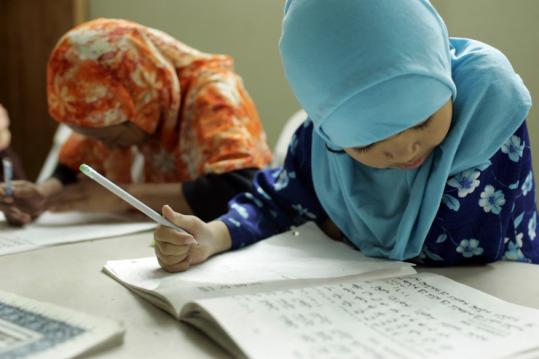
In a mosque fashioned from a condo unit in Santa Ana, Calif., Cham girls practiced writing the Arabic alphabet.In a mosque fashioned from a condo unit in Santa Ana, Calif., Cham girls practiced writing the Arabic alphabet. (Gina Ferazzi/los angeles times)

By Paloma EsquivelLos Angeles Times / January 18, 2009

SANTA ANA, Calif. – In the secluded courtyard of a weathered condominium complex, at the dead end of a graffiti-marred Santa Ana street, the Cham are busy preparing a feast.

Discuss
COMMENTS (0)

Banana trees grow tall in Santa Ana, shadowing crowded stalks of lemon grass and green onion. Severed bits of a cow slaughtered in conformity with Islamic law fill bright blue plastic tubs. Nearby, women sit cross-legged, chatting and laughing; their strong hands grind fresh ginger in stone mortars.

Centuries ago, the Cham ruled over their own kingdom, known as Champa, along the coastline of what is now Vietnam. They were maritime traders whose first religion was a form of Hinduism, but they later adopted Islam. Today they are a people without a homeland, their numbers a few hundred thousand. For centuries, they have been chased from place to place – from the highlands of Vietnam to the rivers of Cambodia and, in the aftermath of genocide, to the United States, where thousands have settled.

In the margins of each place, they have come together.

So it is in Santa Ana, where a hundred Cham families live in this worn Santa Ana complex alongside Hispanics, Laotians, and Cambodians. In the middle of one of the city’s most crime- infested neighborhoods, they have turned one apartment into a mosque and built a world centered on faith. In celebration, neighbors prepare feasts and share stories. In hardship, they share burdens, the cost of food, and the cost of burial.

As they have struggled to keep their community intact, the world has crept in. Some youths have turned to gangs and drugs. Others have packed their bags and fled. A few have drifted from the religion and language that shaped their youth. When the call to prayer goes out, the mosque is filled mostly with elders and small children, as if those in the middle disappeared.

On the day of the feast to celebrate the beginning of Ramadan and the end of the Islamic school year, one man finds himself wanting to rebuild his ties.

Nasia Ahmanth doesn’t properly speak Cham, which is related to Malay. He rarely attends mosque and can’t read the Arabic of the Koran. He rarely prays.

He was a baby when his father, El Ahmanth, led a village of Cham refugees in Santa Ana. But as the group put down roots, Nasia drifted, lured by the streets. By the time he was 17, he says, he was an addict, and speed was his drug of choice. As it raced through his body, he felt unstoppable, light, and creative at once.

He’s 30 and, he says, sober. He has a son and two years ago moved out of the neighborhood to distance himself from drug-using friends. Last year, though, when his father died, he found himself looking homeward, wanting to rebuild his ties to a community he feared was fading.

“I want my son to know what Cham is,” he said.

Nasia had just been born when in 1979 his family fled the Khmer Rouge’s brutal reign in Cambodia. They went to Thailand, then to refugee camps in the Philippines before landing in Southern California.

With a few hundred dollars in refugee assistance, his father rented an apartment in a neighborhood ravaged by shootings and drugs. He sponsored 10 families living in refugee camps in Thailand who had fled Cambodia, and before long those families were sponsoring refugees.

“You need to learn to walk before you can run,” Nasia’s father tells his three young boys.

U.S. Financial Aid To Israel: Figures, Facts, and Impact Summary

U.S. Financial Aid To Israel: Figures, Facts, and Impact Summary Benefits to Israel of U.S. Aid Since 1949 (As of November 1, 1997) Foreign Aid Grants and Loans $74,157,600,000 Other U.S. Aid (12.2% of Foreign Aid) $9,047,227,200 Interest to Israel from Advanced Payments $1,650,000,000 Grand Total $84,854,827,200 Total Benefits per Israeli $14,630 Cost to U.S. Taxpayers of U.S. Aid to Israel Grand Total $84,854,827,200 Interest Costs Borne by U.S. $49,936,680,000 Total Cost to U.S. Taxpayers $134,791,507,200 Total Taxpayer Cost per Israeli $23,240 Special Reports: Congress Watch: A Conservative Total for U.S. Aid to Israel: $91 Billion—and Counting Congressional Research Report on Israel: US Foreign Assistance by Clyde Mark (213K pdf file) U.S. Aid To Israel: The Strategic Functions U.S. Aid to Israel: What U.S. Taxpayer Should Know U.S. Aid to Israel: Interpreting the ‘Strategic Relationship’ The Cost of Israel to U.S. Taxpayers: True Lies About U.S. Aid to Israel THE STRATEGIC FUNCTIONS OF U.S. AID TO ISRAEL By Stephen Zunes Dr. Zunes is an assistant professor in the Department of Politics at the University of San Francisco Since 1992, the U.S. has offered Israel an additional $2 billion annually in loan guarantees. Congressional researchers have disclosed that between 1974 and 1989, $16.4 billion in U.S. military loans were converted to grants and that this was the understanding from the beginning. Indeed, all past U.S. loans to Israel have eventually been forgiven by Congress, which has undoubtedly helped Israel’s often-touted claim that they have never defaulted on a U.S. government loan. U.S. policy since 1984 has been that economic assistance to Israel must equal or exceed Israel’s annual debt repayment to the United States. Unlike other countries, which receive aid in quarterly installments, aid to Israel since 1982 has been given in a lump sum at the beginning of the fiscal year, leaving the U.S. government to borrow from future revenues. Israel even lends some of this money back through U.S. treasury bills and collects the additional interest. In addition, there is the more than $1.5 billion in private U.S. funds that go to Israel annually in the form of $1 billion in private tax-deductible donations and $500 million in Israeli bonds. The ability of Americans to make what amounts to tax-deductible contributions to a foreign government, made possible through a number of Jewish charities, does not exist with any other country. Nor do these figures include short- and long-term commercial loans from U.S. banks, which have been as high as $1 billion annually in recent years. Total U.S. aid to Israel is approximately one-third of the American foreign-aid budget, even though Israel comprises just .001 percent of the world’s population and already has one of the world’s higher per capita incomes. Indeed, Israel’s GNP is higher than the combined GNP of Egypt, Lebanon, Syria, Jordan, the West Bank and Gaza. With a per capita income of about $14,000, Israel ranks as the sixteenth wealthiest country in the world; Israelis enjoy a higher per capita income than oil-rich Saudi Arabia and are only slightly less well-off than most Western European countries. AID does not term economic aid to Israel as development assistance, but instead uses the term “economic support funding.” Given Israel’s relative prosperity, U.S. aid to Israel is becoming increasingly controversial. In 1994, Yossi Beilen, deputy foreign minister of Israel and a Knesset member, told the Women’s International Zionist organization, “If our economic situation is better than in many of your countries, how can we go on asking for your charity?” U.S. Aid to Israel: What U.S. Taxpayer Should Know by Tom Malthaner This morning as I was walking down Shuhada Street in Hebron, I saw graffiti marking the newly painted storefronts and awnings. Although three months past schedule and 100 percent over budget, the renovation of Shuhada Street was finally completed this week. The project manager said the reason for the delay and cost overruns was the sabotage of the project by the Israeli settlers of the Beit Hadassah settlement complex in Hebron. They broke the street lights, stoned project workers, shot out the windows of bulldozers and other heavy equipment with pellet guns, broke paving stones before they were laid and now have defaced again the homes and shops of Palestinians with graffiti. The settlers did not want Shuhada St. opened to Palestinian traffic as was agreed to under Oslo 2. This renovation project is paid for by USAID funds and it makes me angry that my tax dollars have paid for improvements that have been destroyed by the settlers. Most Americans are not aware how much of their tax revenue our government sends to Israel. For the fiscal year ending in September 30, 1997, the U.S. has given Israel $6.72 billion: $6.194 billion falls under Israel’s foreign aid allotment and $526 million comes from agencies such as the Department of Commerce, the U.S. Information Agency and the Pentagon. The $6.72 billion figure does not include loan guarantees and annual compound interest totalling $3.122 billion the U.S. pays on money borrowed to give to Israel. It does not include the cost to U.S. taxpayers of IRS tax exemptions that donors can claim when they donate money to Israeli charities. (Donors claim approximately $1 billion in Federal tax deductions annually. This ultimately costs other U.S. tax payers $280 million to $390 million.) When grant, loans, interest and tax deductions are added together for the fiscal year ending in September 30, 1997, our special relationship with Israel cost U.S. taxpayers over $10 billion. Since 1949 the U.S. has given Israel a total of $83.205 billion. The interest costs borne by U.S. tax payers on behalf of Israel are $49.937 billion, thus making the total amount of aid given to Israel since 1949 $133.132 billion. This may mean that U.S. government has given more federal aid to the average Israeli citizen in a given year than it has given to the average American citizen. I am angry when I see Israeli settlers from Hebron destroy improvements made to Shuhada Street with my tax money. Also, it angers me that my government is giving over $10 billion to a country that is more prosperous than most of the other countries in the world and uses much of its money for strengthening its military and the oppression of the Palestinian people. “U.S. Aid to Israel: Interpreting the ‘Strategic Relationship”‘ by Stephen Zunes “The U.S. aid relationship with Israel is unlike any other in the world,” said Stephen Zunes during a January 26 CPAP presentation. “In sheer volume, the amount is the most generous foreign aid program ever between any two countries,” added Zunes, associate professor of Politics and chair of the Peace and Justice Studies Program at the University of San Francisco. He explored the strategic reasoning behind the aid, asserting that it parallels the “needs of American arms exporters” and the role “Israel could play in advancing U.S. strategic interests in the region.” Although Israel is an “advanced, industrialized, technologically sophisticated country,” it “receives more U.S. aid per capita annually than the total annual [Gross Domestic Product] per capita of several Arab states.” Approximately a third of the entire U.S. foreign aid budget goes to Israel, “even though Israel comprises just…one-thousandth of the world’s total population, and already has one of the world’s higher per capita incomes.” U.S. government officials argue that this money is necessary for “moral” reasons-some even say that Israel is a “democracy battling for its very survival.” If that were the real reason, however, aid should have been highest during Israel’s early years, and would have declined as Israel grew stronger. Yet “the pattern…has been just the opposite.” According to Zunes, “99 percent of all U.S. aid to Israel took place after the June 1967 war, when Israel found itself more powerful than any combination of Arab armies….” The U.S. supports Israel’s dominance so it can serve as “a
su
rrogate for American interests in this vital strategic region.” “Israel has helped defeat radical nationalist movements” and has been a “testing ground for U.S. made weaponry.” Moreover, the intelligence agencies of both countries have “collaborated,” and “Israel has funneled U.S. arms to third countries that the U.S. [could] not send arms to directly,…Iike South Africa, like the Contras, Guatemala under the military junta, [and] Iran.” Zunes cited an Israeli analyst who said: “‘It’s like Israel has just become another federal agency when it’s convenient to use and you want something done quietly.”‘ Although the strategic relationship between the United States and the Gulf Arab states in the region has been strengthening in recent years, these states “do not have the political stability, the technological sophistication, [or] the number of higher-trained armed forces personnel” as does Israel. Matti Peled, former Israeli major general and Knesset member, told Zunes that he and most Israeli generals believe this aid is “little more than an American subsidy to U.S. arms manufacturers,” considering that the majority of military aid to Israel is used to buy weapons from the U.S. Moreover, arms to Israel create more demand for weaponry in Arab states. According to Zunes, “the Israelis announced back in 1991 that they supported the idea of a freeze in Middle East arms transfers, yet it was the United States that rejected it.” In the fall of 1993-when many had high hopes for peace-78 senators wrote to former President Bill Clinton insisting that aid to Israel remain “at current levels.” Their “only reason” was the “massive procurement of sophisticated arms by Arab states.” The letter neglected to mention that 80 percent of those arms to Arab countries came from the U.S. “I’m not denying for a moment the power of AIPAC [the American Israel Public Affairs Committee], the pro-Israel lobby,” and other similar groups, Zunes said. Yet the “Aerospace Industry Association which promotes these massive arms shipments…is even more influential.” This association has given two times more money to campaigns than all of the pro-Israel groups combined. Its “force on Capitol Hill, in terms of lobbying, surpasses that of even AIPAC.” Zunes asserted that the “general thrust of U.S. policy would be pretty much the same even if AIPAC didn’t exist. We didn’t need a pro-Indonesia lobby to support Indonesia in its savage repression of East Timor all these years.” This is a complex issue, and Zunes said that he did not want to be “conspiratorial,” but he asked the audience to imagine what “Palestinian industriousness, Israeli technology, and Arabian oil money…would do to transform the Middle East…. [W]hat would that mean to American arms manufacturers? Oil companies? Pentagon planners?” “An increasing number of Israelis are pointing out” that these funds are not in Israel’s best interest. Quoting Peled, Zunes said, “this aid pushes Israel ‘toward a posture of callous intransigence’ in terms of the peace process.” Moreover, for every dollar the U.S. sends in arms aid, Israel must spend two to three dollars to train people to use the weaponry, to buy parts, and in other ways make use of the aid. Even “main-stream Israeli economists are saying [it] is very harmful to the country’s future.” The Israeli paper Yediot Aharonot described Israel as “‘the godfather’s messenger’ since [Israel] undertake[s] the ‘dirty work’ of a godfather who ‘always tries to appear to be the owner of some large, respectable business.”‘ Israeli satirist B. Michael refers to U.S. aid this way: “‘My master gives me food to eat and I bite those whom he tells me to bite. It’s called strategic cooperation.” ‘To challenge this strategic relationship, one cannot focus solely on the Israeli lobby but must also examine these “broader forces as well.” “Until we tackle this issue head-on,” it will be “very difficult to win” in other areas relating to Palestine. “The results” of the short-term thinking behind U.S. policy “are tragic,” not just for the “immediate victims” but “eventually [for] Israel itself” and “American interests in the region.” The U.S. is sending enormous amounts of aid to the Middle East, and yet “we are less secure than ever”-both in terms of U.S. interests abroad and for individual Americans. Zunes referred to a “growing and increasing hostility [of] the average Arab toward the United States.” In the long term, said Zunes, “peace and stability and cooperation with the vast Arab world is far more important for U.S. interests than this alliance with Israel.” This is not only an issue for those who are working for Palestinian rights, but it also “jeopardizes the entire agenda of those of us concerned about human rights, concerned about arms control, concerned about international law.” Zunes sees significant potential in “building a broad-based movement around it.” The above text is based on remarks, delivered on. 26 January, 2001 by Stephen Zunes – Associate Professor of Politics and Chair of the Peace and Justice Studies Program at San Francisco University. The Cost of Israel to U.S. Taxpayers: True Lies About U.S. Aid to Israel By Richard H. Curtiss For many years the American media said that “Israel receives $1.8 billion in military aid” or that “Israel receives $1.2 billion in economic aid.” Both statements were true, but since they were never combined to give us the complete total of annual U.S. aid to Israel, they also were lies—true lies. Recently Americans have begun to read and hear that “Israel receives $3 billion in annual U.S. foreign aid.” That’s true. But it’s still a lie. The problem is that in fiscal 1997 alone, Israel received from a variety of other U.S. federal budgets at least $525.8 million above and beyond its $3 billion from the foreign aid budget, and yet another $2 billion in federal loan guarantees. So the complete total of U.S. grants and loan guarantees to Israel for fiscal 1997 was $5,525,800,000. One can truthfully blame the mainstream media for never digging out these figures for themselves, because none ever have. They were compiled by the Washington Report on Middle East Affairs. But the mainstream media certainly are not alone. Although Congress authorizes America’s foreign aid total, the fact that more than a third of it goes to a country smaller in both area and population than Hong Kong probably never has been mentioned on the floor of the Senate or House. Yet it’s been going on for more than a generation. Probably the only members of Congress who even suspect the full total of U.S. funds received by Israel each year are the privileged few committee members who actually mark it up. And almost all members of the concerned committees are Jewish, have taken huge campaign donations orchestrated by Israel’s Washington, DC lobby, the American Israel Public Affairs Committee (AIPAC), or both. These congressional committee members are paid to act, not talk. So they do and they don’t. The same applies to the president, the secretary of state, and the foreign aid administrator. They all submit a budget that includes aid for Israel, which Congress approves, or increases, but never cuts. But no one in the executive branch mentions that of the few remaining U.S. aid recipients worldwide, all of the others are developing nations which either make their military bases available to the U.S., are key members of international alliances in which the U.S. participates, or have suffered some crippling blow of nature to their abilities to feed their people such as earthquakes, floods or droughts. Israel, whose troubles arise solely from its unwillingness to give back land it seized in the 1967 war in return for peace with its neighbors, does not fit those criteria. In fact, Israel’s 1995 per capita gross domestic product was $15,800. That put it below Britain at $19,500 and Italy at $18,700 and just above Ireland at $15,400 and Spain at $14,300. All four of those European countries have contributed a very large share of immigrants to the U.S., yet none has organized an ethnic group to lobby for U.S. foreign aid. Instead, all four send funds and vo

lunteers to do economic development and emergency relief work in other less fortunate parts of the world. The lobby that Israel and its supporters have built in the United States to make all this aid happen, and to ban discussion of it from the national dialogue, goes far beyond AIPAC, with its $15 million budget, its 150 employees, and its five or six registered lobbyists who manage to visit every member of Congress individually once or twice a year. AIPAC, in turn, can draw upon the resources of the Conference of Presidents of Major American Jewish Organizations, a roof group set up solely to coordinate the efforts of some 52 national Jewish organizations on behalf of Israel. Among them are Hadassah, the Zionist women’s organization, which organizes a steady stream of American Jewish visitors to Israel; the American Jewish Congress, which mobilizes support for Israel among members of the traditionally left-of-center Jewish mainstream; and the American Jewish Committee, which plays the same role within the growing middle-of-the-road and right-of-center Jewish community. The American Jewish Committee also publishes Commentary,one of the Israel lobby’s principal national publications. Perhaps the most controversial of these groups is B’nai B’rith’s Anti-Defamation League. Its original highly commendable purpose was to protect the civil rights of American Jews. Over the past generation, however, the ADL has regressed into a conspiratorial and, with a $45 million budget, extremely well-funded hate group. In the 1980s, during the tenure of chairman Seymour Reich, who went on to become chairman of the Conference of Presidents, ADL was found to have circulated two annual fund-raising letters warning Jewish parents against allegedly negative influences on their children arising from the increasing Arab presence on American university campuses. More recently, FBI raids on ADL’s Los Angeles and San Francisco offices revealed that an ADL operative had purchased files stolen from the San Francisco police department that a court had ordered destroyed because they violated the civil rights of the individuals on whom they had been compiled. ADL, it was shown, had added the illegally prepared and illegally obtained material to its own secret files, compiled by planting informants among Arab-American, African-American, anti-Apartheid and peace and justice groups. The ADL infiltrators took notes of the names and remarks of speakers and members of audiences at programs organized by such groups. ADL agents even recorded the license plates of persons attending such programs and then suborned corrupt motor vehicles department employees or renegade police officers to identify the owners. Although one of the principal offenders fled the United States to escape prosecution, no significant penalties were assessed. ADL’s Northern California office was ordered to comply with requests by persons upon whom dossiers had been prepared to see their own files, but no one went to jail and as yet no one has paid fines. Not surprisingly, a defecting employee revealed in an article he published in the Washington Report on Middle East Affairs that AIPAC, too, has such “enemies” files. They are compiled for use by pro-Israel journalists like Steven Emerson and other so-called “terrorism experts,” and also by professional, academic or journalistic rivals of the persons described for use in black-listing, defaming, or denouncing them. What is never revealed is that AIPAC’s “opposition research” department, under the supervision of Michael Lewis, son of famed Princeton University Orientalist Bernard Lewis, is the source of this defamatory material. But this is not AIPAC’s most controversial activity. In the 1970s, when Congress put a cap on the amount its members could earn from speakers’ fees and book royalties over and above their salaries, it halted AIPAC’s most effective ways of paying off members for voting according to AIPAC recommendations. Members of AIPAC’s national board of directors solved the problem by returning to their home states and creating political action committees (PACs). Most special interests have PACs, as do many major corporations, labor unions, trade associations and public-interest groups. But the pro-Israel groups went wild. To date some 126 pro-Israel PACs have been registered, and no fewer than 50 have been active in every national election over the past generation. An individual voter can give up to $2,000 to a candidate in an election cycle, and a PAC can give a candidate up to $10,000. However, a single special interest with 50 PACs can give a candidate who is facing a tough opponent, and who has voted according to its recommendations, up to half a million dollars. That’s enough to buy all the television time needed to get elected in most parts of the country. Even candidates who don’t need this kind of money certainly don’t want it to become available to a rival from their own party in a primary election, or to an opponent from the opposing party in a general election. As a result, all but a handful of the 535 members of the Senate and House vote as AIPAC instructs when it comes to aid to Israel, or other aspects of U.S. Middle East policy. There is something else very special about AIPAC’s network of political action committees. Nearly all have deceptive names. Who could possibly know that the Delaware Valley Good Government Association in Philadelphia, San Franciscans for Good Government in California, Cactus PAC in Arizona, Beaver PAC in Wisconsin, and even Icepac in New York are really pro-Israel PACs under deep cover? Hiding AIPAC’s Tracks In fact, the congressmembers know it when they list the contributions they receive on the campaign statements they have to prepare for the Federal Election Commission. But their constituents don’t know this when they read these statements. So just as no other special interest can put so much “hard money” into any candidate’s election campaign as can the Israel lobby, no other special interest has gone to such elaborate lengths to hide its tracks. Although AIPAC, Washington’s most feared special-interest lobby, can hide how it uses both carrots and sticks to bribe or intimidate members of Congress, it can’t hide all of the results. Anyone can ask one of their representatives in Congress for a chart prepared by the Congressional Research Service, a branch of the Library of Congress, that shows Israel received $62.5 billion in foreign aid from fiscal year 1949 through fiscal year 1996. People in the national capital area also can visit the library of the U.S. Agency for International Development (USAID) in Rosslyn, Virginia, and obtain the same information, plus charts showing how much foreign aid the U.S. has given other countries as well. Visitors will learn that in precisely the same 1949-1996 time frame, the total of U.S. foreign aid to all of the countries of sub-Saharan Africa, Latin America and the Caribbean combined was $62,497,800,000–almost exactly the amount given to tiny Israel. According to the Population Reference Bureau of Washington, DC, in mid-1995 the sub-Saharan countries had a combined population of 568 million. The $24,415,700,000 in foreign aid they had received by then amounted to $42.99 per sub-Saharan African. Similarly, with a combined population of 486 million, all of the countries of Latin America and the Caribbean together had received $38,254,400,000. This amounted to $79 per person. The per capita U.S. foreign aid to Israel’s 5.8 million people during the same period was $10,775.48. This meant that for every dollar the U.S. spent on an African, it spent $250.65 on an Israeli, and for every dollar it spent on someone from the Western Hemisphere outside the United States, it spent $214 on an Israeli. Shocking Comparisons These comparisons already seem shocking, but they are far from the whole truth. Using reports compiled by Clyde Mark of the Congressional Research Service and other sources, freelance writer Frank Collins tallied for theWashington Report all of the extra items for Israel buried in the budgets of the Pentagon and other federal agencies
in fiscal year 1993.Washington Report news editor Shawn Twing did the same thing for fiscal years 1996 and 1997. They uncovered $1.271 billion in extras in FY 1993, $355.3 million in FY 1996 and $525.8 million in FY 1997. These represent an average increase of 12.2 percent over the officially recorded foreign aid totals for the same fiscal years, and they probably are not complete. It’s reasonable to assume, therefore, that a similar 12.2 percent hidden increase has prevailed over all of the years Israel has received aid. As of Oct. 31, 1997 Israel will have received $3.05 billion in U.S. foreign aid for fiscal year 1997 and $3.08 billion in foreign aid for fiscal year 1998. Adding the 1997 and 1998 totals to those of previous years since 1949 yields a total of $74,157,600,000 in foreign aid grants and loans. Assuming that the actual totals from other budgets average 12.2 percent of that amount, that brings the grand total to $83,204,827,200. But that’s not quite all. Receiving its annual foreign aid appropriation during the first month of the fiscal year, instead of in quarterly installments as do other recipients, is just another special privilege Congress has voted for Israel. It enables Israel to invest the money in U.S. Treasury notes. That means that the U.S., which has to borrow the money it gives to Israel, pays interest on the money it has granted to Israel in advance, while at the same time Israel is collecting interest on the money. That interest to Israel from advance payments adds another $1.650 billion to the total, making it $84,854,827,200.That’s the number you should write down for total aid to Israel. And that’s $14,346 each for each man, woman and child in Israel. It’s worth noting that that figure does not include U.S. government loan guarantees to Israel, of which Israel has drawn $9.8 billion to date. They greatly reduce the interest rate the Israeli government pays on commercial loans, and they place additional burdens on U.S. taxpayers, especially if the Israeli government should default on any of them. But since neither the savings to Israel nor the costs to U.S. taxpayers can be accurately quantified, they are excluded from consideration here. Further, friends of Israel never tire of saying that Israel has never defaulted on repayment of a U.S. government loan. It would be equally accurate to say Israel has never been required to repay a U.S. government loan. The truth of the matter is complex, and designed to be so by those who seek to conceal it from the U.S. taxpayer. Most U.S. loans to Israel are forgiven, and many were made with the explicit understanding that they would be forgiven before Israel was required to repay them. By disguising as loans what in fact were grants, cooperating members of Congress exempted Israel from the U.S. oversight that would have accompanied grants. On other loans, Israel was expected to pay the interest and eventually to begin repaying the principal. But the so-called Cranston Amendment, which has been attached by Congress to every foreign aid appropriation since 1983, provides that economic aid to Israel will never dip below the amount Israel is required to pay on its outstanding loans. In short, whether U.S. aid is extended as grants or loans to Israel, it never returns to the Treasury. Israel enjoys other privileges. While most countries receiving U.S. military aid funds are expected to use them for U.S. arms, ammunition and training, Israel can spend part of these funds on weapons made by Israeli manufacturers. Also, when it spends its U.S. military aid money on U.S. products, Israel frequently requires the U.S. vendor to buy components or materials from Israeli manufacturers. Thus, though Israeli politicians say that their own manufacturers and exporters are making them progressively less dependent upon U.S. aid, in fact those Israeli manufacturers and exporters are heavily subsidized by U.S. aid. Although it’s beyond the parameters of this study, it’s worth mentioning that Israel also receives foreign aid from some other countries. After the United States, the principal donor of both economic and military aid to Israel is Germany. By far the largest component of German aid has been in the form of restitution payments to victims of Nazi attrocities. But there also has been extensive German military assistance to Israel during and since the Gulf war, and a variety of German educational and research grants go to Israeli institutions. The total of German assistance in all of these categories to the Israeli government, Israeli individuals and Israeli private institutions has been some $31 billion or $5,345 per capita, bringing the per capita total of U.S. and German assistance combined to almost $20,000 per Israeli. Since very little public money is spent on the more than 20 percent of Israeli citizens who are Muslim or Christian, the actual per capita benefits received by Israel’s Jewish citizens would be considerably higher. True Cost to U.S. Taxpayers Generous as it is, what Israelis actually got in U.S. aid is considerably less than what it has cost U.S. taxpayers to provide it. The principal difference is that so long as the U.S. runs an annual budget deficit, every dollar of aid the U.S. gives Israel has to be raised through U.S. government borrowing. In an article in the Washington Report for December 1991/January 1992, Frank Collins estimated the costs of this interest, based upon prevailing interest rates for every year since 1949. I have updated this by applying a very conservative 5 percent interest rate for subsequent years, and confined the amount upon which the interest is calculated to grants, not loans or loan guarantees. On this basis the $84.8 billion in grants, loans and commodities Israel has received from the U.S. since 1949 cost the U.S. an additional $49,936,880,000 in interest. There are many other costs of Israel to U.S. taxpayers, such as most or all of the $45.6 billion in U.S. foreign aid to Egypt since Egypt made peace with Israel in 1979 (compared to $4.2 billion in U.S. aid to Egypt for the preceding 26 years). U.S. foreign aid to Egypt, which is pegged at two-thirds of U.S. foreign aid to Israel, averages $2.2 billion per year. There also have been immense political and military costs to the U.S. for its consistent support of Israel during Israel’s half-century of disputes with the Palestinians and all of its Arab neighbors. In addition, there have been the approximately $10 billion in U.S. loan guarantees and perhaps $20 billion in tax-exempt contributions made to Israel by American Jews in the nearly half-century since Israel was created. Even excluding all of these extra costs, America’s $84.8 billion in aid to Israel from fiscal years 1949 through 1998, and the interest the U.S. paid to borrow this money, has cost U.S. taxpayers $134.8 billion, not adjusted for inflation. Or, put another way, the nearly $14,630 every one of 5.8 million Israelis received from the U.S. government by Oct. 31, 1997 has cost American taxpayers $23,240 per Israeli. It would be interesting to know how many of those American taxpayers believe they and their families have received as much from the U.S. Treasury as has everyone who has chosen to become a citizen of Israel. But it’s a question that will never occur to the American public because, so long as America’s mainstream media, Congress and president maintain their pact of silence, few Americans will ever know the true cost of Israel to U.S. taxpayers. Richard Curtiss, a retired U.S. foreign service officer, is the executive editor of the Washington Report on Middle East Affairs.

Palestine

Gallery Gaza air strikes: More Than 155 Palestinians Killed In Israeli Air Attacks On Gaza

1 / 55

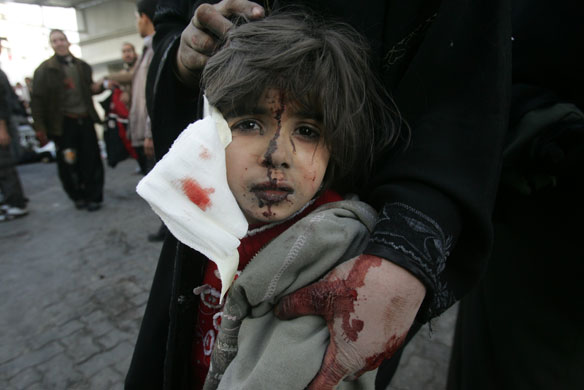
27 December: Amid thousands of images of civilian casualties of the Israeli airstrikes in Gaza, the solemn stare of one child appears to have stood out more than any other. Newspapers and broadcasters across the world selected the image of a young girl looking into a camera lens outside the Shifa hospital hours after an Israeli air strike

Photograph: Abid Katib/Getty Images

Islamic warfare protects noncombatants, and manipulating terrorists are violating its laws.

VOICE OF THE DAY

A Muslim view

Islamic warfare protects noncombatants, and manipulating terrorists are violating its laws.

ANNANINA JOY GLOVER • JANUARY 16, 2009

Peace to you, dear readers. I was asked to write a reply to the letter written in the Dec. 19 Voices section (“Muslim reaction to killings sought,” by Bob W. Rush) asking for the Muslim community to respond to the terrorism/violence being perpetrated by so-called Muslim extremists.

Advertisement
Click Me!

I am an American who has embraced Islam post-Sept. 11, 2001. Islam does not teach hate, violence or exclusivity of salvation. In fact, there are rules to Islamic warfare that protect noncombatants, their property and also a cease-fire if the people pursue peaceful relations. It does not matter if the people are Muslim or non-Muslim. The point of Islamic warfare is to establish justice in a land where people are oppressed and corruption abounds or defend one’s life, home and right to practice his religion. These laws are being violated by the terrorists; their attacks harm men, women and children who offer no violence or opposition to justice. Property is stolen or destroyed, crops wiped out and no peace treaties are welcomed. So ultimately what we have are rampaging murderers and political extremists pulling the strings, manipulating the emotional state of people to convince them that they are acting to serve justice.

Killing Spawns Resentment

It is hard for most Americans to understand what it is that has spawned such a resentment in people, until they are offered insight into a different life that is reality on the other side of the world. To us it is articles in the newspaper, images on television and counts of how many of our people have given their lives in what we believe is a fight for freedom, justice and liberty for all. But to many ordinary people who consider themselves to be patriotic, honest, hard-working folk of Middle Eastern nations, American military action or support of certain governments results in the death of children, friends and family. We know from experience that anyone who loses a child or a beloved family member in a violent way generally becomes embittered and blames what they perceive to be the source of the problem, whether it be drunk drivers, gang-bangers or military skirmishes.

After the attacks of Sept. 11, 2001, our government ordered an investigation and the report concluded that the primary motivation was U.S. military aid to Israel. No matter how bitter people might be or what terrible things have been done to them or their loved ones, it does not justify the actions the terrorists took. It certainly did nothing to improve the conditions of the people trying to live alongside Israel.

No Room For Hate

When politically minded people gather emotionally wounded people together and focus those feelings into hate, they can manipulate them to do anything, and by perverting scripture they believe they serve justice. There is no room for hate in the heart of any true believer of God, be they Muslim, Christian or Jew. When there is arrogance (racial or social) or hate, love for God cannot be. I do understand that Israel is a very sensitive subject, but I ask you to think about the country not for religious affiliation or historical events. There are international laws that designate certain human rights, and if a country does not comply with them, we do not support their governments. Israel’s military actions violate human rights laws, and have continued to do so for more than 20 years. Yet the U.S. gives more aid to Israel (in weapons and so forth) than any other nation (to my understanding ).

The most horrifying to me, as a woman, is the checkpoint that refused to allow a woman in labor to cross to the waiting ambulance until after she and her twins had died. The most disturbing fact about the weaponry being used is the so-called “rubber bullets” that are metal rounds coated in plastic and end up killing many children, even entering their brains.

I am not calling an end to Israel or reviling the children of Israel. I am simply saying that there is another side to the story and that some of the bitterness and resentment is based in reality. I believe if we truly want peace, people (Muslim, Christian, Jew, or other) are going to have to recognize the humanity in the other and strive for a common goal: the right to live and believe free from persecution.

If you disagree, please feel free to contest my words with credible sources. If you want to know what all Muslims must abide by, try reading a translation of the meaning of the Quran. Look for a way to prove me wrong. I, as a Muslim – one who submits my whole self to God – believe in: God, the Messengers, the Angels, the Book, the Final Day, that Islam is my guide and inviolate law, that there is no compulsion in religion, other religions must be respectfully disagreed with but not reviled and to treat people gently. Most of all, I believe on living by example; clean and courteous. Religion must be lived in every breath, every word and every step – a way of life.

Annanina Joy Glover lives in Springfield.

‘s Gaza Daily Update

Hatem’s Gaza Daily Update

GAZA: 15 January
 
I am stuck in my house. Things are very difficult today as tanks are in the area next to where I live and where my colleagues have family.

My colleague is writing my words down as I am unable to get to the office and use my computer.

Many people have left the area and are moving in with relatives deeper in Gaza City.

When I look out of the window I can see people leaving with small bags – many of those leaving are with their families. There are many women and children.

I hear a loud explosion a few metres away. The shelling is becoming more intense and rockets are also falling.

I can see smoke from a building that is behind my house.

The Unrwa (UN relief agency) building is close by and my colleague has told me that it has been hit.

Shelling is going on. Explosions are shaking the house. My family are gathered in one room and we make sure everyone is OK and the house is OK.

My mother shouts out to make sure we are all with her in the room.

Children crying

My sisters-in-law are with us and the children, and we crouch down in case glass from the windows shatters and hits us. I can hear the neighbour’s children crying and shouting.

My sister called earlier and said she will try to make it to our home.

She has three young daughters and a son but we don’t think she will make it as it is not safe to travel.

Some family friends are now on their way to a UN shelter. They wanted to stay with us but it was simply too dangerous for them to make their way here.

Thick black smoke is getting thicker and blocking the sun. The fighting is coming closer to our homes and the soldiers are now in urban areas. What scares me is that our homes could come under attack and there will be more death and destruction.

When I meet people I find that they have almost become indifferent to death, as we know death is not far away 
 
I was supposed to be out distributing aid to hospitals around Gaza with Islamic Relief’s emergency relief team.

Yesterday we managed to deliver hospital trolleys, heart machines and first aid equipment including bandages, disposable gloves and syringes to five hospitals around Gaza.

We were supposed to deliver more aid today but our work has been suspended due to the intensity of the attacks in the centre of Gaza.

Aid is entering Gaza through Israel and Egypt but people can’t collect the food and medicine as it is not safe for them to leave their homes.

A few days ago Islamic Relief was able to receive 20 ambulances through the Rafah border which will be donated to the main Shifa hospital and other smaller hospitals.

Hopes dashed

Today is the 20th day of the attack. Every day we hope that this will be the last day but the attacks go on and people feel depressed and scared.

Gazans feel that this won’t end any time soon. When I meet people I find that they have almost become indifferent to death, as we know death is not far away.

In the past 20 days more than 1,000 people have been killed, many of them women and children. Death has come close to the average Gazan.

My colleague is asking me how I am coping with the situation and how I overcome my fear.

I take a deep breath and try to explain as best I can.

During the day when I am out working with the Islamic Relief team I stay strong and never show exhaustion or fear.

I am there to help people who in many cases have nothing.

When I get home I try to stay strong for my family especially my nieces and nephews who are very young and frightened.

At night when I read the evening prayer I can’t control myself and I cry and cry all night.

In the morning I leap up and force myself to shake off the despair and hurt and get ready to go out and try to help the people of Gaza.

Gaza 13 January

The water situation in Gaza is dire. Those people who are lucky enough to have any water in their storage tanks are trying to save as much as possible. Many people have had their tanks destroyed by the bombing and shooting.

Most homes in Rafah, Khan Younis and in the middle and northern areas of Gaza have almost no water or electricity. Eighty per cent of people in Gaza are dependent on international aid. Most Gazans can’t afford to buy water.

Only today my colleague, Diya Skaik, returned to his home which he was forced to leave 10 days ago due to the intensive bombing.

“The water tank which is the only source of water for my small family is crushed,” he told me.

“I went to the roof and just had a glance. I had to leave the place quickly as it is too dangerous to be there.”

A few months ago my father had a feeling something awful might happen in Gaza and bought a larger water tank.

We are very much aware that Gaza will need long-term help from the outside world to rebuild the devastated infrastructure 
 

However, the water that we have is almost finished. This is despite the fact that we have cut our usage down to the bare minimum. I know my father is concerned about our limited supply, even though he doesn’t talk about it.

The water shortage in Gaza is causing health and environmental problems.

Only a few months ago Islamic Relief provided Gaza’s main water pump station with spare parts. The system is old and in need of repair and was already feeling the strain during the siege of the past 18 months.

Today we provided eight shelters in Gaza with drinking water for the many hundreds of people who have been displaced by the bombing. Many of the shelters are overcrowded and have no access to clean water. We provided each person with 20 litres.

No doubt, after the fighting is over, we are going to see vast amounts of damage to houses and the water tanks on the roofs.

As an aid worker I am focused on coping with the here and now but like everybody in Gaza I am waiting and praying for a ceasefire so we can try to rebuild our lives.

Right now our aid team is reacting to what is happening around us.

However, we are very much aware that Gaza will need long-term help from the outside world to rebuild the devastated infrastructure.

It will take the people of Gaza even longer to heal from the physical and psychological damage of this war.

Gaza 12 January

I haven’t been able to write my diary for 48 hours – I’ve simply not had time and have been busy working with colleagues to prepare thousands of food parcels for desperate people.

We have to finish distributing aid before it gets dark and make sure that we are back home, as there is no electricity and families and loved ones worry if we are out on the streets. The bombardment intensifies at night and so it’s not wise to be out then.

Lost friends

I sometimes wonder if there will be enough space to bury the dead. Yesterday a friend of mine was killed in his home. He was a journalist and worked for a radio station.

Since the attacks started on Gaza I have lost good friends – and if you ask me how I feel about it – well, I can’t really say as I’m trying to block it out so I can focus on my work.

  I feel exhausted – as does everyone around me – but as an aid worker I have no choice but to keep going 
 
I’m one of the lucky ones, as I can keep busy with my work and focus my energy on trying to assist people – this is one of the things that is keeping me going.

My manager’s home was exposed to heavy gunfire – he lives close to the borders of Gaza City – and the bullets hit the room his children sleep in.

Crowded hospitals

I decided today to try and speak to people on the streets around the office to find out more about their situation, but it’s hard to find people and when you do everyone is in a rush to visit a relative or friend and pay their condolences to families who have lost loved ones.

The shops are closed, the most crowded areas are near hospitals. I met a few people in the streets but many more are in shelters in school buildings, which are now housing hundreds of frightened people who have fled their homes hoping they will be safer in these buildings.

The “hidden” homeless are staying with their extended family members. Hundreds of families have moved in with relatives and for Gazans this is adding further pressure on them to take care of their extended families.

Islamic Relief has received many phone calls from people asking for blankets and food – they need to keep warm and to feed their families. We are now distributing aid to these families alongside people who are living in shelters.

More aid is arriving in Gaza through Israel’s borders and my logistics colleagues work out how to get the aid loaded on to trucks and out to the hospitals and shelters.

I feel exhausted – as does everyone around me – but as an aid worker I have no choice but to keep going.

Gaza 9th January

I’m using my brother’s laptop to type these words – it has an hour left on the battery. The battery on my laptop has already died.

As I write this I can hear the sound of explosions around. Thirteen days on and I can’t say that I’m getting used to the sounds of bombs and missiles hitting Gaza.

Today Islamic Relief was unable to distribute any aid as the bombing was so intense – vast parts of Gaza are now under thick black smoke.

Yesterday we were able to distribute 1,000 food parcels to local aid organisations who are helping us to reach desperate families – each parcel has enough food to feed a family of eight for one month.

This morning I heard about six people killed in the Qarrah area – all of them were over 50 years old. They were considered to be the elders in the community and they were respected and loved by all in Qarrah. People are in a state of shock.

Medical crisis

The whole health sector in Gaza is in meltdown. In the hospitals the doctors are sending home the severely injured – they have no choice due to the shortage of beds.

Many of those sent home are in urgent need of hospital treatment and anywhere else in the world they would be expected to stay in hospital for weeks. But Gaza is no ordinary place – it’s a place full of deep pain and misery.   I don’t think there any words in the dictionary that can accurately capture what’s happening here 
 

The injured are being forced to return to their homes a few hours after arriving at the hospital and are forced to try and recover from their injuries as the bombs keep falling.

The shortage of doctors can be seen in the operating theatres. While a doctor is operating on a patient two more will be brought in for emergency surgery at the same time – it’s an impossible situation.

It’s not only the doctors; there is a severe shortage of nurses too. The hospitals asked student nurses in their third and fourth years to come and help, as well as other volunteers – such is their desperation.

It’s important to remember that Gaza has been under siege for the last 18 months, so the hospitals were already suffering from a severe shortage of medical equipment.

Power fears

Al-Shifa is the largest hospital in Gaza and it just cannot cope with all the injured. In most hospitals around the world generators are used as emergency back-up if anything happens to the electricity.

In Gaza the generators are the main source of electricity for the hospitals and there is no back up. If the generators do not work properly there is nothing the doctors can do. This can happen during an operation.

Islamic Relief is going regularly to the hospitals and supplying them with medical equipment. But what will happen when the fuel runs out in Gaza and the generators no longer work?

Most people in Gaza are already without electricity as most do not have access to generators.

When I sit down to gather my thoughts and write these diaries my mind often goes blank because sometimes it’s too difficult to process the full magnitude of the suffering in Gaza.

Often I struggle to find the words to describe what’s happening here – I don’t think there are any words in the dictionary that can accurately capture what’s happening here.

Gaza 8th January

While I was writing this diary entry I received news that a Palestinian family had been killed in the northern Jabaliya refugee camp after their house was bombed.

Jabaliya is home to an estimated 125,000 people and is the most densely populated camp in Gaza.

They were a father, mother and son from the Aljaro family. Other members of the family had been injured. 

But the news got worse: the father was the brother of my Islamic Relief colleague Alaa.

I tried to reach Alaa to check he was OK and pay my condolences but couldn’t get through to him on the phone.

I finally received news that Alaa was OK. But what do I say to him when I see him?

Every day that passes brings more and more bad news and with every passing hour the human misery increases.

One minute we hear news that five people have been killed in a certain neighbourhood, then a few minutes later we receive more news that people have been killed in a different area.

It seems like Gazans are just becoming numbers.

Gazans are not just numbers, Gazans are very kind people who love life and love others.

Orphaned children

Every child that has died enjoyed playing, like other children across the world.

Every child that died had a family that loved them dearly.

Our aid team also learnt today that the fathers of three of the children in our Psychosocial Support program had been killed.

They are now orphans.

Islamic Relief runs a project with Gazan children who have been traumatised by conflict. It is funded by the Catholic Agency for Overseas Development (CAFOD).

Two thousand children are involved in the project, which aims to help youngsters deal with their loss and provide them with support and care.

I wonder what effect this conflict and losing their fathers will have on those three children in the long term.

One thing is for sure, when the bombing ends – and we pray for it to end now – this project will need to be one of our priorities.

Poor shelters

I’ve met a lot of children over the past 12 days and I can see the fear in their eyes.

The state of the shelters in which people are seeking refuge is dire.

There is no electricity, and no fuel for cooking. Neither is there any kind of heating to keep people warm in these cold winter nights.

The good news is that our relief teams continued with our distribution to three UN shelters, supplying people with hygiene kits and blankets.

We also prepared a list of medicines desperately needed by Gazan hospitals and are now working on trying to purchase the medication inside Gaza and co-ordinate the purchasing of aid from outside Gaza and work out how to get it into Gaza.

Gaza 7th January

Today we had a few hours of calm. For three hours we could deliver aid without the worry of bombardment. It was a busy day.

An Islamic Relief aid team went to the Paediatric Hospital to provide it with medical items, such as surgical sets, bandages and scissors among other items which are continuously required.

We also delivered soaps and other hygiene material and blankets to six UN shelters.

The people in the shelter were happy to see aid workers arriving with supplies, especially blankets as it’s very cold here in Gaza.

During this three hours of calm we were also given a deeper insight to the misery on the streets of Gaza.

We visited a building near the International Committee of the Red Cross (ICRC) office in Gaza where 200 people were sheltering.

Many of the people there asked me if I could tell them where a safe shelter was – where they could go to stay safe with their loved ones. I had no answer.

Despite the temporary halt in the bombing I only met people, young and old, full of sadness and fear. Many people that I met looked bewildered and exhausted.

In one shelter I met a man called Abu Mohamed. He had been forced to leave his home and was desperate to return.

“I refuse to go to a UN school as it is unsafe. Yesterday a school was hit and more than 40 were killed.

“I can’t let my family and relatives be killed. I want all this to stop and go back home safely,” he said.

Child’s play

I also met a 12-year-old girl named Fatima. She had fled with 12 members of her family to be in a UN school.

Her home was partially destroyed after her neighbour’s house was bombed.

Along with other children, she didn’t feel safe but was trying her best to block out the bombing by playing with her cousins in the school yard.

Despite the dangers, the children of Gaza are resilient and some are determined to keep playing.

Our aid teams are working out how we can source more aid supplies into Gaza and deliver the aid we have inside Gaza.

We have precious minutes and seconds in the day to try to reach desperate people whose suffering continues.

Eleven days on and there is no end in sight.

GAZA: 6 January

I’m absolutely exhausted. Despite the bombing last night I managed to get some sleep – I don’t know how – I think my body just had enough.

A homeless Palestinian woman weeps in a school turned into a UN shelter in Gaza. Families have sheltered in schools

An Islamic Relief aid team went out and visited one of the UN schools that has been turned into a shelter for families displaced by the bombing.

What I saw was heartbreaking. Before me were families who have had their homes destroyed and have lost everything. Gaza is a very poor place and many people didn’t have much before the bombing started. Many more are left with even less now.

The people I met told me that they had found themselves in the firing line and had no choice but to leave their homes.

I met a mother who was burning paper in order to boil water for her child. She was doing this because she had no milk – maybe she could fool her hungry baby with the warm water?

I was surprised at the amount of women and children I saw in the school – and worried too.

Suffering

People are exhausted, traumatised and they are surviving on a limited amount of food – there simply isn’t enough.

I found it very hard to see people suffering like this, especially the children.

At Islamic Relief we have decided that we have no choice but to deliver food to people – no matter what the dangers, and there are plenty of dangers in Gaza.

As aid workers we can not stand by and watch as people suffer – they have nothing and we have to do something to help them.

There are around 500 people sheltering in the school and we are also preparing to provide people with hygiene kits, which contain simple things like soap which are important in preventing the spread of disease.

Seeing women and children living in these kind of conditions is unbearable. Many of the children had walked long distances to reach the schools. Their parents had thought they would be safe here.

The children are tired and hungry and do not know why they have been made to leave their homes and live in classrooms, like most Gazans they are cold and hungry and bewildered by the events of the past 11 days.

GAZA: 5 January

For the second day we have had to postpone our planned aid distribution. The security situation gets worse by the hour, making it very difficult to go out on the streets and deliver aid.
 
Picture of Islamic Relief aid worker, Hatem Shurrab
I often feel like I am saying the same thing again and again, but the humanitarian situation is nothing short of desperate

Homes are without water and electricity. Gazans have only been receiving water once a week for the last six months. But the electricity is down, which means the water cannot be pumped up.

This is very dangerous. As well as the obvious danger of being without water, there are added health issues and the possibility of the spread of disease.

Gaza is now divided due to the presence of the Israeli army and it is pretty much impossible to travel to the central areas.

My Islamic Relief colleagues who work with orphans are in the middle of Gaza – it is now very difficult to reach this area.

The inability to travel safely is severely affecting the aid effort. Only today I was at a bread queue talking to ordinary Gazans. Explosions could be heard in the background.

I met one woman who had been queuing from 0730 to 1030. But others had been queuing for up to 10 hours – such is the shortage. One man I met told me he was taking shifts with his brother in the bread queue in order not to lose their place.

Others I met just broke down in tears when I began speaking to them – it seems they had no words left.
A little girl takes shelter at a UN aid centre in Gaza on 5 January 2009
Gazans face crippling shortages and constant blasts, Hatem Shurrab says

I often feel like I am saying the same thing again and again, but the humanitarian situation is nothing short of desperate. Our colleagues in the UN are calling it a humanitarian crisis.

Each day in Gaza it feels like it can’t get any worse – but it does. People just don’t know what to do or expect.

I ask you to imagine how you would feel if you found yourself in a situation where you and your loved ones had little food, water and no electricity. And all the time the sound of explosions – bombs, missiles and tank fire – can be heard everywhere.

Ten long days and nights the people of Gaza have been living with fear – we are exhausted and every day brings more violence and more misery. 

January 4th 2009

The moment we all feared has come – ground troops are in Gaza.

For the first time I was forced to hide in the basement of our house, as there are no shelters or bunkers to take refuge from the bombing or shelling.

With seven members of my family – the youngest, Majd, being seven months old – we spent the night listening to explosions.

The bombardment was relentless. Some of the explosions were near our home and were causing Majd to cry. Our house was rocked by a nearby explosion – it was terrifying.

This is worse than the aerial bombing – everything feels so close.

The night was very cold and we spent it listening to the radio to see if we could find out what was going on. We knew what was happening; that now the fighting would be on the streets of Gaza.

This was what we were hoping would not happen. Everyone selected a corner in the basement to sit in – we knew it was going to be a long night.

I woke up at 0710 – exhausted and suffering from a headache, like most people I had barely slept. Outside there was silence – maybe everything had stopped? But almost immediately, I heard an air strike and realised that the nightmare wasn’t over.

Islamic Relief Worldwide had planned to deliver some aid today but the situation on the streets of Gaza was just too dangerous.

Instead, we made preparations for the delivery of aid to hospitals. Our emergency manager was at the al-Shifa hospital; he told us many of the injured were being taken there.

It is very dangerous now to be out in the streets. With each passing day and night, the dangers in Gaza increase and so does the humanitarian crisis.

Electricity is not available and people are using generators.

Even in the Islamic Relief Worldwide office we have to leave early in order to save fuel for the generators for the coming days.

On Monday, we plan to distribute aid to the hospitals – I, like the rest of Gaza, hope it will be safe to do so.

January 3rd 2009

As I finish writing this I am having to move to the basement of my house with seven members of my family, including a baby aged 7 months.  
The American International School in Gaza was hit in an Israeli strike

Loud explosions are going off all around and a colleague from the UK is writing down my words as I speak to her on the phone.

I am trying very hard to hide the fear in my voice but I don’t think I’m doing a very good job.

The ground invasion has started and now nobody knows what will happen next.

My colleague is asking me if the rest of our team are safe – I spoke to them one hour ago and as far as I know everyone is ok for now.

The colleagues who live in Jabaliya camp have moved out deeper into Gaza so that they can try and stay safe. Jabaliya is a very exposed place and its safer for people to move out of this area.

Before this ground invasion was launched I had been out visiting children who should have been in school, but of course all the schools are closed.

I heard the news that the American International School was hit in a strike. Of course the school was empty – they all are.

I spoke to 12-year-old Nour today. He studies at Dar Al Arqam school. It was hit in the first few days of the bombing.

Instead of sitting his exams he sits at home reading books trying desperately to blank out the bombing.

“I have a number of story books. I love reading but I read all the stories. There is no electricity to watch cartoons and there is no safety to go and buy new story books, it’s terrifying and boring to stay under fire all this time,” he said.

The schools have called the winter holidays early as the security situation is getting worse each day.

But these holidays won’t be the same for Nour or his friends. They won’t be playing in the streets of Gaza, instead they will be sitting terrified in their houses.   I want the shelling stop because I become scared when I hear it everyday

Masa, 9

“I’ll never enjoy this holiday. Everyday I listen to bad news about people being killed.

“I will also not go to my desk if schools open because my class is among the classes which were destroyed.,” he said.

Nine-year-old Masa is another Gazan child who is trying to make sense of what is happening: “I fill my time in studying, but the sound of planes and shelling is not letting me focus on the lessons. I try to stay near my mother and father and hug them several times a day,” she said.

“I got bored of staying at home all this time. I want to play with my friends and cousins. I want the shelling stop because I become scared when I hear it everyday.”

It’s sad speaking to these children and hearing their stories and thoughts.

They should be playing in the streets, but instead they spend their time hiding indoors – terrified and confused.

More than 50 children were killed during the last week. Schools are shut down and students are not going to their exams.

Tomorrow [Sunday] we had planned to deliver blankets and food parcels to three shelter locations which have been opened in schools for families who live in the border areas and who have been evacuated from their homes.

Now that the ground invasion has started…well, we simply have no idea if we will be able to leave our homes. It’s going to be a very long night in Gaza.

January 2nd 2009

A week is a long time when you live in a place that is cut off from the outside world and are surrounded by death, devastation and destruction. 

It is seven days since the attacks were launched on Gaza and in that time hundreds of people have been killed and many more injured. According to the Palestinian Centre for Human Rights among the dead are 51 children and 14 women. 

When I do manage to snatch the odd hour of sleep I wake up hoping to find that all of this has been a bad nightmare and that Gaza is back to being a place full of life. It seems that the situation we are in now is not going to end anytime soon and the nightmare will go on. The bombardment continues and I hope it stops so that people can go out and bury the dead. 

The numbers of people who went to attend the Friday prayer today was much less than any other Friday prayer I can remember. Mosques are located in the heart of communities and often close to government buildings. These mosques have closed their gates, something unheard of in the Middle East – a mosque being closed on a Friday. 

Long bread queues 

Today I managed to have a snatched conversation with a woman who was on her way to buy some bread from one of the few bakeries open on Gaza’s Wihda Street.

Um Nasir is a mother of five children; the eldest is 17 years old. She told me she was widowed and her husband had been killed during an air raid on Gaza some three years ago. 

She told me that she hides in the basement of her house with her children when the bombing attacks start. Every night the children sleep on mattresses close to their mother. 

Um Nasir had to wait for over an hour to get her bread but she said she felt lucky she didn’t have to spend more than an hour queuing. She said she was terrified to be away from her children and was eager to get back to them in the case the bombs started dropping again. 

Um Nasir is one of thousands of Gazan women who are worried for the safety of their children and are trying their best to keep their families safe and keep some kind of normality in their homes. 

While we were talking I discovered that two of Um Nasir’s children are being sponsored by Islamic Relief and this makes life a little easier for her as she survives with very limited resources. 

Islamic Relief has a large orphans sponsorship programme and individuals from around the world provide Islamic Relief with donations so we can assist these youngsters. 

The office in the UK told me that many people have been calling to find out if the children are safe and how they can help them. 

The good news is that some aid is now arriving in Gaza through Israel’s borders and this has given the Islamic Relief aid team a much needed energy boost. We hope to step up our work on the ground and reach more people in the coming days.

January 1st 2009

I could barely sleep last night due to the continuous explosions – they seem to be hitting every part of the Gaza Strip.

Despite the dangers, Islamic Relief is increasing its humanitarian work – we have no choice. This morning we delivered four trucks of food to the main Shifa hospital.

Even as we were delivering the food, newly injured people were arriving at the hospital. I wonder if the doctors are having any rest at all – it seems the wounded just keep on coming with no pause. 
 
It’s the new year, but for Gazans it feels like 2008 never ended 
 
The food aid included flour, rice, beans, tinned meat and fish. Islamic Relief also provided hospital stores with four large trucks filled with food supplies. It was desperately needed. The supplies are enough for the Gaza Strip hospitals for more than a month.

Since the bombing started six days ago, people are becoming more and more desperate. I’ve met families who are resorting to boiling weeds that they’ve dug out from the ground in order to feed their families.

People are queuing up to an hour to get bread rations. The long queues are dangerous – bombs could fall at any time and being out in the open is the worst place to be.

The weather is getting colder and this is another danger for Gazans. Islamic Relief has already distributed blankets. We distributed 400 today to the injured at Shifa hospital to take home with them.

Vulnerable children

Due to the density of people in Gaza, homes are built very close to government buildings so when bombs are dropped, homes are damaged too.

Many people are living without windows or doors, shattered by the force of the bombs. People are worried about the structures of their homes as walls have caved in. Some people are trying to replace the broken glass with nylon. But nylon, like most things in Gaza, is in short supply and not many people can afford to buy it.  
The children are hungry, tired, scared and cold

Most people do not have gas, and electricity is limited. There are long periods of time when Gaza has no electricity.

People are trying to keep themselves warm by using extra blankets. Many people have started to burn wood to cook food – it also helps to keep them warm. Others are burning paper from exercise books to cook tea on.

As usual, it is the vulnerable who suffer the most, and it’s the children I fear for – they are hungry, tired, scared and cold. It is not easy to blank out the sounds of screaming F-16s or bombs being dropped for an adult, but more so for children.

As aid workers, we know we are taking big risks leaving our homes in the morning and going to work but we have no choice as we can’t stand by and watch our people suffering, and so we keep going.

The Islamic Relief staff are trying their best to do what they can. They are Gazans like the rest of the people and we all feel scared. But at the same time we know that if we do not go out and help our fellow Gazans then who will?

It’s the new year, but for Gazans it feels like 2008 never ended.

December 31 2008

People around the world will be about to celebrate the new year – not here in Gaza.

This is usually a time when people make new plans and have high hopes for the coming year. At the moment the people in Gaza are just hoping they will be alive tomorrow.  2008 was a bitter year for Gazans – it looks like 2009 will be the same 

Food is beginning to become a major issue. Only two weeks ago the United Nations Relief Works Agency (UNRWA) suspended the distribution of food in Gaza because of shortages.

We pray there is some respite from the constant bombing – this will allow desperately needed aid to get in. The crisis in Gaza seems to tick every box to make it a major humanitarian disaster; hunger, killing, insecurity and poverty.

What makes the food situation even worse is that Gazans were already facing difficulties with food over the last year – now they are on the brink.

Eighty per cent of Gaza’s 1.5 million population depends on international humanitarian assistance; that is an incredible amount of people in such a small area of land. The level of poverty is spiralling out of control.

When we go out and assess what is needed you can see that the people are beyond despair. Food provided by Islamic Relief, the UN and other agencies is beginning to run out in people’s homes. The heads of households are despairing at the thought of how to feed their children.

Every family has a story of suffering. They will tell you about the shortage of food, of cooking gas and fuel, and of course electricity. People have to queue for an hour to get bread.  
Gaza residents are facing serious shortages of basic necessities

At the moment only a quarter of the bakeries are operating due to a shortage in gas and electricity.

There are 47 bakeries in Gaza. However, 27 of them have not been operating for some time now and the rest are unable to open every day. There is only enough flour in Gaza to last two weeks unless more supplies are brought in.

As an aid worker I have seen poverty deepening in Gaza since the blockade began 18 months ago. This year has been one of the worst years I can remember in terms of the desperation people are feeling – not knowing if there will be enough food in the markets, if there will be electricity or fuel.

Over the past 12 months Islamic Relief has delivered food assistance to 40,000 families, in addition to supplying vast amounts of medical equipment, hygiene kits and kitchen tools to half a million people.

At the moment Islamic Relief is able to source food from suppliers here in Gaza. In a few days we will begin emergency food distribution. 2008 was a bitter year for Gazans – it looks like 2009 will be the same.


December 30 2008

On Saturday Gazan school children were supposed to be sitting their exams – schools should have been full. This is exam time but instead of sitting at their desks children hide in their homes. The intensity of the bombing is effecting me – but I’m a grown man so what about the children? I can see how my nephews and nieces are being affected. Tala, my youngest niece, is only five years old – when she hears the explosions she rushes to her mothers lap – both mother and daughter are terrified. A lot of the time parents try telling their children that the bombing is the sound of thunder – but Gazan children are not ordinary children –they know bombing when they hear it.

The panic caused by the strikes and the shelling from the sky and the sea has an immense impact on the psychology of Gazan children. Islamic Relief has been running a project in Gaza for a number of years trying to deal with psychological trauma suffered by children. The program has taken many stapes forward – however the current bombing means we will have to start all over again – sadly I feel the need for counselling will be greater.

The security situation is getting worse. My colleagues and I make sure we walk to our office – going by car is far too dangerous. We phone the office as soon as we step out of our houses. Then along the way we phone the office about four times at specific points – we do this so they know we are safe. Once we get to the office we ring our families to tell them we have made is safely. This is what life in Gaza is like in these days. Even a simple walk to work could be life threatening. This is why most of the shops and businesses are closed – the safest place to be – if there is one – is to stay indoors. But as humanitarian workers we have to be out in the community, our job is to help people.

We are now communicating with suppliers outside of the Gaza Strip. We are trying to prepare for what lies ahead in the coming days. We do not know if the bombing will stop or if it will get worse – but we have to prepared- and unfortunately that means preparing for the worst.

December 28 2008

the shops are running out of suppliesWe are working round the clock now to try and get as much medical aid to the hospitals.   The fact that nobody knows when the next bomb will fall makes our job very dangerous 
 
As the bombing continues, the hospitals are reaching breaking point. We are doing our best to source the aid needed from local suppliers and our existing stocks. We have enough at the moment but the way things are going we need to start getting aid in from outside Gaza as stocks will be running out very soon. The hospitals were already low on supplies before this crisis – they can barely cope now.

Yesterday we delivered five trucks of aid to the ministry of health in Gaza – they then distributed this to five hospitals. The hospitals seem to be the focus of the aid effort at the moment.

We just met the UN and other aid agencies to help co-ordinate the aid effort and make sure there is no duplication.

I can’t bear to think what will happen if the bombing continues. There are not enough beds in the hospitals and they are severely short of equipment, including x-ray machines.

But as we go out and asses the damage, we can see other needs. There is a shortage of food and flour and people are rushing to the bakeries but there’s not enough bread.

I can’t imagine the fuel lasting much longer. Due to the bombings, people are staying in their homes – they are too frightened to venture out. Aid workers are not exempt – the fact that nobody knows when the next bomb will fall makes our job very dangerous.  
The urgent need for Gazans will soon be food distribution

The shops are closed and so getting food is not easy. Trying to live in electricity blackouts is difficult – so working becomes that much harder.

Soon we will be distributing food as this is going to be an urgent need in the coming days if the bombing doesn’t stop. That’s our plan but we are now working to make sure we can source what is needed.

Every day is bringing fresh challenges and we have to find ways of dealing with them. The lack of supplies in hospitals, the food shortage and of course the fear that stalks the streets – I only hope and pray that tomorrow is different.

December 27 2008

I was coming home after visiting a friend at 11.30 on Saturday, when I heard the horrific sound of three huge explosions. Then a series of explosions rocked Gaza City. I live in the centre near a number of police buildings which were targeted first.

As I rushed home, I saw the main Gaza police station had been destroyed. Suddenly, another missile hit it again and, along with dozens of people nearby, I ran away. When I got home I found almost all the glass from the windows and doors was shattered due to the explosions.

I ran to the Shifa hospital to check on casualties and was shocked by the number of cars and ambulances bringing in the injured. There was panic everywhere.

In less than half an hour, the hospital was full of casualties. There was no space for more, yet the casualties kept coming. At the hospital I saw something I have never seen before – dead bodies outside on the floor. Everyone in Gaza has a relative or a friend killed or injured after these attacks.

Islamic Relief is working hard to get medical aid to the hospitals, which desperately need disposable equipment. We spoke to the committee at the Shifa Hospital to find out what’s needed. We are now supplying it with syringes, sponges, surgical gloves and other such equipment.

Hospitals are so overwhelmed that they are now using normal beds for intensive care patients. Everything is so desperate. Only 50% of the ambulances are working. If the attacks go on for another week the doctors are going to have to start using old and traditional ways of treating the injured – that means no anaesthetic. We have to get new supplies in!

For two years, Palestinians in the Gaza Strip have been witnessing daily crises over shortages of food, fuel, health services in addition to severe poverty and unemployment. We have seen the closure of crossings and the banning of patients from travelling for medical treatment.

All these restrictions have slowly sucked the life out of Gazans and it’s no exaggeration when I say that trying to live daily life is a struggle. But Gaza has not witnessed anything like this onslaught since 1967.

I used to describe what was going on in Gaza as a catastrophe, now I have no words. I received news that the brother of one of my work colleagues has been killed in the attacks. They had been looking for him all day and discovered him under the ruins of a destroyed building.


Those gentle Muslims

Jan. 14, 2009 


DENNIS MYERS
Against the Grain

It was 25 years ago that Congress and President Reagan created the King Day national holiday we mark this week. One hopes that in that quarter century our citizenry learned more about Martin Luther King’s message, which drew heavily on Gandhi’s nonviolent resistance techniques. The two men are now honored around the world. There is a third figure who deserves that kind of recognition.

In popular culture, Islam is a caricature. Journalism and politicians have learned the skill of pitting us against Muslims by emphasizing all the worst events and figures of Islamic history and by marginalizing the complexities of Islam from our knowledge, the admirable figures of the faith from our view. Imagine if Gandhi were unknown to us. Think how much his life and example have leavened our view of Hinduism. Imagine how distorted our view of that faith would be if we did not have him as a bridge to understanding.

The Taliban is mainly Pathan, meaning they are natives of the region along the Afghan/Pakistan border. So was Khan Abdul Ghaffar Khan. The Pathans have for centuries been known as fierce warriors (Kipling wrote admiringly of their prowess).

When India was still intact, Ghaffar Khan led Pathans from militarism to nonviolent action. In 1930, after an Indian declaration of independence in defiance of British occupation, Ghaffar and his followers, the Servants of God, set the city of Peshawar on its ear with nonviolence. The British had never seen anything like it, least of all among the ferocious Pathans. When a group of resisters was fired on, according to one account, the wounded fell down and “those behind came forward and with their breasts bared, exposed themselves to the fire … so that some got as many as 21 bullet holes in their bodies, and all the people stood their ground without getting into a panic.”

Awed by the courage of the resisters, a renowned British regiment refused orders to participate further in the slaughter. (All the anger of the British empire in decline fell on those gallant, unfortunate soldiers — arrests, courts martial, long prison terms, and, in one case, exile to a penal colony.) The regiment had been inspired by the nonviolent example of the resisters.

Ghaffar Khan’s example went beyond nonviolence. In other fields, too, he represented Muslim views that the people of the United States do not today credit, given our ignorance of Islam. George Bush used the Taliban’s treatment of women to build support for a war, as though one group within Islam typified the entire faith (how many Christians would want Bush to typify Christianity?). Ghaffar Khan deplored purdah, the tradition of repression of women. Nor did he view religion as simplistically or restrictively as many Christians do.

As the British were being driven out of India by nonviolence in the 1940s, London (which had helped carve up Czechoslovakia for Hitler) wanted the nation slashed in two. For years, the Servants of God controlled the northwest region, defying and frustrating this western scheme to invent another nation. And they did it peacefully. Ghaffar’s followers swore an oath: “I shall never use violence. I shall not retaliate or take revenge, and shall forgive anyone who indulges in oppression and excesses against me.”

That the Pathans with their brutal culture and history could so easily adapt to nonviolence — and succeed at it! — mystified Ghaffar Khan himself. “I started teaching the Pathans nonviolence only a short time ago,” he told Gandhi. “Yet in comparison the Pathans seem to have learned this lesson and grasped the idea of nonviolence much quicker and much better than the Indians … How do you explain that?” Gandhi responded, “Nonviolence is not for cowards. It is for the brave, the courageous. And the Pathans are more brave and courageous than the Hindus. That is the reason why the Pathans were able to remain nonviolent.”

The Pathans’ territorial triumphs were lost in negotiation and the nation was carved up into India and Pakistan. The partition pitted Muslims (who dominated Pakistan) against Hindus and Sikhs (who dominated India) and triggered war in which hundreds of thousands of people died.

In the ensuing years, though he lived until 1988 (he died in Peshawar under house arrest), Ghaffar Khan vanished from view, expunged from the history he did so much to make. The obliteration of Ghaffar Khan from history has two consequences. First, those of us in the west are robbed of history that would contradict our stereotypical view of Islam. Second, the glittering example of Ghaffar Khan could have given Muslims an alternative to those leaders who appealed to their worst instincts. Imagine if George Wallace were remembered in U.S. history books while Martin King was obliterated.

The director of Jerusalem’s Palestinian Center for the Study of Nonviolence has written, “The life of Khan can change and will challenge many readers in the Middle East.”

It can do the same for those of us in the west — if it ever finds its way into our history books.

The War On Terror Is Over

By Mark Juergensmeyer
January 15, 2009
First of all, the phrase “war on terror” needs to be retired. As a war, it is largely imagined, and as an idea it is ill-conceived. The effect of thinking in terms of global war is to make enemies out of millions of Muslims who would otherwise have been our friends.

he first step in ending the War on Terror is to stop calling it “the war on terror.”

Ever since 9/11, the Bush administration—supported by the news media—has endorsed the radical jihadi idea that the world is engaged in a great ideological struggle between two competing foes. But this has never been the case. The United States was attacked on 9/11, as it had been many times before and since, by a small band of extremists who cloaked their disdain for America’s global power in the language of religion and the images of cosmic war. They needed to be isolated and brought to justice for their misdeeds, not glorified as America’s global enemy.


The effect of thinking in terms of global war was to make enemies out of millions of Muslims who otherwise would have been our friends—or at least not our cosmic foes. Perhaps the greatest paradox is that the war rhetoric also made George W. Bush into a satanic figure in many parts of the Muslim world.

Shortly before the previous presidential election, I interviewed a Muslim activist in Iraq who supported the jihadi insurgency against the US occupation. I asked him who he wanted to win the US presidential race, and to my surprise, he supported the reelection of President George W. Bush.

“But you hate Bush,” I said in astonishment. “Why would you want him to win the election?”

“We want to defeat him,” he told me, saying that he didn’t want Bush to go quietly.

“We want to win the war and humiliate him,” he said, “the way he has tried to humiliate us.”

Now, over four years later, Bush is on his way out. Whatever symbolic significance he has had as an enemy of radical Islam is leaving the global political stage. The Obama administration has a golden opportunity to rethink the War on Terror.

It seems to me that there is a strategy for victory that does not require armed conquest. My suggestion is that the new administration can “win” the War on Terror in part by rethinking the nature of the conflict. Let me suggest five steps that the U.S. could take in a post-Bush era to bring the War on Terror to an end:

1. Recognize that we are not confronting war but a war mindset.


The radical Muslim war against the secular West has been a powerful idea, erupting from time to time in destructive acts of terrorism, but it is largely an idea. It has no organized army nor is it poised to take political control over any country, especially not the United States. It is an imagined war between what are thought to be the forces of good against the forces of evil—incarnate in the likes of George Bush and his colleagues.

To some extent the Bush administration’s “war on terror” is an imagined war as well. It has placed Osama bin Laden and his cadre on a symbolic pedestal in what has been characterized as a struggle between good and evil. President Bush’s exhortation to be either “with us or against us” might well have compelled a good number of people who were otherwise on the fence to take sides against America. The young Muslims who were involved in the bombings in London’s subway said that they chose to take a stand, and thought of themselves as soldiers in a great moral war. If that image of war disappeared, young men like them would not be enticed into imaginary roles as soldiers for truth.

Obama’s pledge to hunt down bin Laden and exterminate him might have sounded good in tough campaign rhetoric, but it is not a platform for building a foreign policy in South Asia and the Middle East. Anti-Americanism is at an all-time high in Pakistan, and Obama has a fresh opportunity to rebuild the terms and image of US military presence in the region. The Muslim world is waiting for a US president who can stop treating them like enemies to be invaded but as potential friends.

2. Accept that America is the enemy because of what it does, not what it is.


America and other Western powers are thought to be evil because of their actions, such as supporting the invasion and occupation of Iraq. The United States is imagined to be an evil enemy by jihadi activists not because of its freedom or anything else that is inherent in American society, but because of its policies and actions, particularly in the Middle East. Specifically, the U.S. is regarded as the enemy of Islam because of its support of undemocratic dictators like Egypt’s Mubarak and the Saud family monarchy in Saudi Arabia, its invasion and occupation of Afghanistan and Iraq, and for its one-sided support for Israel without equal concern for the rights of Palestine.

When I interviewed one of the Muslim activists involved in bombing the World Trade Center in 1993, he told me that he liked America. It was easy for him to be a Muslim in the United States, he said, and he respected our freedom of religion. Though he and other Muslim activists, such as Sayyid Qutb, disliked what they regarded as America’s lax moral standards, they were angered only when they thought that we were trying to force our way of living onto them, or to control or exploit Muslim countries. They did not hate America’s freedom—they hated what they regarded as America’s attempts to control others and deprive them of what they regarded as their freedom from the West.

In the same way, most Americans do not despise Muslim activists because of who they are—Muslims—but because of what they do. Bin Laden and his forces are thought to be evil because of their horrible acts of terrorism, not because we think that there is anything inherently evil about Islam. This means that the differences between the two positions are not insurmountable, and the imagined war will end when each side stops doing things that the other side regards as acts of evil.

This means that the Obama administration should not waste its energy in trying to shore up America’s public relations image. That will improve instantly once US military forces are out of Iraq and Afghanistan, and the U.S. has brokered an enduring peace between Israel and Palestine.

3. Stop acting like an enemy.

The great terror war would come shuddering to a halt if the United States was no longer perceived as doing evil things in the eyes of its Muslim activist opponents. Many of these allegedly “evil things” involve the US military. The jihadi recruiting videos that are posted on the internet always begin in the same way—showing American military actions that kill and oppress Muslims. An end to those military actions will immediately undercut the support for the anti-American jihadi ideology.

One proof of the effectiveness of a non-military response is the Awakening movement in al Anbar province of Iraq, a movement that arose in 2005 and then became associated with the so-called “surge” strategy of General David Petraeus. As Obama correctly pointed out in the 2008 campaign debates, the success of Petraeus’ strategy was only partially related to a surge in troop strength. In fact the strategy actually involved a reduction of troops in the Sunni territory of al Anbar province. Though these troops were re-deployed to Baghdad—where they joined a surge of new American forces dispatched to patrol neighborhoods and make them more secure—they were not replaced in the al Anbar countryside.

With no US military around to hate—and with American financial support for their new security operations—local militias turned their attention away from America and toward another enemy, the al Qaeda forces that had infiltrated the resistance movement. In this case the US military quickly changed from an enemy to an ally.

When the United States withdraws from Iraq, a major symbol of America’s imagined evil will disappear. During the campaign, Obama consistently supported a pull-out of US troops, and Iraqis will be watching to see how completely this promise is kept. If the withdrawal is slow, if large numbers of combat forces remain in a new name, such as “military advisors,” if the huge US military bases that have been constructed in the Iraqi desert are allowed to remain under US control, Obama’s words about withdrawal from Iraq might be seen as an empty promise.

Of even more concern is Obama’s stance on Afghanistan. During the campaign, he has called for an increase of a hundred thousand troops, which would double the number presently there. Yet it will still be half of the numbers of Russian troops that the former Soviet Union had deployed in Afghanistan—and it lost the war, dragging much of the Soviet economy down with it.

A similarly dismal prognosis is in store for America’s continuing presence in Afghanistan. Moreover, the persistence of US troops in the region will continue to provide an irritant that will bolster anti-American forces not only in Afghanistan but in neighboring Pakistan. There, this presence is a major catalyst, supporting the kind of radical jihadi ideology that has led to acts of terrorism both within Pakistan and in adjacent India, including the recent attacks in Mumbai. For this reason, a strategy for withdrawal from Afghanistan, and from Iraq, should be a high on the list of objectives for the Obama administration.

4. Become a problem solver not a problem maker.

Aside from what is regarded as its military meddling, the other thing that makes the United States appear as an enemy to many Muslim activists is its influence on Middle Eastern politics. As I mentioned, this includes US financial and political support for regimes that are regarded as dictatorial, and its seemingly uncritical stance toward Israel.

Though the U.S. will not retreat from its political support for Israel—for it has moral and historical reasons for assuring Israel’s security—this stance need not appear completely one-sided. It is important that America be seen as championing the just cause of Palestinian freedom. The Baker-Hamilton Commission report correctly concluded that peace between Israelis and Palestinians would affect the way that the U.S. is perceived in the Middle East, and that a positive outcome to the peace process would undermine the militant anti-American jihadi cause.

The perception that the U.S. is tied to Israel affects everything else that the U.S. does in the Middle East. In Iraq, for example, when citizens in Fallujah demonstrated against the killing of Hamas leader Sheik Ahmed Yassin by an Israeli military strike in 2004, the protesters linked the Israeli actions toward Palestine with the US military occupation in Iraq. The mob then turned on American contract workers who happened to be driving down Fallujah’s main street (which had just been renamed “Sheik Yassin Street” in honor of the fallen Palestinian leader), killing them and stringing up their charred corpses from the girders of a bridge. It was an image that hardened the resolve of US officials to punish and control Fallujah, which led to the invasion and decimation of the city later that year—actions that in turn increased the level of anti-Americanism among Iraqi insurgents.

So the support for Israel has had a direct effect in increasing the anti-American sentiment in Iraq and elsewhere in the Middle East. Conversely, American support for Palestinian autonomy and a renewed effort by the U.S. to become engaged in the peace process would be seen as an attempt by America to be a problem solver rather than a problem maker in the region. It is disconcerting that during the recent Israeli attacks on Hamas in Gaza there has not been a more vocal expression of concern from the Obama camp. Though his administration will not be in a position to affect US policy until after the inauguration, they should appear poised to enter into the negotiations in a positive and fair-minded way, concerned not only about Israel’s security—which it should be—but about the security and autonomy of the Palestinian people as well.

5. Take the moral high road and adhere to international standards of justice.

Perhaps the most enduring position the new administration can take to end the War on Terror is to elevate the discourse of international politics. This means in large part restoring America’s image as a protector of human rights and international law. Both have been tarnished in the zealous antiterrorism tactics of the neo-con years of Bush foreign policy, and this has deeply damaged America’s image throughout the world.

Soon after the revelations of prisoner abuse in Abu Ghraib, a well-educated woman who taught at Baghdad University asked me, “How can the U.S. expect Iraq to adhere to human rights when it doesn’t do so itself?” Though she had hated Saddam, she told me, she was disheartened to see the U.S. stoop to some of his standards.

The Iraqi woman had a good point, and illustrated the fact that by relaxing our standards of justice and human rights we helped to make enemies out of those who might otherwise have been our friends. Rather than diminishing the threat of terror, it was one of the factors that promoted anti-Americanism and made terrorism possible. Practices of torture and imprisonment without trial have helped to enlarge the image of America as an evil enemy.

The Obama administration would be well counseled to restore the standards of international justice and human rights that were reduced in the name of the War on Terror. For one thing the most pernicious aspects of the anti-terrorism legislation should be repealed. Torture in any form should never be acceptable, and the incarceration facilities at Guantanamo Bay should be closed. Persons accused of abetting in terrorist acts need to be held accountable for their actions, of course, but in the same way that any person involved in a criminal act is held accountable and brought to justice.

These five courses of action will help to diminish the spiral of violence associated with the War on Terror. They will not obliterate all acts of terrorism, however, since there will always be lone acts of extremists who will try to goad us into responses that will magnify their importance and spread their view of the world. Terrorism has become a tool of those disaffected with authority, and it would be as difficult to eradicate all forms of terrorism as to do away with all forms of handguns.

It would be prudent not to overreact to incidents of terrorism when they occur in the future, however. Following the Good Friday Agreement that ended the troubles in Northern Ireland, a rogue band of IRA extremists who were unhappy with what they thought was a sell-out by their own leader instigated a bloody act of terror in the town of Omagh. To the credit of the British and Northern Irish authorities, however, they did not let this incident affect the agreement that they had signed, and they treated the incident as a criminal act undertaken by a few extremists rather than the expression of a mass movement.

The War on Terror will come to a close when America takes the high road in international affairs, and does not exaggerate its response to the provocation of a few. Some aspects of the strategy to end the War on Terror will be difficult. Removing US troops from Iraq and Afghanistan will take time and effort, and engaging in the peace process between Israel and Palestine will involve a great deal of diplomatic maneuvering.

Other aspects of the end to the War on Terror will be more easy to accomplish, and can be done as soon as the new Obama administration is installed. Among them will be an end to the phrase “war on terror,” words that indicate a long-term engagement with ideological positions that are not easily changed. That’s the kind of stagnant thinking that Obama has pledged to overcome. It is time to stop thinking and acting as if the world was at war.

Mark Juergensmeyer is director of the Orfalea Center for Global and International Studies at the University of California, Santa Barbara, and author of Terror in the Mind of God: The Global Rise of Religious Violence, and Global Rebellion: Religious Challenges to the Secular State.
RELATED STORIES

U.N. condemns shelling of aid complex, blames Israel

updated 35 minutes ago
  • Share
  • E-mail
  • Save
  • Print
  • STORY HIGHLIGHTS
  • NEW: Israeli spokesman says shells may not have been from Israeli forces
  • NEW: Israel uses disputed white phosphorus shells, U.N. spokesman says
  • U.N. relief agency’s Gaza City headquarters, warehouse ablaze after attack
  • Next Article in World »
Decrease font
Enlarge font

JERUSALEM (CNN) — U.N. Secretary-General Ban Ki-moon condemned an attack on a U.N. relief agency’s compound in Gaza City Thursday, which he and other U.N. officials say was committed by Israeli forces.

Firefighters try to douse a fire Thursday at the United Nations' main relief agency in  Gaza City.

Firefighters try to douse a fire Thursday at the United Nations’ main relief agency in Gaza City.

Click to view previous image
1 of 3
Click to view next image

“[Israeli] Defense Minister Barak said to me it was a grave mistake and he took it very seriously,” Ban said at a news conference in Tel Aviv with Israeli Foreign Minister Tzipi Livni.

But Israeli government spokesman Mark Regev said the matter is still under investigation. When asked about Ban’s comment, Regev said Defense Minister Ehud Barak actually told the U.N. chief that “if it was Israel’s fire, it was a grave mistake.”

Regev said it was “not clear whose shells, whose fire hit the U.N. facility.”

“It could have been ours, it could have been Hamas’,” Regev said. “This is being investigated.” Video Watch Regev respond to accusation »

Israeli forces moved into Gaza City overnight. During the clash with Hamas fighters, the U.N. Relief and Works Agency headquarters complex — located in a densely populated neighborhood — was hit repeatedly by shrapnel and artillery.

The burning compound emitted a massive pillar of billowing black smoke. Clashes around the compound in Gaza City made it impossible to extinguish the fires, UNRWA Director John Ging said. Video Watch as fire blazes at U.N. compound »

An artillery shell struck one building wounded three workers, and the compound’s warehouse and workshop were burning out of control within an hour and a half, he said.

“We warned the Israelis hour by hour through the night of the vulnerabilities here as the shells came closer and closer and shrapnel was coming into the compound on a regular occasion,” Ging said. “Nonetheless, we have now been subjected to these direct hits.”

Ging identified the source of the fires as white phosphorus shells, whose use is restricted under international law.

“It looks like phosphorus, it smells like phosphorus and it’s burning like phosphorus,” Ging said. “That’s why I’m calling it phosphorus.”

The Israeli military did not immediately comment on the allegation. But the U.S.-based group Human Rights Watch has accused Israel of using white phosphorus shells in Gaza during its campaign againstHamas, the Palestinian militant group that has ruled Gaza since 2007.

Human Rights Watch said that although the use of white phosphorus to obscure military movements is legal, the substance can burn civilians and start fires in the densely populated territory. Video Watch as civilians suffer most »

The Israel Defense Forces initially denied using the ordnance. But by Monday, Israeli officials said only that any shells fired in Gaza “are in accordance with international law.”

Regev said Hamas is also armed with phosphorus shells and has fired them at Israelis.

“Phosphorus shells were shot by Hamas from Gaza into Israel,” Regev said Thursday. “That was documented yesterday.”

More than 1,000 Palestinians have been killed and nearly 5,000 wounded since the conflict began, Palestinian officials said Wednesday. Israel said 10 of its soldiers and three civilians have been killed and more than 100 soldiers have been wounded.

Following the last two days of bombardment, the private relief agency CARE announced it was canceling its distribution of food and medical aid to the territory during Thursday’s fighting as well. Read an aid worker’s diary

advertisement

UNRWA spokesman Christopher Gunness said the agency had urged both Israel and Hamas, which has been firing rockets into southern Israel, to heed the “conscience of the world” and comply with a U.N. resolution that calls for a cease-fire.

But he added, “I’m standing looking over the town of Beit Hanoun, and with every dull thud and every plume of smoke that comes out of there, it’s sad to say that the parties on the ground are not listening.”


CNN’s Michal Zippori and Talal Abu Rahmi contributed to this report.

All About Hamas • Israel • Gaza • Ban Ki-moon

  • E-mail
  • Save
  • Print

” shells

From 
January 15, 2009

How The Times broke the story | Photographic evidence | Spent shells prove use | The burn victims | War in Gaza photojournalism

The main UN compound in Gaza was in flames today after being struck by Israeli artillery fire, and a spokesman said that the building had been hit by shells containing the incendiary agent white phosphorus.

The attack on the headquarters of the UN Relief and Works Agency (UNRWA) came as Ban Ki Moon, the UN Secretary-General, arrived in Israel on a peace mission and plunged Israel’s relations with the world body to a new low.

Mr Ban told reporters in Tel Aviv that he had expressed “strong protest and outrage” to the Israeli Government over the shelling of the compound and was demanding an investigation. He said that Ehud Barak, the Israeli Defence Minister, had told him that it was “a grave mistake”.

UNWRA, which looks after around four million Palestinian refugees in the region, suspended its operations in Gaza after the attack, in which it said that three of its employees had been injured.

Chris Gunness, a UNRWA spokesman, said that the building had been used to shelter hundreds of people fleeing Israel’s 20-day offensive in Gaza. He said that pallets with supplies desperately needed by Palestinians in Gaza were on fire.

“What more stark symbolism do you need?” he said. “You can’t put out white phosphorus with traditional methods such as fire extinguishers. You need sand, we don’t have sand.”

The Israeli military has denied using white phosphorus shells in the Gaza offensive, although an investigation by The Times has revealed that dozens of Palestinians in Gaza have sustained serious injuries from the substance, which burns at extremely high temperatures.

The Geneva Convention of 1980 proscribes the use of white phosphorus as a weapon of war in civilian areas, although it can be used to create a smokescreen. The Israel Defence Forces (IDF) said today that all weapons used in Gaza were “within the scope of international law”.

The attack on the UN compound came as Israeli forces pushed deeper into Gaza City and unleashed their heaviest shelling on its crowded neighbourhoods in three weeks of war. At least 15 Palestinians were killed in the Israeli attacks, medical officials said, pushing the death toll up towards 1,100 — a level that Mr Ban described as “unbearable”.

It was not clear whether the escalation signalled a new phase in the conflict. Israel has held back from all-out urban warfare in the narrow alleyways of Gaza’s cities, where Hamas militants are more familiar with the lay of the land.

Black smoke billowed over Gaza City, terrifying civilians who said that they had “nowhere left to hide” from the relentless shelling.

Page 1 of 2