Peace Homes Aluva

Simplify Building Your Dream Home

Archives October 2009

Indian engineer builds glaciers to stop global warming


By    siliconindia news bureau
Wednesday,28 October 2009, 15:14 hrs

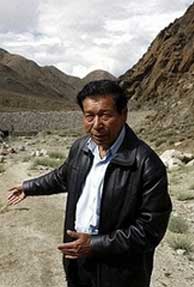
New Delhi: A retired Indian engineer, Chewang Norphel, 76, has built 12 new glaciers already and is racing to create five more before he dies, and by then he hopes to train enough new ‘icemen’ to continue the work he is doing to save the world’s ‘third icecap’ from being transformed into rivers, reports Telegraph.

His race against time is shared by Manmohan Singh, the Indian Prime Minister, who called on the region’s Himalayan nations, including China, Pakistan, Nepal and Bhutan, to constitute a united front to tackle glacial melting.

The Himalayan glaciers, including Kashmir’s Siachen glacier, feed the region’s most important rivers, as they irrigate farm lands in Tibet, Nepal and Bangladesh and throughout the Indian subcontinent. The acceleration in glacial melting has been blamed as the reason for the increase in floods that have destroyed homes and crops.

But Chewang Norphel, the “Iceman of Ladakh”, believes that he has an answer.

By diverting melt water through a network of pipes into artificial lakes in the shaded side of mountain valleys, Norphel states that he has created new glaciers.

A dam or embankment is built to keep the water in, which freezes at night and remains frozen in the absence of direct sunlight. This water remains frozen until March, when the start of summer melts the new glacier and releases the water into the rivers downside.

His glaciers have been able to each store up to one million cubic feet of ice, which in turn can irrigate 200 hectares of farm land. This can make the difference between crop failure and a bumper crop of more than 1,000 tons of wheat for the farmers.

Norphel says that he has seen the effects of global warming on farmland as snows have become thinner on the ground and ice rivers have melted away.

His work has now been recognized by the Indian government, which has given him 16,000 pounds to build five new glaciers. But time is his enemy, he told The Hindustan Times. “I’m planning to train villagers with instruction CDs that I have made, so that I can pass on the knowledge before I die,” he said.

HINDU PATRON OF MUSLIM HERITAGE SITE

The 87-year-old Raja Valiyathampuran of  Kodungallur in Central Kerala is a descendant of King Cheraman Perumal, the first Indian to embrace Islam in the early 7th century. Talking to him is like talking with history. In the following interview taken by A U Asif  in Ernakulam, he dwells in detail upon his great early ancestor and the oldest mosque (above) of the sub-continent. He also asks North Indians to come to Kerala and see how people of different religions are living here for centuries in an atmosphere of harmony, fraternity and peace.

How do you take your great great grandfather Cheraman Perumal?

Cheraman Perumal was not only a king and my ancestor, but the first Indian to come into the fold of Islam. He was actually the person who gifted Islam and the first ever mosque to the Indian sub-continent. This happened much before the advents of Muhammad bin Qasim and Mahmood Ghaznavi. This shows that Islam didn’t come to India with the sword. 

Is it a fact?

As is well known in Kerala, on a moon-lit night the king while walking on the rooftop of his palace along with the queen saw the moon suddenly splitting into two halves. Later he came to know through the Arab traders that that a prophet called Muhammad had wrought a miracle on that fateful night and sundered the moon before a crowd of dazed spectators. Impressed by this new messenger of God in Arabia, the king set out for the holy land after dividing his kingdom and assigning various territories to local chieftains to ensure smooth governance. In Arabia he met the Prophet and embraced Islam in the presence of Abu Bakr Siddique, who later became the first caliph. Cheraman, who took a Muslim name, Tajuddin, died on his way back to India and was buried on the shore of the Arabian Sea at Salala in the Sultanate of Oman. It is said that he had earlier written letters to the local rulers of Malabar and sent it through his ministers along with Malik bin Dinar, a companion of the Prophet. In the letters he had asked them to “receive the bearers of the letters and treat them well and help them to construct mosques at Kodungallur and elsewhere”. The rulers of Kerala honoured the letters and permitted Malik Bin Dinar and his fellow Arab traders to build mosques in Kerala. The mosque built in the early 7th century at Kodungallur, known as Cheraman Malik Masjid, still exists with its original structure and is said to be the oldest mosque in the sub-continent. It is named after both Cheraman Perumal and Malik bin Dinar. 

Is the mosque intact with its original structure?

Yes, the original structure, including the sanctum sanctorum, remains intact. However, there have been a few extensions in the past. Its front portion is new while the back portion with its sanctum sanctorum, mehrab, mimbar  (pulpit), wooden work on the roof of mimbar  and traditional lamp as well as the ancient ceremonial pond, is still untouched.     

Anything more about Malik bin Dinar?

After the construction of the mosque at Kodungallur, Malik bin Dinar moved towards Mangalore and died at Kasaragod, now in Karnataka, where rests in peace. Interestingly, Cheraman Perumal and Malik bin Dinar are buried on two sides of the Arabian Sea, one at Salala in the Sultanate of Oman and the other at Kasaragod in India. In other words, their graves are interlinked by the waters of the sea. There exist 14 mosques of the same pattern and design from Kodungallur to Mangalore. 

How do you see all this?

We see all this with pride. There is no question of any ill-feeling about Cheraman Perumal. We have high regard for him. He was our patriarch. He embraced Islam but could not come back from Arabia as he fell ill and died on way. I hail from his lineage and have faith in Hinduism. 

How do the general people, particularly Hindus consider Cheraman and his gift in form of the first ever mosque in the Indian sub-continent? 

People belonging to different religions, including Hindus, hold him in high esteem and the mosque built as per his wish as a historical monument. The historic mosque has been visited by numerous dignitaries over the centuries and decades.

President Dr A P J Abdul Kalam was recently here. He was given a warm reception in the mosque. I was also among those present on the occasion.

Unlike north India, there is no communal strife over places of worship in South India?

No, not at all. In this part of land exist India’s oldest places of worship. The first synagogue, the first church, the first mosque and the ancient Bhagwathi and Mahadeva temples are located in this region. We have maintained a record of exemplary communal harmony here. I often wonder about the sudden eruption of controversy over places of worship. Unlike north, people of all faiths have high regard for all places of worship. My suggestion is: People in the north should come to Kerala and see and learn how we belonging to different religions live here for centuries without any communal hatred, animosity and strife. g

[The interviewer is a Delhi-based senior journalist. He can be contacted at au_asif@yahoo.co.in]

Batla and post-Batla incidents in Azamgarh were planned years ago: rights activists

By Mumtaz Alam Falahi, TwoCircles.net,

On the first anniversary of Batla House encounter, two young Azamgarh human rights activists — from two different religions – recall the post-encounter incidents in their district. Neither Batla nor post-Batla incidents were accidents, rather the results of well-thought out politically motivated conspiracy hatched out years ago, Rajiv Yadav and Tariq Shafique tell Mumtaz Alam Falahi of TwoCircles.net

Was post-Batla incidents in Azamgarh were planned or just accident?

Rajiv Yadav: It was not an accident. It was a well-thought out politically motivated conspiracy hatched and execution of which began a year ago – coincidentally a year before the Lok Sabha elections. The post-Batla situation in Azamgarh and eastern UP was used by certain political parties. And this was not new. Gujarat and UP itself have witnessed such political conspiracies. Several encounters were staged in Gujarat just before elections. As all encounters were said to be carried out to save Narendra Modi, he got the dividends in elections. Same has happened in UP where many encounters took place in the name of protecting Mayawati. What happened in Azamgarh post-Batla was planned and being executed gradually for the last 10 years.

[youtube=http://www.youtube.com/watch?v=4m27Z7_CgWc&hl=en&fs=1&color1=0x2b405b&color2=0x6b8ab6&border=1]

Why conspiracy against Azamgarh Muslims?

Rajiv Yadav: In the last one decade or so, the standard of living of Muslims in Azamgarh rose up, and big houses and madrasas came up. This was because of the affluence brought to the district by local Muslims living abroad mainly in the Middle East (in thousands). The local Muslims’ affluence was projected as the direct fruit of terrorism in which they are alleged to be involved. Then Batla House was executed and scores of people, mostly young and educated, were picked or arrested from Azamgarh and outside. Azamgarh was presented as a hub of terrorism.

Political parties and media wanted to show that Muslims in India are not merely assisting terror outfits working from foreign land but also hatching and executing terror attacks in the country.

Post-Batla, how many people were arrested from Azamgarh in connection with terror cases?

Tariq Shafique: Of 18 persons only one was arrested from Azamgarh. All the 17 people have been arrested from some other districts – at railway station, outside railway station or sometimes in trains. Only Hakeem Tariq was arrested in 2007 in Azamgarh.

According to charge sheets, 11 people are missing. There is no information about them.

Are people still living in fear in Azamgarh or the situation has changed?

Tariq Shafique: There is very slight improvement in the situation in the district. People still fear while venturing out. They fear that they may be picked. I fear whether I would reach home.

Every year more than 10,000 students would go out of town to get higher education. Bu this year only about 2000-2500 could go out. They fear they may be picked. Another problem they are facing is that they are not getting accommodation as they belong to Azamgarh. They are facing the situation in Delhi, Mumbai, Bangalore and other cities.

About two dozen youths from Azamgarh are in jails facing multiple terror charges with charge sheets in several thousand pages and witnesses in hundreds. As human rights activist are you sure the cases will reach natural conclusion?

Tariq Shafique: We have no option but to hope for justice. What is disturbing is that these accused are being tortured and denied of basic human and civil rights even in jails. On the day of Eid this year, the Muslim inmates were beaten up in Jaipur jail and not allowed to offer Eid prayers. Similar atrocities were meted out to the prisoners in Sabarmati Jail in March 2009. They were also not allowed to offer Eid prayers. The jail authorities have also banned letters in Urdu.

How do you see the experiment of Ulema Council which got about 2.5 lakh votes in the last Lok Sabha elections?

Rajiv Yadav: Ulema Council was created by some other political party. While Peace Party was created in Trai region of UP, Ulema Council in Azamgarh region. And this is clear from the rise of Congress in these areas after several decades that these two are politically sponsored parties.

Tariq Shafique: Muslims had joined and supported Ulema Council not on political issues but actually they joined the movement on the Batla House encounter. Now the Ulema Council has wrapped up the movement and thus Muslims have gone away from it. Ulema Council got everything – money, fame, honor — from Batla House but Batla House victims got nothing from the Council. Today Batla House has become a secondary issue for the Council, and the murder of their man by Ramakant Yadav supporters has become the top issue.

When they started the movement a lot of people including rights activists had joined them but as soon as they went political, people went away from them. And media also started to ignore the Batla issue.

Azamgarh speaks: TCN special series.

Azamgarh speaks

A special TwoCircles.net series on Azamgarh

In recent month, Azamgarh has seen many journalists; and the world has seen many reports, coverage, and opinions on Azamgarh and its connection with terrorism. Mumtaz Alam Falahi of TwoCircles.net visited Azamgarh to let the area and its residents speak for themselves. In this special series on Azamgarh you will hear Hindus and Muslims, Young and Old, Students and Intellectuals speak their mind.

We are thankful to Kaleem Kawaja of Washington DC for sponsoring this series. Thanks to those in and around Azamgarh who let us speak to them and helped us in this series.

Stories:

Shadow of fear:
This MBA youth from Azamgarh fearing returning to Delhi
Sanjarpur still living in fear, hasn’t lost hope
A conspiracy to halt progress of Azamgarh Muslims: ex-SIMI chief
No Azamgarh Muslim is terrorist: local Hindus

Community:
No Azamgarh Muslim is terrorist: local Hindus
Hindu-Muslim relations in Azamgarh remain intact

Progress:
Where did Azmis working abroad spend their money?
Top doctors in Azamgarh are Muslims
Muslim girls in Azamgarh getting higher education, giving tough fight to boys

Opinion:
Batla House encounter: what do Azamgarh Muslim intellectuals say?

Photos:

Videos:

TwoCirclesTV: TCN YouTube channel

Timeline: Siege of Srebrenica

In the summer of 1995, two years after being designated a United Nations Safe Area, the Bosnian town of Srebrenica became the scene of the worst massacre in the Bosnian war.

This is an account of the critical days leading up to the killings.


6 – 8 July 1995: Bosnian Serb forces had laid siege to the Srebrenica enclave, where tens of thousands of civilians had taken refuge from earlier Serb offensives in north-eastern Bosnia.

Refugees flee Srebrenica

Survivors from Srebrenica fled to Muslim-held territory

They were under the protection of about 600 lightly armed Dutch infantry forces. Fuel was running out and no fresh food had been brought into the enclave since May.

Serb forces began shelling Srebrenica. Bosnian Muslim fighters in the town asked for the return of weapons they had surrendered to the peacekeepers but their request was refused.

The Dutch commander called UN Headquarters in Sarajevo asking for “close air support” after shells and rockets landed close to refugee centres and observation posts manned by peacekeepers.

9 July 1995: The Bosnian Serbs stepped up their shelling and thousands of refugees fled to the town from southern camps ahead of advancing Serbs, who attacked Dutch observation posts, taking about 30 soldiers hostage.

One peacekeeper was fatally wounded when Bosnian Muslims fired on retreating Dutch troops.

10 July 1995: Dutch Commander Colonel Karremans filed a request for UN air support after the Bosnian Serbs shelled Dutch positions. UN Commander General Janvier initially refused, but agreed after another request from the colonel. Serb attacks stopped before the planes arrived and strikes were postponed.

Some 4,000 refugees were in the town by the evening and there was panic on the streets. Large crowds were gathered around the Dutch positions.

The Dutch commander told town leaders that Nato planes would launch massive air attacks against the Serbs if they had not withdrawn from the safe area by 0600 the following morning.

11 July 1995: The Serb forces did not withdraw, but at 0900 Colonel Karremans received word from Sarajevo that his request for close air support had been submitted on the wrong form. At 1030, the re-submitted request reached General Janvier, but Nato planes had to return to base in Italy to refuel after being airborne since 0600.

By midday, more than 20,000 refugees – mostly women, children and the infirm – fled to the main Dutch base at Potocari.

At 1430, two Dutch F-16 fighters dropped two bombs on Serb positions surrounding Srebrenica. The Serbs responded with a threat to kill their Dutch hostages and shell refugees, causing the suspension of further strikes.

The Bosnian Serb commander Ratko Mladic entered Srebrenica two hours later, accompanied by Serb camera crews. In the evening, General Mladic summoned Colonel Karremans to a meeting at which he delivered an ultimatum that the Muslims must hand over their weapons to guarantee their lives.

12 July 1995: Buses arrived to take women and children to Muslim territory, while the Serbs begin separating out all men from age 12 to 77 for “interrogation for suspected war crimes”.

Ratko Mladic (left) drinks with Dutch Col Ton Karremans

Ratko Mladic (left) drank with Dutch Col Ton Karremans on 12 July

It is estimated that 23,000 women and children were deported in the next 30 hours. Hundreds of men were held in trucks and warehouses.

About 15,000 Bosnian Muslim fighters had attempted to escape from Srebrenica overnight and were shelled as they fled through the mountains.

13 July 1995: The first killings of unarmed Muslims took place in a warehouse in the nearby village of Kravica.

Peacekeepers handed over about 5,000 Muslims who had been sheltering at the Dutch base at Potocari. In return, the Bosnian Serbs released 14 Dutch peacekeepers who had been held at the Nova Kasaba base.

16 July 1995: Early reports of massacres emerged as the first survivors of the long march from Srebrenica began to arrive in Muslim-held territory.

Following negotiations between the UN and the Bosnian Serbs, the Dutch were at last permitted to leave Srebrenica, leaving behind weapons, food and medical supplies.

In the five days after Bosnian Serb forces overran Srebrenica, more than 7,000 Muslim men are thought to have been killed.

A Muslim-dominated colony in New Delhi waiting for roads, water for 25 yrs

By Mumtaz Alam Falahi, TwoCircles.net

New Delhi: If you are a stranger and airdropped in this locality, I
am sure you won’t even imagine that you are in the National Capital of
India. You will be more surprised when told that you are a few
kilometers from the Parliament House and Rashtrapati Bhawan and at
equal distance from the Delhi State Assembly House. You are in Kacchi
Khajuri, a Muslim-dominated colony in North-East Delhi. The government
is spending over Rs 800 crore on infrastructure for Commonwealth Games
2010, just a few kilometres from here, but this locality has been
waiting for road and drinking water for over a quarter century.
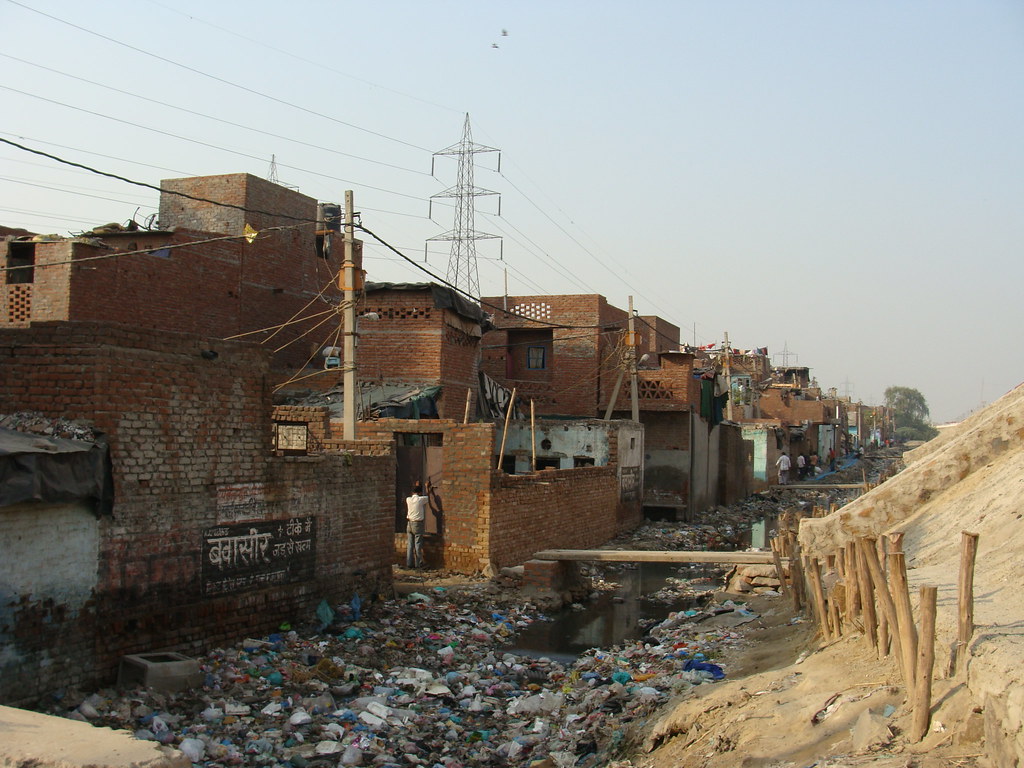
Kacchi Khajuri is a predominantly Muslim locality in New Delhi, but
like many other Muslim-dominated areas in the country, this too is
highly neglected in terms of civic amenities, drinking water, roads,
schools and hospitals.
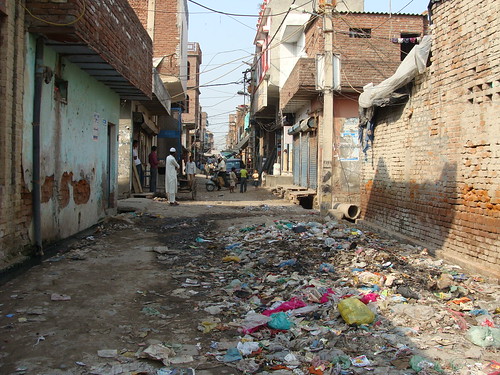
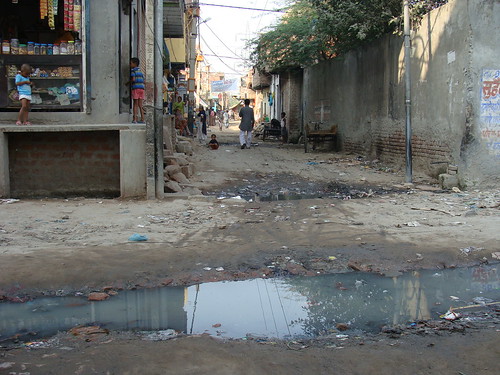
People started living here in 1983. Most of them came, and are still
coming, from Western Uttar Pradesh and Bihar. They are mostly from
labor classes or do small businesses. 25 years on, and they are living
without pucca roads and drinking water facility – electricity reached
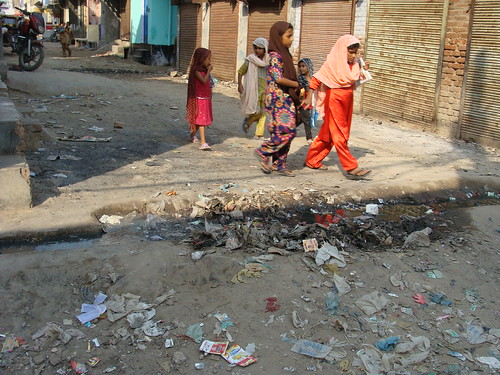
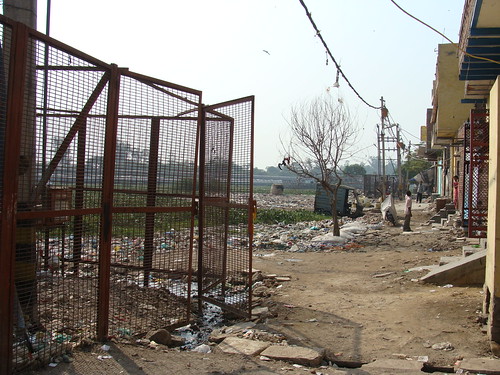
here very recently. With no roads, there is no drainage system, making
the area a big drain or pond of garbage in rainy season. Interestingly,
the Kacchi Khajuri area, now populated by about 80,000 people (80-90%
Muslims), is surrounded by deep long drain from one side and a pond
from other side, yet there is no proper drainage system connecting the
lanes and bylanes of the locality to the drain or pond.

“Labor class people are living here. Very few have their own
businesses. Illiteracy is rampant. Government has shown little interest
in this locality. Since the colony came into existence, there has been
no drinking water facility. There is no pucca road either. With no
drainage system, lanes and bylanes are littered with filth and garbage,
causing various diseases among the residents,” says Muhammad Abdullah,
Imam, Jama Masjid Tayyeba – the oldest mosque of the colony.
To keep an area clean is certainly the responsibility of a civic
body but how the residents as Muslims can shy away from their
responsibility to keep their homes and the bylanes clean by sparing an
area for garbage rather than letting a heap of garbage piling just in
front of their home.

The government here has just two things that it can claim to be its
own: a primary school – for an area of 80,000 population, denoting how
sincere the State is about education of the largest minority of the
country; and a police station, clearly exposing the mindset of the
government about the Muslim community — they need no road, no drinking
water, no ration shop and no hospital but they surely need a police
station.

Yes, besides road and water, Kacchi Khajuri has also no government
ration shop and no state-run dispensary or hospital. This is no
Bengali-speaking Muslim dominated area over which hovers a cloud of
suspicion about their being Indian citizens, and thus door of
development is shunted on such areas. They are Hindi-speaking people
from Bihar and Uttar Pradesh, genuinely Indian citizens beyond any
shred of doubt. They have extended families in their native states.
They have election IDs here and cast votes in elections to choose their
representatives, religiously. And yet, they are living as second-class
citizens.

[youtube=http://www.youtube.com/watch?v=ORVGFcW1ib8&hl=en&fs=1&color1=0x2b405b&color2=0x6b8ab6&border=1]

Economic conditions

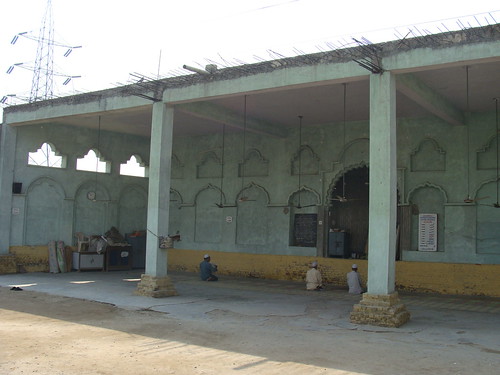
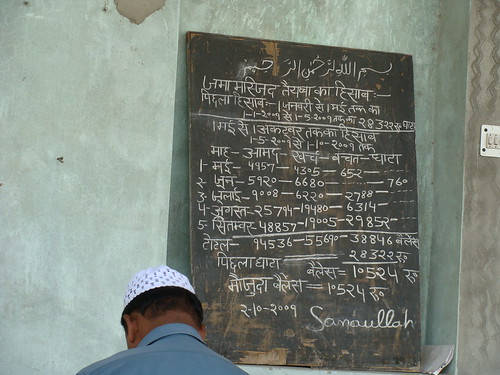
Muhammad Abdullah, Imam, Jama Masjid Tayyeba, has been leading
prayers in this mosque since 1992. He is paid about Rs 2000 per month
by the locals. The mosque, where Friday prayers are also held, is as
old as the colony. The mosque isn’t yet complete as it is half covered
by roof and the floor out of the roofed area is not even plastered. The
Imam is from Gorakhpur in UP.
Meet this boy from Darbhanga in Bihar. He has been living here with
his family for over one year. He sells cold water for Re-1 per glass,
and thus supports his family.

Muhammad Waris is from Bijnore in UP. He shifted here three years ago. He has six children. He works at a small printing shop.

This is the normal pattern of the socio-economic condition of this locality – either they are laborers or do small businesses.

Educational condition

Though poor, Waris wishes to give good education to his children but
fears he can’t. The area with about one lakh population has just one
primary school run by Municipal Corporation of Delhi, and no other
government school. So, people are forced to send their children to
private schools if they can afford, or just drop the idea to educate
their children.

[youtube=http://www.youtube.com/watch?v=dJWSNLe6p7M&hl=en&fs=1&color1=0x2b405b&color2=0x6b8ab6&border=1]

“I have four daughters. I want to educate them and make them big
people like Indira Gandhi, Sonia Gandhi and Mayawati, but I lack
resources. If I could have money I would educate them at good schools,
otherwise will drop the idea altogether to educate them,” says Waris.

This is Abdur Rahman from Bijnore. His family is here for over 10
years. The 17-year-old boy Abdur Rahman learns Arabic and Persian at
Jama Masjid Tayyeba where a temporary madrasa is run by the masjid
committee. He has completed 10th from open schooling system.

There are about 23 mosques in the colony but no formal madrasa or
community run school. Yes, some maktabs are being run in some mosques.

One reason for low education rate here is poverty. “People are
mostly laborers, and so need earning hands as early as possible and
thus very few send their children to school,” says the Imam. After
primary schooling, fewer send their children to high school or senior
secondary school that are in Pucci Khajuri, a Hindu-dominated area on
the other side of the Pushta Road that divides Khajuri Khas area into
Kacchi Khajuri and Pucci Khajuri.

A road that divides an area into two – one developed, another backward
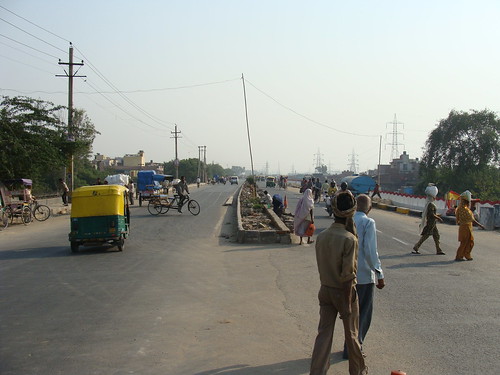
Kacchi Khajuri and Pucci Khajuri are part of Khajuri Khas area. The
Pushta Road linking Delhi with Uttar Pradesh divides Khajuri Khas into
two localities, not only geographically but also development-wise. The
Hindu-dominated Pucci Khajuri has all facilities including High
Schools. Boys from the dominating community of Gurjars in Pucci Khajuri
harass boys and girls from Kacchi Khajuri – the Muslim-dominated area.
And here lies the second reason why literacy is low in Kacchi Khajuri.

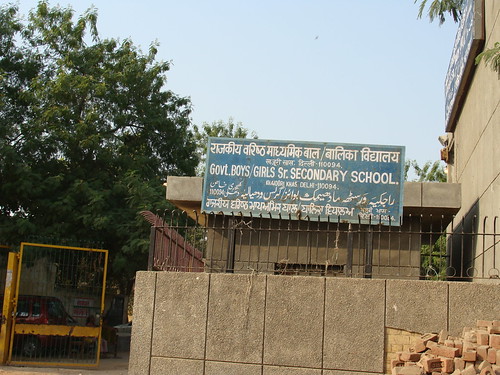
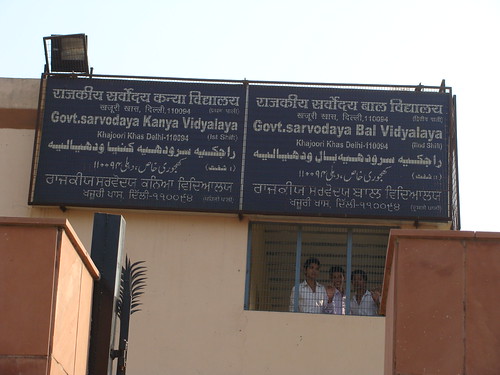
Pucci Khajuri has Government Boys and Girls Senior Secondary School.
It has Government Sarvodaya Boys and Girls School. A deadly stampede at
government senior secondary school on September 10 – in which five
girls (three Muslims) from Kacchi Khajuri area were killed and scores
others injured – has further alienated Kacchi Khajuri residents from
Pucci Khajuri. An independent fact-finding team has concluded that the
stampede was caused by sexual harassment of girls from Kacchi Khajuri
by the boys from Pucci Khajuri. Now the area of victims demands
upgradation of the lone government primary school into senior secondary
school, at least for girls, at this stage. Otherwise, many have made up
mind to withdraw their girls from the school.
On the surface there is no communal tension between the two
localities. However, one can feel anger and disappointment in residents
of Kacchi Khajuri.

The two colonies came into being almost at the same time but one,
dominated by Gurjars, got progress and development very fast while the
Muslim area was left to lurch. Besides schools, the Pucci Khajuri area
has drinking water facilities, government ration shop, a hospital and
pucca roads, leaving Kacchi Khajuri seething with anger. Their women
and children have to cross accident-prone Pushta Road to fetch drinking
water and ration from Pucci Khajuri. While Pucci Khajuri got status of
authorised colony long ago, Kacchi Khajuri got the same only recently.

The ward councilor of the area (Mr Ranbeer) is from Congress while
the MLA (Mr Mohan Singh Bisht) – who has more power and grants at his
command for developmental work in his area – is a BJP man. When people
of Kacchi Khajuri approach the BJP MLA he does not listen to them
saying they did not vote for him, say the residents. The area falls in
the Karawal Nagar Assembly segment in Northeast Delhi, a minority
concentration district, with a population of 17,63,712 (Census 2001).
The MP of this Lok Sabha constituency is Mr Jaiprakash Aggarwal, a
Congressman.

While the people of Kacchi Khajuri elect their representatives
regularly as a religious duty development has so far eluded them. They
don’t know how long this will go on.

[Photos: TwoCircles.net]

Slide show:

MUSLIM DOMINATED AREAS

THERE
IS NOTHING NEW IN THIS STORY. IT IS VERY OLD STORY BUT THE PLACES
CHANGE IN EVERY STORY BE IT OKHLA, KHAJURI, KHUREJI, SEEELAMPUR OR
MUSTAFABAD.
WHAT IS INTERESTING HERE IS THAT THERE IS A GOVERNMENT OF A SO CALLED
SECULAR PARTY FOR LAST 11 YEARS IN DELHI. THIS AREA WAS UNDER THE
CONSTITUENCY OF MR SANDEEP DIXIT(THE SON OF DELHI CM) FOR 5 YEARS. NOW
ANY ONE CAN SEE THEIR TRUE FACES. MASKS SLIP QUITE OFTEN BUT WE MUSLIMS
BEHAVE IN A VERY INDIFFERENT WAY, AS IF WE ARE NOT AFFECTED BY IT. BJP
MLA IS SOME WHAT JUSTIFIED BECAUSE IT IS A KNOWN FACT THAT WE NOT ONLY
VOTE FOR CONGRESS( OF WHICH WE ARE BONDED SLAVES) BUT WE VOTE IN A WAY
TO ENSURE THE DEFEAT OF BJP. OUR MAIN AIM BECOMES TO DEFEAT BJP AND
CONGRESS IS UTILISING IT AS A TOOL AGAINST US. WHAT ARE THE CONG
COUNSELLAR AND MP FROM THAT AREA DOING?
IS IT NOT A FACT THAT CONGRESS GOVT TOTALLY BYPASSED OKHLA N JAMIA
MILLIA ISLAMIA(A CENTRAL UNIVERSITY) WHEN THEY WERE PLANNING METRO
ROUTES. METRO IS PASSING THROUGH WHOLE OF DELHI, EVEN IN FAR FLUNG
AREAS LIKE DWARKA, EVERY SECTOR OF ROHINI BUT NOT IN DARYAGANJ OR
OKHLA. WE HAVE CLOSED OUR EYES. THERE IS NO ONE TO RAISE THE VOICE.
THEY ARE DOING WHAT IS GOOD FOR THEM AND GIVING US LOLLYPOPS. THEY ARE
PLANNING IN A WAY SO AS TO GIVE MUSLIMS MINIMUM BENEFIT.
BROTHERS PLEASE AWAKE BEFORE ITS TOO LATE!!!!!!

KAchi KAhjuri

While
those pictures were bad; it points to one thing. Why cannot we
ourselves keep our streets clean? There were newspapers, plastics,
garbage all around– agreed government does not care; do we care? Could
not people collectively take responsibility for maintaining a clean
street? That trash be dumped in one place, that people take turns to
dump them in remote city designated places etc etc.

If we decide to live in filth; we are only responsible for that!

You are right..

Mr. Shoeb, You are right.
We (the people) only want govt to spoon feed us and also wash our
backs. I said ‘we’ because everyone is one way or other responsible –
either we do not have time, do not care, love the filth to live in,
expect govt to take care, expect some NGO to take care. There are
always some people who with their tunnel vision sit in comfy location
throw filth (worst than the one seen here) from their mouth against the
govt not taking care and how country is going to dogs.

Education is most important in such cases. If the people were
educated about cleanliness, they wouldn’t have seen so much filth. We
don’t have to be sympathetic with the people, saying oh those are so
poor and no funds from govt, how can they take care..? type of attitude.

I would recommend one thing. Lets make it compulsory for the kids
in high schools to go to hose localities and educate the public about
the health problems. The children can become good leaders at the
sametime imparting education.

Similar stories

Similar
stories every where. Many times I struggle to keep my strict national
instinct fighting it out with the sensitive Muslim in me as to creation
of Pakistan was atleast emancipation of few. Atleast the discrimination
of poor or rich is the only reason everywhere in India but here the
communcal discrimination too is applicable.
There would be many Muslims who are ready to counter my contention
because of the unrest in Pakistan. This unrest again is assigned to
lack of democracy and religion. But the fact is not so because here in
out country we find that we too have our have-nots who are dismissed as
Moist and of no-consequence because they are poor. Mind it how much
nuisance they create will determine whether they are consequential or
not. Already a few killings of officials made them ‘terrorist’ despite
not being Muslims while the State terrorism of keeping agigators as
non-tried ala ‘enemy combatatnt’ of Gitmo. Have we forgotten that the
enemy combatants were alien to the US of A but these people are our
own. The double whammy is that they are not he famous whipping boys,
Muslims, not has India been ruled by Military even for a single
‘second’.
No amount of progress by India or Pakistan will solve these problems.
Dismissing all problems of Pakistan as being ‘Islamic’ or Indian one
being of Muslims or Leftist does not make South Asia any safer. To
those who have kept my first few sentences in mind, might ask me to
leave for Pakistan, but they are in for a shock, shock of their life,
that people like me are not to leave our place, not even after we are
no more, because we have taken on ourselves, the task of setting things
right. If there is shedding of blood in our land, we’ll try to lessen
it. Even if one official or a moist or a Muslim or a Hindu is saved, it
would be our gain. By arithmatics is not x-1
Long live India!!

Rise of the Turkish crescent


Erdogan said Turks supported his decision to cancel military exercises with Israel [REUTERS]

Since the Israeli war on Gaza last January, Turkey’s role in Middle Eastern politics has become significantly more prominenft.

When Recep Tayyip Erdogan’s
Justice and Development (AK) Party took office in 2002, it pledged that
it would not forsake its historic, religious and cultural bonds with
other Muslim countries.

During the Gaza conflict, the
party made good on its promise. Turkey’s government did not hesitate to
voice its displeasure at Israel’s military actions, which it said were
targeting the civilian population of Gaza. 

Last week, the Turkish government demonstrated its loyalties again, banning Israeli warplanes from participating in an international military air exercise. 

The Anatolia Eagle exercise has been held since 2001 under the auspices of a Turkish-Israeli military agreement signed in 1996. The war-game usually
involves Turkish, Israeli and US troops, and has been seen by Israel as
a golden opportunity for its pilots to practise over
a much larger air-space than usual.  

The Turkish decision raised
eyebrows in Israel, where Turkey has long been seen as an ally, and has
prompted concerns about future relations between the two countries.

“It raises the question: What
direction is Turkish policy taking?” wondered Binyamin Netanyahu, the
Israeli prime minister, after Turkey’s decision was made public. 

Revived role 

Turks have traditionally supported the Palestinians’ right to their homeland

Observers believe that Turkey’s new attitude toward Israel is part
of a plan to revive the role it believes it should play as the leader
and guardian of the Muslim World.

“The new Turkish policy is interesting, in terms of trying to regain
its ties with the Arab and Muslim world,” said Mounzer Sleiman, the
director of the Centre for American and Arab Studies.

“It is not the first Turkish
government that has tried to do this, but the aspiration to join the EU
was an obstacle. This government realises that the road to the EU is
rough and complicated, so it chose to go with its strategic plans in
its Muslim environment instead of waiting indefinitely.”

Turkey also believes it is
traditionally and historically linked to the rest of the Middle East –
the Turkish Ottoman Empire ruled large parts of Asia, Africa, and
Europe for almost five centuries, until its defeat in the first world
war.

The new policy, aimed at placing
Ankara at the centre of the Middle East’s geopolitics and
regaining Turkey’s former power and influence over the region, makes
conscious reference to the country’s imperial past. The trend is even
known as Neo-Ottoman, a term coined by Ahmet Davutoglu, the Turkish
foreign minister and architect of the policy. 

It is a popular approach.
Erdogan says that the decision to exclude Israel from the Anatolia
Eagle drill was based on Turkish public opinion.

“Anyone who exercises political
power has to take account of public opinion … It is a question of
sincerity… I want people to know that Turkey is a powerful country
which takes its own decisions,” he said. “We do not take orders from
anyone.”

Erdogan believes that the
Turkish people back his goals to use the country as a
counter-weight in relations between Israel, the West and the Muslim
World. This viewpoint is shared by many observers.  

“Anyone
who looks at the Turkish press and listens to people in the street
would realise how much the Turkish public opinion is in support of the
government’s new approach toward Israel,” says Yousef al-Sharif, Al Jazeera’s correspondent in Turkey.
  

“Also, the nature of the current Israeli government, which
consists of conservative figures like Netanyahu and [foreign minister
Avigdor] Lieberman, makes it easier for Erdogan to take such a tough
approach against Israel.”

History matters

Since it took office,
Erdogan’s government has been keen to show that Israel is no
longer the only serious power in the region. During the Palestinian intifada uprising in 2000,
Turkey condemned Israel’s use of force and cancelled a proposed water deal wi
th Tel Aviv.

By the end of 2008, the neo-Ottoman doctrine was more advanced. When Tel Aviv launched a war on Gaza in late December 2008, Erdogan squarely blamed the Israelis.

But he also invoked the shared
history of Jews and Turks to make his point: “We are speaking as the
grandsons of Ottomans who treated your ancestors [Jews] as guests in
this land [Turkey] when they were expelled from Europe,” he said.

But such references will also remind Israel that the
cash-strapped Ottoman Empire turned down an offer by the Zionist leader
Theodor Herzl to cede Jerusalem to the Jews in return for huge loans
and a personal reward for Sultan Abd al-Hamid II (1842-1918).

Erdogan’s coded historical message was clear: Turkish policy towards
the Middle East is no longer led by political expedience, but by
principle.

Regional mediator?

Erdogan, left, convinced Bashar al-Assad, the Syrian president, to resume Israel talks [AFP]

Until recently, political analysts and observers characterised the
relationship between Turkey and Israel as one based on mutual interests.

Israel needed a strong regional Muslim ally, and Turkey needed the
Jewish lobby in the US to prevent Greek and
Armenian groups from securing a congressional condemnation against
Turkey for its alleged role in the deaths of more than a million
Armenians in the early 20th century.

Some observers, however, now believe that Erdogan’s current
Middle East approach could jeopardise the delicate balance of power in
the region.

Elter Turkmen, a former Turkish foreign minister, warned earlier
this year that the short-term benefits may be outweighed by the
long-term disadvantages. “I do not think Turkish-Israeli relations
would reach the point of clash,” he said. 

“Both sides will lose, Israel will lose a reliable partner and Turkey would lose the backing of Jewish lobby in Washington.”

Still, others question whether Turkey still needs the US Jewish lobby.

Turkey and Armenia signed a landmark peace accord earlier this
month, pledging to restore ties and open their shared border after a
century of hostility stemming from what Armenians said was the mass
killing of their people by Ottoman forces during the first world war.

Some believe that Israel and the US will nevertheless continue to
need Turkish help in brokering indirect talks between Israel and
Syria, widely seen as a crucial but difficult step in the Middle East
peace process. 

In June 2008, and after years of diplomatic effort, Turkey succeeded
in kick-starting indirect Syrian–Israeli talks. In Iraq, Turkey
maintained balanced relationships with almost all Iraqi factions. The
culmination of that successful policy was the visit of Muqtada al-Sadr,
the Iraqi Shia leader of the al-Mahdi Army, in May 2009.

Turkey also played a pivotal role in brokering a strategic deal
between al-Sadr, the Iraqi government, the UK and the US. Al-Mahdi
Army militias laid down their arms and released US and British hostages
they had been holding since 2007.

In return, the Iraqi government stopped the arrest campaign against
the al-Mahdi Army and released some of its jailed leaders such as Abd
al-Hadi al-Darraji, in 2009.

Middle East powerhouse

Bashir Nafie, a Palestinian historian specialising in Turkish
politics, believes that Ankara is adopting a multi-directional policy,
simultaneously resolving conflicts directly linked to its history
(rapprochement with Armenia and resolving its Kurdish problem), and
tackling the tensions in the greater region.

He said: “Turkey has realised that its future [is] not only with the
EU, but more importantly with its Arab, Muslim and Caucasian
neighbours. It also realises that Western arrangements imposed after
the first world war are the core of many problems the region is
suffering, and it is willing to solve the problems of that heavy
heritage.”

Hasan Koni, a former adviser to the Turkish
National Security Council, agrees that Turkey is likely to play an
increasingly important role in Middle Eastern politics in coming years. 
 
“Given
the fact that there are no more neo-cons in the White House, and that
the new US administration is attempting to get out of Iraq, the US will
need Turkey to stand against Iran in Iraq and the Middle East in
general,” he says. 

“Turkey is qualified to play that role since it is a Muslim state that maintains ties with both Israelis and Arabs.”


 Source: AlJazeera and agencies

Goldstone dares US on Gaza report


The war left about 1,400 Palestinians dead and prompted a UN-led investigation [File: EPA]

Richard
Goldstone, the jurist who authored a UN report accusing Israel of war
crimes and crimes against humanity during its war on Gaza, has
challenged the US to justify its claims that his findings are flawed
and biased.
 
Goldstone told Al Jazeera on Thursday that he had
not heard from the administration of Barack Obama, the US
president, about the flaws Washington claims to have identified in the
report.


“I
have yet to hear from the Obama administration what the flaws in the
report that they have identified are. I would be happy to respond to
them, if and when I know what they are,” Goldstone said.

“The
Obama administration joined our recommendation calling for full and
good-faith investigations, both in Israel and in Gaza [by Hamas], but
said that the report was flawed.”

‘Personal attack’

Goldstone said the attacks on him had become personal and that he believed most critics had not even read the report.

“I’ve no doubt, many of the critics – the overwhelmingly majority of critics – have not read the report,” he said.

In video

Interview with Al Jazeera

“And, you know, what proves that, I think, is that the level of criticism does not go to the substance of the report.

“There
still have not been responses to the really serious allegations that
are made. People generally don’t like to be accused of criminal
activity.

“So it didn’t surprise me that there was criticism, even strong criticism, and it has come from both sides.”

Goldstone said he regretted the “extremes from which some of the criticism has come and the fact that it has been so personal”.

The remarks follow US criticism of the report, which it says is one-sided.

The US was among countries which voted against a UN human rights
council resolution on the report passed in Geneva by 25 votes to six
with 11 countries abstaining.

Palestinian support

But other UN diplomats have vowed to support Goldstone.

Riyad Mansour, the Palestinian ambassador to the UN, has said that
he expects the Goldstone Report to be given serious consideration at
the UN Security Council.

“We know that there are certain members in the Security Council that
prefer that the [UN] council on human rights and the [UN] General
Assembly deal with this issue [and] not the Security Council. But we
will not take “no” from anyone.

“We will contact all members of the Security Council and we expect
the Security Council to shoulder its responsibilities with regard to
the implementation of the recommendations in the report addressed to
the Security Council.”

The Goldstone report also accuses Hamas, the Palestinian faction
in control of Gaza, of war crime violations, but it reserved most of
its criticism for Israel.

Israel’s three-week offensive on Gaza between last December and
January killed about 1,400 Palestinians, a majority of them women and
children, and 13 Israelis.

Israel said it attacked the coastal territory to stop Hamas fighters firing rockets into southern Israel.

 Source: Al Jazeera

Israel cutting Palestinian water

Amnesty said the water situation in the
Gaza Strip has reached a “crisis point”
 

Israel
is denying Palestinians adequate access to clean, safe water while
allowing almost unlimited supplies to Israeli settlers in the occupied
West Bank, human rights group Amnesty International has said.

“Swimming pools, well-watered lawns and large irrigated farms in
Israeli settlements… stand in stark contrast next to Palestinian
villages whose inhabitants struggle even to meet their domestic water
needs,” the group said in a report released on Tuesday.


Amnesty
said between 180,000 and 200,000 Palestinians in West Bank rural
communities have no access to running water, while taps in other areas
often run dry.

“Israel allows the Palestinians access to only a fraction of the
shared water resources, which lie mostly in the occupied West Bank”,
Donatella Rovera, an Amnesty researcher, said.

Israel’s
daily water consumption per capita is four times higher than the 70
litre per person consumed in the West Bank and the Gaza Strip,
according to the report entitled: Troubled waters – Palestinians denied fair access to water

Shortages

Israel, which itself faces unprecedented water shortages, controls
much of the West Bank’s supplies, pumping from the so-called Mountain
Aquifer that bridges Israel and the territory.

in depth


Amnesty report: Troubled Waters (PDF)

Video: Water crisis sickens Gazans

  Focus: Limiting a Palestinian state
  Video: The settlements issue
  Video: Jerusalem remains obstacle
  Video: Debating Israeli settlements
  Analysis: US shifting stance on settlements
  Timeline: 1967 Arab-Israeli war

Al Jazeera is not responsible for the content of external websites

The Amnesty report said Israel uses more than 80 per cent of water
drawn from the aquifer and while Israel has other water sources, the
aquifer is the West Bank’s only supply of water.

In the Gaza Strip, several repair works were under way to improve sanitation before the Israeli blockade was imposed in 2007.

But the projects have been on hold under the siege, as Israel is preventing repair materials from coming into the Strip.

Adding to an already dire situation, Israel’s war on Gaza early this
year left water reservoirs, wells, sewage networks and pumping stations
severely damaged.

The Amnesty report said Gaza’s coastal aquifer, its sole fresh water
resource, has been polluted by infiltration of seawater and raw sewage
and degraded by over-extraction.

The water situation in Gaza had now reached a “crisis point,” with
90 to 95 per cent of the water supply contaminated and unfit for human
consumption, Rovera said.

Israel’s water authority called the report “biased and incorrect, at
the very least” and said that while there is a water gap, it is not
nearly as big as presented by Amnesty.

The authority said Israel had met its obligations under the Oslo
peace agreement but said the Palestinian authorities had failed to meet
their own requirements to recycle water and were not distributing water
efficiently.

 Source: Agencies

‘s nuclear support

Ahmadinejad, left, thanked Erdogan, right, for his support on Iran’s nuclear programme [EPA

Mahmoud
Ahmadinejad, Iran’s president, has said that he “appreciates” the
support shown by Recep Tayyip Erdogan, Turkey’s prime minister, over
Tehran’s nuclear programme.

Erdogan, who arrived in Tehran for
bilateral talks on Tuesday, has accused Western nations of hypocrisy in
criticising Iran’s uranium enrichment programme while remaining silent
on Israel, which is believed to have an undeclared nuclear arsenal.


Ahmadinejad
told Erdogan: “When an illicit regime possesses nuclear arms, one can
not talk about depriving other nations from the peaceful nuclear
programme.

“Your clear stance towards the Zionist regime had a positive effect
in the world, especially the Islamic world, and I am sure that everyone
was satisfied,” he said, according to the Iranian presidential website

‘Peaceful’ programme

Erdogan
had told journalists travelling with him to Iran that the country’s
nuclear programme, which Western nations say could be a cover for
building weapons,
“is an energy project with peaceful, humanitarian purposes”.

“If
their [Iran’s] positive attitude is answered with a positive attitude,
this will bring forward the process in the positive direction”

Recep Tayyip Erdogan,
Turkey’s prime minister

He said talks between Tehran and world
powers in Geneva on October 1 showed that it “can work with” the United
States and Russia on uranium enrichment. 

“If their positive
attitude is answered with a positive attitude, this will bring forward
the process in the positive direction,” Erdogan said.

His latest remarks came after an interview in Britain’s The Guardian newspaper in which he accused Western powers of treating Iran unfairly and referred to Ahmadinejad as a “friend”.

Ties between Israel and Turkey have deteriorated since the December-January war on Gaza.

Ankara had previously attempted to mediate relations between Israel
and other Middle Eastern nations, but earlier this month, Turkey banned
Israel from an international air exercise because of the Gaza conflict. 

Gas ‘co-operation’

The
Turkish prime minister has brought a 200-member delegation, comprising
ministers, members of parliament and business leaders, to Iran to
discuss a wide range of bilateral, regional and international issues.

Isna, the Iranian students news agency, said that Ahmadinejad had
told Erdogan there were no limitations to Iranian-Turkish co-operation.

Taner
Yildiz, Turkey’s energy minister, said that one of the areas in which
the two neighbours would work together was gas exploration.

He
said that Turkey would start exploration work at Iran’s South Pars gas
field next month as part of a project to sell gas to Europe, the
state-run Anatolian news agency reported.

“Turkish Petroleum
will be exploring in the South Pars Field … The work will have
started by the first or second week of November,” Yildiz said.

It
was not immediately clear whether the gas would go through the planned
$11.76bn European Union-backed Nabucco pipeline, which was agreed with
ankara in July.

Erdogan on Tuesday said he supported Iran’s presence in the Nabucco
project and added: “I believe that sooner or later, the project will
understand the importance of Iran’s participation”.

Iranian-Turkish trade stands at around $12bn a year and the two nations are seeking to expand it to $20bn in the next two years.

Erdogan is
also expected to hold talks with Ayatollah Ali Khamenei, Iran’s supreme
leader and Ali Larijani, the parliamentary speaker during, his visit.

 Source: Agencies