Peace Homes Aluva

Simplify Building Your Dream Home

Archives 2009

Mothers Day Heroine

Rola Awwad
Town: Wayne
Children: Adam, 10; Amana, 7; Miriam, 3
Occupation: Stay-at-home mom; Arabic teacher

Rola
Awwad wasn’t angry at first. Her son Adam’s elementary school in Wayne
had denied requests for the Muslim fifth-grader to pray in a private
room during school, citing safety concerns.

But
then Awwad learned from chatting with a woman at her mosque that the
Constitution protected the right to practice religion and that children
in nearby public schools had been praying in school for decades without
incident.

“I
never knew he had the right to pray, as long as it’s not interfering
with education and others,” said Awwad, a Palestinian raised in Jordan.

Awwad
sprung into action, pressing the school district to allow her son to
perform the obligatory afternoon prayer in a quiet, private space, such
as the library or the principal’s office. The Council on American
Islamic Relations, a Muslim civil rights group, intervened on Awwad’s
behalf and a compromise was reached in February. Adam was growing weary
of the public attention surrounding the case. Adam agreed to pray
during recess, while other children played nearby, either outdoors or
in the back of the classroom.

“This
was a lesson for my son not to give up on your rights. Be proud you are
a Muslim and to be proud you’re an American and born here,” she said on
a recent afternoon in her Wayne living room. Relenting on the issue for
now, she still worries about her son praying outside during recess when
it’s cold or rainy or when he enters middle school next year, when his
peers may be more apt to bully him.

Awwad
says she’s more outspoken than her husband, an engineering professor.
Her first foray into community activism was as a graduate student in
Jordan. She and a group of women built a social services center that
was controversial in the community. On a trip home, she brought her
kids to the site. “I wanted them to see it,” she said.

As
the clock struck 4, a recording of the afternoon call to prayer floated
from her kitchen while the children played in their rooms upstairs.
Awwad explained that she is intent on raising her kids with strong
Muslim values.

“I
want my kids to have a relationship with God,” said Awwad. “That will
protect them, and they will grow up to be good citizens,” she said.

ETHICAL INVESTMENT = SHARIAH COMPLIANCE

ISLAM & FINANCE FROM MY PERSPECTIVE: ETHICAL INVESTMENT = SHARIAH COMPLIANCE

Friday, May 8, 2009
ETHICAL INVESTMENT = SHARIAH COMPLIANCE

The notion of ethical investing goes back at least to 1758, when the Quakers banned profiting from the slave trade. But the market for ethical investments has always remained a niche. The goals of maximizing profit and fulfilling a moral agenda conflict more often than they complement one another, and investors who want to put ethics first have turned out to be relatively few.

Finance that complies with Shariah, is still a niche within the ethical investing niche. In all, there are at least $500bn worth of Islamic finance assets worldwide and Islamic banking has expanded by more than 10% annually over the past decade, according to Standard & Poor’s. It’s grabbing the attention of some of the biggest banks in the world and changing how they do business.

So just what does Shariah-compliant banking entail? Some of it is simply prohibiting things seen as immoral. Investing in casinos, pornography and weapons of mass destruction is out.

The animating religious goal behind other restrictions is to achieve greater social justice by sharing risk and reward. Islamic finance bans people from selling what they don’t own, which rules out short selling, and from engaging in contracts deemed to have excessive uncertainty on either side. That rules out traditional insurance, so Islamic banks have instead developed takaful, in which a group of people pool risk.

The Shariah stipulation banning interest, though, is the one that poses the most problems for modern finance.

To be sure, from the Bible to Buddhism, most of the world’s faiths have issued warnings against usury, and theologians through the ages have debated the line between permissible and excessive interest rates. But ultimately, in the West, governments and religious authorities deemed some amount of interest permissible.

Not so in Islam, in which most scholars deem fixed-interest payments forbidden. So, for example, the sukuk issuer does not sell a debt, as a traditional bond issuer would, but rather sells a portion of an asset, on which the buyer is then entitled to receive rent. Likewise, rather than take out an interest-bearing loan, a business in need of financing might enter a musharaka, a partnership with profit-and-loss sharing.

Why the growth in Islamic finance now? After all, Islam’s rules have been around since the seventh century, and some Muslim countries have been rich since the discovery of oil.

One important factor has been the recent rise in religiosity in Muslim countries especially, after the terrorist attacks of September 11, 2001. With the US-led invasions of Afghanistan and Iraq, there was a feeling in many countries that Islam was a religion under siege.

Some observers date the rise in religious observance back even further, to the 1980s, when guest workers in Saudi Arabia from across the Muslim world began returning to their own countries, re-importing with them the strict Wahhabi subsect of Islam for which the desert kingdom is known.

Whenever this burgeoning religious observance began there is now an increasing appetite for Shariah finance. In some cases, Middle Eastern governments have embraced Islamic banking to advertise their religious chops.

Some of the growth in Islamic finance has also been due to clever positioning by Malaysia. After September 11, US authorities froze the bank accounts of several prominent Saudis, which triggered other wealthy Arabs to withdraw their funds from the United States.

Ultimately, some $200bn left the US. Many of the investors were from tiny Gulf states whose economies were too small to absorb their funds, and so they looked to Malaysia, a Muslim country with a relatively sophisticated financial system. It issued the first sovereign sukuk in 2002, and made a point of appointing Shariah scholars from the Gulf to monitor compliance.

Today, Kuala Lumpur rivals traditional hubs like Dubai and Bahrain as a global centre of Islamic finance.

In the end, the maths behind the growth of Islamic banking may be pretty simple: There are 1.3 billion Muslims in the world – roughly a fifth of the world’s population. Some live in quickly developing economies, some sit on vast oil wealth and some are newly middle-class Americans and Europeans.

No one can say for sure how many will seek out banking that complies with Shariah, but even a small fraction of 1.3 billion is a market no one wants to ignore.

Posted by SWEET CHILD at 11:52 AM

” to Britain

Poll: Brit Muslims more ‘loyal’ to Britain – UPI.com

Poll: Brit Muslims more ‘loyal’ to Britain
Published: May 8, 2009 at 7:57 PM

LONDON, May 8 (UPI) — A survey suggests 77 percent of British Muslims describe themselves as loyal to the country, compared to only 36 percent of the general public.

The survey, conducted by Gallup and the Coexist Foundation, suggests British Muslims are more likely than the general public to have high opinions of British elections, courts, media and financial bodies, The Times of London reported Friday.

“Since 9/11 and the terrorist attacks in Madrid and London, mistrust towards European Muslims has become palpable. Significant segments of European societies openly express doubt that Muslim fellow nationals are loyal citizens,” the report’s authors wrote. “The general construct of this premise rests on an oversimplified and erroneous understanding of Islam and terrorism.”

The poll involved 1,000 telephone interviews and 500 face-to-face interviews with Muslims living in areas with high Islamic populations.

UN blames Israel for Gaza attacks

UN blames Israel for Gaza attacks

More than 1,400 Palestinians were killed in
Israel’s month-long assault on Gaza [EPA]

A United Nations inquiry into the war in Gaza has found that Israel was to blame for at least seven direct attacks on UN operations – including schools and medical centres.

The UN report, commissioned by Ban Ki-moon, the UN secretary-general, said the Israeli military intentionally fired at UN facilities and civilians hiding in them during the war and used disproportionate force.

Missiles, bombs and small arms were all used by Israel against the UN – leading to dozens of deaths.

The UN’s own fuel and aid depot in Gaza was hit with Israeli artillery shells causing widespread damage.

The attack continued for two hours after the UN asked the Israeli military for it to stop.

‘Negligence and recklessness’

Report reaction


 Palestinian politician Mustafa Barghouti
 Israeli spokesman Mark Regev
 UN rapporteur Richard Falk

The report’s summary accused the Israeli army of “varying degrees of negligence or recklessness with regard to United Nations premises and to the safety of UN staff and other civilians within those premises, with consequent deaths, injuries and extensive physical damage and loss of property.”

Ban said at a news conference on Tuesday that the aim of the report, which is not legally binding, was to establish “a clear record of the facts” surrounding incidents involving UN premises and personnel.

A total of 53 installations used by the United Nations Relief and Works agency (UNRWA) were damaged or destroyed during Israel’s Gaza campaign, including 37 schools – six of which were being used as emergency shelters – six health centres, and two warehouses, the UN agency said.

In video


 Ban denies downplaying Gaza report
 Revisiting Gaza attacks

Al Jazeera’s Kristen Saloomey in New York said the UN secretary-general was still determining the UN’s course of action over the report’s 11 recommendations.

The report said the UN would seek reparations for damages from Israel and meet the Israeli government.

Shimon Peres, the Israeli president, told Al Jazeera that the report was “one-sided” and that he hoped Ban would take into account Israel’s response to it.

Israel’s army concluded its own report into the three-week war on Gaza in late April, finding that Israel followed international law and that while errors occurred they were “unavoidable”.

Notorious incident

The report found that in seven out of the nine incidents involving UN premises or operations that it investigated, “the death, injuries and damage involved were caused by military actions … by the IDF [Israeli army]”.

The UN has called for an impartial inquiry into alleged crimes during the war [AFP]

It also said one of the incidents, when a World Food Programme warehouse in the Karni industrial zone in Gaza was damaged, was largely caused by a rocket “most likely” fired by Hamas or another Palestinian faction and condemned those responsible for using such “indiscriminate weapons” to cause deaths and injuries.

The investigation included one of the most notorious incidents in the war, when up to 40 people are believed to have died at a UN school in Jabaliya after Israeli mortar shells struck the area.

The UN initially said the shells had hit the school but later retracted the claim, while Israel initially said its forces were responding to firing from within the school, but also later reportedly withdrew the statement, although the UN report noted the claim still appeared on the Israeli foreign ministry’s website as of Tuesday.

The report also recommended that because there had been “many incidents” during the war involving civilian victims, an impartial inquiry should be mandated “to investigate allegations of violations of international law in Gaza and southern Israel by the IDF [Israeli army] and by Ha
mas and other Palestinian militants”.

Israel’s 22-day war on Gaza left more than 1,400 Palestinians dead, including around 400 children, Gaza health officials said, along with 13 Israelis.

Much of the coastal territory was also left in ruins.

Report ‘flawed’

In depth


Analysis and features from after the war

Mark Regev, an Israeli government spokesman, told Al Jazeera that the report was “fundamentally flawed” and contained “methodological problems are so deep that everyone has to ask on what basis they make these criticisms”.

“Evidence shows one thing and the UN report clearly shows that they are not looking at reality.”

Israel has said the aim of its operations in Gaza was to cripple the Palestinian group Hamas’s ability to launch rockets into the south of Israel.

Earlier this month an Israeli foreign ministry spokesperson confirmed to Al Jazeera that it would not co-operate with a separate UN Human Rights Council investigation into alleged war crimes during the assault on the Gaza Strip.

International rights groups have accused both the Israeli military and Palestinian groups such as Hamas of violations throughout the conflict.

The UN secretary-general commissioned the report, written by a special committee led by Ian Martin, former head of Amnesty International, in January, shortly after fighting ended.

 Source: Al Jazeera and agencies

Islam and democracy can – and do – coexist

Islam and democracy can – and do – coexist

Just look at successes in Indonesia and Turkey.

/* story tools */ #story-tools { width:640px; height:18px; padding:8px 0 4px; margin:10px 0 20px 0; text-align:right; border-top:1px dotted #ccc; border-bottom:1px dotted #ccc; } #story-tools ul { text-align:left; list-style-type:none; padding:0 0 0 0; margin:0 0 20px 0; } #story-tools ul li { color:#31639c; font-family: ‘Arial’, ‘Helvetica’, sans-serif; font-size:11px; font-weight:normal; line-height:12px; display:inline; border-left:1px solid #bbb; padding:0 0 0 10px; margin:0 0 20px 10px; } #story-tools ul li.first{ border:0; padding:0 0 0 0px; margin:0 0 20px 0px; } #story-tools img { border: none !important; padding: 0 !important; margin: 0 5px 0 0; display: inline; float: none; vertical-align: middle; }

Over the years American presidents have preached the power of freedom to the un-free nations of the world.

In recent times, the focus has been on the Arab world, where democratic progress has been scant. President George W. Bush’s efforts – from candid speeches to Arab leaders to a costly war in Iraq – have yielded mixed results.

President Obama is pursuing a different course, using a blend of personal charm abroad and efforts at home to burnish America’s image as a democratic example.

Throughout all this, skeptics have argued that this is a lost cause, and that democracy and Islam are incompatible.

So it is heartening to see the integration of democracy and Islam taking place in three huge countries whose Muslim populations make up somewhere between a quarter and a third of the world’s entire Muslim populace.

Indonesia, which has the world’s largest Muslim population (205 million), is undergoing national elections that will strengthen its steady democratic progress. India, which has a minority population of some 150 million Muslims, is finishing up month-long elections for a nation of more than 1 billion people. Turkey, with a Muslim population of 77 million, is a working example of a secular democracy in a Muslim country.

These examples may not offer a blueprint for the mostly undemocratic Arab world. But their success does offer welcome evidence that Islam and democracy can coexist, maybe even integrate.

Indonesia’s emergence as a peaceful democracy is notable because its past has not always been free of violence or manipulation. When I worked as a correspondent in Indonesia in the 1960s, the Army put down a communist-triggered coup and wrought terrible vengeance across the Indonesian archipelago.

Estimates of the death toll rose as high as 1 million people. My own estimate was about 200,000. An investigating commission reporting to President Sukarno listed 78,000 people dead – a dreadfully inaccurate figure that was offered up, a source told me, because “We gave Sukarno the figures we thought he wanted to hear.”

Indonesia’s travail continued under the man who deposed him, General Suharto. Yet today, Indonesia has become a country of order and promise.

India is currently conducting its 15th national election since achieving independence in 1947. Indians proudly proclaim the process to be the “world’s biggest exercise in democracy.” Though India is predominantly Hindu, the Muslims who live there tend not to vote as a religious bloc, but spread their votes across a multiplicity of parties with differing policies.

Months ago, Mr. Obama said he wanted to make a major address in an Islamic capital early in his presidency. He hasn’t done that yet, but it is no surprise that he chose Turkey for his “the US is not at war with Islam” speech. Turkey has proved, as Steven Cook, a senior fellow at the Council on Foreign Relations, once said, “that you can have a democracy in a Muslim-majority country.” In free elections, the Justice and Development Party (AKP) has successfully maintained Turkey as a secular, free-market society since 2003.

There have been spats between Turkey and the US. Turkey barred US forces from using its territory as a launching pad for the war against Saddam Hussein. Its prime minister, Recep Tayyip Erdogan, has been a blistering critic of Israel over Gaza. But Obama’s visit was well received, and the US considers Turkey a useful potential interlocutor in the various challenges of the Middle East – a role that Turkey appears ready to assume.

Though Indonesia, India, and Turkey, each in their different ways, present welcome examples of compatibility between Islam and democracy, it is often democracy molded to accommodate local cultures and customs. It is freedom, but not necessarily democracy as defined in Washington or the capitals of western Europe.

John Hughes, a former editor of the Monitor, won a Pulitzer Prize in 1967 for his coverage of Indonesia. He writes a biweekly column for the Monitor Weekly.

‘Go back and die in Gaza’
Short on supplies and facilities, Gaza’s hospitals cannot treated the most severe cases [GETTY]

Since Israel’s closure of the Gaza Strip in 2007, only severely sick Palestinians have been allowed to seek medical attention elsewhere provided they receive authorisation and security clearances from the Israeli authorities.

However, getting the special permit that allows patients to leave Gaza for medical treatment is a bureaucratic hassle and, many Gazans say,
comes with strings attached. 

According to the Israeli organisation Physicians for Human Rights (PHR), Palestinian patients are increasingly being asked to make an impossible choice: Either to become collaborators with the Israeli intelligence apparatus – or to remain in Gaza without medical treatment. 

Al Jazeera spoke with Hadas Ziv, the director of PHR.

Al Jazeera: Your organisation has collected dozens of testimonies of patients who were pressured to collaborate with the Israeli General Security Services. How did you find out about this? A Palestinian will not easily admit he or she has been asked to become an informant. 

Ziv: True; it is not a subject people talk about easily and it happened gradually. Our organisation tries to support Gazan patients who were prevented by the Israeli authorities from treatment in Israel, or from crossing Israel on their way to hospitals in the West Bank.

Instead of clear rejection or admittance, the Israelis started saying: “permit pending interrogation”. The permit became conditional – not so much on individual health conditions, but on the outcome of the interrogation at the Erez Crossing. 

Then, many of the patients we were in touch with came back from interrogation and told us they did not get the permit: “They tried to extort me to collaborate and I wasn’t willing to give them information, so they sent me back to Gaza.”

When more and more people told us the same story, we understood that this was a new policy.

How do you know the testimonies are true?

The testimonies come from very different people, of different ages, different political opinions and from different towns in the Gaza strip. To believe that there is such a high degree of co-ordination among all the patients is pretty far-fetched. But more importantly, it needs a lot of courage to speak to us about this.

Some of the patients have a lot to lose if they talk.

You started collecting testimonies in the summer of 2007. But when do you think this practice started?

Very soon after the Hamas takeover of the Gaza Strip. Since then Israel sees Gaza as an enemy entity, as something that has to be closely monitored and controlled.

And since then, it has become more difficult for the General Security Services (GSS) to gather intelligence from Gaza. They have little direct contact with Palestinians.

The only ones who are still allowed to cross Erez, even if they also have a lot of difficulties, are the patients. They are an easy prey for the GSS.  They are very vulnerable – for some, getting out of Gaza can be a question of life and death.

The GSS is using this situation to exert pressure.

Is there a standard procedure for these interrogations?

It varies. The newest development is that you have a specific appointment for interrogation and it’s not on the day of your treatment. But there are also cases where people think they have a permit and can go out, but then they are suddenly being taken to interrogation. Sometimes the patient has to wait in a room for several hours, without his family.

Then, they take him to another room for interrogation. They may ask just a couple of questions to find out if you know any Hamas members or they may suggest a deal for long term co-operation: “If you help us, we will help you. You need a treatment, we need information. We will give you a number, you call us once a week and give us information about your neighbours.”

If you refuse, they become more blunt: “Okay, go back and die in Gaza.”

What happens back in Gaza?

The patients are in a lose-lose situation. If they refuse to co-operate with the Israelis and are sent back, they may die because they can’t get appropriate treatment in Gaza.

If they do manage to get the permit, they will be branded as potential collaborators.

Whether you really did it or not is not so important. If people think you collaborated, your life may be at risk. In the end, everyone suspects everyone else. It’s like Orwell’s 1984.

And this is the objective – humiliation and fragmentation.

Isn’t the objective in the first place a more immediate one – simply gathering intelligence?

That’s just the surface.

I think the main goal is to break the cohesiveness and solidarity among Palestinians. This way, it’s much more difficult for them to unify and to struggle for a common cause.

What already happens between Fatah and Hamas then also happens between neighbours, between families … and this is good for the one who tries to control you.

But the Israeli government says it wants a partner for negotiations and thus a united Palestinian position.

What troubles me most as an Israeli citizen is that we suffer from a kind of collective psychosis.

We are governed by fear and manipulated by fear. Security is everything.

But what we are being offered is a very narrow definition of security. No one has the courage to say that long-term security is security for everyone, not just for us but also for Palestinians. But we are obstructed from seeing this, because we let fear govern our lives.

We constantly have something to fear. If one fear stops, another comes up. When Hamas took over the Gaza Strip, it was very convenient for the Israeli government to use this. Hamas is being presented to the Israeli public as an entity that you cannot talk to. But 20 years ago, we claimed Fatah could not be talked to. Every time, a situation is being created in which you claim you have no one to talk to.

How are your views received by other Israelis?

When I argue with people they tell me I should be grateful to the people who defend me. That the GSS may be saving my life through these interrogations. They say I’m naive, that I am not patriotic and things like that.

But I think my point of view has the same legitimacy as others.

In Israel, if you mention the word “security”, no further arguments are needed. They say patients may come to Israel to organise terror attacks. In this case, Israeli society does not demand further explanation.

The result is that even things that we wouldn’t think about doing with convicted criminals, these things are suddenly permissible when it comes to Palestinians. It is as if we had two diff
erent sets of values. And this is only possible because we constantly dehumanise the Palestinians. If we would consider them as normal human beings, it would not be possible.

Everything is conditioned according to us. To our needs and our security. I think this is not justifiable. Not just because the victims suffer. Of course, the victims’ suffering is unimaginable.

It is beyond what I can express. Imagine you are the mother of a 17-year-old girl who has cancer, needs urgent treatment and is being extorted by the GSS. You, as a mother, are in a different room and you don’t know what your daughter is going through. This is unimaginable to me.

But it is also unimaginable to me what future my society has if it continues to act like this. I’m afraid for my society as well. I think we are at a crossroads. We have to choose. If we want to remain human, we cannot continue like this.

In a written statement given to Al Jazeera, the Israeli defence ministry has denied all the allegations made by Ziv.

“These charges are false. The only considerations Israel has are humanitarian and security-related ones,” the statement says.

“There is no truth to the contention that other factors are involved. The reason why clarifications are conducted by our security personnel is to ensure that those granted medical entry permits are indeed in need of such permits, and to ensure that those planning on abusing these permits to foment terror in Israel cannot gain entry into Israel.”

 Source: Al Jazeera

Police pulls down a portion of Madina Masjid

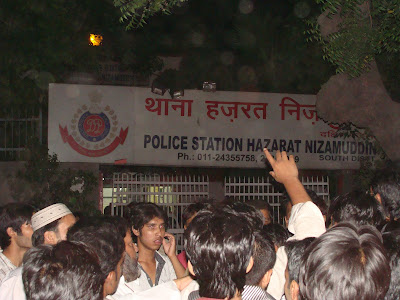
People gherao Nizamuddin PS, block traffic following police pulling down a portion of Madina Masjid

By Mumtaz Alam Falahi, TwoCircles.net

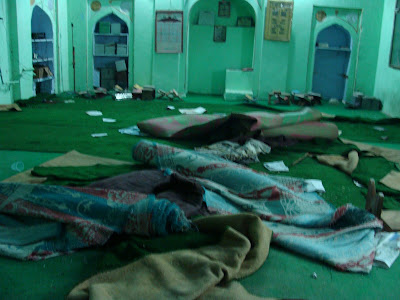
New Delhi: In an incident which the local people described as a calculated move by the police to vitiate the communal atmosphere on the eve of the elections in Delhi, a police team from Nizamuddin Police Station on May 5 allegedly demolished some portions of the Madina Masjid near Delhi Public School in Sunder Nagar area near Nizamuddin Dargah.

According to eyewitnesses, a police team comprising 8-10 policemen in the leadership of Nizamuddin Police Station SHO came to the mosque around 12:30 pm on Tuesday. Without any provocation they started pulling down the asbestos sheets structure on the veranda of the mosque. Locals said the police also demolished wazukhan (place of abulation.)

When TCN reached the mosque it found the inside of the mosque ransacked. Prayer mats, books and rehals were strewn over there. The locals also alleged that the children of the madrasa attached to the mosque were also roughed up by the policemen. The children were sleeping when the policemen came. They used filthy language for them and roughed up them.

“Over the time the police have been threatening us. Whenever we put up a sheet or do some temporary construction on the land of the mosque, police come and threaten us,” said Muhammad Islam, imam of the mosque.

Local people got enraged that the mosque and the adjoining land are the properties of the wakf board yet the police have pulled down the sheets and ransacked the wazukhan. They took away the sheets and the water taps fitted in the wazukhana, the locals said.

When TCN tried to know from ACP Gurucharan Das who was visiting the site, he said he was looking into the case and verifying about the incident. People surrounding him did not seem to be satisfied with his statement.

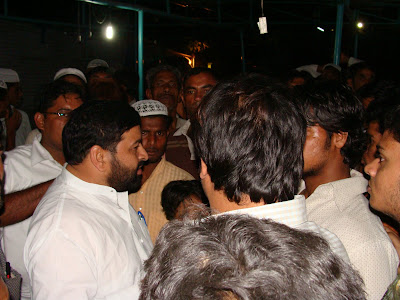
The news about the incident has already spread. People began gathering near the mosque. About 10:30 pm about 200 people marched towards the Nizamuddin Police Station. They were shouting anti-police slogans. When they reached the station they blocked the road on both sides causing halt to the traffic for about half an hour. The mob also threw stones on the road and forced some vehicles to retreat.

Locals said the incident was planned to instigate Muslims and vitiate the communal atmosphere before the voting due on May 7. The election campaign ended on May 5. Nizamuddin area falls in the East Delhi Lok Sabha constituency for which among others Delhi CM Shiela Dikshit’s son Sandeep Dikshit (Congress) and Chetan Chauhan (BJP) are in the fray.

”’ in Afghanistan

Jeremy Scahill: Al Jazeera Strikes Back at Pentagon, Releases Unedited Footage of US Soldiers’ ‘Bible Study’ in Afghanistan (Video)

Al Jazeera Strikes Back at Pentagon, Releases Unedited Footage of US Soldiers’ ‘Bible Study’ in Afghanistan (Video)
digg Share this on Facebook Huffpost – stumble reddit del.ico.us ShareThis RSS
Read More: Afghanistan, Al Jazeera, Bible Study, Breaking News, Brian Hughes, Christianity, Jesus, Pentagon, War In Afghanistan, World News

A day after the Pentagon accused Al Jazeera of being ‘irresponsible and inappropriate’ for broadcasting the ‘hunt for Jesus’ in Afghanistan footage, the network releases unedited tapes.

Hours after Al Jazeera first broadcast a video showing US soldiers in Afghanistan being instructed by the military’s top chaplain in the country to “hunt people for Jesus” as they spread Christianity to the overwhelmingly Muslim population, the Pentagon shot back. It charged that Al Jazeera had “grossly misrepresent[ed] the truth.” Col. Greg Julian, told Al Jazeera: “Most of this is taken out of context … this is irresponsible and inappropriate journalism.”

Now, Al Jazeera and the man who filmed the controversial material are striking back. The network has just released unedited and unaltered footage (see below) of US soldiers in ‘bible study’ in Afghanistan. Jazeera describes it as “Extended footage shot by Brian Hughes, a US documentary maker and former member of the US military who spent several days in Bagram near Kabul.”

In Al Jazeera’s original report, Hughes addressed the fact that soldiers had imported bibles translated into Pashto and Dari. “[US soldiers] weren’t talking about learning how to speak Dari or Pashto, by reading the Bible and using that as the tool for language lessons,” Hughes told Al Jazeera. “The only reason they would have these documents there was to distribute them to the Afghan people. And I knew it was wrong, and I knew that filming it … documenting it would be important.”

Regarding allegations that the sermon of the military’s top chaplain in Afghanistan, Lieutenant-Colonel Gary Hensley, where he instructs soldiers to “hunt people for Jesus” was taken out of context, Hughes said in a statment, “Any contention by the military that his words are purposefully taken out of context to alter the tone or meaning of his sermon is absolutely false.”

Hughes is completely standing by the accuracy of Al Jazeera’s report. Here is Hughes’s statement:

On Sunday, May 3, the Al Jazeera English network and I made an agreement to produce a broadcast segment from a rough cut of my documentary film. This opportunity came after a May 2009 Harper’s magazine cover story called “Jesus Killed Mohammed.” While he researched and prepared that article, I allowed the author Jeff Sharlet to view the work-in-progress documentary. Sharlet’s article brought the film to Al Jazeera English’s attention.

My documentary, titled The Word and the Warriors, is inspired by a personal experience I had while serving as a combat flight crew member during the first Gulf War. During a very difficult and emotional time at war, an Army chaplain provided me comfort and counsel. I will never forget the important advice or the man who – without questioning my own faith – helped me at a time of need.

For two-and-a-half years, I have been researching and producing this film. I have traveled the world, interviewing both military servicemembers and civilians about the important role of these religious leaders/military officers.

During April/May 2008, I went to Afghanistan. With the assistance and full cooperation of the U.S. Army, I was allowed to film at Bagram Air Field. During that time, I was always wearing press credentials, and I was always accompanied by a media liaison while filming. The media liaison staff knew everything I filmed and – as I was told by them – they filed reports every evening about what I had filmed. It was my primary media liaison, an Army NCO, who – on my first day – invited me to meet LTC Gary Hensley. Hensley, the ranking chaplain in Afghanistan talked to me off camera expressing a concern he had about allowing me to film his chaplains. At the conclusion of the discussion, he agreed that I would be allowed to embed with his chaplains and invited me to film several hours of religious services.

Those hours at the Enduring Faith Chapel included his own sermon at a service called Chapel Next. With the exception of a few minutes I could not film because I was reloading my camera or moving to position for another shot, I videotaped Hensley’s entire sermon.

Any contention by the military that his words are purposefully taken out of context to alter the tone or meaning of his sermon is absolutely false…

In recent press statements, the military also contends that – in the footage depicting the Afghan-language (Dari and Pashto) bibles – a cut was made before “it would have shown that the chaplain instructed that the Bibles not be distributed.” This is a false statement. The chaplain – as seen in the footage before the cut – instructs the group to be careful and reiterates the definition of General Order #1. After this cut he begins to organize the group for the evening’s bible study lessons.

Finally, and in my opinion most important, is the fact that EVERY FRAME of the rough cut from Bagram was provided to the U.S. Army Public Affairs Office in advance of this release. On Thursday, April 30 at approximately 1 pm EST, the Army took possession of a DVD with this footage by accepting a FedEx from me. Since Al Jazeera English first aired the piece Sunday, May 3 at 10pm EST, the Army had every frame of this rough cut for more than 80 hours.

See related:

US Soldiers in Afghanistan Told to “hunt people for Jesus… so we get them into the kingdom”

U.S.
Military Calls Al Jazeera ‘Irresponsible and Inappropriate’ After
Network Broadcast US Soldiers Being Told to “hunt people for Jesus” in
Afghanistan

Read more of Jeremy Scahill’s work at RebelReports.com

A day after the Pentagon accused Al Jazeera of being ‘irresponsible and
inappropriate’ for broadcasting the ‘hunt for Jesus’ in Afghanistan
footage, the network releases unedited tapes. Hours after …

A day
after the Pentagon accused Al Jazeera of being ‘irresponsible and
inappropriate’ for broadcasting the ‘hunt for Jesus’ in Afghanistan
footage, the network releases unedited tapes. Hours after …

Related News On Huffington Post:


How Hackers Can Steal Secrets from Reflections

How Hackers Can Steal Secrets from Reflections: Scientific American

From the May 2009 Scientific American Magazine | 7 comments
How Hackers Can Steal Secrets from Reflections
Information thieves can now go around encryption, networks and the operating system

By W. Wayt Gibbs

JEN CHRISTIANSEN (photoillustration of reflection); DIGITAL VISION/GETTY IMAGES (man with glasses)
e-mail print comment
Key Concepts

* Even with the best network security, your electronic data may not be safe from a
determined hacker.
* Researchers have extracted information from nothing more than the reflection of a computer monitor off an eyeball or the sounds emanating from a printer.
* These attacks are difficult to defend against and impossible to trace.

More from the Magazine

* coverMay
2009 Issue
* Feature Articles Our Planet’s Leaky Atmosphere
* Updates Updates: Whatever Happened to the Universal Flu Vaccine?
* News Scan Quiet Bacteria and Antibiotic Resistance
* Buy the Digital Edition

Through the eyepiece of Michael Backes’s small Celestron telescope, the 18-point letters on the laptop screen at the end of the hall look nearly as clear as if the notebook computer were on my lap. I do a double take. Not only is the laptop 10 meters (33 feet) down the corridor, it faces away from the telescope. The image that seems so legible is a reflection off a glass teapot on a nearby table. In experiments here at his laboratory at Saarland University in Germany, Backes has discovered that an alarmingly wide range of objects can bounce secrets right off our screens and into an eavesdropper’s camera. Spectacles work just fine, as do coffee cups, plastic bottles, metal jewelry—even, in his most recent work, the eyeballs of the computer user. The mere act of viewing information can give it away.

The reflection of screen images is only one of the many ways in which our computers may leak information through so-called side channels, security holes that bypass the normal encryption and operating-system restrictions we rely on to protect sensitive data. Researchers recently demonstrated five different ways to surreptitiously capture keystrokes, for example, without installing any software on the target computer. Technically sophisticated observers can extract private data by reading the flashing light-emitting diodes (LEDs) on network switches or by scrutinizing the faint radio-frequency waves that every monitor emits. Even certain printers make enough noise to allow for acoustic eavesdropping.

Outside of a few classified military programs, side-channel attacks have been largely ignored by computer security researchers, who have instead focused on creating ever more robust encryption schemes and network protocols. Yet that approach can secure only information that is inside the computer or network. Side-channel attacks exploit the unprotected area where the computer meets the real world: near the keyboard, monitor or printer, at a stage before the information is encrypted or after it has been translated into human-readable form. Such attacks also leave no anomalous log entries or corrupted files to signal that a theft has occurred, no traces that would allow security researchers to piece together how frequently they happen. The experts are sure of only one thing: whenever information is vulnerable and has significant monetary or intelligence value, it is only a matter of time until someone tries to steal it.

From Tempest to Teapot
The idea of stealing information through side channels is far older than the personal computer. In World War I the intelligence corps of the warring nations were able to eavesdrop on one another’s battle orders because field telephones of the day had just one wire and used the earth to carry the return current. Spies connected rods in the ground to amplifiers and picked up the conversations. In the 1960s American military scientists began studying the radio waves given off by computer monitors and launched a program, code-named “Tempest,” to develop shielding techniques that are used to this day in sensitive government and banking computer systems. Without Tempest shielding, the image being scanned line by line onto the screen of a standard cathode-ray tube monitor can be reconstructed from a nearby room—or even an adjacent building—by tuning into the monitor’s radio transmissions.

Many people assumed that the growing popularity of flat-panel displays would make Tempest problems obsolete, because flat panels use low voltages and do not scan images one line at a time. But in 2003 Markus G. Kuhn, a computer scientist at the University of Cambridge Computer Laboratory, demonstrated that even flat-panel monitors, including those built into laptops, radiate digital signals from their video cables, emissions that can be picked up and
decoded from many meters away. The monitor refreshes its image 60 times or more each second; averaging out the common parts of the pattern leaves just the changing pixels—and a readable copy of whatever the target display is showing.


Read Comments (7) | Post a comment


1 2 3 4 Next >