Peace Homes Aluva

Simplify Building Your Dream Home

Archives 2009

Modi’s rise is a very scary prospect for India

Narendra Modi as Man Muslims Love to Hate Wins Billionaire Vote

By Abhay Singh

March 30 (Bloomberg) — As Narendra Modi, chief minister of the state of Gujarat, walks into a cavernous tent filled with 20,000 investors and business leaders in western India, he’s greeted like a Bollywood movie star. Conference goers surround the politician to shake hands, snap photos and touch his shoes — a show of reverence in India.

After the January conference gets under way in the city of Ahmedabad, billionaire Anil Ambani, whose empire ranges from telecommunications to financial services, steps to the lectern. He praises Modi, 58, for turning Gujarat into India’s top destination for investors before paying the Hindu nationalist the ultimate compliment: He should be prime minister.

Since Modi became head of Gujarat in 2001, he’s lured investors with a rapid approval process for developments, a network of roads and ports and uninterrupted power supply — a rarity in India.

“If Narendra Modi can do so much for Gujarat, imagine the possibility for India by having him as the next leader of India,” Ambani says.

Some 40 kilometers (25 miles) from the conference, in a Muslim ghetto called Juhapura on the outskirts of Ahmedabad, Modi’s name isn’t celebrated. He’s a top official in the Hindu nationalist Bharatiya Janata Party (BJP), or Indian People’s Party, which opposes special treatment from the government of any one religious group, including Muslims.

Contaminated Food

For the 700,000 residents of Juhapura, the water runs only 15 minutes a day, potholed asphalt roads are lined with rubble and government-subsidized shops sell contaminated flour and rice that make people sick, says Mohammad Ishaq Sayed, a tailor who lives with his family of six in a one-room, 100- square-foot (9.3-square-meter) apartment.

“We live in Gujarat and still we get nothing,” says Sayed, 53, sitting in a plastic chair outside his apartment, where naked electrical wires snake along the walls. “Why is there no development for us? What enmity do they have with us? We are Muslims, that’s why.”

As India continues to tally the economic costs from the terror attacks by Islamic militants that killed 164 people in Mumbai in November, Modi stands out as a symbol of a nation that, 62 years after independence, has yet to come to grips with a sectarian divide that’s fueled decades of violent riots and the marginalization of Muslims.

Shut Out

The 158.6 million Muslims, which account for 13.4 percent of India’s population of about 1.2 billion, are among the poorest people in the country. They are shut out of jobs and unable to get equal access to education, according to a 2006 government-sponsored report. At state-run companies such as banks and railways, Muslims make up only 4.9 percent of the workforce.

Thirty-eight percent of them live in such deprivation that they consume less than 2,100 calories of food a day, the report says. By comparison, 20 percent of Hindus living in cities don’t receive proper nutrition.

Alakh Sharma, director of the Institute for Human Development, a New Delhi-based group that studies labor markets, development policy and education, says India’s exclusion of Muslims from the mainstream hampers its economic growth.

“If 13 percent of the population is alienated and doesn’t become part of the economic process, how will the country continue to grow?” Sharma says. “It’ll affect demand for goods and become a source of conflict and strife.”

‘Scary Prospect’

In more than two decades in the BJP, during which time he’s ascended to the position of general secretary, the third- highest rank, Modi has been in the middle of the sectarian conflict whose origins go back centuries.

Modi helped organize a campaign in 1990 for the BJP leader to drum up support for building a Hindu temple at the site of a Muslim mosque in the state of Uttar Pradesh, according to his Web site, narendramodi.in. In Gujarat alone, the BJP campaign spurred 1,520 violent incidents between Hindus and Muslims from April 1990 through April ‘91, according to a report by the New Delhi-based Institute of Peace and Conflict Studies.

“Modi’s rise is a very scary prospect for India,” says Shabnam Hashmi, an atheist who runs Act Now for Harmony and Democracy, a group started to counter sectarian politics in India. “He polarizes people by promoting the ideology of hate.” Jagdish Thakkar, Modi’s public relations officer, didn’t respond to several requests for an interview.

Rampaging Mobs

In February 2002, four months after Modi took control of Gujarat, Hindu mobs went on a rampage against Muslims after a fire on a train claimed 58 lives, among them Hindu pilgrims. In the riots that followed, more than 1,000 people were killed, mostly Muslims, while Modi allegedly instructed police to stand down and allow the violence to continue, according to an investigation by the eight-member Concerned Citizens Tribunal. The group, with no legal standing, was made up of former judges, professors and a retired police officer.

“If you are a minority you are pushed to the brink and treated like dirt in this state,” says Cedric Prakash, a Jesuit priest who runs a human rights center in Ahmedabad.

Modi has denied the allegations from the citizens group and critics.

“My future will be dete
rmined by the people of Gujarat,” Modi said at a conference sponsored by the Hindustan Times newspaper in October 2007. “In a democracy, criticism is welcome, but I am against the allegations.” The Supreme Court of India is still investigating the riots.

Holy War

The killings in Gujarat partly inspired Lashkar-e-Taiba, an Islamic militant group based in Pakistan, to launch its holy war against India, according to a study on the Web site of the Asia-Pacific Center for Security Studies, a U.S. Department of Defense institute in Honolulu.

In November, 10 members of Lashkar-e-Taiba attacked two luxury hotels, a Jewish center, a cafe and railway station in Mumbai, according to Indian officials. In a massacre that shook India, the terrorists killed 164 people, including 26 foreigners. Earlier in 2008, the Muslim group Indian Mujahideen claimed responsibility for a series of bombings in three Indian cities.

The spate of violence weighs heavily on Indians as they elect a new prime minister starting in mid-April. The BJP is attacking the ruling Indian National Congress party for being soft on terrorism. The government of Prime Minister Manmohan Singh, 76, has delayed the hanging of a convicted Muslim terrorist sentenced to death in 2002 — a fact that the BJP’s candidate, Lal Krishna Advani, 81, rails against on the campaign trail.

Slowing Economy

The BJP is trying to return to power after a six-year term from 1998 to 2004, during which time it stiffened prison penalties for terrorists and lengthened the maximum detention period for suspects who hadn’t been charged to 180 days.

“People lived under six years of a BJP government, but the end of terrorism was not one of its achievements,” says Mahesh Rangarajan, a professor of modern Indian history at Delhi University. “The terrorism card that the BJP could cash in on is gone.”

India’s economic downturn may be an even bigger election issue in a country where voters have regularly rejected incumbents, Rangarajan says. The economy grew 5.3 percent from October through December, the weakest pace since the last quarter of 2003. The recessions in the U.S. and Europe, combined with the terrorist strikes in 2008, are taking a toll on India’s tourist industry.

Partition

The number of visitors to the country plunged 12 percent in February compared with a year earlier. A February poll by an Indian affiliate of CNN showed that neither party would gain 50 percent of the vote, forcing the winner to cobble together a coalition government.

The divide between Hindus, who make up 80.5 percent of the population, and Muslims runs deep. In the 16th century, the Mughals, an Islamic dynasty, took over and ruled the land until the British made the subcontinent a part of its empire three centuries later. Before Britain relinquished control of India in 1947, it partitioned the nation into Muslim Pakistan and Hindu-majority India to buffer historical conflicts.

Eleven million Hindus, Muslims and Sikhs were uprooted, seeking refuge in one of the two countries and clashing along the way. The violence took 500,000 lives. Since the 1960s, there have been at least four major sectarian battles each decade in India, spurred by everything from a Muslim’s cow entering a Hindu’s house to conflicts over religious sites.

‘This is Not Our Country’

Muslims, fearing violence, tend to live together in small clusters in places like the Byculla area in Mumbai and the neighborhood of Nizamuddin in New Delhi, according to the 2006 report sponsored by the Singh government, “Social, Economic and Educational Status of the Muslim Community in India.” In Ahmedabad, Gujarat’s largest city, where investors have backed new malls with big grocery and electronics stores and movie multiplexes, some apartment complexes are off-limits to Muslims, according to the rules of occupancy set by building owners.

Activist Hashmi says her family, because of its Muslim name, has felt unwelcome in parts of New Delhi. In 2003, her daughter, then 7 years old, came home from school after being verbally attacked.

“Another girl told her that we should go live in Afghanistan, this is not our country,” Hashmi says.

Finding Jobs

Muslims also face obstacles in finding employment at state-run companies, which provide 70 percent of the full-time jobs with benefits in India, the report says. At Indian Railways, one of the country’s largest employers, with 1.4 million workers, Muslims make up only 4.5 percent of the total. Among civil service officers — bureaucrats, diplomats and police — 3.2 percent are Muslim. At banks such as State Bank of India, the No. 1 lender, the figure drops to just 2.2 percent. Of the 30 companies in the Bombay Stock Exchange’s benchmark Sensitive Index, only one — software services provider Wipro Ltd. — is led by a Muslim, billionaire Azim Premji.

The report recommends that employers include Muslims in hiring to increase their numbers.

“A very small proportion of government employees are Muslims, and on average, they are concentrated in lower-level positions,” the report says. “While no discrimination is being alleged, it may be desirable to have minority persons on relevant interview panels.”

Drop Outs

Dev Desai, an economics undergraduate student at GLS College in Ahmedabad, encountered discrimination recently when trying to get a Muslim friend and fellow student a job.

“I spoke to some people and told them she was from my college and studies with me,” says Desai, a Hindu. “On hearing her name, they asked if she is Muslim. When I said yes, they told me to let it be.”

The minority group lags behind in education as well, partly because of a shortage of schools that teach in Urdu, a language used by Muslims. As many as 25 percent of Muslim children ages 6-14 never attend school or drop out. Muslim kids in the Juhapura ghetto face another issue: Their school is in a Hindu area.

“Some children are afraid and don’t go,” says Niaz Bibi, a resident and mother. “Their thinking is, we’ll never get a job so why study? Might as well learn a vocation like fixing cars.”

Bollywood

In top colleges offering science, arts, commerce and medical courses, only 1 in 25 undergraduate students is Muslim.

“This has serious long-term implications for the economic empowerment of the community and consequently for economic development of the country,” the report says.

India has put aside its sectarian differences in a few areas, such as its movie industry. Muslim film celebrities Shah Rukh Khan, a romantic leading man also known as “King Khan,” and Aamir Khan often top the box office. Aamir Khan starred in Bollywood’s biggest hit of 2008, Ghajini. While Indians have never elected a Muslim prime minister, lawmakers have selected three Muslim presidents, the titular head of government, including A.P.J. Abdul Kalam from ‘02 to ‘07.

Modi mocked the government report, which was chaired by retired judge Rajindar Sachar, at a conference sponsored by India Today magazine in March 2008.

Spiraling Investments

“Mr. Sachar came to see me and asked, ‘Mr. Modi, what has your government done for Muslims?’ I said, ‘I’ve done nothing,’” Modi said. “Then I said, ‘Please also note that I’ve done nothing for Hindus either. I work for the people of Gujarat.’”

As head of the state, Modi has spurred a construction boom by attracting a slew of investors, including Sabeer Bhatia, co-founder of e-mail service Hotmail. Investors pledged $243 billion to Gujarat at the 2009 Vibrant Gujarat Global Investors’ Summit in January, a 60 percent jump from the previous event in 2007. In a country infamous for bureaucratic red tape, Gujarat lures investors with a streamlined process requiring developers to get approval for major projects at only one agency, the Gujarat Infrastructure Development Board.

Tata Group, the $62.5 billion conglomerate that owns everything from salt to software companies, got permission from the state to build a plant to produce the $2,500 Nano, the cheapest car in the world, in three days.

Hindu Nationalist

“Most of us in India have come to regard a time frame of six months or three months as an average time to get clearances,” Ratan Tata, chairman of Tata Group, said from the stage at the January conference in Ahmedabad. “In this particular case, that tradition was shattered, and we had our land and most of our approvals in three days. That, in my experience, has never happened before.”

After Tata’s speech, Modi walked toward the lectern and gave the executive a hug before addressing the crowd himself.

“Even in a recession, companies aren’t going to stop manufacturing,” he said. “They will prefer a destination where low-cost manufacturing is possible. This is a chance for a country like India, if we can provide a low-cost manufacturing environment, to grab this opportunity.”

Modi joined the burgeoning Hindu nationalist movement as a teenager after growing up in a family of modest means; his father ran a tea stall at Vadnagar railway station in Gujarat, according to a 2007 article in the Times of India.

Ideological Fraternity

After completing his master’s degree in political science at Gujarat University in the 1970s, he became a member of the Rashtriya Swayamsevak Sangh, or National Volunteers Corps, his Web site says. The RSS advocates that Hinduism is central to Indian culture and life.

At the time, northern India was recovering from a famine and sectarian violence was rising: 500 people were killed in Ahmedabad in 1969. Members of the still active RSS take part in regular military-style parades, drills and exercises dressed in white shirts and khaki shorts. The RSS, which hatched political groups that would coalesce into the BJP in 1980, remains the fount of the party’s ideas.

“The RSS ideology is all about cultural nationalism,” says Prakash Javadekar, spokesman for the BJP and a member of India’s upper house of parliament. “We are an ideological fraternity.”

Babri Mosque

The BJP built itself into a national power starting in the late 1980s with a campaign to construct a temple where a mosque stood in Ayodhya, Uttar Pradesh. Modi, who joined the BJP in 1987, helped organize a 10,000-kilometer journey for Advani, now the BJP’s candidate for prime minister, to rally support for the temple and the party. Advani’s trip in a truck, with the bed trussed up to resemble a chariot from Hindu mythology, was scheduled to end at the site of the mosque.

Hindus believe the site was the birthplace of the Hindu god Ram and that a temple once stood there until Muslim invaders destroyed it in the 16th century and built the Babri Mosque.

Advani’s journey was cut short when authorities arrested him in the state of Bihar in October 1990. According to Advani’s Web site, he was arrested by political foes who opposed a resurgence of nationalism in India. Two years later, Hindu mobs tore down the mosque, fomenting riots in Mumbai that claimed more than 1,000 lives, mostly Muslims.

Train Fire

The temple campaign catalyzed Hindu support across India for the BJP, which won its first national election in 1996 and its second in ‘98.

“Communal violence in the last two decades is a result of the manipulation of religious sentiments by Hindu right- wing organizations for political gains,” according to the Institute of Peace & Conflict Studies report. “The politicization of the temple-mosque issue and the subsequent demolition of the mosque gave the BJP the opportunity to consolidate its vote bank.”

Javadekar rejects that claim, saying the Congress Party’s sectarian politics and favoritism toward minorities poses the biggest danger to India. Javadekar says the BJP supports the equal treatment of all religious groups in India.

“That means you do justice to all and appeasement of none,” he says.

The 2002 riots in Gujarat began with a fire in a train coach carrying Hindu pilgrims returning from Ayodhya. A commission set up by the Gujarat government said that Muslims set the fire after an altercation at the station between some pilgrims and Muslim vendors.

Lost Everything

The report of the citizens tribunal, which was released in October ‘02 and based on about 2,000 interviews, shows the fire started within the coach and was not deliberate, says Ghanshyam Shah, a social scientist who was a member of the tribunal.

As news of the fire spread through the state, Hindu mobs surrounded Muslim neighborhoods, destroyed houses with homemade bombs, raped and killed women and butchered men, according to the three-volume report of the citizens tribunal.

“We escaped with just the clothes on our backs,” says Sayed, the tailor in Juhapura. “Everything was destroyed. Our house was torn down, and all our possessions were stolen.”

Sayed, his wife and three sons were rescued by a Muslim police officer and taken to a camp outside Juhapura.

Somali Muslims Changing Small Town

Somali Muslims Changing Small Town – World – CBN News

Somali Muslims Changing Small Town
By Erick Stakelbeck
CBN News Terrorism Analyst
March 28, 2009

CBNNews.com – SHELBYVILLE, Tenn. – It has been nearly 20 years since Somalia last had a functioning government. Islamic jihadists now control most of the country-and sharia is the law of the land. Tens of thousands of Somali refugees have resettled in America in recent years to escape the chaos of their homeland, which is located in the Horn of Africa.

But the transition isn’t going smoothly in one small town.

Click the player to watch the report from CBN News Terrorism Analyst Erick Stakelbeck followed by comments from Pat Robertson.

At first glance, Shelbyville is your typical sleepy southern hamlet. It’s nestled in middle Tennessee, where the walking horse is king.

RELATED STORIES:
U.S. Somalis Helping Holy War Abroad?

U.S. Muslims: The Culture War

Somali Refugees: The Cost of Freedom
There’s Main St., the local sheriff, a movie theatre. It’s all very “Mayberry,” except for one big difference: the recent arrival of hundreds of Somali Muslims.

Small Town Having Difficulties

Shelbyville is about an hour’s drive from Nashville, in the heart of the Bible Belt. Like many Americans, the citizens of Shelbyville knew little about Somalia other than the 1993 Black Hawk Down incident, in which 18 U.S. servicemen were killed while battling warlords and Islamic jihadists in the Somali capital of Mogadishu.

So when hundreds of Somalis began turning up in the town–many of them dressed in traditional Islamic garb–locals quickly took notice.

“They’ve had an impact here. Unfortunately, it’s not been a good impact,” said Brian Mosely, a reporter for the local Shelbyville Times-Gazette.

Mosely won an award from the Associated Press for a series of articles he wrote for the paper about Shelbyville’s Somalis.

“I found that there was just an enormous culture clash going on here,” he said. “The Somalis were–according to a lot of the people I talked to here–were being very, very rude, inconsiderate, very demanding. Tthey would go into stores and haggle over prices. They would also demand to see a male salesperson, would not deal with women in stores”

Different People, Different Culture

“Their culture is totally alien to anything the residents are used to,” Mosely added.

The problems extend to local schools–where some Somali students won’t talk to female administrators. There have also been issues with local law enforcement.

“I’m not really sure whether that is because of experiences with the police in their country, or whether that’s just the way their culture is,” said Shelbyville’s Police Chief, Austin Swing.

Shelbyville is home to about 17,000 people. The town’s Somali population is estimated to be between 400 and 1,000.

Mosely says the Somalis have isolated themselves from the rest of the community.

“We’re talking about people who have not had any experience with Western civilization,” he explained. “They don’t know the language. Things like running water are a miracle to some of these folks…you don’t take people from a totally alien culture, put them into a community, and then say ‘alright, you must get along.’

Little Chance to Adapt

Abdirizak Hassan is the director of the Somali Community Center in nearby Nashville. He says the state of Tennessee has no programs to help immigrants integrate into their new surroundings.

“They come, and the only thing they can do is go to work, and then after work they go back to the apartment,” Hassan said. “They’re totally isolated and there’s no interaction between them and the locals.”

He added that some have even expressed a desire to return to Somalia.

“A lot of them face eviction. They put them in an apartment complex that costs $600 a month. They can’t get a job that gives them that much money,” Hassan explained.

“And sometimes you have families, like, a single mother with eight kids, or seven kids or six kids, and you expect her to go to work in six months time with no English, no driver’s skills, nothing? I mean, sometimes it’s impossible.”

“The locals, mostly, when they see a few hundred people in their backyard with a different look, strangers, you know, of course they have the right to be concerned,” he added. “But I think if the local authorities and organizations like ours do a lot of outreach, I think we can bridge the gap.”

So how did so many Somalis end up in rural Shelbyville? The answer can be complicated.

Taken in by the U.S.

The State Department helps resettle refugees from war-torn countries like Somalia in the United States. The resettlement project is one part of a taxpayer-funded refugee aid program with a billion dollar budget.

Immigrants are chosen from UN refugee camps. The selected refugees then undergo a few days of cultural orientation and are soon on their way to America.

Although most of the refuges are repatriated to their home countries, the U.S. takes in more refugees than any other nation–with a cap of about 80,000 this year.

“What we do is we look at the most vulnerable groups of refugees,” said Todd Pierce of the State Department’s Bureau of Population, Refugees and Migration. “One group we’ve tried to help is Iraqi Christians and those who’ve worked with U.S. and Coalition forces.”

Pierce said the resettlement program helps improve America’s image in the eyes of the world.

“It’s one of the best facets of America, that we are a very generous, hospitable country,” he said. “This is something that has been bipartisan for decades now–we’ve brought people in….we look at Africa, we look at the Middle East, we look at Southeast Asia.”

A Rocky Transition?

More than 150,000 Somalis now live in the U.S., most in larger cities like Minneapolis, Nashville, Boston, Seattle and Columbus, Ohio.

Gang activity has been a major concern. And according to the U.S. government, at least a dozen young Somali Americans have returned home in recent months to join an al-Qaeda-linked terrorist group called al-Shabab.

As a result, the FBI is conducting investigations in several cities with large Somali populations. The fear is that the Somalis will return to America and put their terror training to use on U.S. soil.

Pierce says the government tries to shut any potential troublemakers out of the refugee resettlement program.

“We work closely with the Department of Homeland Security to make sure we vet people coming here, especially since 9/11. It’s very important,” he said.

Motivated by Jobs

“Our experience has been that refugees are very successful at resettling,” said Holly Johnson of the Tennessee Office of Refugees.

Johnson said the federal government contracts with social welfare groups at the local level to help set the refugees up in apartments, find them jobs and ease their transition to America.

“They are completely self sufficient, usually within 4 months,” she said. “They arrive here with nothing but a duffel bag of clothes, and they’re on their own, paying their bills, children are attending school, they know where their doctor’s office is within a few months.”

After a few months in their settlement cities, the refugees are free to move around the country and live wherever they please.

Enter Shelbyville

Somalis in other cities were drawn to Shelbyville by the jobs offered at the local Tyson chicken processing plant.

The plant came under fire from the Department of Justice in 2001 for hiring illegal Hispanic immigrants.

The large influx of Somalis has only added to locals’ frus
tration with the plant and the government.

“We’ve had three major industries shut down here and 700 to 800 people have lost their jobs,” Mosely said. “They’re trying to find anything they can, and then–as they see it–the government is shipping people from overseas to come here and take their jobs.”

Getting Past Controversy

Despite locals’ continued complaints over its hiring practices, Tyson says it is doing things by the book. A Tyson spokesman said the company is following federal employment guidelines–and that the majority of its employees are local residents.

The Tyson plant generated national controversy last fall when it dropped Labor Day as a paid holiday in favor of the Muslim holiday Eid al-Fitr.

The decision was later reversed, but longtime local residents say the incident was symbolic of the larger changes taking place in Shelbyville–changes they are coping with as best they can.

“We’re probably as culturally diversified as any small town in America.” said Chief Swing. “There’s been a lot of changes. But I think most people just take it in stride and keep going along with it.”

*Originally aired March 26, 2009

”’| TwoCircles.net

Glimpses of 18th century Delhi through a ‘Storyteller’s Tale’ | TwoCircles.net

Glimpses of 18th century Delhi through a ‘Storyteller’s Tale’
Submitted by admin4 on 27 March 2009 – 12:20pm.

* Indian Muslim
* Literature

By Madhusree Chatterjee, IANS,

New Delhi : A storyteller and a begum swap tales and match their narrative wits in writer-journalist Omair Ahmad’s new book “The Storyteller’s Tale” – giving a glimpse of 18th century Delhi after Afghan warlord Ahmad Shah Abdali’s army plundered it.

“At the core of the story is a man and a woman exchanging stories. It is set in 18th century Delhi after massive raids by Ahmad Shah Abdali’s forces, which devastated the capital. A part of it is history while the other is what happened to the city, alongside history,” Ahmad told IANS following the release of the book at the American Centre.

In the 18th century, when Abdali’s forces had crushed the city of Delhi, a Muslim storyteller found himself in an isolated casbah (settlement), a day’s ride from the capital, on his way out of the city.

A begum in the casbah invites him to share a story. The storyteller, anguished by the destruction of Delhi, tells her a bitter tale of two brothers, Taka and Wara – a wolf and a boy – a story of love, loyalty, hurt and fear that came with unrequited love.

The begum responds with a story of her own – the story of Aresh and Barab, a friendship that transcended death. It leads to a chain of stories as the two match their narrative wits.

And with each story, the begum and the storyteller are drawn into a whirlpool of forbidden love.

“The book happened more by chance than by thought. I did not plan it. In fact, I wrote the first story in the ‘…Tale’ as a short story. I showed it to my friend Olivia, to whom the book is dedicated. And she said I had not been particularly kind to the woman. So, I wrote a second story. But I wasn’t convinced by the guy’s point of view and wrote the third story, and then the fourth,” said Ahmad, who has given up his job as a journalist to become a full-time writer.

Before becoming a journalist, Ahmad was a political adviser to the British government and had also worked for the Conservative Party on international security issues.

He has also advised the Indian government on several key issues and prepared the brief for the India-US nuclear deal.

Ahamad’s book, in a form reminiscent of “The Tales of Sinbad”, “One Thousand and One Nights (Arabian Nights)” and Salman Rushdie’s “Haroon and the Sea of Stories”, weaves the turbulent history of northern India in the 18th century with fables – most of which read like popular lores.

“I was inspired by the fables of Panchatantra, the Bible, the Quran, Japanese folklore from the ‘Tales of Genji’, the adventures of Hamza and the Sinbad tales. Story-telling in India is an ancient format. Between 900 and 1500 AD, a huge number of people came from West Asia bringing with them their own stories. Delhi then was largely populated by immigrants,” Ahmad said.

He also drew from the “Tota-Maina ki kahani” – the rural folk tales of northern India – and a combination of the Alif Laila traditions of story-telling and the Panchatantra.

“But I really don’t want to compare myself with Salman Rushdie. ‘Haroon and the Sea of stories’ is by far his best work which showcases his talent without getting political,” said Ahmad, an Aligarh Muslim University and Jawaharlal Nehru University alumnus.

Ahmad has now signed a four-book deal with Penguin.

“The first is a travelogue and a narrative history of Bhutan, a novella ‘Jimmy, The Terrorist’, which I will submit for the Man Asian shortlist, a book of interlinked short stories based on my dad’s city Gorakhpur in eastern UP (Uttar Pradesh) and a biography of my grand-dad’s brother, Pakistan’s high commissioner to India between 1948 and 1952, who retained his Indian citizenship,” Ahmad said.

The Delhi-based writer is often referred to as a “true Sufi”. “I can’t say I am not a Sufi,” says Ahmad, when asked about his faith.

(Madhusree Chatterjee can be contacted at madhu.c@ians.in)

Amana expecting licence to begin commercial banking

The Amana Group has reached another milestone in their journey with the granting of a Letter of Provisional Approval to establish a licensed commercial bank named Amana Bank Limited by the Monetary Board of CBSL, a statement released by the company said.

The Amana Group is currently taking steps to establish the first truly Islamic Commercial Bank in the country. Amana Bank has not yet been granted a licence to carry on banking business under the Banking Act No. 30 of 1988 (as amended).

Upon achieving certain conditions listed in the Letter of Provisional Approval such as the raising of a minimum capital requirement of Rs.2.5 billion, Amana Bank expects to receive a banking licence from the CBSL that will enable it to begin commercial banking operations.

Upon receiving its commercial banking licence, Amana Bank plans to use its unique position as the first truly Islamic bank in the country to attract Sharia-compliant investment flows from the Middle East and the Far East.

Subject to Malaysian and Sri Lankan regulatory clearances, Amana Bank hopes to utilize the technical expertise and specialized Islamic banking know-how of Bank Islam Malaysia Berhad (BIMB), which currently holds a 10% stake in AIL, to design and deliver a new range of Islamic banking services, which includes current accounts, foreign exchange transactions, inward and outward remittances, export financing, guarantees, performance bonds, bid bonds, corporate treasury placements, private banking, wealth management, long term housing finance, infrastructure financing, agricultural finance and leasing. BIMB pioneered Islamic banking in Malaysia and is a globally acknowledged leader in Islamic banking, the statement said.

Amana Bank plans to actively participate in the Government’s ‘Re-awakening of the East’ program by expanding it’s branch network in the Eastern province beyond the currently existing five and offering appropriate Islamic banking solutions to facilitate the resurgence of the Eastern Province’s infrastructure and economy.

Amana Bank has plans to build on the solid foundations laid by AIL to take its products and services to all ethnic groups, realize the full business potential that would ensue from a licensed commercial banking operation and provide its customers and shareholders with higher value and returns.

Map of Chinese Muslims

Map of Chinese Muslims

6 FEBRUARY 2009 NO COMMENT

The following map shows regions in China with large number of Chinese Muslims.

While other provinces and regions may not have that many Muslims but Muslims are nonetheless found in all parts of China. One of the reasons is because traditionally Muslims were involved in trade in China.

Brief Bio: Wang Daiyu is a doctoral student and the editor of the Islam in China webzine. He also maintains a blog on Islam and China.

Courting confidence


Ahllam Berri gets into the middle of the action for a rebound in game vs Godinez.

Save/Share       

Starting forward was hesitant to wear a hijab at first, but says it’s part of who she is now and her peers are supportive.

Updated: Thursday, February 5, 2009 5:35 PM PST

There are No comments posted.

If you didn’t know better, you’d think it’d take Ahllam Berri a littler longer than most players to put on her game face.

White Under Armour leggings and top: check.

Uniform: check.

Shoes: check.

Focused mind set: check.

White hijab: check.

“Hijab?”

Yes, the hijab — a traditional garment or head cover for Muslim women — has distinguished the starting forward from the rest of her teammates on the Laguna Beach High girls’ basketball team.

Make that, has distinguished the senior from all players on the court the past two-plus years.

“It takes me about five to 10 minutes to get ready for a game. That’s it,” she said. “It doesn’t take me that long to put on my head scarf. I put a head band on first, wrap the scarf around, tie it in the back, slip it down and pin it under my chin. I’ve gotten used to it. It’s simple, really.”

Berri, 17, has been wearing the hijab since she was 15. A Muslim girl, she said, starts to wear the headdressing when she turns 9.

“It is expected in the religion to wear it when a girl turns 9, but it is your choice,” Berri said. “My parents never pushed me to wear it, although my mom always reminded me that someday I would wear it.

“Now, it’s a part of who I am. I wear it all day at school and wear it when there are men not related to me are around. Even my male cousins cannot see me without it. I don’t take it off until I’m in my room at home.”

She said she can be seen most days on campus in jeans and a loose, long-sleeved shirt, wearing her head scarf.

Berri, born in Fountain Valley, moved to Laguna Beach before the start of her freshman year. She said she didn’t wear her head scarf her first year at Laguna Beach High due to insecurities.

“I wasn’t too sure about wearing it when I started high school,” she remembered. “I wanted to wear it, but I was just insecure about it. After my freshman year I decided, on my own, to start wearing it. I began to grow up personally and gained confidence. I came into my sophomore year wearing it, without warning anyone at school. When kids at school saw me, they asked questions like, ‘why are you wearing that?,’ or, ‘how come you didn’t wear it before?’

“But everyone was really supportive and accepting. On a few occasions, I’ve even been asked by some teachers at school to speak to their classes, like foreign language and history classes, about my attire and why I wear it. That has given me the opportunity to tell people about my religion. It’s been a positive thing.”

When it comes to playing basketball, Berri — who averages four points and five rebounds a game this year — said the head scarf hasn’t been cumbersome.

“It has slipped a few times, but I just adjust it and get back to the game,” she said.

During her sophomore year on varsity, Berri was nearly unrecognizable facially for a stretch of the 2006-07 season, yet everyone still knew who she was. In addition to wearing her head scarf, she wore a protective face mask after fracturing her nose during a game.

“My teammates looked at me like I was crazy,” she said. “Everyone was telling me to take the mask off. It did look pretty crazy.”

Berri played varsity as a sophomore, then junior varsity ball during her junior year before earning a starting spot on varsity this year.

“I had no qualms about her headdress and actually thought it was a physical symbol of her dedication to herself, her faith and our team,” Laguna Coach Jon Hendrickson said. “We’ve had no questions from referees, or opponents, about it.

“It’s been a pleasure to coach Ahllam and see first-hand her dedication. She brings intensity and leadership. She is very committed to the team and her teammates. She’s gotten extremely better and we struggle when she is not on the floor. She is definitely an asset to our team, both on and off the court.”

Although the Breakers will have a tough season end next Tuesday, Berri said she has nothing but great memories of playing for the Breakers.

“I’m extremely glad that I played basketball here,” she said. “I have a real close bond with my teammates, and it’s been a great experience.”

Berri, who intends to study medicine at a four-year university, says her decision to wear the hijab a little more than two years ago has been educational.

“Wearing it has taught me about myself and about people, in general,” she said. “I realize that I’m stronger than I thought and wearing it actually has given me more confidence. It’s also made me want to be a better Muslim.”

Gaza massacres (27 December 2008 – )

Gaza massacres (27 December 2008 – )
 

Hundreds of Palestinians have been killed and thousand more injured as Israel continues to assault the 1.5 million Palestinians in Gaza — the majority of them children and refugees — from the air, sea and sky.


On 27 December, Israel began its bombardment on Gaza and then on 3 January began its ground offensive. At the end of 8 January in Gaza, at least 763 Gazans had been killed, including more than 200 children, and more than 3,000 injured since 27 December, according to Al Jazeera.

Israel claims that it is targeting Hamas armed fighters and infrastructure, ostensibly in response to the firing of homemade rockets from Gaza into Israel. However, field investigations by the Gaza-based human rights organization Al Mezanshow that United Nations-administered schools, mosques, universities, emergency medical crews, private homes and other civilian objects have all been in Israel’s sights.

Among those killed on the first day of bombing, when more than 100 tons of bombs were dropped on the tiny coastal enclave, included police officers who were attending a graduation ceremony, school children heading home after a day of study, and other Gazans killed without warning as they were conducting their normal business.

Entire families have been wiped out during the air strikes and shelling, including that of Hamas leader Nizar Rayyan who was extrajudicially executed along with his family in their home in a Gaza refugee camp. More than 40 were killed on 6 January when Israeli forces shelled the United Nations-administered Fakhoura school in the Jabalia refugee camp, where families who had been displaced by the bombing were seeking shelter. The UN has demanded an independent investigation and its spokespersons assert that GPS coordinates of all UN locations were given to Israel to prevent such an atrocity. Israel recanted its claim that resistance fighters released fire on Israeli soldiers from the school, which has been categorically denied by UN officials.

The death toll will most likely rise as corpses are recovered from the rubble of destroyed buildings and the critically injured die of their wounds. The International Committee of the Red Cross has protested Israeli forces preventing them from evacuating casualties. Many will likely die because Gaza’s hospitals — already chronically short of medicines and supplies due to the Israeli siege — are unable to cope with the scale of the catastrophe. Medical workers face grave danger as they respond to the sites of Israeli strikes; according to the World Health Organization, as of 8 January, 21 medical workers had been killed and more than 30 injured since 27 December.

The bloody operation in Gaza comes after the expiration of a six-month-long ceasefire between Israel and resistance groups in Gaza, including Hamas. Israel had broken the ceasefire on 4 November, when it extrajudicially executed six Palestinians in Gaza whom it said was digging tunnels to Israel. During the five previous months of the ceasefire, Hamas had refrained from firing rockets and prevented other groups from doing so. However, Israel failed to ease the nearly two-year-long embargo on the Gaza Strip that has crippled economic life and brought the area to the brink of a humanitarian crisis — one of Israel’s obligations under the ceasefire.

Instead, in Israel, where the fate of the Gaza Strip has become part of politicking as the country gears up for an election, leaders blamed Hamas for the carnage and Prime Minister Ehud Olmert cynically appealed, “to the people of Gaza, you are not our enemy.” While the other three members of the so-called International Quartet for Middle East Peace criticized what they called Israel’s “excessive” use of force, the US refrained from doing so. White House spokesperson Gordon Johndroe stated from Texas, where President George W. Bush was presently vacationing: “Hamas’ continued rocket attacks into Israel must cease if the violence is to stop.”

The ongoing assault on Gaza is the largest Israeli military operation in the territory occupied during the 1967 War. Although Israel unilaterally withdrew its illegal settler population from the Gaza Strip in 2005, it remained the occupying power as it controlled the borders, sea and airspace, as well as the population registry, and regularly carried out sonic booms over the area, terrorizing the population. Israeli forces have also frequently carried out extrajudicial executions of Palestinian activists in Gaza, killing scores of bystanders as well.

Gaza hospitals were unable to cope with the situation as Israel’s closure of the Gaza Strip for a year and a half has prevented the importing of medical supplies and equipment. As the morgues filled to capacity, corpses lined the hallways of Gaza hospitals. Hospitals were forced to turn away many of the injured due to the lack of space and supplies.

The massive air strikes came after a food crisis broke out in Gaza, as Israel’s banning of imports into the Strip have depleted stocks of flour and cooking gas, causing some bakeries — the few still in operation — to resort to baking bread made out of animal feed. On 18 December, the United Nations agency for Palestine refugees (UNRWA) was forced to stop its food aid delivery to 750,000 refugees in the Gaza Strip. Though it briefly resumed services in January 2009 after a “humanitarian corridor” was established, and a daily three-hour ceasefire was declared, the United Nations announced it was ceasing all services after Israeli forces targeted and killed a UN aid worker and wounded others on 8 January.

Israel’s measures of collective punishment on the Gaza Strip are resulting in “the breakdown of an entire society,” according to economist Sara Roy, who asks in a commentary published recently by The London Review of Books, “How can keeping food and medicine from the people of Gaza protect the people of Israel?”

The devastating attack on Gaza was described as “willful killing” by leading Palestinian human rights and civil society organizations, and therefore constitute “a war crime.” The organizations stated: “Both the time and location of these attacks also indicate a malicious intent to inflict as many casualties as possible with many of the police stations located in civilian population centers and the time of the attacks coinciding with the end of the school day resulting in the deaths of numerous children.”

The assault was met with loud calls for a boycott of Israel, including a boycott appeal from by the Palestinian Boycott, Divestment and Sanctions National Committee, which stated on the day of the massacres: “Israel seems intent to mark the end of its 60th year of existence the same way it has established itself — perpetrating massacres against the Palestinian people. In 1948, the majority of the indigenous Palestinian people were ethnically cleansed from their homes and land, partly through massacres like Deir Yassin; today, the Palestinians in Gaza, most of whom are refugees, do not even have the choice to seek refuge elsewhere. Incarcerated behind ghetto walls and brought to the brink of starvation by the siege, they are easy targets for Israel’s indiscriminate bombing.”

And while government leaders and the US president-elect remain resoundingly silent over the ongoing massacres in Gaza (with the exception of Hugo Chavez in Venezuela, which removed Israel’s ambassador from the country), millions of people around the world have taken to the streets to express their solidarity with Palestinians under siege. Analysts say that Arab regimes seen as being in collusion or supporting the siege and massacres, such as the Ramallah-based Palestinian Authority, Egypt, Jordan and Saudi Arabia, will not be unscathed by the popular anger towards these policies.

Palestinian firemen try to extinguish a fire following an Israeli strike in Rafah, southern Gaza Strip, 27 December 2008. (Hatem Omar/MaanImages)

Diaries and voices from Gaza

Humanitarian updates, action and advocacy

via Twitter


  • Rt @AJEnglish Israeli jets strike Rafah tunnels: Raids test fragile Gaza ceasefires as US envoy visits region – http://tinyurl.com/dgzjyy about 11 hours ago
  • VIDEO: Cairo hospitals treat Gaza’s war-scarred children (Warning: Images may disturb or offend some viewers) – http://tinyurl.com/bapg9h 3 days ago
  • Blair said that without Palestinian reconciliation, #Gaza reconstruction would be “harder” to achieve 3 days ago
  • Quartet Envoy Tony Blair met Palestinian PM Salam Fayadh in Ramallah, discusses #Gaza humanitarian needs, reconstruction and reconciliation 3 days ago
  • Retweet @AJEnglish Hamas to pay victims of #Gaza war: Palestinian group promises money to families of the dead… http://tinyurl.com/ddhya2 3 days ago
  • Retweet @AJEnglish #Gaza ceasefire talks due in Cairo: Hamas and other factions to meet Egypt, EU mediators… http://tinyurl.com/bpqmt7 3 days ago
  • Hamas says families who lost their homes in the #Gaza war will receive $5,190 in emergency aid, partially damaged homes get $2,595 3 days ago
  • Families will receive about $1,300 for each member killed in the #Gaza war, $650 would be paid out to those injured, a Hamas spokesman said 3 days ago
  • Hamas administration in #Gaza begins distribution of $52 million in emergency aid 3 days ago
  • Bashar al-Assad, the Syrian president, congratulates Khaled Meshaal, the Hamas leader, on the group’s “victory” against Israel. 3 days ago
  • Hamas-run government in Gaza says it will create a committee of senior officials to oversee all relief efforts in the territory. 3 days ago
  • France has decided to deploy a frigate off the coast of the #Gaza Strip to fight arms smuggling “in full co-operation with Egypt and Israel” 4 days ago
  • #Gaza children return to UN schools, teachers forced to tackle psychological trauma of pupils – http://tinyurl.com/bu3fys 4 days ago
  • Palestinian children in the #Gaza Strip have gone back to school for the first time since the 22-day Israeli offensive 4 days ago
  • VIDEO: United Nations struggles to house tens of thousands of people displaced by war in #Gaza – http://tinyurl.com/b3bv5r 4 days ago
  • Stay up to date with features, analysis and video from the aftermath of the #Gaza war with our special report – http://tinyurl.com/warongaza 4 days ago
  • Israel forms defence team, withholds names of soldiers who conducted #Gaza war amid potential war crime charges – http://tinyurl.com/c9r7gh 4 days ago
  • VIDEO: BBC spurns #Gaza appeal, defends decision not to air a fund-raising appeal for the victims of the war – http://tinyurl.com/b95uyw 4 days ago
  • VIDEO: Doctors believe that illegal chemical weapons were used in #Gaza, as Al Jazeera’s Todd Baer reports – http://tinyurl.com/b79tvy 4 days ago
  • United Nations aid chief John Holmes has condemned Israel’s alleged use of white phosphorous during its offensive on #Gaza 4 days ago

Gaza blogs:

The shortcut to peace

The shortcut to peace
Hasan Abu Nimah, The Electronic Intifada, 28 January 2009

Palestinians in Jabaliya in the northern Gaza Strip huddle around a fire next to their home destroyed during Israel’s 22 days of attacks on Gaza. (Wissam Nassar/MaanImages)

Because it is generally accepted by the so-called “international community” that Hamas is a major threat to Israel, and therefore to world peace and security, France has dispatched a frigate to participate in a new blockade of the Gaza Strip. The Sunday Times reported that United States naval ships hunting pirates in the Gulf of Aden have been instructed to track down Iranian arms shipments (25 January). Many other European states offered their navies to assist. Indeed, United Nations Security Council resolution 1860 emphasized the need to prevent illicit trafficking in arms and ammunition.

Unfortunately not one European country offered to send its navy to render humanitarian assistance to the thousands of injured, hungry, cold and homeless people in Gaza rendered so as a result of Israel’s attack. Perhaps helping children dying from white phosphorus burns, or just lack of clean water, would be seen as supporting “terrorism.”

The perverse assumption behind all the offers of help to Israel seems to be that Hamas and other resistance groups in Gaza fired rockets at Israel merely because rockets were available. Therefore, the logic goes, peace would prevail if the supply of rockets were curtailed.

Another strange assumption is that Hamas was freely importing rockets from Iran or elsewhere because Gaza’s borders were open and free of any control.

This ignores the fact that since Israel “disengaged” from Gaza in the summer of 2005, the coastal territory was never allowed any free access to the outside world. Gaza has been under varied forms of siege and blockade by land, sea and air. Fishermen were not even free to fish without constant attacks by the Israeli navy.

The Rafah crossing linking Gaza to Egypt was kept closed on Israeli insistence until a regime for strict Israeli proxy surveillance, with European monitors acting on Israel’s behalf, was established for it.

If Hamas, despite the blockade and total financial and diplomatic boycott managed to import so many rockets or the materials to make them, what level of further siege would guarantee an end to arms importation now?

But the glaring moral and legal question is why the “international community” is mobilizing its navies and political efforts to protect the aggressor, preserve the occupation, and deny the victims any means to defend themselves? If they do not want Palestinians to resist, why do they not themselves confront the aggressor and force an end to the occupation, the siege and dispossession?

In the better past when war broke out in a region the immediate response was often to impose an arms embargo on all sides. But when the defenseless population in Gaza were under attack from the region’s strongest army all calls were to prevent the victims from defending themselves. Meanwhile, endless supplies of sophisticated weaponry were sent to the occupier despite its already massive dominance and indiscriminate and criminal attacks on civilians.

Without objective and daring diagnosis of the conflict’s root causes there is no chance of any effective treatment. Sadly this lesson has never been learned, although it has been written repeatedly with much innocent blood.

When Palestinians started their first unarmed uprising in 1987, 40 years after their expulsion from their homes and 20 years after the brutal occupation of the West Bank and Gaza Strip began, they had no rockets; they had only stones to confront heavily armed occupation forces. Israel used its guns and deliberate, sadistic bone-breaking against unarmed demonstrators killing almost 1,500 and injuring tens of thousands in its failed efforts to crush that uprising. Only with the 1993 Oslo accords was it possible to put an end to the uprising.

Hamas, as a resistance movement, was born in 1988. Israel, desperate to break the political monopoly of the Palestine Liberation Organization as the sole legitimate representative of the Palestinian people, tacitly allowed Hamas to flourish.

Before any Palestinian fired a single shot at the start of the second uprising, in September 2000, Israel had already gunned down dozens of unarmed demonstrators. Palestinians learned these lessons well: Israel will meet any peaceful challenge with lethal force so one had better be prepared to fight back.

We need to recall these facts to understand the pure folly and detachment from reality of international politics today. The tendency has been to choose as the “cause” of the conflict to be addressed only what is politically expedient and easy, whether it is wrong or right, just or unjust, legal or illegal. The starting point of history is chosen not from the origins of the problem, but from whatever point suits the narrative of the strong.

It is utterly misleading and dishonest to pretend — as so many now do — that the sum total of the Palestinian-Israeli conflict is a confrontation over what expired Palestinian Authority President and Israeli puppet Mahmoud Abbas himself referred to as “silly rockets.” To pretend that stopping the supply of rockets will make any difference to the course of a conflict that results from the historic dispossession — the Nakba — of an entire nation, and its replacement with a racist rogue state that has exiled, occupied and massacred the survivors for 61 years is the height of delusion.

It is convenient for the occupier and aggressor to forget all these things and talk only of rockets. And it is convenient for the cowards who dress themselves in diplomats’ suits and don’t dare utter the truth.

Should we not acknowledge — if there is any real desire to resolve this conflict — that the resistance did not fire rockets just because they had them, and Israel did not carry out its barbarous massacres in Gaza just because it wanted to stop them? Should we not acknowledge the indisputable truth that Hamas did not break the truce, but Israel did when it attacked across the border on 4 November killing six Palestinians? Hamas did not refuse to renew the truce — as Abbas and Egyptian officials confirmed. All they asked was that the halt to killing be extended to the West Bank (which Israel refused) and that the starvation siege that was quietly killing Palestinians in Gaza be lifted. Have we not been all along taught that blockade is an act of aggression and that occupation legitimizes resistance?

The gunboats that Europe is sending to police the inmates of the Gaza Ghetto are not manifestations of strength, neither are they — or the recent shocking statements of European Union Humanitarian chief Louis Michel in Gaza blaming Hamas for Israel’s crimes on 26 January — acts of responsible diplomacy in pursuit of peace and stability; they are a new prescription, if not a clear endorsement, for further bloodshed and war crimes. They are signs of a moral weakness and corruption unparalleled since Europeans stood by silently at stations and watched as their compatriots were loaded onto Nazi trains. Who could have thought that in the 21st century such things would need to be said — and to those we thought had overcome their terrible history? But silence is not, and should not be an option any more. For years we have been told we should learn from the darkest episode in Europe’s history, but never make comparisons to it lest we diminish its enormity. But the horrifying atrocities in Gaza which an Israeli official proudly predicted last March would be a “bigger holocaust” compel us to cast our reservations aside.

There is a shortcut to calm, the elimination of violence and eventually peace. It is a lesson that should have been learned many years, and countless thousands of lives ago: justice.

Hasan Abu Nimah is the former permanent representative of Jordan at the United Nations. This essay first appeared in The Jordan Times and is republished with the author’s permission.

Related Links

Latest articles on EI:

Palestine : Activism News: Surge of direct action at UK universities in support of Palestine (28 January 2009)
Palestine : Multimedia: Ali Abunimah discusses Obama’s presidency with “progressives” (28 January 2009)
Palestine : Opinion/Editorial: The shortcut to peace (28 January 2009)
Palestine : Business & Economy: Palestinian economy: Foundation of a state or common burden? (27 January 2009)
Palestine : Human Rights: Ceasefire broken from day one (27 January 2009)
Palestine : Opinion/Editorial: The Indian example (26 January 2009)
Palestine : Diaries: Live from Palestine: “May God take revenge on those who did this!” (26 January 2009)
Palestine : Art, Music & Culture: Book review: “Cycles of violence,” US media and Palestine (26 January 2009)
Palestine : Diaries: Live from Palestine: “Let me tell you about Palestine, the way it used to be” (26 January 2009)
Palestine : Role of the Media: BBC violates its own principles by not airing Gaza appeal (26 January 2009)


RSS Help | EI RSS Feeds

EDITOR’S PICKS


NEWS & ANALYSIS

THE MEDIA

ACTION & ACTIVISM

EI EXTRA

Buy EI Merchandise

KEY RESOURCES


RECENT EDITORIALS FROM ELECTRONIC IRAQ

<a href=”http://feed2js.electronicintifada.net//feed2js.php?src=http%3A%2F%2Felectroniciraq.net%2Fnews%2Fopeds%2Frss.xml&amp;num=5&amp;date=y&amp;utf=y&amp;html=y”>View RSS feed</a>

Israeli settlers steal land, distort truth

17/11/2008 04:00:00 PM GMT Comments (show_art_comments_count(‘183623’);51) Add a comment Print E-mail to friend
(electronicintifada.net) The establishment of Israeli settlements on the West Bank violates international humanitarian law.

<!–
if (!document.phpAds_used) document.phpAds_used = ‘,’;
phpAds_random = new String (Math.random()); phpAds_random = phpAds_random.substring(2,11);

document.write (“<” + “script language=’JavaScript’ type=’text/javascript’ src='”);
document.write (“http://admin.alclick.com/adjs.php?n=” + phpAds_random);
document.write (“&amp;what=zone:2141”);
document.write (“&amp;exclude=” + document.phpAds_used);
if (document.referrer)
document.write (“&amp;referer=” + escape(document.referrer));
document.write (“‘><” + “/script>”);
//–>

<a target=’_blank’ href=”http://admin.alclick.com/adclick.php?bannerid=1725&amp;zoneid=2141&amp;source=&amp;dest=http%3A%2F%2Fclk.atdmt.com%2FWGR%2Fgo%2F129342649%2Fdirect%2F01%2F&amp;ismap=” ><img border=”0″ src=”http://view.atdmt.com/WGR/view/129342649/direct/01/” /></a>

<a href=’http://admin.alclick.com/adclick.php?n=a290519d’ target=’_blank’><img src=’http://admin.alclick.com/adview.php?what=zone:2141&amp;n=a290519d’ border=’0′ alt=”></a>

<!–The establishment of Israeli settlements on the West Bank violates international humanitarian law.

–>

By Paul J. Balles

In April 2008, Jeremy Ben-Ami wrote in Forward about Israeli settlements in occupied Palestine:

Somehow, for American politicians or activists to express opposition to settlement expansion – or support for active American diplomacy, dialogue with Syria or engagement with Iran – has become subversive and radical, inviting vile, hateful emails and a place on public lists of Israel-haters and anti-Semites. For the particularly unlucky, it leads to public, personal attacks on one’s family and heritage.

My own experience bore out Jeremy’s. In one article, I had referred to the settlers as “land thieves”. A reader complained, saying the label was “a racial slur, and textbook anti-Semitic”. While it was a slur against illegal settlers in Palestine, and critical of Israeli occupation and settlement behaviour, it could not qualify as anti-Semitic, textbook or otherwise.

In 2005, Stephanie Khoury observed:

From the outset of its occupation, the government of Israel has deliberately settled its citizens in the West Bank and the Gaza Strip despite the clear prohibition of this action under the Fourth Geneva Convention, to which Israel is a party. Israel has constructed a legal shroud to shield its settlement policy from criticism by maintaining that these territories are not occupied but were “liberated” or are “disputed,” despite international consensus and decisions by Israel’s High Court to the contrary.

Does this mean that “international consensus” and Israel’s High Court have been anti-Semitic?

B’tselem, an Israeli organization, has noted that the establishment of settlements on the West Bank violates international humanitarian law, which establishes the principles applying during war and occupation. Moreover, the settlements lead to the infringement of international human rights law. Could that make B’tselem guilty of racial slurs?

On 1 November 2008, the Israeli newspaper Haaretz reported: “Israel will reduce government services to illegal outposts in the West Bank in a bid to combat settler violence, the government decided on Wednesday during a meeting headed by Defence Minister Ehud Barak and attended by the country’s top military and legal brass.”

The British foreign minister, David Miliband, said: “Britain considers that Israeli settlement building anywhere in the occupied Palestinian territories is illegal under international law. This includes settlements in both East Jerusalem and the West Bank.”

Reporting in Britain’s Guardian newspaper (29 October 2008), Josh Freedman Berthoud writes: “Oscillating between covert support and active encouragement, left- and right wing- governments alike have looked the settlers in one eye and told them to sit still, while, with a wink of the other, they have facilitated their expansion.” Admittedly, “settlers’ expansion” sounds friendlier than “land thieves” but it’s somewhat less accurate.

Finally, from Al-Haq, an independent Palestinian non-governmental human rights organization:

The settlements in the OPT [occupied Palestinian territories] violate a number of international legal norms, and their illegality has been recognized by the International Court of Justice (ICJ) and several United Nations (UN) resolutions. They are a flagrant violation of Article 49(6) of the Fourth Geneva Convention, which prohibits an occupying power from transferring parts of its civilian population into occupied territory.

Now, if my use of a phrase like “land thieves” is “very close to being a racial slur, and textbook anti-Semitic”, then I’m in good company. The accolade should also be accorded to other Semites – both Arab and Israeli – to the International Court of Justice, to B’tselem and several other organizations and prominent Israelis who have testified to the illegality of the settlements.

What is it that makes the settlements illegal? They have been built on stolen land. Who else steals land but land thieves? Be careful of mistaking legitimate criticism of Israel for racial slurs or anti-Semitism. It’s not only counter-productive, it’s nasty.

— Paul J. Balles is a retired American university professor and freelance writer who has lived in the Middle East for many years. For more information, see pballes.com. This article appeared in Redress Information & Analysis.

Source: Middle East Online

‘s “Near East Report”

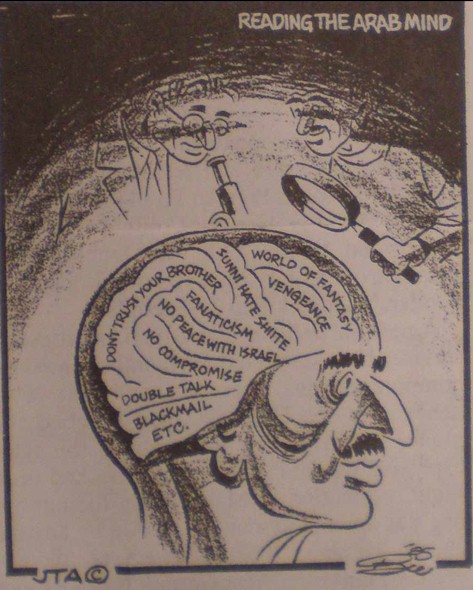
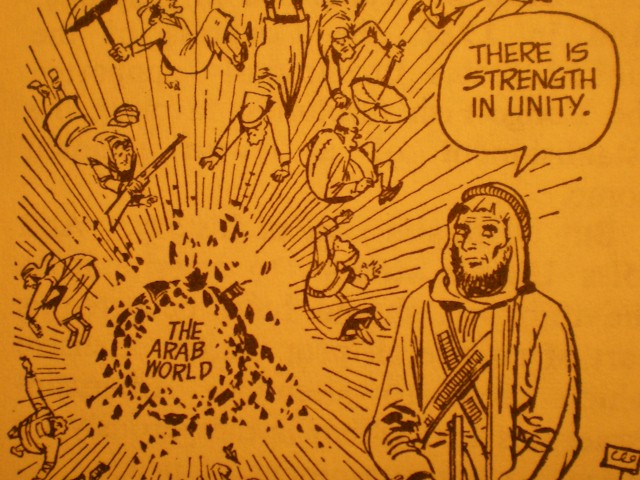
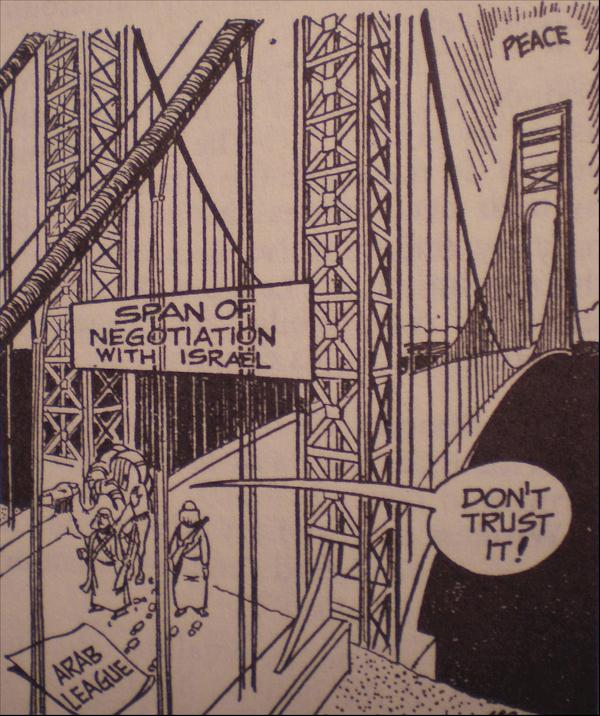
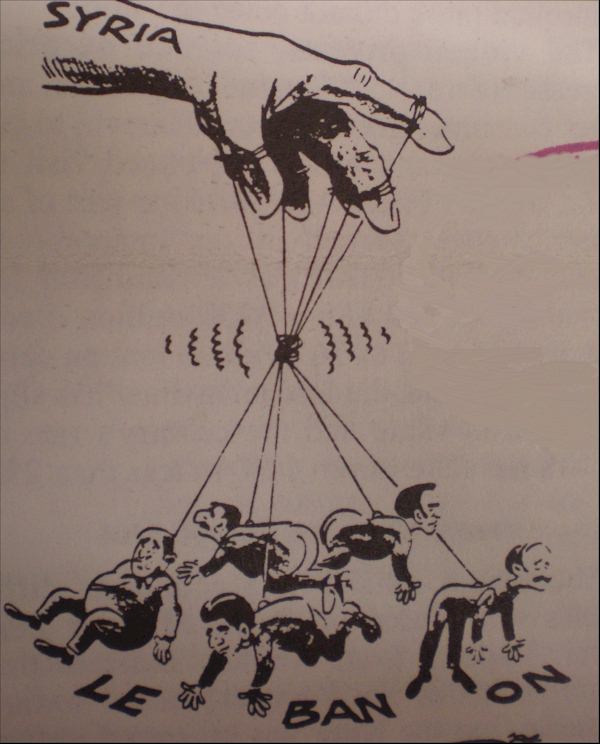
Cartoons from AIPAC’s “Near East Report”

Documents

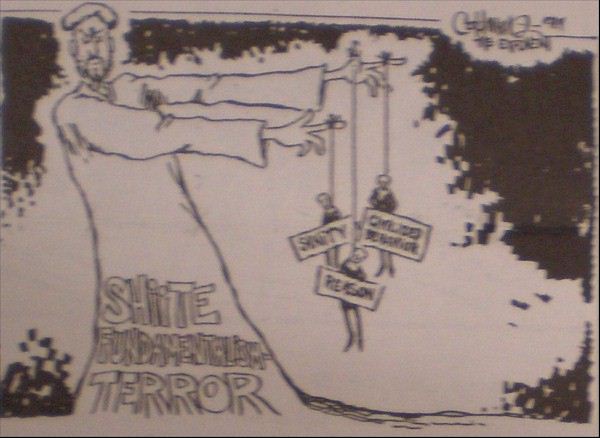
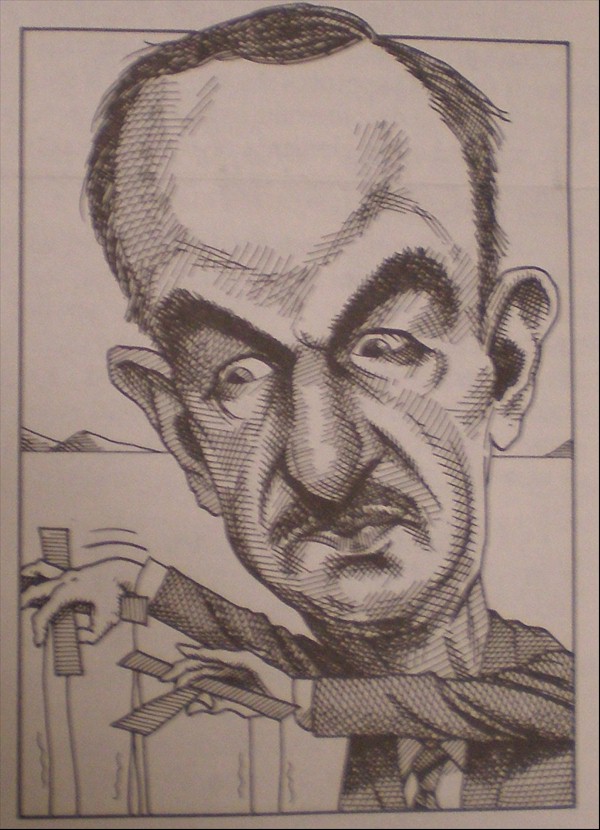
The following cartoons appeared in the “Near East Report” the lobbying newsletter founded by Isaiah L. Kenen and currently published by the American Israel Public Affairs Committee or AIPAC.