Peace Homes Aluva

Simplify Building Your Dream Home

Archives 2009

Lisbon Treaty Referendum: Is the European Union an example for the Islamic World?

Lisbon Treaty Referendum: Is the European Union an example for the Islamic World?

By Yamin Zakaria

Lisbon Treaty established on 13th of December 2007,
is another step towards cementing European unity. Almost all the member
states of the European Union have ratified the treaty through the
parliamentary process. Ireland is the only country to have done this
through a referendum. Once the treaty comes into effect, Europe will
have its first President, Tony Blair looks set to occupy that position.

It all started back in 1957 with the treaty of Rome;
six European countries formed the EEC (European Economic Unity). The
small economic club has now increased to 27 member states, which is
increasingly asserting itself beyond an economic entity. It is only a
matter of time that we may see a call for the creation of a European
army, controlled by the European Parliament, headed by the new
President of Europe. To a spectator, it seems they are moving
inexorably towards a Federal Europe or some kind of super state. Is the
new Roman Empire on the rise again? Many would view this power as a
positive force to counterbalance the negative situation of having a
lone super power.

Only 70 years ago, Europe was at war, and despite
their historical animosity, diversity of language, culture and race,
they are gradually moving forward with greater unification. One can
argue the formation of European unity has been one of the main factors
that have prevented wars breaking out in the continent. This period of
stability is slightly tainted by the limited air raids carried out over
Serbia by the NATO forces. However, this is seen in the fringes of
Europe, and hardly constituted a full-scale war.

Rational justification for unity is self-evident. It
gives more strength by pooling the resources of various nations. A
unified European economy is one of the largest economies in the world
that is competing with the US and the Japanese economy. The Euro looks
set to replace the US Dollar as the dominant currency.

The tide of European unity is opposed by those who
are concerned about sovereignty of their nation. The counter argument
is the old notion of sovereignty of territorial or national integrity
is outdated, has to be modified to conform to the globalised world.
Increasingly the nation’s ability to determine its own economic or
political policy is being limited by the rising tide of globalisation.
Sovereignty is redefined as the ability of a nation to determine the
welfare of its own citizen.

As an example, the European powers have collectively
relinquished some level of political and economical sovereignty for the
increasing collective benefit. Hence, if the UK were to pull out from
the EU it would be more sovereign to determine its economic and
political policies internally, but its influence would be reduced
significantly in the international arena. Consequently, this would harm
the welfare of its own citizen significantly. If it loses power and
influence, in effect it is losing real sovereignty.

Nation states are supposed to be inherently divisive
as each nation seeks to promote its interests. Yet, these European
states have overcome these barriers and forge unity, propelled largely
by the mutual economic benefit, which is reinforced by cultural and
political cohesion brought through education, open debates and
legislation.

Unity does not mean uniformity in every aspect.
Different nations within Europe maintain their cultural identity,
language and religion. In this age, mass participation is a feature of
most society; this implies unity should come from within through mutual
consultation, rather than the imposition of force, like the good old
days of Napoleon. European Union reflects that ethos, and it seems to
be working well.

Many of the Muslim countries and the respective
minorities can learn from European countries like the UK, which has
different nations (Scotland, Wales, Irish) flourishing within. The
minorities retain their cultural identity, there is no ban imposed on
the Celtic or Cornish language or the Scottish Kilt. In fact, the
central government encourages all minorities, including the recent
migrant populations to express their cultural identity; it adds
character to the nation and enriches the culture.

The case for unification of the Islamic world is
even greater. Apart from the rational justification of increasing
material benefit, there is a religious obligation to be unified. Our
values are identical, from Morocco to Indonesia. The cultural
similarities are stronger than our regional differences.

However, the Islamic world is more divided than ever
before, and to blame this entirely on the west is simply being in
denial of our failure. We were colonised argument has passed its sell
by date. Other countries have made considerable progress since
independence, whereas the Muslims countries are constantly falling
behind.

Take the example of India and Pakistan (and
Bangladesh), both countries have gained independence in 1947, yet India
has made far more progression, despite having far greater levels of
disparity in terms of language, race, religion and culture. To blame
the British for the stagnation and corruption that exists within
Pakistan and Bangladesh is ludicrous. Whenever, I have travelled
through these parts of the world, just the experience with the airport
officials seeking bribes tells the story. When you peek under their
cover, you see nepotism and bribery is a way of life. There is no
evidence to suggest the west is dictating or influencing the Muslim
countries to behave in this manner. Why should they?

Those who argue the absence of Caliphate is the
reason for our failure are missing the point. The progression does not
start with the Caliphate but rather Caliphate would embody the result
of our progression, which should begin before that. The existence of
the Caliphate should not be a prerequisite to have the basic level of
civility and some level of progression even within secular
dictatorships or monarchs.

The stable European model and the volatile Islamic
world shows, unity in the modern age has to be achieved gradually
through mutual consultation, rather than the imposition of force. It
has to be cultivated in the minds of people. The various organisations
have failed to create any form of unification, even in terms of close
cooperation between the various Islamic nations. There is deep-seated
racism amongst various racial groups; the Turks see themselves as
superior to Arabs, and the Arabs in turn looks towards the Pakistanis
with disdain, and so on. The example of Iraq clearly illustrates this
fracture, each group based on racial and sectarian motive pursued its
interests, and thus the war was lost even before the US invaded Iraq.

Even the smaller experiment of Arab nationalism has
failed at every level because the same prejudice is replicated amongst
the various Arab states. It is no secret, many of the Arab states are
eager to delete the Palestine issue, rather than collectively confront
Israel. All they can offer is some token economic aid to the
Palestinians after watching the routine Israeli massacres.

The world is moving on, but the Muslims seem to be
stuck in the past literally. You see the endless lectures of what the
Muslims achieved in the 12th century, failing to see the scientific
advances made by the west in the last 500 years have left us behind in
another galaxy!

‘Allah will never change the situation of a people unless they change what is within themselves’ (Quran – 13:11)

Palestinians barred from Old Jerusalem

Israel has deployed extra troops around
the al-Aqsa compound [AFP]

Israeli
police have barred Palestinians protesting in defence of the al-Aqsa
mosque compound from gaining access to Jerusalem’s Old City.

Friday’s
increased restrictions on the mosque compound in occupied East
Jerusalem followed a series of clashes that started late last month.  

Men under the age of 50 were prevented from accessing the mosque for the past six days.


Towards
the end of Friday, Israel lifted its curfew, but for most of the day
several hundred Palestinians were denied entry to the mosque.

Many performed Friday prayers just outside the gates of the Old
City, while the heavily armed Israeli police deployed extra troops.

Palestinian
leaders called for a one-day strike, as some suggested that the Israeli
actions could spark a third uprising, or intifada, against the
occupation.

Mahmoud Abbas, the Palestinian president who heads the Fatah movement, called the strike “to peacefully protest”.

‘Holy places’

The protest also
sought to “proclaim the attachment of the Palestinian people to their
holy places and to Jerusalem as the eternal capital of the independent
Palestinian state”.
  

in depth

  Jerusalem’s religious heart
  Jerusalem’s myriad divisions
  Redefining the holy city’s past
  Video: Praying for al-Aqsa access
  Video: Jerusalem remains an obstacle

Fatah accused Israeli forces of allowing rightwing Jewish extremists to
enter the mosque compound while denying access to Muslims.

Security
forces set up checkpoints around and within the Old City and were seen
turning back Palestinians who do not live or work there.

But they were allowing in tourists and Jews wanting to pray at the
Western Wall – also known as the Wailing Wall – just below the mosque
compound.
  
Most shops in the Old City shut down, though some shop-owners complained about the strike.

“We need to strengthen our presence in Jerusalem, not weaken it,”
said Ramdan Abu Sbeeh, 32, a sweets-seller who defied the strike call.
   
A
senior police official told public radio: “We have deployed thousands
of people in Jerusalem and in the north of Israel following incitation
by extremists.”
  
Israeli police have accused the Islamic
Movement of inciting tension and this week briefly detained its leader,
Sheikh Raed Salah, whom they said had made “inflammatory statements”.
  
Salah,
who previously spent two years in Israeli prison, has repeatedly called
in recent days for Muslims to “defend” al-Aqsa against Israel.

Ongoing clashes

Sherine
Tadros, Al Jazeera’s correspondent in East Jerusalem, said: “Despite
the heavy police presence around the Old City we have still been
hearing of skirmishes and clashes taking place around occupied East
Jerusalem.

“We’ve also heard of a brewing situation taking place not far from
the Old City where dozens of Palestinian protesters have been clashing
for more than an hour with Israeli police forces. There are at least
four Palestinians and five Israeli soldiers who  were injured in those
clashes. The protesters were subjected to tear gas by the Israeli
police, that situation we are hearing has calmed down.

“All of these protests and skirmishes have been taking place today,
as they have been throughout last week, because of Israel’s continued
restrictions on the al-Aqsa mosque. This has caused outrage not just in
the territories but across the Muslim world.

“The Palestinians say it is yet another example of Israel asserting
its occupation and presence here in the Old City. The Israelis are
saying this is simply a security measure to keep the area safe,” she
said.

 Source: Al Jazeera and agencies

Muslim Scientists

Paul Vallely 

From
coffee to cheques and the three-course meal, the Muslim world has given
us many innovations that we take for granted in daily life. As a new
exhibition opens, Paul Vallely nominates 20 of the most influential-
and identifies the men of genius behind them

taken from: http://www.independ ent.co.uk/ news/science/ how-islamic- inventors- changed-the- world-469452. html

1
The story goes that an Arab named Khalid was tending his goats in the
Kaffa region of southern Ethiopia , when he noticed his animals became
livelier after eating a certain berry. He boiled the berries to make
the first coffee. Certainly the first record of the drink is of beans
exported from Ethiopia to Yemen where Sufis drank it to stay awake all
night to pray on special occasions. By the late 15th century it had
arrived in Mecca and Turkey from where it made its way to Venice in
1645. It was brought to England in 1650 by a Turk named Pasqua Rosee
who opened the first coffee house in Lombard Street in the City of
London . The Arabic qahwa became the Turkish kahve then the Italian
caffé and then English coffee.

2
The ancient Greeks thought our eyes emitted rays, like a laser, which
enabled us to see. The first person to realise that light enters the
eye, rather than leaving it, was the 10th-century Muslim mathematician,
astronomer and physicist Ibn al-Haitham. He invented the first pin-hole
camera after noticing the way light came through a hole in window
shutters. The smaller the hole, the better the picture, he worked out,
and set up the first Camera Obscura (from the Arab word qamara for a
dark or private room). He is also credited with being the first man to
shift physics from a philosophical activity to an experimental one.

3
A form of chess was played in ancient India but the game was developed
into the form we know it today in Persia . From there it spread
westward to Europe – where it was introduced by the Moors in Spain in
the 10th century – and eastward as far as Japan . The word rook comes
from the Persian rukh, which means chariot.

4
A thousand years before the Wright brothers a Muslim poet, astronomer,
musician and engineer named Abbas ibn Firnas made several attempts to
construct a flying machine. In 852 he jumped from the minaret of the
Grand Mosque in Cordoba using a loose cloak stiffened with wooden
struts. He hoped to glide like a bird. He didn’t. But the cloak slowed
his fall, creating what is thought to be the first parachute, and
leaving him with only minor injuries. In 875, aged 70, having perfected
a machine of silk and eagles’ feathers he tried again, jumping from a
mountain. He flew to a significant height and stayed aloft for ten
minutes but crashed on landing – concluding, correctly, that it was
because he had not given his device a tail so it would stall on
landing. Baghdad international airport and a crater on the Moon are
named after him.

5 Washing
and bathing are religious requirements for Muslims, which is perhaps
why they perfected the recipe for soap which we still use today. The
ancient Egyptians had soap of a kind, as did the Romans who used it
more as a pomade. But it was the Arabs who combined vegetable oils with
sodium hydroxide and aromatics such as thyme oil. One of the Crusaders’
most striking characteristics, to Arab nostrils, was that they did not
wash. Shampoo was introduced to England by a Muslim who opened
Mahomed’s Indian Vapour Baths on Brighton seafront in 1759 and was
appointed Shampooing Surgeon to Kings George IV and William IV.

6 Distillation,
the means of separating liquids through differences in their boiling
points, was invented around the year 800 by Islam’s foremost scientist,
Jabir ibn Hayyan, who transformed alchemy into chemistry, inventing
many of the basic processes and apparatus still in use today –
liquefaction, crystallisation, distillation, purification, oxidisation,
evaporation and filtration. As well as discovering sulphuric and nitric
acid, he invented the alembic still, giving the world intense rosewater
and other perfumes and alcoholic spirits (although drinking them is
haram, or forbidden, in Islam). Ibn Hayyan emphasised systematic
experimentation and was the founder of modern chemistry.

7
The crank-shaft is a device which translates rotary into linear motion
and is central to much of the machinery in the modern world, not least
the internal combustion engine. One of the most important mechanical
inventions in the history of humankind, it was created by an ingenious
Muslim engineer called al-Jazari to raise water for irrigation. His
1206 Book of Knowledge of Ingenious Mechanical Devices shows he also
invented or refined the use of valves and pistons, devised some of the
first mechanical clocks driven by water and weights, and was the father
of robotics. Among his 50 other inventions was the combination lock.

8
Quiltin
g is a method of sewing or tying two layers of cloth with a
layer of insulating material in between. It is not clear whether it was
invented in the Muslim world or whether it was imported there from
India or China . But it certainly came to the West via the Crusaders.
They saw it used by Saracen warriors, who wore straw-filled quilted
canvas shirts instead of armour. As well as a form of protection, it
proved an effective guard against the chafing of the Crusaders’ metal
armour and was an effective form of insulation – so much so that it
became a cottage industry back home in colder climates such as Britain
and Holland .

9
The pointed arch so characteristic of Europe ’s Gothic cathedrals was
an invention borrowed from Islamic architecture. It was much stronger
than the rounded arch used by the Romans and Normans , thus allowing
the building of bigger, higher, more complex and grander buildings.
Other borrowings from Muslim genius included ribbed vaulting, rose
windows and dome-building techniques. Europe ’s castles were also
adapted to copy the Islamic world’s – with arrow slits, battlements, a
barbican and parapets. Square towers and keeps gave way to more easily
defended round ones. Henry V’s castle architect was a Muslim.

10
Many modern surgical instruments are of exactly the same design as
those devised in the 10th century by a Muslim surgeon called
al-Zahrawi. His scalpels, bone saws, forceps, fine scissors for eye
surgery and many of the 200 instruments he devised are recognisable to
a modern surgeon. It was he who discovered that catgut used for
internal stitches dissolves away naturally (a discovery he made when
his monkey ate his lute strings) and that it can be also used to make
medicine capsules. In the 13th century, another Muslim medic named Ibn
Nafis described the circulation of the blood, 300 years before William
Harvey discovered it. Muslims doctors also invented anaesthetics of
opium and alcohol mixes and developed hollow needles to suck cataracts
from eyes in a technique still used today.

11 The
windmill was invented in 634 for a Persian caliph and was used to grind
corn and draw up water for irrigation. In the vast deserts of Arabia ,
when the seasonal streams ran dry, the only source of power was the
wind which blew steadily from one direction for months. Mills had six
or 12 sails covered in fabric or palm leaves. It was 500 years before
the first windmill was seen in Europe .

12 The
technique of inoculation was not invented by Jenner and Pasteur but was
devised in the Muslim world and brought to Europe from Turkey by the
wife of the English ambassador to Istanbul in 1724. Children in Turkey
were vaccinated with cowpox to fight the deadly smallpox at least 50
years before the West discovered it.

13 The
fountain pen was invented for the Sultan of Egypt in 953 after he
demanded a pen which would not stain his hands or clothes. It held ink
in a reservoir and, as with modern pens, fed ink to the nib by a
combination of gravity and capillary action.

14
The system of numbering in use all round the world is probably Indian
in origin but the style of the numerals is Arabic and first appears in
print in the work of the Muslim mathematicians al-Khwarizmi and
al-Kindi around 825. Algebra was named after al-Khwarizmi’s book,
Al-Jabr wa-al-Muqabilah, much of whose contents are still in use. The
work of Muslim maths scholars was imported into Europe 300 years later
by the Italian mathematician Fibonacci. Algorithms and much of the
theory of trigonometry came from the Muslim world. And Al-Kindi’s
discovery of frequency analysis rendered all the codes of the ancient
world soluble and created the basis of modern cryptology.

15 Ali
ibn Nafi, known by his nickname of Ziryab (Blackbird) came from Iraq to
Cordoba in the 9th century and brought with him the concept of the
three-course meal – soup, followed by fish or meat, then fruit and
nuts. He also introduced crystal glasses (which had been invented after
experiments with rock crystal by Abbas ibn Firnas – see No 4).

16 Carpets
were regarded as part of Paradise by medieval Muslims, thanks to their
advanced weaving techniques, new tinctures from Islamic chemistry and
highly developed sense of pattern and arabesque which were the basis of
Islam’s non-representationa l art. In contrast, Europe ’s floors were
distinctly earthly, not to say earthy, until Arabian and Persian
carpets were introduced. In England, as Erasmus recorded, floors were
“covered in rushes, occasionally renewed, but so imperfectly that the
bottom layer is left undisturbed, sometimes for 20 years, harbouring
expectoration, vomiting, the leakage of dogs and men, ale droppings,
scraps of fish, and other abominations not fit to be mentioned”.
Carpets, unsurprisingly, caught on quickly.

17
The modern cheque comes from the Arabic saqq, a written vow to pay for
goods when they were delivered, to avoid money having to be transported
across dangerous terrain. In the 9th century, a Muslim businessman
could cash a cheque in China drawn on his bank in Baghdad .

18
By the 9th century, many Muslim scholars took it for granted that the
Earth was a sphere. The proof, said astronomer Ibn Hazm, “is that the
Sun is always vertical to a particular spot on Earth”. It was 500 years
befor
e that realisation dawned on Galileo. The calculations of Muslim
astronomers were so accurate that in the 9th century they reckoned the
Earth’s circumference to be 40,253.4km – less than 200km out. The
scholar al-Idrisi took a globe depicting the world to the court of King
Roger of Sicily in 1139.

19 Though
the Chinese invented saltpetre gunpowder, and used it in their
fireworks, it was the Arabs who worked out that it could be purified
using potassium nitrate for military use. Muslim incendiary devices
terrified the Crusaders. By the 15th century they had invented both a
rocket, which they called a “self-moving and combusting egg”, and a
torpedo – a self-propelled pear-shaped bomb with a spear at the front
which impaled itself in enemy ships and then blew up.

20 Medieval
Europe had kitchen and herb gardens, but it was the Arabs who developed
the idea of the garden as a place of beauty and meditation. The first
royal pleasure gardens in Europe were opened in 11th-century Muslim
Spain. Flowers which originated in Muslim gardens include the carnation
and the tulip.

www.1001inventions. com.

Egyptian Pregnant Doctor Murdered in German Court for Wearing Hijab

German courtroom killer allegedly driven by hate of Muslims

Image: Crowds at Egyptian funeral procession
Thousands
of Egyptians surround the coffin of a 32-year old pregnant woman who
was stabbed to death in Germany as she was about to testify against a
man who allegedly called her an Islamist. 
Nasser Nouri / AP

updated 3:37 p.m. ET July 6, 2009
function UpdateTimeStamp(pdt) {
var n = document.getElementById(“udtD”);
if(pdt != ” && n && window.DateTime) {
var dt = new DateTime();
pdt = dt.T2D(pdt);
if(dt.GetTZ(pdt)) {n.innerHTML = dt.D2S(pdt,((”.toLowerCase()==’false’)?false:true));}
}
}
UpdateTimeStamp(‘633825058418130000’);

CAIRO
– Egyptians are horrified by the brutal slaying of a pregnant Muslim
woman stabbed repeatedly inside a German courtroom, calling what they
see as a lack of outrage in Germany evidence of racism and anti-Islamic
sentiment.

On
Monday, thousands of mourners marched behind the coffin of Marwa
al-Sherbini, 32, in her Mediterranean hometown of Alexandria where her
body was buried after being flown back from Germany.

“There
is no god but God and the Germans are the enemies of God,” chanted the
mourners, while others carried banners condemning racism. Her brother Tarek el-Sherbini told The
Associated Press by telephone from the mosque where prayers were being
recited in front of his sister’s coffin. “In the West, they don’t
recognize us. There is racism.”

Courtroom erupts into violence
Al-Sherbini,
who was about four months pregnant, was involved in a court case
against her neighbor for calling her a terrorist and was set to testify
against him when he stabbed her 18 times inside the courtroom in front
of her 3-year-old son.

Her
husband, who was in Germany on a research fellowship, came to her aid
and was also stabbed by the neighbor and shot in the leg by a security
guard who initially mistook him for the attacker, German prosecutors
said. He is now in critical condition in a German hospital, according
to al-Sherbini’s brother.

“The
guards thought that as long as he wasn’t blond, he must be the attacker
so they shot him,” al-Sherbini told an Egyptian television station.

The
man, who has only been identified as 28-year-old Alex W., remains in
detention and prosecutors have opened an investigation on suspicion of
murder.

Driven by a deep hatred
Christian
Avenarius, the prosecutor in Dresden where the incident took place,
described the killer as driven by a deep hatred of Muslims. “It was
very clearly a xenophobic attack of a fanatical lone wolf.”

He
added that the attacker was a Russian of German descent who had
immigrated to Germany in 2003 and had expressed his contempt for
Muslims at the start of the trial.

At
its regular news conference on Monday, a German government spokesman
Thomas Steg said if the attack was racist, the government “naturally
condemns this in the strongest terms.”

The
killing has dominated Egyptian media for days, while it has received
comparatively little coverage in German and Western media.

‘Meager’ response from government, media
A German Muslim group criticized government officials and the media for not paying enough attention to the crime.

“The
incident in Dresden had anti-Islamic motives. So far, the reactions
from politicians and media have been incomprehensibly meager,” Aiman
Mazyek, the general secretary of the Central Council of Muslims, told
Berlin’s Tagesspiegel daily.

Egyptian
commentators said the incident was an example of how hate crimes
against Muslims are overlooked in comparison to hate crimes committed
by Muslims against Westerners. Many commentators pointed to the uproar
that followed the 2004 murder of filmmaker Theo van Gogh by a
Dutch-born Islamic fundamentalist angry over one of his films
criticizing the treatment of Muslim women.

Abdel
Azeem Hamad, chief editor of the independent Egyptian daily el-Shorouk,
said that if the victim had been a Jew, there would be have been in an
uproar.

“What we
demand is just some attention to be given to the killing of a young
innocent mother on the hands of fanatic extremist,” he wrote in his
column.

An Egyptian blogger Hicham Maged, wrote “let us play the ‘What If’ game.”

“Just
imagine if the situation was reversed and the victim was a Westerner
who was stabbed anywhere in the world or — God forbid — in any Middle
Eastern country by Muslim extremists,” he said.

The Egyptian Pharmacists’ Association called for a boycott of German drugs.

According
to numerous interviews in Egyptian local papers with el-Sherbini
family, the man who stabbed al-Sherbini used to accuse her of being a
“terrorist,” and in one incident, he tried to take off her headscarf.

Victim couldn’t find work
Laila
Shams, al-Sherbini’s mother, told the el-Wafd daily that her daughter
said she’d difficulty finding a job in Germany because of her head
scarf.

“One (employer) suggested she remove her head scarf to get a job. She said no,” she said.

Officials
from a German Muslim group and the country’s main Jewish group made a
joint visit Monday to the Dresden hospital where the victim’s husband
is being treated.

“You don’t have to be a Muslim to act against anti-Muslim behavior, and
you don’t have to be a Jew to act against anti-Semitism,” said Stephan
Kramer, the general secretary of the Central Council of Jews.

Israel Deploys Thousands of Police; Outrage Grows Among Palestinians


05 October 2009

Israeli border police officer, masked plainclothes police officers detain Palestinian youth during clashes in east Jerusalem, 5 Oct 2009
Israeli
border police officer, masked plainclothes police officers detain
Palestinian youth during clashes in east Jerusalem, 5 Oct 2009

Israel has deployed thousands of police around Jerusalem’s Old City,
following several recent clashes between Jews and Palestinian Muslims
at the compound that houses sites holy to both groups.  

Israeli
police deployed thousands of additional officers at entrances to the
Old City leading to the compound containing the Al Aqsa mosque – sacred
to Muslims and the Western Wall – Judaism’s holiest site.

Clashes
have erupted during the past week between Muslims and Jewish
worshippers, fueled largely by rumors that Jews were planning to storm
the compound.

Israel national police spokesman Micky Rosenfeld
says Monday was especially sensitive as 30,000 Jewish worshippers
approached the compound – known to Jews as the Temple Mount – at the
start of the week-long Jewish holiday of Sukkot.

“The Temple
Mount was open to Muslims that wanted to come and pray only from the
age of 50 upwards, and women of all ages,” Rosenfeld explained. “This
was necessary to prevent any disturbances from taking place on the
Temple Mount.”

Among those prevented from approaching the area
was 36-year-old Dmitri Diliani, a member of the Revolutionary Council
of the ruling Palestinian Fatah faction of Palestinian President
Mahmoud Abbas.  

“This is pure provocation of the Palestinian people since this is one of the holiest Muslim sites,” Diliani said.

Diliani,
a Christian, serves as the Fatah spokesman for Jerusalem. He told VOA
that Fatah is encouraging Palestinian Muslims to resist what he views
as Jewish efforts to take over the compound.

“Fatah stands at
a point where it will continue to organize the process of defending the
holy sites through popular effort and grass-roots mobilization,” he
said.

Monday saw mobilization by Palestinians against their own
leadership, as anger mounts over a decision by the government of
President Abbas to suspend efforts to bring war crimes charges against
Israeli officials involved in the assault on militants in the Gaza
Strip 10 months ago.

Hundreds of Palestinians protested
peacefully in the West Bank town of Ramallah near Jerusalem. The
protesters included Mustafa Barghouthi, a prominent commentator, who
said the Palestinian leaders’ decision showed little regard for the
people they represent.  

“They lack the ability to have
collective decision,” Barghouthi said. “There was no consultation and
I think they made a grave mistake against the interests of their own
people.”

Israel says it will maintain heightened security in Jerusalem until the tension around the holy sites subsides.  

In
2000, confrontations at the site of the al-Aqsa mosque and the Western
Wall sparked a bloody, Palestinian uprising known as the Second
Intifada, which lasted for several years. 

The Tesla Roadster is a rocket. And all-electric, too

Sep 22, 2009 04:00 PM in Energy & Sustainability |
21 comments

By Mark Fischetti

e-mailprint

comment

tesla-roadster“Are you ready?” the young driver beside me asked, as we sat in the two-seat Tesla Roadster
convertible, facing a straight, steep, quarter-mile road that rises
from the water of San Francisco Bay up the headland to the Golden Gate
Bridge. Then he floored the accelerator. I was driven into the
seat-back behind me—and I mean driven, like I was strapped into some
insane amusement park ride—for several full seconds as the car
accelerated and accelerated like a rocket up the climb. Only there was
no screaming flame blasting behind us. There was no engine roaring
either. I was being shot up this road so fast my emergency senses were
on full alert, yet all was eerily quiet.

The Tesla Motors roadster is an all-electric vehicle. Which means zero
emissions. There’s no engine, no fuel tank, just a deep bank of lithium-ion batteries
and a single-gear, direct-drive motor that hits maximum torque
instantly (that’s the beauty of electric propulsion). The car is
blistering fast; the sport edition goes from zero to 60 miles per hour
in 3.7 seconds. Not up on car specs? The Chevy Corvette, with a monster
6.2 liter, eight cylinder, 430 horsepower engine takes 4.6 seconds. The
Tesla accelerates faster than the Porsche 911. Faster than the Ferrari
Spider. The typical sedan takes a good 6.0 seconds or more to reach the
same speed.

The Tesla is not a one-trick pony, however. It has a range of 244 miles on a full charge,
which it has proven in real-world driving tests. It meets all the
standard safety requirements and looks and handles like any other
exotic roadster, particularly the Lotus: it is a low-slung, two-door,
hard-top convertible with tight cockpit seats and little room for much
else. The price tag is $128,500, which sounds like a lot until you
start looking up exotic roadsters, which can cost even more. If you
want to save some money for sushi lunches on the pier, you can buy the
regular Tesla Roadster for $101,500, but you’ll have to wait a full 3.9
seconds to hit 60 miles per hour.

Few people can afford this car, of course, but the pin-drop quiet
Tesla makes a loud statement: an all-electric car can compete with
gasoline roadhogs. And if they can do that, they can certainly make it
as mainstream vehicles. The Roadster is much more than a proof of
technology; it proves to the world that all-electric automobiles are
for real. The company has begun offering a four-door sedan for $49,900
that will be delivered in 2011.

Sales manager Dan Myggen gave me my ride outside the GoingGreen conference
in Sausalito, Calif. All day he took passengers for a spin around the
half-mile circle in front of the Cavallo Point hotel, then up the steep
road to the bridge. Every person who returned climbed out of the car
with a big smile on his or her face. It was impossible not to grin. The
car looks hot and rides hot. It’s a smile machine. Whether Tesla will
succeed commercially remains to be seen, but other startups are making
their own all-electric models, and the major car companies are diving
in too. Whether the standard claim that volume production will bring
down cost proves true also remains to be seen, but I can say with
certainty, now, that if anyone doubts whether all-electric cars can
compete: they can.

Credit: Courtesey of Tesla Motors

Read More About:

alternative fuels,
electric cars,
Tesla Motors

AGE WELL

Quest for a Long Life Gains Scientific Respect

Published: September 28, 2009

BOSTON — Who would have thought it? The quest for eternal life, or at least prolonged youthfulness, has now migrated from the outer fringes of alternative medicine to the halls of Harvard Medical School.

Robert Spencer for The New York Times

AGE WELL David Sinclair, left, and Christoph Westphal, co-founders of Sitris Pharmaceuticals, in Dr. Sinclair’s laboratory in Cambrdge, Mass. The company develops drugs that mimic resveratrol, a chemical found in some red wines.

RSS Feed

#articleInline ul { margin: .5em 0 1.2em 0; } #articleInline ul li { margin-bottom: .5em; padding: 0; background-image: none; font-size: 81.5%; font-family: Arial, Helvetica, sans-serif; line-height: 1.4em; } #articleInline li a { padding: .2em 0 .2em 4.5em; background: transparent url(http://graphics8.nytimes.com/images/global/icons/rss.gif) no-repeat 0 0; }

At a conference on aging held here last week, the medical school’s dean, Jeffrey Flier, was to be seen greeting participants who ranged from members of the 120 club (they intend to live at least that long) to devotees of very low calorie diets.

The heavyweight at the conference was Sirtris Pharmaceuticals. The company is developing drugs that mimic resveratrol, a chemical found in some red wines. Resveratrol has been found to activate proteins called sirtuins, from which the company derives its name. Activation of sirtuins is thought to help the body ride out famines.

Mice and rats put on a diet with 30 percent fewer calories can live up to 40 percent longer. They seem to do so by avoiding the usual degenerative diseases of aging and so gain not just longer life but more time in good health.

Sirtris’s researchers think that drugs that activate sirtuins mimic this process, strengthening the body’s resistance to the diseases of aging. The company has developed thousands of small chemical compounds that are far more potent than resveratrol and so can be given in smaller doses.

In mice, sirtuin activators are effective against lung and colon cancer, melanoma, lymphoma, Type 2 diabetes, cardiovascular disease and Alzheimer’s disease, said David Sinclair, a Harvard Medical School researcher and co-founder of Sirtris. The drugs reduce inflammation, and if they have the same effects in people, could help combat many diseases that have an inflammatory component, like irritable bowel syndrome and glaucoma.

Any sirtuin activator that averted all these diseases in people would be a rather remarkable drug. So there is considerable interest in how well Sirtris’s drug trials are going.

Sirtris’s senior director of corporate development, Brian Gallagher, said at the conference that four active clinical trials were under way.

SRT-501, the company’s special formulation of resveratrol, is being tested against two cancers, multiple myeloma and colon cancer that has spread to the liver. A chemical mimic of resveratrol, known as SRT-2104, is in a Phase 2 trial for Type 2 diabetes, and in a Phase 1 trial in elderly patients. (Phase 1 trials test for safety, Phase 2 for efficacy.)

Dr. Gallagher said that unpublished tests in mice showed that another chemical mimic, SRT-1720, increased both health and lifespan; after two years, twice as many mice taking the drug were alive compared with the undosed animals. Resveratrol itself has not been shown to increase lifespan in normal mice, although it does so in obese mice, laboratory roundworms and flies.

Sirtris has so far been doubly fortunate. No severe side effects have yet emerged from the clinical trials. The company has also been lucky in having apparently picked the right horse, or at least a good one, in a fast-developing field.

Besides the sirtuins, several other proteins are now known to influence longevity, energy use and the response to caloric restriction. These include the receptors for insulin and for another hormone called IGF-1, and a protein of increasing interest called TOR (“target of rapamycin”). Rapamycin is an antimicrobial that was recently found to extend lifespan significantly, even when given to mice at an advanced age. Since TOR is involved in the response to caloric restriction, rapamycin may extend life through this pathway.

Sirtuins may not be the most important genes for longevity, Dr. Sinclair conceded at the conference, because the pathways controlled by the sirtuins, TOR and the others “all talk to each other, often by feedback loops.”

Many theories of aging attribute senescence to the inexorable buildup of mutations in a person’s DNA. Dr. Sinclair said that in his view “aging can be reversed” because the DNA mutations did not directly cause aging. Rather, they induce the sirtuin molecules that help control the genome to divert to the site of damage. With the sirtuins absent from their usual post, genes are not regulated efficiently, and the cells’ performance degrades. Diversion of the sirtuins should be a reversible process, in Dr. Sinclair’s view, unlike DNA damage, which is not.

“In five or six or seven years,” said Christoph Westphal, Sirtris’s other co-founder, “there will be drugs that prolong longevity.”

But neither Dr. Sinclair nor Dr. Westphal was the most optimistic person at the conference. That status belonged to the English gerontologist Aubrey de Grey, who sports a beard so luxuriant that it is hard to see if he is wearing a tie. His goal is “negligible senescence.”

Some attendees were so convinced of the virtues of less food that they have begun severe diets of various kinds. Cynthia Kenyon, of the University of California, San Francisco, said she had gone on a low-carb diet in 2002 after finding that food with even 2 percent sugar reduced the lifespan of the laboratory roundworms she studies. “Basically I try to steer clear of desserts and starches, though I do eat chocolate,” she said.

Her willowy figure makes her look at least a decade younger than her age. But a practitioner of more severe caloric restriction who was at the conference looked gaunt and a little frail.

Sirtris’s quest for longevity drugs is founded on solid and promising research. But most drugs fail at some stage during trials. So there is no guarantee that any of Sirtris’s candidate compounds will work in people. The first result from a Phase 2 clinical trial is not expected until the end of next year at the earliest.

Meanwhile, it is a pleasant and not wholly unfounded thought that, just possibly, a single drug might combat every degenerative disease of Western civilization.

Being American — and Muslim

Shireen Khan rides a bus in New York City
Shireen Khan rides a bus in New York City.
Nicholas Hegel McClelland for TIME.com

It was evening rush hour in New York City. 42nd St. was packed, and I was hoping I would make the bus. His voice came out of
the crowd.

“Take that rag off!”

Huh?

In my four months of working in New York, that was a first. Actually,
that was a first in the seven years since I started wearing a
hijab. A lot of people turned to look at me as he shouted those
words. I don’t know exactly what I was feeling — some mixture of
anger and embarrassment — but I knew I wanted to stop and explain to
this man the significance of what he dismissed as a “rag.” He didn’t
understand the one thing I cherished most, the thing that I took so much
care in making sure I did right — my religion.

It’s second nature to me now, but in the beginning, learning how to
put on my hijab was a challenge. I taught myself how to tuck my
hair in neatly, where to fasten the safety pin, and what material would
best stay put. It is now the thing that people notice first when they
see me. As a 23-year-old Muslim woman, I can’t imagine walking out of my
house without it.

The explanations for wearing the hijab often start with
modesty. But modesty, like religiosity, is relative. Who am I to say
that I am more modest than someone else just because I cover my hair? I cover because God commanded it in the Qur’an. Wearing
the hijab is first and foremost an act of worship and obedience;
after that, it serves to check my modesty.

Other values such as charity, tolerance and respect, are some of the
same ones that Muslims, American or not, are taught to uphold in their
daily lives. As an American-born Muslim, it’s easy for me to follow
these values — just as easy as it is for my husband and his friends
to gather together to watch the Super Bowl: just sketch in some beards,
insert a prayer break and delete the alcohol. (The legal drinking age is
one American law that Muslims disregard completely — Islam prohibits
alcohol consumption, at any age.) Such strict rules, to some, are a sign
of extremism, and so are the beards — to some, our five daily prayers
are another.

When I was nine years old, my father took a job in Saudi Arabia and
moved our family from Virginia to Riyadh. In Saudi Arabia, there was
easy access to mosques — almost every street or neighborhood had one.
While out shopping, I didn’t have to plan around prayer times: shops
closed at each prayer, and we would simply walk over to the closest
mosque, pray, then resume our shopping. It’s different in America. When
I shop with a friend at a mall in New Jersey, we often find ourselves
looking for a place to pray. We prefer quiet, secluded areas, but
sometimes we have to resort to the fitting rooms. We carry outfits into
separate stalls and pretend to try them on. When I finish praying, I ask
my friend “Are you done?” Yes, she answers, but now she wants to try on
the clothes, and more often than not, we actually end up leaving the
store with a new pair of something.

Prayer is one of the five basic pillars of Islam. “Everyone prays,”
my husband says. People innately want to call out to God. We all do it,
in different ways. By missing my prayers, I would be shrugging off one
of the most important, yet basic, obligations of my faith — being
observant of it doesn’t make me less “American.”

So as I continued my walk to the Port Authority bus terminal that
day, it might have seemed like I didn’t hear that man yell what he did.
But I did. I just chose to ignore it. I figured it wasn’t the right time
to have a discussion, so I just let it pass. I have rarely been bothered
by anybody about my hijab. If anything, I often get complimented
on it. I may cover my hair for the sake of God, but I love getting it
cut and styled. I have a husband who can’t understand how I spend so
much time at the mall; I have big dreams for work; I play sports; I love
to run. I cringe at the word extremist. And I thank God that I am both
Muslim and American at the same time.

Shireen Khan is a producer for Time.com

Gaddafi on Obama, Israel and Iran

Exclusive Interview: Gaddafi on Obama, Israel and Iran

Libyan leader Muammar Gaddafi

Libyan leader Muammar Gaddafi

Marc Asnin / Redux for TIME

  • Print
  • Reprints
  • var artId= “1926125”;
    var chn = “world”;
    var contType = “article”;

var ad = adFactory.getAd(88, 31);
ad.setPosition(8)
ad.write();

On Sept. 24, TIME editors Romesh Ratnesar and Michael Elliott met with Libyan leader Muammar Gaddafi.

Given your experience in dealing what the United States offered
in return for giving up your [nuclear] program, what advice would you
give to a country like Iran? And what advice would you give to the
United States in dealing with Iran’s nuclear ambitions?

America has the responsibility to reward and encourage such countries
who take such decisions, so that they will be able to use nuclear
energy or nuclear power in peaceful means. (Watch the video of TIME’s interview with Libya’s Muammar Gaddafi.)

Upon the advice of our American friends, and others, when they told
us to maybe get in touch with Pyongyang and Iran, and encourage them
and talk to them so that they would not go to the use of nuclear energy
for military purposes, divert the potentials of the capability they
have for peaceful means, the actions or the answers from those such
countries was, What did Libya gain in the trade?

Are you saying that Iranians and North Koreans don’t think that Libya got enough benefits for giving up its program?

Indeed that’s what they said to us. Indeed.

Libya spoke to both the Iranians and the North Koreans on this topic?

Yes, indeed. Of course, I mean we have conveyed to them the wish of the
friends, that they got in touch with us, mainly in the interest, the
wish that they would take the peaceful road.

You’re chairman of the African Union at the moment. You referred
to President Obama in your speech yesterday as the “son of Africa.” Do
you feel a kinship with President Obama? And what would you like the
United States to do in Africa?

Indeed this kinship is there, is existing.

Regarding the second part of the question, Africa, I mean there are
good intentions, legitimately speaking, particularly with international
governing toward Africa — some sort of sympathy.

In the conflict between Israel and the Palestinian people you
have advocated a one-state solution. Many people criticize that kind of
idea as something that would lead to the end of Israel as a Jewish
state, a homeland for the Jews. Do you believe that Israel has a right
to exist as a Jewish state?

I am keen and anxious for the safety of both the Jews and the Palestinians.

The position that we are in, the road that the world is going on,
would lead to the destruction of the Jews. Because generally speaking,
Jews as a community are limited, their number is limited, all over the
world. We know that they’re not that big. Unfortunately, they were
persecuted by all nations. They were persecuted by the Romans and King
Edward I. And we all know the Holocaust during Hitler’s time. Once
seeing the history like that we can only but sympathize with them as
Jews. The Arabs actually were the ones who gave them the safe haven and
the protection along all these areas when they were persecuted. (See pictures of the rise of Gaddafi.)

As recent as ’48 or ’49 — I was a little boy at the time but I can
still remember — the Jews were there in Libya. There was no animosity,
no hatred between us. They were merchants, moving from one place to the
other, traders … and they were very much respected and very much
sympathized with. I mean, they did their own prayers and we saw them.
They spoke Arabic, wearing Libyan uniforms, Libyan clothes.

So that’s why I said, the way things are going, in the end they
would — it will be the eradication of them, or the extinction of such a
community. And I believe that the whole world is plotting against them,
against the Jews. They want to get rid of them, the world wants to. And
things that happened in the past indicate or give witness to this idea
or this notion. It was the Holocaust in Europe. We all know that, this
is a fact. (Read TIME’s 1981 cover story about Libya.)

So what is the answer?

The answer is as follows: That we have to serve God, or guarantee the
safety of the Jews. And this can be done by them accepting the
Palestinians, recognizing the Palestinians, accepting that fact that
they should live with the Palestinians in one state, together.
Unfortunately, the Jews are fighting or struggling against their own
friend — the Arabs. The Arabs did not do the Holocaust, and the Arabs
are not the Romans who persecuted them or massacred them. The only way
open for them is to accept the Arabs and to accept to live with them,
to co-exist with them. Because the establishment of a pure Hebrew state
is not in their own interest. That would be a target. Their protection
comes from being part of the Arab scene. Mixing with the Arabs. I
believe that the youth supports me, supports my idea … Investors
would prefer this mixing with the Arabs, being with the Arabs, living
with the Arabs, co-existing with the Arabs. But they have to accept
refugees that were kicked out in 1948. This is a fundamental thing, a
basic thing. Otherwise, war will continue, the struggle will continue.

Some Americans still view you, and view Libya, with some
suspicion, despite the normalization of relations. How can that
impression be changed and do you think it ever will change?

This is the result of accumulation of so many years of strained
relations between our two peoples and our two countries. It was
propaganda .
.. against us. It was very much exaggerated, this
information campaign, this sustained campaign against us. But if I may
… Over the process of years it will thaw out. I mean, just gradually
through contact, through dialogue, through investment.

I know that the Lockerbie case has come to a legal end,
but there are people in the United States who would still say, in 2003,
Libya accepted responsibility for its officials but it would be
wonderful if it was a heartfelt expression of remorse and an apology
for what happened. That might help thaw the ice.

It was always said that it is not us who did that and they don’t accept
the fact that they have a responsibility for the Lockerbie bombing. And
all the nonaligned nations used to support the Libyan claim. But we go
through the resolutions adopted by … more than 150 countries, both of
the resolutions of the Arab League, all of the resolutions adopted by
the African Union, all of the organizations … conflict resolutions.

But of course, Americans, Libyans, the whole world express sympathy
or regret over such tragedies. No one would be happy over such
tragedies, no one would welcome such a tragedy, indeed, of course. Do
the American people feel happy, are the American people happy over the
killing of the Libyan citizens in 1986? And is the world happy about
the Gaza massacre? By the same token none of us are happy over the
tragedy of Lockerbie. Up to now, if you visit the house that was bombed
in the American raid, you will find a picture of my daughter, a picture
of the daughter of Jim Swire, in a frame there, and everybody goes
there. Our children are all victims. I mean, these pictures, just to
say the fact that we are all fathers of victims.

Tell us about your impressions of America.

We didn’t see anything because of the security measures.

Is there any place in America that you have always wanted to see?

America is so afraid of terror and terrorism to the point that they
don’t allow people to move around freely and see what they wish to see.
I really wish to see the whole of America, if it is possible.

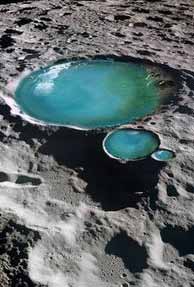
Indian spacecraft finds water on the moon

By
  
IANS

Thursday,24 September 2009, 14:48 hrs

Bangalore: In a
sensational scientific discovery, India’s maiden lunar mission
Chandrayaan-1 has found evidence of water on the moon.

“The moon has distinct signatures of water,” top American scientist Carle Pieters confirmed Thursday.

“The evidence of water molecules on the surface of the moon was found
by the moon mineralogy mapper (M3) of the US-based National Aeronautics
and Space Administration (NASA) on board Chandrayaan-1,” M3 principal
investigator Carle Pieters said in a paper published in the journal
Science.

M3 was one of the 11 scientific instruments on board the lunar
spacecraft that was launched Oct 22, 2008 by the Indian Space Research
Organisation (ISRO). The mission was aborted Aug 30 after Chandrayaan-1
lost radio contact with Earth.

Crediting ISRO for its role in the findings, Pieters said: “If it were
not for them (ISRO), we would not have been able to make this
discovery.”

ISRO chairman G. Madhavan Nair had told the media Wednesday that he
could not yet confirm the presence of water on the moon, but “before
the end of this week, we will let you know”.

However, confirming the finding and terming it a major discovery,
Pieters said the discovery of water on the lunar surface would
reinvigorate studies of the moon and potentially change thinking on how
it originated.

“Hydroxyl, a molecule consisting of one oxygen atom and one hydrogen
atom, were discovered across the entire surface of the Earth’s nearest
celestial neighbour,” claimed Pieters, a planetary geologist at Brown
University in Rhode Island.

Though the abundance of the hydroxyl molecules are not precisely known,
about 1,000 parts per million could be in the lunar soil, the paper
noted.

“Harvesting one ton of the top layer of the moon’s surface will yield
as much as 32 ounces (907 grams) of water,” scientists involved in the
discovery said.

As lead author of the M3 findings, Pieters said more evidence of water was found in the moon’s high latitudes.

“It greatly expands current thinking about where water in any form was presumed to be located,” she pointed out.

The findings give rise to interesting new questions about where the water molecules come from and where they may be going.

Scientists have speculated that water molecules may migrate from
non-polar regions of the moon to the poles, where they are stored as
ice in ultra-frigid pockets of craters that never receive sunlight.

“If the water molecules are as mobile as we think they are — even a
fraction of them — they provide a mechanism for getting water to those
permanently shadowed craters. This opens a whole new avenue (of lunar
research), but we have to understand the physics of it to utilise it,”
Pieters noted.

The NASA payload found water molecules and hydroxyl at diverse areas of
the sunlit region of the moon’s surface, but the water signature
appeared stronger at the moon’s higher latitudes.
Two NASA spacecrafts — the
Visual and Infrared Mapping Spectrometer (VIMS) on the Cassini
spacecraft and the High-Resolution Infrared Imaging Spectrometer on the
EPOXI spacecraft also confirmed the data on the discovery of water by
M3.

“This is a very, very important finding… If somehow water was found
on the moon, you could use that water right out there. You could
extract it,” said Amitabha Ghosh, space scientist at NASA.

“Right now, we don’t know what temperature it is, and whether there is a cost effective way of extracting it,” he added.