Peace Homes Aluva

Simplify Building Your Dream Home

Archives 2009

Six Imams ‘Flying While Muslim’ Case Goes to Trial

CAIR ACTION ALERT #583:

Action: Six Imams ‘Flying While Muslim’ Case Goes to Trial
Minn. judge sides with imams on key issues in discrimination lawsuit

(WASHINGTON, D.C., 7/27/09) – CAIR is urging members of the Muslim community and other people who value a diverse and inclusive society to support justice in the case of the six American imams who say their rights were violated in 2006 when they were removed from a US Airways flight in Minnesota and arrested.

On Friday, CAIR released the breaking news that a judge in Minnesota sided with the imams on key issues in their lawsuit against those involved in their removal from the plane. U.S. District Judge Ann Montgomery cleared the way for a trial by denying several motions to dismiss the case and ruling that a law passed by Congress after the incident does not grant protection from lawsuits to those sued by the imams.

SEE: Imams Can Pursue Claims Against Police, Judge Rules (Star Tribune)
SEE ALSO: Judge Says Imams Booted from Flight Can Sue Police (MPR)

Judge Montgomery also ruled that the actions of the imams prior to their flight did not justify their detention. She noted that the imams were subjected to “extreme fear and humiliation of being falsely identified as dangerous terrorists.”

Read the entire ruling here.

“The six imams ‘flying while Muslim’ case is a landmark in our nation’s civil rights movement, like other historic cases that have defined the struggle for equality and constitutional rights,” said CAIR National Executive Director Nihad Awad. “We urge all those who value freedom of religion and freedom from discrimination to support the imams in the final phase of their case.”

He said justice in this case will, inshallah, set a positive precedent against religious and ethnic profiling for travelers of all faiths. Awad noted that CAIR receives a number of reports each year from those who believe they were singled out for “flying while Muslim.”

Earlier this month, CAIR called on the Transportation Security Administration (TSA) to investigate an incident in which a disabled Muslim traveler from Pennsylvania was forced to undergo a “humiliating” search by airport security personnel in Ohio.

IMMEDIATE ACTION REQUESTED TO MAKE THIS EFFORT SUCCEED:

1. Pray for the success of the case and the protection of the civil and religious rights of the traveling public.

2. Help make history by supporting the imams in the final phase of the case, the trial in August.

To donate, click here:

PLEASE POST, COPY AND DISTRIBUTE

In AP’s budget of Rs 1 lakh crore, share of Muslims is less than 0.25%

By Mohammed Siddique, TwoCircles.net,

Hyderabad: Andhra Pradesh’s budget for the year 2009-10, with a
total outlay of more than Rs 1 lakh crore, has come as a big
disappointment to the Muslim minority as the state’s Congress
government has not increased a single rupee in its last year’s
allocation of Rs 177 crore.

In the budget presented by the state finance minister K Roshaiah in
the state assembly, the total budget of minority welfare department has
been retained at Rs 177 crore. But the total figure has been shown as
Rs 222 crore by adding the Rs 45 crore of central government’s schemes
for the minorities.

The allocation of Rs 177 crore out of the total budget of Rs 1 lakh
three thousand crore means that the share of the minorities was less
than quarter of a percent. On the contrary, the government has
allocated Rs 702 crore for the backward classes welfare and Rs 309
crore for the tribal welfare.

According to the Census 2001, Muslims constitute 9.17% of the state population of 762,10,007.

An amount of Rs 700 crore will be spent on the educational
scholarships and fee reimbursement of BC students and Rs 83 crore on
tribal students.

The minority welfare budget, which was Rs 120 crore in 2007-08, was
increased to Rs 177 crore in 2008-09 crore. As the support of the
Muslim minority had played a crucial role in bringing Congress back to
power both in the state and the center, the minority community was
hopeful of being rewarded with a handsome increase in its budget. But
they were in for a big disappointment as the allocation for some of the
schemes was drastically reduced.

The state government has earmarked an amount of Rs 153 crore for the
educational scholarships and fee reimbursement and the central
government has provided another Rs 45 crore for the scholarships to the
minority students of Andhra Pradesh. This will take the total fund for
educational programs to Rs 198 crore.

There has been a big change in the component of scholarship and free
reimbursement. The budget for pre and post metric scholarship has been
reduced from last year’s Rs 80 crore to Rs 75.09 crore, the allocation
for fee reimbursement for the higher education and professional courses
has been increase from Rs 35 crore of last year to Rs 72.75 crore. Rs
10 crore is provided for the minority girls residential schools.

However the budget for the mass marriages, which was Rs 5 crore last
year has been reduced to mere Rs 1.25 crore Similarly the budget for
the repair of mosques and churches was reduced from Rs 5 crore to Rs 1
crore. The government retained Rs 2 crore subsidy for the Christians
going on pilgrimage to Bethlehem.

Voicing the dejection and unhappiness of the Muslim minority over
the budgetary allocation Majlis-e-Ittehadul Muslimeen described the
budget as “ridiculous and disappointing”.

“Several representations were made to the state government for the
welfare and over all development of minorities specially Muslims. But
the decision of the government shows that it only wants to use Muslims
as a vote bank”, said MIM floor leader Akbaruddin Owaisi.

Warning the Congress party to change its attitude, Owaisi said that Muslims can not be placated by offering the lollypops.

“The state government is making a lot of noise about allocations for
the educational scholarships and fee reimbursements, but the fact is
that still there are thousands of minority students at every level who
are not getting the scholarships”, he said.

Apart from causing the disappointment all around, the budget will
also have a crippling impact on various minorities institutions
including the AP Urdu Academy, Waqf Board and state Haj Committee. The
petty allocations made include Rs 34.62 lakhs for minorities
commission, Rs 36 lakhs for Urdu Academy, Rs 2.80 lakh for Dairatul
Maarif, 8.61 lakh for Waqf properties administration and Rs 15.68 lakh
for Waqf Tribunal.

Demand for higher allocations for the minorities also echoed among
the Muslim leaders of Congress party. The state Congress general
secretary Abid Rasool Khan said that while an amount of Rs 6000 crore
was allotted for the welfare of all the sections of society, the budget
for minority welfare should be increased to Rs 1000 crore.

He pointed out that Muslims will also benefit from the budgetary
allocations made for various other schemes like free health insurance
and Indiramm Housing.

‘s top judge: Lawyers to wear Muslim headscarf

GAZA CITY, Gaza Strip — Gaza’s top judge says he has ordered female
lawyers to wear Muslim headscarves when they appear in court.

The
move is the latest sign that Gaza’s Islamic militant rulers are
increasingly imposing on residents of the coastal strip their strict
interpretation of Islamic law.

Supreme Court chief justice
Abdul-Raouf Halabi says he issued his headscarves order to conform with
Islamic law, which says it’s forbidden for a woman to show her hair in
public.

Hamas seized power in Gaza in June 2007 and vowed never
to force its conservative values on others. But it has taken a series
of steps in recent months that appear to be aimed at forcing residents
to accept its Islamic-oriented social agenda.

Copyright © 2009 The Associated Press. All rights reserved.

Related articles

Morocco challenges Mideast Holocaust mind-set

RABAT, Morocco — From the western edge of the Muslim world, the King
of Morocco has dared to tackle one of the most inflammatory issues in
the Middle East conflict — the Holocaust.

At a time when Iranian
President Mahmoud Ahmadinejad’s dismissal of the Holocaust has made the
biggest headlines, King Mohammed VI has called the Nazi destruction of
the Jews “one of the most tragic chapters of modern history,” and has
endorsed a Paris-based program aimed at spreading the word among fellow
Muslims.

Many in the Islamic world still ignore or know little
about the Nazi attempt to annihilate the Jews during World War II. Some
disbelieve it outright. Others argue that it was a European crime and
imagine it to be the reason Israel exists and the Palestinians are
stateless.

The sentiment was starkly illustrated in March after a
Palestinian youth orchestra performed for Israeli Holocaust survivors,
only to be shut down by angry leaders of the West Bank refugee camp
where they live.

“The Holocaust happened, but we are facing a
similar massacre by the Jews themselves,” a community leader named
Adnan Hindi said at the time. “We lost our land and we were forced to
flee.”

Like other moderate Arab leaders, King Mohammed VI must
tread carefully. Islamic fervor is rising in his kingdom, highlighted
in 2003 by al-Qaida-inspired attacks in Casablanca on targets that
included Jewish sites. Forty-five people died.

The king’s
acknowledgment of the Holocaust, in a speech read out in his name at a
ceremony in Paris in March, appears to further illustrate the radically
different paths that countries like Morocco and Iran are taking.

Morocco
has long been a quiet pioneer in Arab-Israeli peace efforts, most
notably when it served as a secret meeting place for the Israeli and
Egyptian officials who set up President Anwar Sadat’s groundbreaking
journey to Jerusalem in 1977.

Though Moroccan officials say the
timing is coincidental, the Holocaust speech came at around the same
time that Morocco severed diplomatic relations with Iran, claiming it
was infiltrating Shiite Muslim troublemakers into this Sunni nation.

The
speech was read out at a ceremony launching the “Aladdin Project,” an
initiative of the Paris-based Foundation for the Memory of the Shoah
(Holocaust) which aims to spread awareness of the genocide among
Muslims.

It organizes conferences and has translated key
Holocaust writing such as Anne Frank’s diary into Arabic and Farsi. The
name refers to Aladdin, the young man with the genie in his lamp, whose
legend, originally Muslim, became a universally loved tale.

The Holocaust, the king’s speech said, is “the universal heritage of mankind.”

It
was “a very important political act,” said Anne-Marie Revcolevschi,
director of the Shoah foundation. “This is the first time an Arab head
of state takes such a clear stand on the Shoah,” she said in a
telephone interview.

While the Israeli-Palestinian conflict often
aggravates Arab sentiment toward Israel, Morocco has a long history of
coexistence between Muslims and Jews.

The recent Israeli military
offensive in the Gaza Strip has further inflamed resentment at Israel’s
treatment of the Palestinians. But Ahmed Hasseni, a Casablanca cab
driver, echoes a widely held view that it shouldn’t affect relations
with Morocco’s Jews.

“We’re not dumb,” he said. “We don’t confuse the Israeli army with the Jewish people,” he said.

Jews
have lived in Morocco for 2,000 years. Their numbers swelled after they
were expelled from Spain in 1492, and reached 300,000 before World War
II, when yet more fled the German occupation and found refuge in
Morocco, then a French colony.

Today they number just 3,000, most
having emigrated to France, North America or Israel, but they are free
to come back to explore their roots, pray at their ancestors’ graves
and even settle here.

Simon Levy heads the Jewish Museum in
Casablanca, a treasure trove of old Torah scrolls, garments and jewelry
illustrating the rich culture of Moroccan Jewry.

“That I still run the only Jewish museum in the Arab world is telling,” he said.

Andre
Azoulay, a top adviser to the current king, is Jewish and one of six
members of the king’s council in a monarchy that oversees all major
decisions. Considered one of Morocco’s most powerful men, he views his
country as “a unique case” for the intensity of its Jewish-Muslim
relations. “We don’t mix up Judaism and the tragedy of the Middle
East,” he told The Associated Press in an interview.

A founding
member of the Aladdin project, Azoulay says part of the program’s goal
is to show the West that Muslims aren’t hostile to Jews, and that
Morocco was among countries that resisted Nazi plans to exterminate
their Jewish populations. He points to king Mohammed V, the current
ruler’s grandfather, who is credited with resisting French colonial
anti-Semitic policies.

Such actions were rare, but not unique in
North Africa during World War II. In Tunisia, the late Khaled
Abdelwahhab hid Jews from the Nazis on his farm, and was the first Arab
to be nominated as “Righteous Among the Nations,” a title bestowed by
Yad Vashem, Israel’s Holocaust memorial, on those who risked their
lives to save Jews in the Holocaust. His case is still under study.

The
Aladdin project is only just beginning. Its work has yet to reach
schools or bookstores in Morocco, although the Shoah foundation’s
Revcolevschi said Anne Frank’s diary is among Holocaust memoirs
available in Arabic and Farsi on the Internet, and is being sold under
the counter in Iran.

“People speak of a clash of civilizations, but it’s more a clash of ignorance,” she said. “We’re countering this.”

Hakim
El Ghissassi, an aide to the senior Islamic Affairs official who
delivered Mohammed’s speech, said the king is uniquely positioned to
promote Islam’s dialogue with Judaism, because his titles include
“Commander of the believers” — meaning he is the paramount authority
for Moroccan Muslims.

“What the king has said on the Holocaust
reflects our broader efforts,” said El Ghissassi, listing such reforms
as courses to reinforce Morocco’s tradition of tolerant Islam by
familiarizing local imams with Jewish and Christian holy books.

“We want to make sure everybody can differentiate between unfair Israeli policies and respect for Judaism,” he said.

Copyright © 2009 The Associated Press. All rights reserved.

Related articles

China, Uighur Groups Give Conflicting Riot Accounts

China, Uighur Groups Give Conflicting Riot Accounts

More than 150 people have been killed in rioting in China’s northwestern Xinjiang region, with the government blaming exiled separatists for the traditionally Muslim area’s worst case of unrest in years.

Washington Post Foreign Service
Saturday, July 25, 2009

BEIJING — Three weeks after the riots that left nearly 200 people dead and more than 1,700 injured in the capital of the far western Xinjiang region, the Chinese government and Uighur exile groups have been circulating dueling versions of what happened, in an emotional global propaganda war with geopolitical implications.

This Story

<!– var rn = ( Math.round( Math.random()*10000000000 ) ); document.write('‘) ; // –>

According to the version of events offered by China’s Foreign Ministry and state media, the ethnic unrest that erupted in Urumqi on July 5 was a terrorist attack by Uighur separatists. Women in black Islamic robes stood at street corners giving orders, and at least one handed out clubs, officials said, before Muslim Uighur gangs in 50 locations throughout the city simultaneously began beating Han Chinese.

In the account being circulated by Rebiya Kadeer, a U.S.-based Uighur leader who has emerged as the community’s main spokesman, Chinese security forces were responsible for the violence that night. According to Kadeer, police and paramilitary and other troops chased peaceful demonstrators, mostly young people protesting a deadly factory brawl elsewhere, into closed-off areas. Then they turned off streetlights and began shooting indiscriminately.

Clear Details Absent

Chinese authorities have allowed foreign reporters access to the area where the clashes occurred and unusual freedom to conduct interviews, and they have provided evidence verifying the brutal attacks on Han Chinese. But few details are clear, and many witnesses who might be able to answer other questions — Who set off the initial violence? Why were the police unable to stop the attacks? — are either in jail or dead.

“The narratives of both the Chinese government and outside observers about what happened are hobbled by the lack of independent, verifiable accounts,” said Phelim Kine, a researcher with New York-based Human Rights Watch, which is calling for a U.N. investigation into the incident.

Both sides face huge obstacles in trying to convince the world of their stories.

The Chinese government, after decades of covering up and denying such incidents, has a major trust problem, many analysts say. Chinese officials have said they will release video footage of the attacks, phone records and other evidence to support their view of the events in Urumqi, but have not yet done so.

if ( show_doubleclick_ad && ( adTemplate & INLINE_ARTICLE_AD ) == INLINE_ARTICLE_AD && inlineAdGraf ) { placeAd(‘ARTICLE’,commercialNode,20,’inline=y;’,true) ; } <!– if ( show_doubleclick_ad && ( adTemplate & INLINE_ARTICLE_AD ) == INLINE_ARTICLE_AD && inlineAdGraf ) { document.write('

‘) ; } // –>

For Kadeer, a 63-year-old former business mogul from Xinjiang who was exiled in 2005 and now lives in the Washington area, observers say the main challenge is convincing people that she can give an authoritative account of events that happened in a country she has not visited in years. Uighur exile groups have declined to provide information about their sources in China, saying they fear that those people will be arrested or worse if they speak out.

Resentment has been building for years between Han Chinese, who make up 92 percent of China’s population and dominate its politics and economy, and Uighurs, who once were the majority in the far west, but whose presence there has shrunk in recent decades because of migration by Han Chinese.

Although the Chinese government says its policies have improved Uighurs’ educational and job opportunities, some Uighurs say its goal is to assimilate them at the expense of their language, religion and culture.

In the past, the government has linked Uighur separatism to a group known as the East Turkestan Islamic Movement, which it characterizes as a terrorist organization and blames for some recent attacks. Some analysts say that China exaggerates the influence of this group.

When it comes to the events of July 5, Dong Guanpeng, director of the Global Journalism Institute at Tsinghua University in Beijing, said he thinks China is being honest this time, but that doubts have been cast on the information it is releasing because Kadeer is “doing a better job than the Chinese government in public relations.”

“Of course, Rebiya’s statements have won sympathy in foreign countries,” Dong said. “They contain beautiful lies.”

<!–
var rn = ( Math.round( Math.random()*10000000000 ) );
document.write('‘) ;
// –>

Kadeer’s version of events appears to have gained traction abroad. In
Turkey, Prime Minister Recep Tayyip Erdogan has expressed solidarity
with China’s Uighurs, a Turkic-speaking minority group, and described
the riots as “a kind of genocide.” Protesters in Tokyo, Washington,
Munich and Amsterdam have descended on Chinese embassies and consulates
demanding a full account of what happened to Uighurs. A top Iranian
cleric condemned China for “horribly” suppressing the community, and
al-Qaeda’s North African arm vowed to avenge Uighurs’ deaths.

Zhan Jiang, a professor of journalism and mass communications at the
China Youth University for Political Sciences, contends that the
Chinese government inadvertently elevated Kadeer’s status and gave her
an audience that she does not deserve. Beijing has accused Kadeer of
being the “mastermind” behind the clashes in Urumqi, accusations she
denies.

“The government should haven’t portrayed her as a hero by condemning
her. She was unknown at first, and she is a well-known person in the
world right now,” Zhan said.


Gaps in Both Stories

Meanwhile, China has hit back by assigning some blame to third
parties. The Communist Party’s People’s Daily newspaper said that the
United States backed the “separatists” who launched the attacks. It
also said that Kadeer’s organization received funds from the National
Endowment for Democracy, which in turn is funded by the U.S. Congress.
Separately, the official China Daily has played up the terrorism angle,
saying that the riots were meant to “help” al-Qaeda and were related to
the continuing U.S. military presence in Afghanistan.

Some analysts say there are holes in both sides’ narratives.

For instance, according to Kadeer’s timeline of events, the violence
was triggered by police who “under the cover of darkness . . . began to
fire” on the protesters. But witnesses have said the rioting began
about 8 p.m. Beijing time, when the sun was still up in Urumqi, 1,500
miles west of Beijing.

if ( show_doubleclick_ad && ( adTemplate & INLINE_ARTICLE_AD ) == INLINE_ARTICLE_AD && inlineAdGraf )
{
placeAd(‘ARTICLE’,commercialNode,20,’inline=y;’,true) ;
}

<!–
if ( show_doubleclick_ad && ( adTemplate & INLINE_ARTICLE_AD ) == INLINE_ARTICLE_AD && inlineAdGraf )
{
document.write('

‘) ;
}
// –>

Chang Chungfu, a specialist in Muslim and Uighur
studies at the National Chengchi University in Taiwan, said “the two
parties — the government and Kadeer — are choosing the parts of the
stories that favor their own agendas,” in efforts to win foreign
sympathy.

He said he considers it “unlikely that a peaceful protest turned
into violence against innocent people just because of policemen
cracking down,” suggesting at least a measure of organization to the
Uighurs’ attacks on Han Chinese that night.

On the other hand, Chang said, he is skeptical of the government’s
assertions that Kadeer instigated the attacks because she lacks that
kind of power. Furthermore, he said, “the government hasn’t released
detailed information of those who were killed, such as their ages and
identities, so even the number of dead is in doubt.”

Li Wei, a terrorism expert at the China Institutes of Contemporary
International Relations, which is affiliated with China’s national
security bureau, dismissed allegations by state media of involvement by
outside terrorist groups. “I have not found any proof that points at
linkage between the riot and other terrorism groups, including
al-Qaeda,” he said.

Li did say, however, that he believes Kadeer is in contact with the East Turkestan Islamic Movement.

Rohan Gunaratna, a Singapore-based terrorism expert, blamed some of
the tension on Beijing’s failure to differentiate “between terrorists
who attack and the political activities of separatists.”

“If China is too hard on the Uighur people, then support of
terrorism will grow,” Gunaratna said. “The Chinese government must be
hard on terrorists but soft on the Uighur people.”

Researchers Liu Liu, Wang Juan and Zhang Jie contributed to this report.

Hu Says China Will Deal Harshly With Instigators
Article
| URUMQI, China, July 9 — Chinese President Hu Jintao and other top
leaders of the Communist Party vowed Thursday to severely punish those
responsible for the bloody, ethnically charged clashes this week in the
far western region of Xinjiang.
This Story
China, Uighur Groups Give Conflicting Riot Accounts
Article
| BEIJING — Three weeks after the riots that left nearly 200 people
dead and more than 1,700 injured in the capital of the far western
Xinjiang region, the Chinese government and Uighur exile groups have
been circulating dueling versions of what happened, in an emotional
global propaganda war with…
This Story
Security Troops Blanket Chinese City
Article
| URUMQI, China, July 8 — The Chinese government blanketed this
strife-torn city with 20,000 new security troops on Wednesday, as
thousands of residents began to flee after deadly ethnic clashes
erupted over the weekend.
China Unrest Tied To Labor Program
Article
| URUMQI, China — When the local government began recruiting young
Muslim Uighurs in this far western region for jobs at the Xuri Toy
Factory in the country’s booming coastal region, the response was mixed.


= 0 ) ? wp_article.comments_period : 3 ;

if ( typeof thisNode == ‘undefined’ )
thisNode = ‘admin’ ;

// (wp_article.allow_comments) && !(black list) && (white list) of ancestors and sections goes here
if ( SITELIFE_ENABLED
&&
( typeof wp_article != “undefined” && typeof wp_article.allow_comments != “undefined” && wp_article.allow_comments != “no” )
&&
!( thisNode.match(//wires$/) || thisNode.match(/^artsandliving/(entertainmentguide|entertainmentnews|travel/index)($|/)/) || thisNode.match(/^business/(portfolio)($|/)/) || thisNode.match(/^metro/(obituaries)($|/)/) )
&&
( thisNode.match(/^(artsandliving|business|cars|education|health|jobs|liveonline|metro|nation|opinions?|realestate|religion|politics|sports|technology|world|kidspost|media)($|/)/) || thisNode.match(/^print/(washpostmagazine|style|sundayarts|sundaysource|weekend)($|/)/) ))
{
COMMENTS_ALLOWED = true ;
document.write(“#ArticleCommentsWrapper {display:block};”);
if(! checkDaysOld(comments_period) ) {
COMMENTS_ACTIVE = true ;
} else {
COMMENTS_ACTIVE = false ;
}
} else {
document.write(”);
}
// –>
#ArticleCommentsWrapper {display:block};

<!–
if (SITELIFE_ENABLED) {
// Include the WPNI functions to display SiteLife content on the page.
document.write("n”);
}
// –>

Discussion Policy

Comments that include profanity or personal attacks or other
inappropriate comments or material will be removed from the site.
Additionally, entries that are unsigned or contain “signatures” by
someone other than the actual author will be removed. Finally, we will
take steps to block users who violate any of our posting standards,
terms of use or privacy policies or any other policies governing this
site. Please review the full rules governing commentaries and discussions. You are fully responsible for the content that you post.

Fence not done and never will be, it seems

Fence not done and never will be, it seems – Haaretz – Israel News

Fence not done and never will be, it seems
By Amos Harel
Tags: Ariel Sharon

Seven years after construction work began on the West Bank separation fence, the project seems to have run aground. Work has slowed significantly since September 2007, and today, after the state has spent about NIS 9.5 billion, only about 60 percent of the more limited, revised route has been completed.

With fierce opposition coming from the United States, Israel has halted work on the “fingers” – enclaves east of the Green Line that were to have included large settlement blocs such as Ariel, Kedumim, Karnei Shomron and Ma’aleh Adumim, within the fence. The military has, in practice, closed up the holes that were to have led to these “fingers.” But giant gaps remain in the southern part of the fence, particular in the southern outskirts of Jerusalem, in the Etzion bloc and in the Judean Desert.

Since the cabinet under former prime minister Ariel Sharon first approved construction of the fence, in June 2002, the route has undergone some dramatic changes. The original route, which was inspired by Sharon, was to have effectively annexed about 20 percent of the territory of the West Bank to Israel.
Advertisement

In June 2004 the High Court of Justice, ruling on a petition by residents of Beit Sourik, ordered the state to amend the route to reduce the disruption it caused to Palestinians.

About nine days later the International Court of Justice in The Hague issued an advisory opinion declaring the barrier illegal and demanding that Israel dismantle it.

In response, the cabinet amended the route in February 2005 to include just nine percent of the West Bank. In April 2006 an additional one percent was shaved off by the government of Ehud Olmert.

In practice, however, the route encompasses only 4.5 percent of West Bank land. The four “fingers” in the last map (and which Israel presented at Annapolis in November 2007) were never built, not at Ariel and Kedumim (where a “fingernail” was built, a short stretch of fence east of the homes of Ariel); not at Karnei Shomron and Immanuel; not at Beit Arieh, nor south of that, at Ma’aleh Adumim. Instead, with little publicity, fences were put up to close the gaps closer to the Green Line, at Alfei Menashe instead of at Kedumim, at Elkana instead of Ariel and in the Rantis area instead of at Beit Arieh.

About 50,000 people in these settlements remain beyond the fence. West of Ma’aleh Adumim the wall built along Highway 1 blocks the gap in the barrier and leaves the city’s 35,000 residents outside of the barrier, forcing them to pass through a Border Police checkpoint in order to reach Jerusalem. The fact that the “fingers” were never built also damages these people’s security because the state refuses to build periphery fences around them and declare their proximity to a “special military area.”

In some cases, such as the roads built around the original barrier route at the Beit Arieh enclave, hundreds of millions of shekels were wasted on unused roads that may never be completed.

Large gaps remain in the southern West Bank. Between Gilo in south Jerusalem and Gush Etzion are tens of kilometers of barrier, work on which was suspended due to two High Court petitions – one filed by residents of Beit Jala, the other by villagers from Batir, Husan and Nahalin. As a result access to Jerusalem from the direction of Bethlehem is relatively easy – for commuters and terrorists both.

In the case of the former petition, the state has delayed submitting its response for months. In the second, the High Court has still not ruled after about two and a half years. Part of the dispute is over the construction of the eastern barrier, one of two surrounding Gush Etzion. The bloc, which even the Palestinians will presumably agree to keeping – at least part of it – within Israeli territory in the final-status agreement, has been without a barrier for seven years.

A second, 30-kilometer gap in the fence, stretches from Metzudat Yehuda (Yatir) in the west to the Dead Sea in the east. The state announced during a recent High Court deliberation of a petition submitted by area Bedouin that work on the barrier there was suspended.

The delay in building the barrier at Ma’aleh Adumim is typical and illuminates the state’s conduct overall. The High Court has intermittently deliberated on a petition by resident of Sawahra against the route of the fence at Kedar that was to have been built on their land. Work was suspended, and the state recently submitted a new map that annexes less of the territory, but at the last High Court session, earlier this month, the representative of the state said the work would not be resumed “for budgetary and other reasons.”

Supreme Court President Dorit Beinisch suspended the court’s ruling, in light of the state’s response, saying she had no intention of “dealing with virtual matters.” That description seems apt for the entire separation fence, at this point.

The Brodet Commission, which in 2007 examined the state’s military budget, included in its report scathing criticism of the way the budget for the separation barrier was handled.

“The conduct regarding construction of the fence is another example of wasteful, inadequate conduct. The committee was not persuaded that the process was carried out with due, detailed consideration that took in all of the economic and security considerations. The commission saw no analysis of cost-effectiveness or a thorough examination. The army viewed itself as a subcontractor,” the report said.

Defense Minister Ehud Barak is “determined to complete the security fence, despite the delays,” his office said in a statement. “The minister and the military establishment are working to solve the problems delaying its completion.”

Defense Ministry officials pointed out that Barak was “among the first supporters of the fence and did much to advance its construction.”

Security officials claim the rate of construction depends on finding a solution to the legal issues and point out proudly that there is an unbroken barrier from Tirat Zvi in the Beit She’an Valley to the southern entrance to Jerusalem, and from southern Gush Etzion to Metzudat Yehuda.

Mysore police attack on peaceful PFI demonstrators, scores injured, hundreds arrested

Mysore police attack on peaceful PFI demonstrators, scores injured, hundreds arrested


By TwoCircles.net Staff Correspondent,

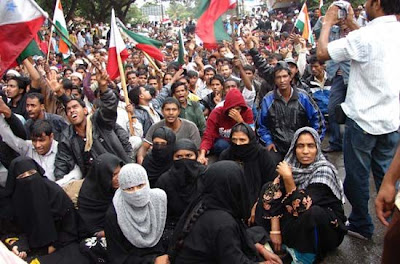
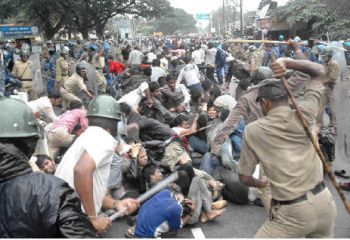
Kochi: Showing their loyalty to the BJP government of Karnataka, the Mysore city police on July 9 attacked on and arrested hundreds of peaceful demonstrators of the Popular Front of India who were demanding release of two hundred innocents including dozens of PFI activists arrested on July 6 in connection with the Mysore communal clash.


Popular Font of India members stage a protest on Bangalore Road in Mysore on Thursday demanding the release of people who were arrested during Kyatamaranahalli violence.

The PFI had organized a Jail Bharo Andolan yesterday afternoon even though Section 144 was in force in the place. The people had assembled at the Fountain Circle. They were peacefully demanding the release of more than 210 innocent people arrested in connection with the communal clashes in Mysore. The people were sitting peacefully and offering voluntary arresting. A group of local women activists of PFI marched in to join the protest. As they reportedly resisted arresting by the police and refused to disperse the police unjustifiably resorted to lathicharge and bursting of tear gas to disperse the protestors. Several people were severely wounded in the lathicharge and the stampede-like situation that followed.

With the police arresting 200 more people yesterday the total number of people arrested so far in relation with the communal clashes in Mysore has reached to 400. None have been released yet.

The state leaders of the PFI including President K Abdul Latheef and General Secretary Afsar Pasha who had been arrested on the spot have not yet been released. Talks are going on with the higher authorities of the police for the release of the leaders and others, said Abdur Razak, a PFI official.

Communal clashes broke out in Udayagiri and nearby places in Mysore on 2nd July when a masjid compound was desecrated by miscreants. The violence that followed took lives of three including a 14-year old, who people say, was killed in police firing. Police had to resort to firing to disperse the angry mob. Prohibitory orders were imposed in the areas till July 6th and then extended to 13th.


US Ambassador visits Jamiat Ulama office, meets its leaders

US Ambassador visits Jamiat Ulama office, meets its leaders


By RINA

New Delhi: The New Delhi US Embassy Chargé d’Affaires Peter Burleigh and Cultural Counselor Michael P. Macy yesterday visited the headquarters of the Jamiat Ulama-I-Hind in the National Capital. This is the first high profile visit by the American officials after the change of guards both in United States of America as well as India.

The American officials discussed with the leaders of JUH various issues including the America’s new strategy to reach out to the Muslims and the Islamic world.

The discussions mainly focused on Islam, desecration of the Holy Quran, Prisoners in the Guantanamo Bay, Deoabandi School of Thought, Israel-Palestine conflict, Afghanistan, Iraq, terrorism and targeting of Muslims in the name of terrorism. Maulana Mahmood Madani made a strong case for Deobandi school of thought and stressed that there are some vested interests who are trying to present a wrong image of it by indulging into false propaganda leading to a sort of extremist perception about it although Deoband is a school of peace and moderation. In the present international scenario peace, Islam and Deoband are three hot topics that need to be tackled cautiously and sensitively.

Maulana Mahmood Madani drew the visiting officials’ attention to the volatile political situations in Pakistan and Afghanistan and remarked that the war on terror initiated by the United States of America against a particular group (read Taliban) has now spread to the civilian population of the country. Maulana Mahmood Madani told the US officials that with the inauguration of the office of President Barack Hussain Obama it is hoped that he will reverse the policies of his predecessor and bring about a paradigm shift in the policy towards Muslims and Islam. The visiting officials assured the Jamiat leaders of all possible steps to redress their concerns.

<iframe src=”http://api.tweetmeme.com/button.js?url=http%3A//iqsoft.co.in/wordpress/&amp;style=normal&amp;source=mohamediqbalp” style=”border-width: 0px; margin: 0px; padding: 0px; outline-width: 0px; font-weight: inherit; font-style: inherit; font-size: 12px; font-family: inherit; vertical-align: baseline;” scrolling=”no” frameborder=”0″ height=”61″ width=”50″></iframe>

Autorickshaw Driver of the year!!!

Suvendu Roy of Titan Industries shares his inspirational encounter with a rickshaw driver in Mumbai

“One man CAN make a Difference” 

“Think Global, Act Local”


Last Sunday, my wife, kid, and I had to travel to Andheri from Bandra. When I waved at a passing auto rickshaw, little did I expect that this ride would be any different. As we set off, my eyes fell on a few magazines(kept in an aircraft style pouch) behind the driver’s back rest. I looked in front and there was a small TV. The driver had put on the Doordarshan channel.

My wife and I looked at each other with disbelief and amusement. In front of me was a small first-aid box with cotton, dettol and some medicines. This was enough for me to realise that I was in a special vehicle. Then I looked round again, and discovered more – there was a radio, fire extinguisher, wall clock, calendar, and pictures and symbols of all faiths – from Islam and Christianity to Buddhism, Hinduism and Sikhism. There were also pictures of the heroes of 26/11- Kamte, Salaskar, Karkare and Unnikrishnan. I realised that not only my vehicle, but also my driver was special.

I started chatting with him and the initial sense of ridicule and disbelief gradually diminished. I gathered that he had been driving an auto rickshaw for the past 8-9 years; he had lost his job when his employer’s plastic company was shut down. He had two school-going children, and he drove from 8 in the morning till 10 at night. No break unless he was unwell. “Sahab, ghar mein baith ke TV dekh kar kya faida? Do paisa income karega toh future mein kaam aayega.”

We realised that we had come across a man who represents Mumbai – the spirit of work, the spirit of travel and the spirit of excelling in life. I asked him whether he does anything else as I figured that he did not have too much spare time.. He said that he goes to an old age home for women in Andheri once a week or whenever he has some extra income, where he donates tooth brushes, toothpastes, soap, hair oil, and other items of daily use. He pointed out to a painted message below the meter that read: “25 per cent discount on metered fare for the handicapped. Free rides for blind passengers up to Rs. 50.

My wife and I were struck with awe. The man was a HERO! A hero who deserves all our respect. Our journey came to an end; 45 minutes of a lesson in humility, selflessness, and of a hero-worshipping Mumbai, my temporary home. We disembarked, and all I could do was to pay him a tip that would hardly cover a free ride for a blind man.

I hope, one day, you too have a chance to meet Mr Sandeep Bachhe in his auto rickshaw: MH-02-Z-8508.

Take a look at pic 1 –

which has got a first aid box on the left and a newspaper box on right (which had all hindi-english-marathi-gujrati and economic times)

Take a look at pic 2 – which has got a tv on the top with cable (I was watching colors channel) and below tat is the tissue box. on the left is the mandir types and dont miss the “Only gandhigiri” written there , below tat is the calender and a notepad and pen along with a blue fan (which is blowing towards the customer who sits)

Take a look at pic 3 – 25% discount for handicap!! who on this earth can expect somethin like this from an rickshawala yaar!!

The photographer spoke to tat person and found him so much interesting and creative. he was telling some new stuff he is gonna do more for the customers to be happy.

Its amazing there are ppl still alive like him in this world!


3D Webcam for shooting 3D photos or 3D video


3D Webcam Images Video CaptureIts time you should move from your low quality 2D 
webcam to these 3D webcam which are the first of their kind called a ‘Minoru’ which is a japanese word meaning ‘Reality’ as it brings real things captured and you can even upload these 3D videos to your youtube account and share with your friends.

Not only the features but the looks are also fascinating because they are not like those other dumb looking camera’s but look like a robot or may be are inspired Wall-E robots from the Pixar movie which came recently.


3D WebcamWall e Robot

Another features of this 3D Webcam include :

3D Glasses Web CamThe webcam user has to use 3D glasses to view the video in order to 
experiance the 3D effects, the same way as the viewers have to watch movies in theatures with 3D glasses while watching a 3D movie.
This Webcam is compatible with instant messengers like AIM, Windows Live Messenger & Skype using which you can stay connected with others and share the webcam and broadcast yourself live.
The output videos would be in youtube compatible format making sure that you can directly upload the captured videos easily.
The price of these webcam’s are expected to be around 100$ lets wait and watch when they are officially launched and we can see something which is almost near to human eyes vision.