Peace Homes Aluva

Simplify Building Your Dream Home

Archives 2010

India’s 150 million Muslims away from extremism: US cable

powered by
Custom Search Control

Web


Power to You

TCN Event


See more of our videos: http://www.youtube.com/twocirclesTV

Career Circle

Cricket

Cricket Score Updates powered by vCricket.com

Javascript is disabled.

India’s 150 million Muslims away from extremism: US cable

By TCN News,

New Delhi: Strongly endorsing the secular a
nd nationalistic nature of
Muslims in India, the United States has acknowledged that India’s over
150 million Muslim population is largely unattracted to extremism.
Separatism and religious extremism have little appeal to Indian Muslims,
and the overwhelming majority espouse moderate doctrines.

In a recorded commentary (released by WikiLeaks) about India’s 150
million plus Muslims (the second largest in the world after Indonesia),
former US envoy to New Delhi David Mulford in 2005 said that Indian
Muslim youth are comfortable in the mainstream and Muslim families and
communities provide little sanction or support to extremist appeals.

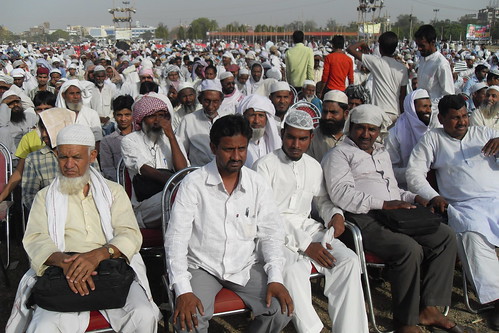
Muslims at Jamiat Ulema conference held in April 2010 in Patna

“India’s vibrant democracy, inclusive culture and growing economy
have made it easier for Muslim youth to find a place in the mainstream,
reduced the pool of potential recruits, and the space in which Islamic
extremist organizations can operate,” Mulford commented about Indian
Muslims.

He also highlighted the problems and backwardness of the Muslim
community in the country. India’s Muslim population suffers from higher
rates of poverty than most other groups in India, and can be the victims
of discrimination and prejudice. Despite this, the vast majority
remains committed to the Indian state and seek to participate in
mainstream political and economic life.

Endorsing secular credential of young Muslim generation he said: Most
Muslims approaching graduation at universities will be prepared to
enter the job market and are not interested in extremism.

Mr Mulford blasted the media propaganda that madrasas and Islamic seminaries in the country are teaching extremism.

The Indian media has published colorful stories implying that
Madrassas are recruiting centers for Islamic terrorism and that many are
funded by Pakistan’s ISI. The accounts are mostly anecdotal, however,
and there has been little or no hard evidence linking Indian Madrassas
to terrorist recruitment, he said.

Islamic extremism is not popular in India and most adults are not
interested. This forces extremists to pitch to young and naive audiences
who may be more amenable.

The US envoy said that at ground level both Muslim and non-Muslims are
facing similar problems as far as social mobility is concerned.

Muslims are facing the same pressures for social mobility as
non-Muslims. Most Indian children are under pressure to get into school,
stay in school, and perform well there, in order to obtain higher
education and access to well-paid jobs. Attempts by extremist groups to
recruit children from Muslim homes are likely to run into a wall of
opposition from parents who would see involvement in extremism as
counterproductive and a threat to future success of their children. This
means that extremism is most attractive to children from families that
are so poor that opportunities for education and advancement are all but
non-existent. As the Indian economy continues to boom, the percentage
of Muslim families who feel there is no hope for their children’s’
future is growing smaller, as is the pool of potential recruits.

The December 2005 commentary on Indian Muslims by Mulford was written at the request of Washington DC.

A Christmas Card From a Muslim Daughter

Amazing

behind the Christmas traditions my family celebrated every year of my
childhood. My mother was able to transform our Southern California home
into a Winter Wonderland as soon as we walked in the door; it may have
been 75 degrees and sunny outside, but inside we felt we were in a
Currier and Ives world of red velvet beribboned pine boughs, twinkling
lights and beautiful music. I loved it. The Christmas season and our
small traditions remained the same no matter how many years passed. My
mother worked extremely hard to build warm, and loving holiday memories,
and I sincerely cherish them.

Like many American homes, there wasn’t much Christ in my family’s

Christmas. There would always be some discussion surrounding the reason
for our celebration, but we didn’t attend church services or talk too
much about what my parents believed. The beautiful nativity on the
mantle, hand-painted by my grandmother, was flanked by tasteful, secular
decorations. This led to a kind of vague confusion between the
miraculous birth of Jesus, and the magical feat of Santa Claus zipping
around the world in one night.

Nostalgia not withstanding, thinking about Christmas is now far more

meaningful to me on a spiritual level than it was when I was young. The
fact that Muslims accept and believe in the virgin birth of Jesus has
been a golden thread that links my childhood Christmas memories to my
very fulfilling adult life as a Muslim.

The world’s more than 1.5 billion Muslims would like their Christian

neighbors to know that we believe in the Annunciation; in the Quran we
read that God sent the angels to Mary:

“When the angels said: O Mary, surely God gives you good news

with a Word from Him of one whose name is the Messiah, Jesus, son of
Mary, worthy of regard in th
is world and the hereafter and of those who
are made near to God. And he shall speak to the people when in the
cradle and when of old age, and he shall be one of the good ones.”
Quran 3:45-46

The Quran has only one chapter named after a woman; Chapter 19 is titled “Mary”, or as it is translated in Arabic — Maryam. The Quran tells us that the infant Jesus, (or Isa as it is translated in Arabic), spoke from Mary’s arms: “…He said: Surely I am a servant of God; He has given me the

Book and made me a prophet; And He has made me blessed wherever I may
be, and He has enjoined on me prayer and charity so long as I live; And
dutiful to my mother, and He has not made me insolent, unblessed; And
peace on me on the day I was born, and on the day I die, and on the day I
am raised to life.'”
Quran 19:30-33*

While Muslims don’t celebrate Christmas, we believe in the awesome

and miraculous birth of Jesus, in the miracles he performed by God’s
Grace, and in the message of love and peace Jesus brought to the world.

I hope my family knows that I am more attached to the account of

Jesus and Mary than I ever was as a child, now that I am a practicing
Muslim. It is a vital part of my faith; a faith that I share with over a
billion and a half people around the world.

This is my Christmas card to my family, and all my Christian friends and neighbors: Peace on earth and goodwill toward men.*Muslims understand this verse in reference to the to death of

Jesus after the second coming and resurrection on the Day of Judgment.
See Quran, 4:157

Follow Kari Ansari on Twitter:


www.twitter.com/KariAnsari

6 Ways to Boost Brain Power

Scientific American Mind 6 Ways to Boost Brain Power
By Emily Anthes

Adapted from the book The Instant Egghead Guide to the Mind, by Emily

Anthes and Scientific American. © 2008 by Scientific American. Published by

arrangement with St. Martin’s Press.

About The Author: Emily Anthes is a freelance science and health writer living

in Brooklyn. Her work has appeared in Seed, Discover, Slate, New York and the

Boston Globe, among other publications.

Amputees sometimes experience phantom limb sensations, feeling pain, itching or other impulses coming from limbs that no longer exist. Neuroscientist Vilayanur S. Ramachandran worked with patients who had so-called phantom limbs, including Tom, a man who had lost one of his arms. Ramachandran discovered that if he stroked Tom’s face, Tom felt like his missing fingers were also being
touched. Each part of the body is represented by a different region of the somatosensory cortex, and, as it happens, the region for the hand is adjacent to the region for the face. The neuroscientist deduced that a remarkable change had taken place in Tom’s somatosensory cortex. Ramachandran concluded that because Tom’s cortex was no longer getting input from his missing hand, the region processing sensation from his face had slowly taken over the hand’s territory. So touching Tom’s face produced sensation in his nonexistent fingers. This kind of rewiring is an example of neuroplasticity, the adult brain’s ability to change and remold itself. Scientists are finding that the adult brain is far more malleable than they once thought. Our behavior and environment can cause substantial rewiring of the brain or a reorganization of its functions and where they are located. Some believe that even our patterns of thinking alone are enough to reshape the brain. Researchers now know that neurogenesis (the birth of new neurons) is a normal
feature of the adult brain. Studies have shown that one of the most active regions for neurogenesis is the hippocampus, a structure that is vitally important for learning and long-term memory. Neurogenesis also takes place in the olfactory bulb, which is involved in processing smells. But not all the neurons that are born survive; in fact, most of them die. To survive, the new cells need nutrients
and connections with other neurons that are already thriving. Scientists are currently identifying the factors that affect the rate of neurogenesis and the survival of new cells. Mental and physical exercise, for instance, both boost neuron survival.
The adult human brain is surprisingly malleable: it can rewire itself and even grow new cells. Here are some habits that can fine-tune your mind.


Secular Nationalism Has Not Delivered Results

Home / Headlines / “Islam is the Solution” – Media Monitors Network (MMN)

“Islam is the Solution”
by Uri Avnery
(Saturday, December 4, 2010)

“In Turkey, the Ataturk revolution is now threatened by the upsurge of a rejuvenated Islam. In Israel, the new Hebrew nation is under siege by a fundamentalist, aggressive Judaism. All over the Arab world, the situation is worse….To put it bluntly: secular nationalism has not delivered. It has brought no real independence, no freedom, no economic and technological breakthrough.”

First, an apology: I am not going to write about the Wikileaks.

I like gossip as much as the next (wo)man. The leaks provide a lot of it, interspersed with some real information.

But there is nothing really new there. The information only confirms what any intelligent person could have worked out already. If there is anything new, it’s exactly this confirmation: the world is really managed the way we thought it was. How depressing.

Four hundred years ago, Sir Henry Wotton, a British diplomat, observed that “An ambassador is an honest man sent to lie abroad for the good of his country.” Since then, nothing has changed except that the ambassador has been joined by the ambassadress. So it is quite refreshing to listen to what they say in secret messages home, when they don’t have to lie.

That said, let’s move on to more important things.

THIS WEEK’S ELECTIONS in Egypt, for example.

Years ago, the story goes that a Soviet citizen went to the polling station on election-day and was handed a sealed envelope to put into the ballot box.

“Aren’t I allowed to see who I am voting for?” he asked.

“Of course not!” the stern-faced official retorted indignantly, “In our Soviet Union, the elections are secret!”

This could not happen in Egypt. First of all, because Egyptians are a very humorous people. If told that their elections were secret, they would burst out laughing.

Second, because they so obviously are not.

On one of my visits to Anwar Sadat’s Cairo, I had the chance to witness an election day. It was a jolly occasion, more a medieval carnival than a solemn fulfillment of democratic duty. Everybody was happy.

Visiting a polling station in a village near the Giza pyramids, I was struck by this atmosphere of jolly cynicism. No one even pretended that it was serious. Good-humored soldiers guarding the locale volunteered to help old women in choosing the right ballot and putting it in the envelope.

I am not sure whether this good humor has been retained under the Mubarak regime, but the results are the same. Media editors, all appointed by the government, prevent any criticism of the government. Opposition activists are arrested well before election day (if they are not in prison already). The government party is a sorry joke. No one seriously pretends that the country is anything but a dictatorship. The upper classes like it that way, not only out of fondness for their privileges but also out of a genuine fear that under democracy, their country would elect a fundamentalist religious regime, with burqas and all.

ALL OVER the Arab world, this is a real dilemma. Free elections would bring fundamentalists to power.

During the last century, secular nationalism was in vogue. In many Arab countries, nationalist movements sprang up. Their model was the great Ataturk – a revolutionary renovator as no other. He suppressed Islam, forbade the fez for men and the hijab for women, replaced the Arabic with the Latin script, fostered Turkish nationalism instead of the Ottoman Islamism.

This, by the way, was a model for many of us, who aspired to replace the Jewish religion and Zionist pseudo-nationalism with a healthy Hebrew territorial secular nationalism. The son of Eliezer Ben-Yehuda, the renovator of the modern Hebrew language, also proposed replacing the Hebrew script with a Latin one.

In Turkey, the Ataturk revolution is now threatened by the upsurge of a rejuvenated Islam. In Israel, the new Hebrew nation is under siege by a fundamentalist, aggressive Judaism. All over the Arab world, the situation is worse.

To put it bluntly: secular nationalism has not delivered. It has brought no real independence, no freedom, no economic and technological breakthrough.

In the economic sphere, no Arab country has succeeded in doing what has been done by Japan, South Korea and even Malaysia, and what is being done now by China and India. The successful Israeli example is near at hand and increases the frustration.

The dream of a secular pan-Arab union, as envisioned by Gamal Abd-al-Nasser and the original Ba’athists, is in tatters. So is the dream of Arab independence. Almost all Arab countries are backward American clients and dance to the American tune. A whole generation of Arab leaders has spectacularly failed.

The most recent example was Yasser Arafat. He created a Palestinian national movement that was proud of its non-sectarianism. Christian Arabs played a significant role in the Palestine Liberation Organization. George Habash was a Christian physician from Ramallah, the Christian Hanan Ashrawi is one of the most articulate Palestinian spokespersons.

Arafat himself was a practicing Muslim. Often, even in private conversations, he would excuse himself, disappear for a few minutes and return unobtrusively, while his assistants would whisper to us that the Ra’is was praying. Yet he never tired of assuring everyone that the future State of Palestine would be free of any religious domination.

As long as he was alive, political Islam remained a minor influence, and not because of any repressive measures.

ALL THIS is history. The Sunni Hamas (“Islamic Resistance Movement”) and the Shiite Hezbollah (“Party of God”) are becoming the models for masses of young people all over the Arab world.

One of the major reasons for this is Palestine.

If Arafat had succeeded in founding the free and sovereign State of Palestine, the texture of Arab politics would have changed, not only in Palestine itself but in all Arab countries.

The rise of Hamas in Palestine is a direct result of this failure. Secular Palestinian nationalism has been given a try, and has failed. The Islamic revolutionaries are appealing to a people deprived of all national and human rights, with no alternative in sight.

As the Wikileaks show (here I go, mentioning them after all) not one single Arab regime gives a damn about the Palestinians. That is nothing new – indeed, Arafat created his movement, Fatah (‘Palestinian Liberation Movement”), in order to liberate the Palestinians, first of all, from the cynical Arab regimes, all of which exploited the “Palestinian Cause” for their own ends.

But the depth of cynicism revealed in these conversations between Arab potentates and their American masters borders on outright betrayal. This will increase the already massive frustration not only in Palestine, but in all Arab countries. Any young Egyptian, Jordanian, Saudi or Bahraini (to mention only a few) must be acutely aware that his country is led by a small group for whom the preservation of their personal power and privileges is vastly more important than the holy cause of Palestine.

This is a deeply humiliating insight. It may not produce immediate results, but when hundreds of millions of people feel humiliated, the effects are foreseeable. The older generation may be used to this situation. But for young people, especially proud Arabs, it is intolerable.

I am very sensitive to this kind of feeling, because at the age of 15 I felt the same and joined the “terrorist” Irgun (“National Military Organization”). I just could not stand the sight of my leaders kowtowing b
efore the British rulers of my country. Putting myself in the shoes of a young Arab of similar age now in Jeddah, Alexandria or Aleppo, I can just imagine what he feels. Even Ehud Barak, that veteran Arab-fighter, once said that if he were a young Palestinian, he would join a terrorist organization.

Sooner or later, the situation will explode – first in one country, then in many. The fate of the Shah of Iran should be remembered by those who speak – in secret documents – about the “Iranian Hitler” who is on the verge of obtaining a nuclear bomb.

THE FRUSTRATION about Palestine is the immediate cause of this humiliation, being manifest for all to see, but the feeling itself goes beyond one single cause.

Secular nationalism has signally failed the Arabs. Communism has never taken root in the Islamic world, being by its very nature inimical to the basic tenets of Islam. Capitalism, while attractive to some, has also failed to solve any of the basic problems of the Arab world.

The Islamic revolutionary movement in its many forms promises a viable alternative. It is no fluke that the Egyptian dictatorship forbids the use of the slogan “Islam is the Solution” – the simple and effective slogan that unites the Islamic opposition in all the countries. There is a gaping vacuum in the Arab world, with no one there to fill it – except Islamism.

FOR THE US, this is a huge challenge. Obama seemed to have perceived it, before he was swallowed – head and body – by the American political routine.

Everybody seems to be talking about the Decline of the American Empire. It’s all the rage. What’s happening in the Arab world may accelerate or slow this process. The creation of a sovereign, free and viable State of Palestine – with the electrifying effect this would have throughout the Arab region, indeed the entire Islamic world – would slow it considerably.

Judging from these leaks, this seems very far from the minds of American statesmen and stateswomen, such as they are.

For Israel, the outlook is even grimmer. The prospect of a fundamentalist Arab world, with a completely new and popular set of leaders, surrounding us on all sides, with the power of America (and its Jewish lobby) declining ever more, is a frightening prospect indeed.

If I were responsible for Israel at this moment, I would worry about this much more than about the Iranian bomb.

Fortunately, this is not an inescapable danger. Israeli policy can do a lot to avert it. Unfortunately, we are doing the exact opposite.

To those who chant “Islam is the Solution”, our answer should be: “A just Peace is the Solution”.

Source:

by courtesy & © 2010 Uri Avnery

U.S. Pressured Saudis to Accept Climate Change Agreement

Leaked Cables Show U.S. Pressured Saudis to Accept Copenhagen Accord

The handful of climate-related cables–among the

hundreds of thousands of secret and unclassified messages released by
the whistle-blower organization Wikileaks–show the United States put
climate change at the center of its foreign policy relationship with the
oil-producing giant

By Lisa Friedman and Climatewire

CLIMATE DIPLOMACY: The
Obama administration leaned heavily on Saudi Arabia to associate itself
with the Copenhagen Accord climate change agreement, confidential State
Department memos show.

Image: Pete Souza, courtesy whitehouse.gov

The Obama administration leaned heavily on Saudi Arabia to
associate itself with the Copenhagen Accord climate change agreement,
confidential State Department memos show.

The handful of climate-related cables — among the hundreds of thousands
of secret and unclassified messages released by the whistle-blower
organization Wikileaks — show the United States put climate change at
the center of its foreign policy relationship with the oil-producing
giant in the months after last year’s blowout U.N. climate summit in
Denmark.

“You have the opportunity to head off a serious clash over climate
change,” James Smith, the U.S. ambassador to Saudi Arabia, wrote to
Secretary of State Hillary Rodham Clinton as she prepared for a February
visit to the kingdom.

“Saudi officials are very concerned that a climate change treaty would
significantly reduce their income just as they face significant costs to
diversify their economy,” Smith wrote. “The King is particularly
sensitive to avoid Saudi Arabia being singled out as the bad actor,
particularly on environmental issues.”

And in a memo summarizing the trip of Assistant Secretary of State for
Near Eastern Affairs Jeffrey Feltman to Saudi Arabia in January, Smith
wrote that Feltman urged the country to send a formal notice to the
United Nations indicating its acceptance of the climate pact.

“A/S Feltman noted the importance that the President places on climate
change, and the Copenhagen Accord,” Smith wrote. “Given that Minister of
Petroleum Al-Naimi was involved in crafting the final agreement, A/S
Feltman noted the United States is counting on Saudi Arabia to associate
itself with the accord by January 31.”

Saudi leaders were noncommittal, according to the cable, noting that the
country’s ministries would need to consult on the topic.

A push for information on key negotiators

The memos come as international climate talks kick off in Cancun,
Mexico. This year, the focus of the United States is to nail down the
agreements that President Obama and other world leaders made in
Copenhagen and to devise a set of formal decisions setting in motion
emission cuts and the mobilization of funding for poor countries that so
far has been agreed to in principle.

The vast majority of the leaked cables deal with Iran’s nuclear program
and other diplomatic issues. But the handful of times that climate
change is raised, it appears as a front-burner Obama administration
issue, a ClimateWire review of the cables found. They provide new
insight into the behind-the-scenes discussions leading up to Copenhagen
and the focus of the administration after the meeting.

In the months before Copenhagen, the summit was listed as a “substantive
issue” about which diplomats were directed to gather information. One
memo getting a lot of attention asks U.S. envoys at the United Nations
and elsewhere to procure credit card and frequent flier numbers as well
as other biographical data. In that same document, diplomats are
instructed to relate “perceptions of key negotiators on U.S. positions
in environmental negotiations” and indications about how cooperative
countries may be.

The document also asks diplomats to be on the lookout for information
about whether countries adhere to their own environmental programs and
laws, and any “efforts by treaty secretariats to influence treaty
negotiations or compliance.”

China makes a brief appearance in the cables. After a meeting of G-5
ambassadors in Beijing in May, acting Deputy Chief of Mission William
Weinstein relayed to Washington that U.K. and Chinese officials
discussed the then-upcoming Copenhagen talks.

“In the lead up to Copenhagen, China would not agree to targets on
emissions, but was willing to be constructive and would come to
Copenhagen with a package of action items related to nuclear power,
renewable energy and reforestation,” Weinstein wrote, adding that the
U.K. diplomat added that “his impression was that China could be induced
to do more on climate change.”

Indeed, by the time nations met in Copenhagen, China had pledged to cut
its carbon intensity about 45 percent below 2005 levels in the next
decade.

Warning signals about skeptics in France
U.S. European envoys sent up warning flares early last year about both
the U.S. political landscape and prospects for Copenhagen. In a memo
called “Scenesetter,” as Secretary Clinton prepared for a trip to France
late last year, U.S. Ambassador to France Charles Rivkin included the
heading, “An urgent focus on climate change.”

In it, he wrote, “The French remain divided on how to respond to the Obama administration’s approaches to climate change.”

At the time, the U.S. House had passed legislation to cut carbon
emissions about 17 percent below 2005 levels in the next decade — a
target that much of Europe considered pitifully low. The Senate later
failed to pass any climate bill, and cap-and-trade legislation is these
days considered dead for the foreseeable future.

According to the November 2009 cable, though, French analysts were early
in recognizing a difficult U.S. political horizon, and American
officials worked hard to stamp out concerns about the strength of the
Obama administration’s commitment to climate action.

“Even sophisticated observers are skeptical that long-term reduction
goals legislated in the United States can be counted on as more than
aspirations, especially if radical cuts are not imposed up front,”
Rivkin wrote. “We have reiterated that U.S. laws are reliably enforced
by the federal government and by U.S. courts, using the Clean Air Act as
an example.”

Rivkin also said that officials in France’s Ministry of Foreign Affairs
took exception to a comment that Environment Minister Jean-Louis Borloo
made criticizing the U.S. House measure, and described the minister’s
comments as “distracting attention from the need for China and India to
reduce their rates of growth of GHG.”

Germans lowered expectations before Copenhagen
And as Clinton arrived in Germany to celebrate the 20th anniversary of
the fall of the Berlin Wall in early December, clim
ate change was also
high on the agenda. According to the Nov. 5, 2009, cable, German
officials wanted “strong U.S. leadership” going into the Copenhagen
summit and advocated for a common position toward major emerging
economies, particularly China and India.

That missive also gave early glimpses of the early efforts to try to
dampen sky-high expectations for that meeting — because of the unlikely
possibility of U.S. action.

“German leaders recognize the challenge of passing climate change
legislation in the U.S. and have lowered their expectations for the
possibility of reaching a legally-binding agreement next month at
Copenhagen,” the cable notes. “They have begun to describe the summit as
one step in a larger process — a politically binding framework — and
may be preparing the German public for a less ambitious outcome.”

Analysts said the Saudi memos, in particular, show the lengths the Obama
administration went to in order to sway a fierce opponent of
international climate action. Saudi Arabia, the world’s largest oil
producer, has a long tradition of blocking movement in the U.N. climate
talks. It and other oil-producing nations have, among other things,
claimed a need for adaptation funding — normally reserved for the poor
nations that have done little to cause climate change but are bearing
the brunt of weather disasters and other problems — because of rising sea levels that threaten offshore oil rigs.

After the Copenhagen summit, Saudi officials expressed “satisfaction”
with the political agreement. But so far, the country has not formally
associated itself with the agreement.

Nevertheless, said World Resources Institute Climate Director Jennifer
Morgan, the cables are “a sign, to me, that the administration is
serious about climate change, and serious about it as a foreign policy
topic if it is raising it with one of its partners who takes a different
position with the U.S.”

Al-Jazari: The Mechanical Genius

Al-Jazari: The Mechanical Genius

Professor Salim T S Al-Hassani *

Al-Jazari was the
most outstanding mechanical engineer of his time. His full name was
Badi’ al-Zaman Abu-‘l-‘Izz Ibn Isma’il Ibn al-Razzaz al-Jazari. He lived
in Diyar-Bakir (in Turkey) during the 6th century H (late 12th
century-early 13th century CE).

Large image

Figure 1: Wash-basin in the form of a peacock described by Al-Jazari in Kitab fi Ma’rifat al-Hiyal al-Handisayya. Manuscript copied in Sha’ban 6002/ March 1205. (Source).

Large image

Large image

Figure 2 a-b:

He
was called Al-Jazari after the place of his birth, Al-Jazira, the area
lying between the Tigris and the Euphrates in Mesopotamia. Like his
father before him, he served the Artuqid kings of Diyar-Bakir for
several decades (at least between 570 and 597 H/1174-1200 CE) as a
mechanical engineer. In 1206, he completed an outstanding book on
engineering entitled Al-Jami’ bayn al-‘ilm wa-‘l-‘amal al-nafi’ fi sinat’at al-hiyal in Arabic. It was a compendium of theoretical and practical mechanics. George Sarton writes: “This treatise is the most elaborate of its kind and may be considered the climax of this line of Muslim achievement” (Introduction to the History of Science, 1927, vol. 2, p. 510).

Large image

Figure 3:
Model of a blood letting device as described by Al-Jazari and
reconstructed in 1977. It measured the blood lost during phlebotomy
(blood-letting) sessions, a popular therapy in the Islamic medieval
world. Two scribes are seated above the device and their actions
describe the amount of blood to be let. Currently on display in The Science and Art of Medicine (inventory number : 1981-1710). (Source).

Al-Jazari’s
book is distinctive in its practical aspect because the author was a
competent engineer and skilled craftsman. The book describes various
devices in minute detail, providing hence an invaluable contribution in
the history of engineering. British charter engineer and historian of
Islamic technology Donald R. Hill (1974) who held a special interest in
Al-Jazari’s achievements wrote:

Large image

Figure 4:
Al-Jazari’s water powered scribe clock brought back to life after 800
years by FSTC. The clock stands 1 metre high and half a metre wide; the
scribe with his pen is synonymous to the hour hand of a modern clock. Click here to see the animation. (Source).

“It
is impossible to over emphasize the importance of Al-Jazari’s work in
the history of engineering, it provides a wealth of instructions for
design, manufacture and assembly of machines.”

Large image

Figure 5: Picture of the internal structure of an automata for dispensating liquids. © JC Heuden at Virtual Worlds. (Source).

Al-Jazari described fifty mechanical devices in six different categories, including water clocks, hand washing device (wudhu’
machine) and machines for raising water, etc. Following the “World of
Islam Festival” held in the United Kingdom in 1976, a tribute was paid
to Al-Jazari when the London Science Museum showed a successfully
reconstructed working model of his famous “Water Clock.”

Large image

Figure 6:
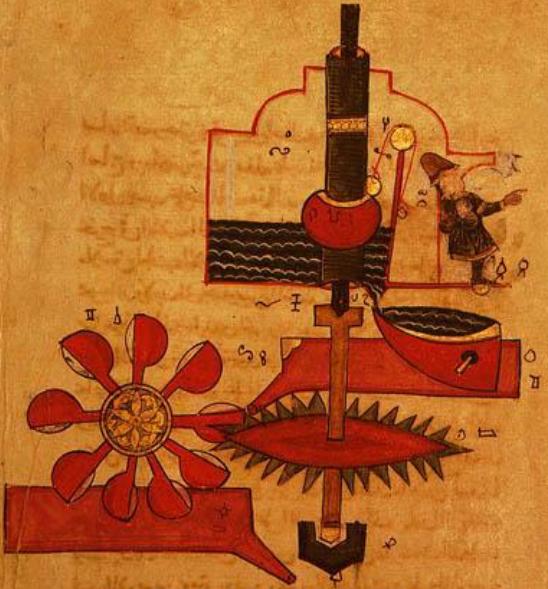
The original drawing of the double action or reciprocating pump from
Al-Jazari’s manuscript. Topkapi Palace Museum Library, Ahmet III, MS
3472. (Source).

Donald
R. Hill translated into English Al-Jazari’s book in 1974, seven
centuries and 68 years after it was completed by its author. Al-Jazari’s
encyclopedic treatise includes six main categories of machines and
devices. Several of the machines, mechanisms and techniques first appear
in this treatise, later entering the vocabulary of European mechanical
engineering. Among these innovations, we mention the double acting pumps
with suction pipes, the use of a crank shaft in a machine, accurate
calibration of orifices, lamination of timber to reduce warping, static
balancing of wheels, use of paper models to establish a design, casting
of metals in closed mould boxes with green sand, etc. Al-Jazari also
describes methods of construction and assembly in scrupulous detail of
the fifty machines to enable future craftsmen to reconstruct them.

Large image

Figure 7: 3D model recreated by FSTC of the double action pump of Al-Jazari. Click here to view the animation. ©FSTC 2009.

And
he was successful in that, for many of his devices were constructed
following his instructions. The work by Al-Jazari is also unique in the
way that other writers often fail to give sufficient details, because –
amongst other factors – they were not craftsmen themselves, or kept
their secrets, or if they were craftsmen, they could have been
illiterate. Al-Jazari in this respect was unique, and this gives his
work immense value. His book, Hill states, is an absolute wealth of
Islamic mechanical engineering.

In their paper on “Mechanical Engineering during the Early Islamic Period” (published in I. Mech. E, The Chartered Mechanical Engineer,
1978, pp. 79-83), C. G. Ludlow and A. S. Bahrani have raised the
important point that it is more than likely that there is more on the
subject in some of the thousands of Arabic manuscripts in the world
libraries which have not yet been inspected closely, and obviously
require looking into.

Hill, too, constantly raises the two major
issues with respect to the history of engineering in general, and that
of fine technology in particular. He first states the fact that the
field, which is absolutely immense, is yet largely unexplored.

Large image

Figure 8: View of The Elephant Clock: Leaf from a manuscript of Al-Jazari’s Kitab fi macrifat al-hiyal al-handasiyya dated 715 H/1315 CE. (Source).

The
other issue is related to fine technology. One of his concluding points
states that “it is hoped that, as research proceeds, firmer evidence
for the transmission of Islamic fine technology into Europe can be
provided.” Hill also offers some hints for such transmission. The most
likely route was Spain. Such fine technology could have followed the
same route as the astrolabe (itself part of this fine technology.) Apart
from Spain, there were other possible lands of transfer: Sicily,
Southern France, Italy, Byzantium and Syria during the Crusades. Hill is
also right on a further account, that what will be seen in this work is
just a fraction of the whole process, which, as with much else has
hardly been explored.

The animation presented in figure 7 shows a
virtual model of one of Al-Jazari’s water raising pumps. The details of
this unique pump were obtained from his manuscript and Hill’s diagrams.
We see two suction pumps in synchronous motion driven by a paddle wheel,
which is driven by a water stream.

Large image

Figure 9: 3D model recreated by FSTC of the Elephant clock. Click here to view the animation. ©FSTC 2009.

The
other animation is for a 3D model recreated from the description of the
elephant clock as described by Al-Jazari (see below fig. 9). Full
details of this animation are given in the works authored by the author
and his collaborators published in the book 1001 Inventions: The Muslim Heritage in Our World (chief editor Salim al-Hassani, Manchester: FSTC, 2006) and in articles that can be consulted online on www.MuslimHeritage.com (see especially the two special folders devoted to Islamic technology: Al-Jazari and Taqi al-Din).

Large image

Figure 10:
A table device automaton designed by Al-Jazari. Manuscript dated from
the early 14th century (1315), copied in Syria by Farrukh ibn Abd
al-Latif. Opaque watercolor, ink and gold on paper. © The Smithsonian
Institution, Washington. (Source).

Large image

Figure 11:
A large ewer held by a kneeling female attendant in a domed pavilion
designed by Al-Jazari: once the bird whistles, water pours into a basin
below; a duck then drinks the used water and releases it through its
tail into a container hidden under the platform. © The Smithsonian
Institution, Washington. (Source).

*
Emeritus Professor at the University of Manchester and Chairman of The
Foundation for Science, Technology and Civilisation (FSTC), Manchester,
UK.

by: Professor Salim Al-Hassani, Fri 09 February, 2001

Related Articles:

The List of Al-jazari Articles Published on MH.com by: FSTC Limited
Some
800 years in the past, in 1206, a brilliant Muslim scholar died : Badi?
al-Zaman Abu al-‘Izz ibn Isma?il ibn al-Razzaz al-Jazari. He was one of
the most important inventors and mechanical engineers in the history of
technology. His magnum opus book of mechanics, the famous Al-Jami? bayn
al-?ilm wa ‘l-?amal al-nafi? fi sina?at al-hiyal (A Compendium on the
Theory and Useful Practice of the Mechanical Arts) was the most
significant treatise of the Islamic tradition of mechanical engineering
and a ground breaking work in the history of mechanics.

Al-Jazari: 800 Years After by: FSTC Limited
Some
800 years in the past, in 1206, a brilliant Muslim scholar died : Badi?
al-Zaman Abu al-‘Izz ibn Isma?il ibn al-Razzaz al-Jazari. He was one of
the most important inventors and mechanical engineers in the history of
technology. His magnum opus book of mechanics, the famous Al-Jami? bayn
al-?ilm wa ‘l-?amal al-nafi? fi sina?at al-hiyal (A Compendium on the
Theory and Useful Practice of the Mechanical Arts) was the most
significant treatise of the Islamic tradition of mechanical engineering
and a ground breaking work in the history of mechanics.

Al-Jazari’s Castle Water Clock: Analysis of its Components and Functioning by: Professor Salim T. S. Al-Hassani
The first machine described by al-Jazari in his famous treatise of mechanics Al-Jami‘ bayn al-‘ilm wa ‘l-‘amal al-nafi‘ fi sina‘at al-hiyal (A Compendium on the Theory and Useful Practice of the Mechanical Arts) is a monumental water clock known as the castle clock.

Al-Jazari’s Third Water-Raising Device: Analysis of its Mathematical and Mechanical Principles by: FSTC Limited
Five pumps or water-raising machines are described by al-Jazari in his monumental treatise of mechanics Al-Jami’ bayn al-‘ilm wa ‘l-‘amal al-nafi’ fi sina’at al-hiyal
(A Compendium on the Theory and Useful Practice of the Mechanical
Arts). The following long article is a detailed study of the third of
these water-raising devices. The study presents a detailed analysis of
the mathematical and mechanical principles of this sophisticated machine
and explains its functioning. Further, the various components of the
pump are reconstructed via computer assisted design. A profusion of 3D
graphics and 3D animations show the device in different angles and helps
in viewing it in operational mode.

Al-Muqaddasi and Human Geography: An Early Contribution to Social Sciences by: FSTC Research Team

FSTC Research Team

Recent
scholarly interest in the genesis of social sciences in Islamic culture
is a noteworthy shift. Until recent times, the development of these
fields was credited exclusively to the modern Western tradition,
especially to the 19th century birth of humanities. The ground breaking
contribution of Ibn Khaldun was recognized; however, the author of the
Muqaddima stands as an isolated genius. In the following article, an
attempt is made to broaden the field by highlighting the contributions
of several other scholars in laying the foundation of social sciences in
Islamic culture. After a short survey on Al-Biruni and Al-Raghib
al-Isfahani, the focus of the article is dedicated to the 10th-century
Palestinian geographer Al-Muqaddasi, who touched on various subjects of
interest to the social sciences in his book Ahsan al-taqasim fi ma’rifat al-aqalim.

Resources:

Al-Jazari’s Water Pump, by: FSTC
The
animation shows a virtual model of one of al-Jazari’s water raising
pumps. The details of this unique pump were obtained from his manuscript
and D.Hill diagrams. We see two suction pumps in synchronous motion
driven by a paddle wheel.

References:

The Book of Ingenious Mechanical Devices of Al-Jazri by: Donald Hill
Al-Jazri Mechanical Devices, First published in 1974

Topics

About FSTC
Agriculture
Art & Architecture
Art of Living
Economy
Education
Engineering
Events
Geography
History: General/Old World
Islam and Science
Language & Literature
Law
Manuscripts
Mathematics
Medicine
Military Science
Music Science
Muslim Heritage Interviews
Muslim Scholars
Nature
Philosophy
Science
Social Sciences
The Science of History
Town & City
Transfer of Science

Click here for a full list of
Feature Publications
Click here for a glossary of
terms on Architecture
Click here for Muslim Heritage Videos.
MuslimHeritage.com brings you 1001 Inventions. Buy the book today!

Transfer of Technology from East to West

About FSTC News & Events

The Transfer of Science Between India, Europe and China via Muslim Heritage

Professor Charles Burnett

Abstract | Short biography

Figure 1

Figure 2

Figure 1-2:Professor Charles Burnett presenting his lecture in the “1001 Inventions” conference. © FSTC 2010.

The Islamic realms served as a crucible for scientific learning from the ancient Greek world in the West and from China, India and Iran, in the East. Western Europe in turn benefited from the transmission of Arabic science into Latin, just as Chinese culture was indebted to Arabic texts travelling eastwards. There was a vast network of transmission over centuries and over continents. Today I would like to tell three stories.

1. The first story concerns astronomy

In 1160 CE, a Hebrew sage from Tudela in the valley of the Ebro, Abraham ibn Ezra, when introducing a commentary written by a Spanish Muslim, Ibn al-Muthanna’, on al-Khwarizmi’s procedures for observing and predicting the movement of the stars and the planets, gave the following account:

In ancient days, neither wisdom nor religion was found among the Arabs who dwelt in tents, until Muhammad arose and gave them a new religion from his heart. After him came wise men who composed many books on their religious law, until there arose a great king of the Arabs whose name was al-Safaah. He heard that in India there were many sciences, and so he ordered that a wise man be sought, fluent in both Arabic and the language of Indian, who might translate one of the books of their widsom for him. … (He found a Jew) and gave him money so that he might travel to the city of Arin on the equator under ths signs of Aries and Libra, where day is equal to night throughout the year, neither shorter nor longer, thinking ‘perhaps he will succeed in bringing one of their wise men to the king’. So the Jew went, and after many subterfuges, persuaded one of the wise men of Arin to agree to go the king…The scholar, whose name was Kanka, was brought to the king, and he taught the Arabs the basis of numbers, i.e. the nine numerals. Then from this same scholar, an Arabic named Jacob b. Sharah translated a book containing the tables of the seven planets..the rising times of the zodiac signs, …the arrangement of the astrological houses, knowledge of the higher stars, and the eclipses of the luminaries (and it goes on in this way).

There are several elements in this story which sound like the stuff of legend, and Ibn Ezra clearly wishes to make some claim for Jewish participation in the transmission of knowledge. But in reality, what the text he translates introduces are Indian methods of plotting the movements of the planets and fixed stars scientifically. These had been brought to their most advanced form by Brahmagupta in Sanskrit in the Brahmasphutasiddanta in the late 7th century. These Sanskrit astronomical tables and their canons (descriptions of procedures) had been brought to Baghdad soon after its foundation at the beginning of the Abbasid era, in the time of the caliph al-Mansur (754-75). This was also the time when chess (Arabic shitranj) and a set of moralizing stories (Kalila wa-Dimna) concerning animals based on the Indian Pancatantra entered Islamic culture (also referred to in Ibn Ezra’s account).

The astronomical tables, known as Sindhind, formed the basis of al-Khwarizmi’s tables and canons in the early 9th century. These were brought to the Islamic Spain, al-Andalus, and adapted to the meridian of Cordoba by Maslama al-Majriti in the late 9th century, and translated into Latin by Adelard of Bath in the early 12th century, as the first complete set of astronomical tables and their canons in Christendom They paved the way for other sets, improvements, developments, and commentaries, including that of Ibn al-Muthanna, which was also translated into Latin by Hugo of Santalla in Tarazona, a couple of decades after Adelard’s translation.

But that is not the entire story. In a Latin text on Arabic numerals, we find that they are described as being ‘especially useful for astronomy’ (Liber ysagogarum in artem astronomiam). It may be no accident that the same al-Khwarizmi wrote the authoritative book on ‘calculating with Indian numerals’. For Arabic numerals are, indeed, Indian numerals—originally Sanskrit symbols brought over to the Arabic world, probably with the astronomical texts (as Ibn Ezra implies), and diffused, like the tables and their canons via Muslim Spain to the Latin West. The new way of calculation, with pen and paper (or rather quill and parchment), using symbols with place value, was quite appropriately called the ‘algorism’—named after al-Khwarizmi himself, the transmitter both of the numerals and the astronomical tables.

Two hundred and fifty years later, in the early years of the Ming dynasty, two sets of Arabic astronomical tables were translated into Chinese. The following words are found in the preface of one set:

In the autumn of 1382, the emprer T’aitsu … ordered this translation, saying: ‘The Western people are very good at observing astronomical phenomena. They have an ingenious method for the computation of the movements of the planets, which we have nothing comparable to’.

In the postscript to the other set of tables we read:

There has been no such book in our country since older times. In the eighteenth year of the Hunwu Era (i.e. 1385), a barbarian came from the Far West and he became naturalized in China. He offered to the emperor a set of astronomical tables written in Arabic numerals. It gave predictions of the occultations of the Moon a
nd five planets. It was turned into Chinese numerals for the first time.

By this time, an Islamic observatory had been active in Beijing for over one hundred years. It had been set up under the Mongols, by Kublai Khan in 1271, who gave the directorship to a certain Jamal al-Din, and it lasted until 1656. To it were brought not only texts on astronomy and astrology, and Euclid’s Elements, the basic textbook on geometry that any prospective astronomer had to start by studying, but also astronomical instruments: astrolabes, quadrants, armillary spheres.

2.The second story concerns medicine

There is a Tibetan legend that a doctor called ‘Galenos’ settled in Lhasa during the reign of Sron-bcan sgam-po (i.e. during the 7th century). The legend tells us that Galenos arrived with the Yellow Emperor of Chinese medicine and the rishi (‘sage’) Bharadhvaja of India. Although this cannot be substantiated, it does provide an origin-myth for the three major strands that can be recognized in Tibetan medicine: Greco-Arabic, Chinese and Indian, and an indication that these arrived in Tibet in ‘imperial times’, when the Tibetan empire rivalled in size and importance the Abbasid Empire, founded in 750, on its Western border, and Tang China (618-907), with its capital of Chang-an (Xi’an), on its Eastern border.

The Arabic influence can be seen in certain Tibetan medical doctrines (especially in the humoral system and the importance of diagnosis by pulse and by urine) and in terminology: kur kum for saffron or turmeric from Arabic kurkum, bad kan for ‘phlegm’ from balgham, and dar yak an from tiryâq (theriake) for a wonder medicine made of multiple ingredients. With the Mongol conquest of the whole of Asia from China to the borders of Hungary, and the consequent revitalizing of the Silk Roads, the spread of medical knowledge became even more remarkable. Rashid al-Din (1247-1318), at the court of the Ilkhanid Mongol Ghazan (who had converted to Islam), translated into Persian a Chinese medical book under the title Tansuqname.

In the contrary direction, Islamic medicine was adopted by the Mongols. As Paul Buell has written, “For the Mongolian world of the 13th and 14th centuries ‘Muslim’ medicine became the mainstream, both in the Mongol east and in the west, but particularly in China. There it briefly superseded Chinese medicine in importance, at least at the court level.” Buell shows that this ‘Muslim’ medicine was transmitted mainly by Tibetans, who had an important role at the Mongol courts, as spiritual advisers and doctors. One result of this was a book known as the Huihui yaofang, literally ‘Muslims’ Medicinal Recipes’, an encyclopaedia once consisting of some 3200 pages (only a fragment remains). In this text, the Arabic names of the medicines are given both in Chinese script and the original Arabic script. Some recipes purport to go back to Galen himself. I quote:

An ointment of Jâlînuus: It is especially good for paralysis on the left hand side of the body, numbness on the right, weakness of the body, the preponderance of phlegm associated with an evil wind, etc.

The ingredients that follow are all Arabic terms, sometimes with explanations in Persian and/or Chinese: Ghârîquun (agaric), ishqîl (‘this is mountain onion; you roast it’), ushaq (gum ammoniac), saqamûniyaa (scamony), harbaq aswad (black hellebore), etc.

3. The third and last example concerns philosophy

In 1642, John Selden, the English Jurist, Legal Historian and Arabist, wrote:

The liberal and correctly taught sciences were formerly for a long time called by the English ‘the studies of the Arabs’—the studia Arabum—as if called from the race and the places were they were then alone seriously cultivated. This is clear also from the preface to his Natural Questions of Adelard the monk of Bath, which he wrote when bringing the sciences back to England from the schools of the Arabs.

He is referring to the opening of the popular dialogue on Natural Questions, written by Adelard, a scholar and teacher at Bath (no evidence that he was a monk), the scholar who translated al-Khwarizmi’s astronomical tables, in which he says that he has gone abroad to pursue the studies of the Arabs. After seven years, he returned to England and there he meets his nephew and they engage in a kind of intellectual competition in which Adelard espouses Arabic studies, and the nephew draws on his French studies. Adelard characterises Arabic studies as being new and exciting and French studies as being traditional and boring. But the main point of contrast is that the Arabs use their brains (they use ‘ratio’–‘reason’), whereas the French rely on authority. To quote Adelard’s own words:

I have learnt one thing from my Arab masters, with reason as guide, but you another: you follow a halter, being enthralled by the picture of authority. For what else can authority be called other than a halter? As brute animals are led wherever one pleases by a halter, but do not know where or why they are being led, and only follow the rope by which they are pulled along, so the authority of written words leads many people into danger, since they just accept what they are told, without question. So what is the point of having a brain, if one does not think for oneself?… If I am going to talk to you, you must give and provide rational arguments.

One may quote another anecdote, by a scholar of the generation after Adelard, Daniel of Morley, who tells us that, like many young scholars, he left England with the intention of studying at the university of Paris (which was now replacing the cathedral schools as the main centre for advanced study), but found that the professors there were more like donkeys than men; they spent their time engaged in minutiae and had no interest in science. But then he heard that Arabic learning concentrated on the mathematical sciences (using the terminology of the time, he calls these the ‘quadrivium’, the four-fold path to wisdom, consisting of arithmetic, geometry, music and astronomy), and that it was possible to study this in Toledo. So he hastened there and was not disappointed. He studied both with the greatest of the translators of Arabic science and philosophy, Gerard of Cremona, and with his Arabic colleague, Ghalib, a Christian from al-Andalus. This allowed him to write a book about how the universe functioned (‘On the natures of the heavens and the earth’), in which he begs his readers to accept the ‘simple and clear opinions of the Arabs’ rather than the obscure statements of Latin scientists who ‘veil their ignorance under a blanket of unintelligibility’.

The liberal arts that John Selden was referring to were the mathematical sciences of the quadrivium. These, together with the three ‘arts of speech’ of the trivium (grammar, rhetoric and logic), made up the curriculum of ‘philosophy’ which Adelard described in another work, called ‘On the Same and the Different’. As the 12th century progressed, the mathematical sciences were incorporated into another philosophical scheme, by being added to works by, or deriving from, Aristotle in natural science and metaphysics. Many of the central texts of this new philosophy were translated from Arabic, and to the original works of Aristotle, were added the paraphrases, re-writings and commentaries of al-Farabi, Avicenna, Algazel and Averroes. These Arabic-Latin translations were incorporated into the curricula of the nascent European universities, in Oxford, Bologna, and Paris.

Bearing in mind the emphasis in Arabic learning on reasoned argument, one scholar, Christopher Beckwith, has recently put forward evidence that the scholastic method pursued in the West according to quite strict rules of procedure, owed its structure to that used in Islamic madrasas. These, in turn, may have been modelled on cen
tral Asian Buddhist viharas in which the same method was pursued. Whether or not this can be substantiated, the reputation of Arabs for rationality and pre-eminence in the mathematical and natural sciences persisted in the West, and remained strong until at least the 17th century. Fortunately, that reputation is being revived today through the work of the FSTC.

Brief Bibliography:

The stories come respectively from:

For (1), see:

  • B.R. Goldstein, Ibn al-Muthanna’s Commentary on the Astronomical Tables of al-Khwarizmi, New Haven, 1967.
  • Charles Burnett, ‘Common Sources of Astrology and Astronomy in West and East’, in The Mutual Encounter of East and West, 1492–1992, ed. P. Milward, Tokyo, 1993, pp. 81-87.
  • W. Hartner, ‘The Astronomical Instruments of Cha-ma-lu-ting: their Indentification, their relations to the instruments of the observatory of Maragha’, reprinted in Oriens-Occidens, Hildesheim, 1968, pp. 215-226.
  • Benno van Dalen, ‘Islamic and Chinese Astronomy under the Mongols: a Little-Known Case of Transmission’, in From China to Paris: 2000 Years Transmission of Mathematical Ideas, eds Y. Dold-Samplonius, Joseph W. Dauben etc., Stuttgart, 2002, pp. 327-356.

For (2), see:

  • Ronit Yoeli-Tlalim, ‘Islam and Tibet, Cultural Interactions—an Introduction’, and Paul D. Buell, ‘Tibetans, Mongols and the Fusion of Eurasian Cultures’, in Islam and Tibet: Interactions along the Musk Routes, eds Anna Akasoy, Charles Burnett and Ronit Yoeli-Tlalim, Farnham (forthcoming in 2010).

For (3), see:

  • Charles Burnett, The Introduction of Arabic Learning into England, London, 1997.
  • Adelard of Bath, Conversations with his Nephew, ed. Charles Burnett et al., Cambridge, 1998.

by: Professor Charles Burnett, Thu 15 July, 2010


Related Articles:
The Stellar and Lunar Keys to Medieval Muslim Agriculture by: Dr. Zohor Idrisi
Dr Zohor Idrisi

[Proceedings of the conference 1001 Inventions: Muslim Heritage in Our World organised by FSTC, London, 25-26 May 2010].

In this short note, Dr Zohor Idrisi, an expert on the history of Islamic agriculture, explores the interaction between some folk astronomical knowledge and the agricultural practice in Islamic civilisation. Taking examples from the al-anwa’ literature, she focuses on the famous Calendar of Cordoba written in 961 CE under the title Kitab al Anwa’ and translated into Latin as Liber anoe.

Statement of HH Princess Sumaya bint El Hassan in the Opening Session by: HH Princess Sumaya bint El Hassan
HH Princess Sumaya bint El Hassan

[Proceedings of the conference 1001 Inventions: Muslim Heritage in Our World organised by FSTC, London, 25-26 May 2010].

In this excellent statement addressed by HH Princess Sumaya bint El Hassan, President of El Hassan Science City and President of the Royal Scientific Society of Jordan, in the opening sessions of the international conference “1001 Inventions: Discover Muslim Heritage in Our World”, issues of the past glory of Muslim science are evoked in the perspective of innovative projects that are being developed in the present. HH Princess Sumaya bint El Hassan alluded particularly to the current collaboration between The Foundation for Science, Technology and Civilization and scientific institutions in Jordan to develop an iconic brand in the spirit of our ingenious forebears.

Statement of HE Professor Ekmeleddin Ihsanoglu in the Opening Session by: Prof. Ekmeleddin Ihsanoglu
Professor Ekmeleddin Ihsanoglu

[Proceedings of the conference 1001 Inventions: Muslim Heritage in Our World organised by FSTC, London, 25-26 May 2010].

In this elogious statement addressed to the international conference organised by Foundation for Science, Technology and Civilization (FSTC) in London, HE Professor Ekmeleddin Ihsanoglu, the Secretary General of the Organization of the Islamic Conference (OIC) and a world class historian of science expresses his admiration for the efforts deployed by FSTC to promote the knowledge about Muslim heritage and outlines the salient traits of the contribution of Muslim civilisation to world history and culture.

Heritage Research for Cultural Inter-Appreciation in the Balkans by: Sali Shahsivari
Sali Shahsivari

[Proceedings of the conference 1001 Inventions: Muslim Heritage in Our World organised by FSTC, London, 25-26 May 2010].

In this vibrant plea for cultural inter-appreciation in the Balkan, Sali Shahsivari outlines the role that may be played by heritage research in the case of this tormented region. Departing from his detailed knowledge of the cultures and histories of the South-East Europe, he states that the world has never been before in more need of understanding and cultural coexistence than today. Arguing that much of the current dialogue between nations and groups is mainly confined to Inter-Faith and Inter-Political dialogue, he indicates that there is a dire necessity to search for a new dimension of dialogue, that of cultural dialogue, developed on our shared common heritage, with its multiple dimensions rooted in the past and the present of the different communities.

Environment on the Edge by: Sir Crispin Tickell
Sir Crispin Tickell

[Proceedings of the conference 1001 Inventions: Muslim Heritage in Our World organised by FSTC, London, 25-26 May 2010].

In this concentrated and well written article, Sir Crispin Tickell addresses one of the most urgent and challenging issues of our times, that of environment. Beyond our actual social and economic problems, the biggest crisis that surrounds us regards the condition of the global environment and its future prospects. In the last period, awareness of environmental issues has entered our daily concerns. However, we still need to think about all the implications of this vast issue. Arguing that our environment is at present on the edge, Sir Crispin Tickell outlines what certainly will be our biggest preoccupation in a near future.

Status of Research in the History of Astronomy in the Arab World by: Professor Hamid M. K. Al-Naimy
Professor Hamid M. K. Al-Naimy

[Proceedings of the conference 1001 Inventions: Muslim Heritage in Our World organised by FSTC, London, 25-26 May 2010].

The aim of this paper is to
introduce the status of research and studies on the history of astronomy in some Arab countries, in regard to research, studies, translations and manuscript editing, including the research activities in Sharjah (UAE). The focus is laid on a proposal for establishing an International Foundation for the History of Islamic Sciences, as an independent international, non profit and legal foundation whose headquarters are suggested to be hosted at the University City of Sharjah.

Topics

About FSTC
Agriculture
Art & Architecture
Art of Living
Economy
Education
Engineering
Events
Geography
History: General/Old World
Islam and Science
Language & Literature
Law
Manuscripts
Mathematics
Medicine
Military Science
Music Science
Muslim Heritage Interviews
Muslim Scholars
Nature
Philosophy
Science
Social Sciences
The Science of History
Town & City
Transfer of Science
Click here for a full list of
Feature Publications
Click here for a glossary of
terms on Architecture
Click here for Muslim Heritage Videos.
MuslimHeritage.com brings you 1001 Inventions. Buy the book today! http://iqsoft.co.in

Amidst Islamophobic Brouhaha, Americans Protest Mosque That’s Actually A Church

Amidst National Islamophobic Upheaval, Arizonans Protest Mosque That’s Actually A Church

In an era saturated with absurd moments of anti-Muslim fear-mongering, mosques have become a touchstone for Islamophobia. Even unbuilt mosques have set off a wave of anti-Muslim sentiment in Tennessee, Texas, California, and most notably, New York. Not to be outdone, the people of Pheonix, AZ were quick to call foul over the appearance of a dome-like structure along an interstate. But in the clamor over the impending Muslim takeover, these Arizonans missed one small detail — the building is not a Mosque, it’s a church:

A new dome-like structure near 19th Avenue along Interstate 10 in Phoenix is the Light of the World church, a nondenominational Christian church hoping to modernize traditional worship services, a church spokesman said

Since the distinctive dome shape went up, church leaders said they have received phone calls from concerned neighbors who’ve mistaken the building for an Islamic mosque.

On Wednesday, church officials hung a sign reminding people they’re Christian congregation. “We’re trying to let people know that we’re Christian and our churches are modern,” said Uzieo Martinez.

Watch a report from KPNX-TV:

“It is unfortunate that people are so intolerant to differences that they aren’t willing to see that the place of worship is not a mosque,” said Tayyibah Amatullah of the Council on American-Islamic Relations’ Arizona chapter. But with so many high-profile figures selling unfounded, anti-Muslim fear to the public, is it any wonder that all many Americans can see in Islam is a phantom menace?

The Dalai Lama calls Islam one of the great religions

The Dalai Lama Tuesday hailed Islam as one of the great religions of the world, saying true jihad was about fighting “negative emotions” within oneself.

Speaking after receiving an honorary Doctor of Letters (D. Litt)
degree from Delhis Jamia Millia Islamia university, the Tibetan
spiritual leader said that some mischievous elements were bringing a bad
name to Islam.

“I defend Islam,”
the Dalai Lama said, “we should not generalize Islam due to few
mischievous people. Such mischievous people are there among Hindus,
Jews, Christians, Buddhists, and all religions”.

“Islam is one of the very important religions for many centuries, in
the past, present and future it is the hope of millions of people,” he
said.

“Some Muslims in this country (India) told me genuine Islam
practitioner must extend love and compassion to all creatures. If a
person creates bloodshed they are not Muslims,” he said adding, “the
meaning of jihad is a struggle within ourselves against all negative
emotions like anger, hatred, attachment, that creates problem in the
society”.

He said though he received similar honour from many universities
around the world, he was particularly honoured to receive it from a
renowned Islamic institution of higher learning in India.

Indo-Asian News Service

Vatican offers Islamic finance system to Western Banks

The Vatican says Islamic finance system may help Western banks in crisis as alternative to capitalistm.
Friday, 06 March 2009 15:10World Bulletin / News Desk


The Vatican offered Islamic finance principles to Western banks as a solution for worldwide economic crisis.

Daily Vatican newspaper, ‘L’Osservatore Romano, reported that Islamic banking system may help to overcome global crisis, Turkish media reported.
The Vatican said banks should look at the ethical rules of Islamic finance to restore confidence amongst their clients at a time of global economic crisis.

“The ethical principles on which Islamic finance is based may bring banks closer to their clients and to the true spirit which should mark every financial service,” the Vatican’s official newspaper Osservatore Romano said in an article in its latest issue late yesterday.

Author Loretta Napoleoni and Abaxbank Spa fixed income strategist, Claudia Segre, say in the article that “Western banks could use tools such as the Islamic bonds, known as sukuk, as collateral”. Sukuk may be used to fund the “‘car industry or the next Olympic Games in London,” they said.

They also said that profit share, gained from sukuk, may be an alternative to the interest. They underlined that sukuk system could help automotive sector and support investments in infrastructure area.

Islamic sukuk system is similar to bonos of capitalist system. But in sukuk, money is invested concrete projects and profit share is distributed to clients instead of interest earned.

Pope Benedict XVI in an Oct. 7 speech reflected on crashing financial markets saying that “money vanishes, it is nothing” and concluded that “the only solid reality is the word of God.” The Vatican has been paying attention to the global financial meltdown and ran articles in its official newspaper that criticize the free-market model for having “grown too much and badly in the past two decades.”

The Osservatore’s editor, Giovanni Maria Vian, said that “the great religions have always had a common attention to the human dimension of the economy,” Corriere della Sera reported today.