Peace Homes Aluva

Simplify Building Your Dream Home

Archives March 2010

Let our name not be ‘Mudd’

NEEM Magazine » Blog Archive » Opinion: Let our name not be ‘Mudd’

Let our name not be ‘Mudd’

Awakened in the middle of the night, a Maryland doctor is startled to find two men at his front door. One has a broken leg and needs immediate attention. Letting them in, he sets the leg and allows them to stay the night. The following morning, the doctor travels to town, only to learn that the president has been shot. In the hysterical witch hunt that follows, Dr. Samuel Mudd is arrested, convicted, and sentenced to life in prison for conspiring to assassinate Abraham Lincoln. The man whose leg he set was John Wilkes Booth. In a 2005 Newsweek article, Mudd is referred to as a “folk hero who was wronged by the government.” Most historians agree.

In the wake of the terrorist attacks of 9/11, a new search began for enemies of the United States. In 2006, Syed “Fahad” Hashmi, a 26-year-old American citizen and Brooklyn College graduate who had earned his masters degree in International Relations at London Metropolitan University only a month earlier, was arrested boarding a plane in London and charged with a number of crimes related to providing “material support” to a terrorist organization.

The American warrant for Fahad’s arrest and extradition was based on the testimony of Mohammed Junaid Babar, a one-time classmate who had been recently sentenced to 70 years in prison. Agreeing to cooperate to reduce his own sentence, Babar has implicated at least eight acquaintances from England, Canada, and America – including Fahad Hashmi. Today, Fahad sits in Manhattan’s downtown federal Corrections Center, where for the past two and a half years, he has had to endure 23-hour solitary confinement.

The United States Government has never alleged that Fahad is or ever has been a member of al-Qaeda or has ever had any involvement in terrorist operations. Instead, the Government states that Fahad let Junaid stay with him while the latter was en route to Pakistan. The prosecution argues that this act is tantamount to providing “material support” to a terrorist organization because Junaid was carrying rain gear in his luggage to give to an al-Qaeda official.

Given the lack of evidence against Fahad, the prosecution plans to buttress its case by establishing alleged “criminal intent” through statements he made criticizing the so-called “War on Terror,” and his membership in a Muslim student group while attending Brooklyn College. Such statements and associations, however, must be constitutionally protected.

In fact, a “Statement of Concern” regarding Fahad’s constitutional rights has been signed in his support by more than 500 notable academics, writers, and intellectuals, including Henry Louis Gates Jr., Noam Chomsky, Angela Davis, and Eric Foner. A rapidly growing community of supporters has rallied around his cause, as well, speaking out in the media, in the courtroom, and in vigils outside the federal facility where Fahad continues to be held in isolation.

Under Special Administrative Measures, Fahad cannot use the telephone, receive letters, talk to other prisoners, exercise in fresh air, attend religious services, contact the news media through mail or his lawyer, or read a newspaper unless thirty days old and censored by jail officials. He can write only one three-page letter per week to a family member, and even his family visits have been recently denied by Judge Loretta Preska, who has stated that these measures are “administrative rather than punitive.”

Also problematic, Fahad has been hamstrung in his efforts to build a viable defense. Restrictions have been placed on his lawyer from discussing some of the prosecution’s evidence with Fahad himself because it is “classified.” In addition to the due process concerns, the excessive time for the defense to get security clearance has left Fahad sitting alone in prison, deprived of his freedom for more than 2 ½ years, in a legal Catch 22.

Fahad’s trial will commence before Judge Preska on Wednesday, April 28th, at the United States Federal Courthouse for the Southern District of New York.

America has often learned too late from past injustices of ‘guilt by association’—be it Samuel Mudd or Ethel and Julius Rosenberg or the victims of McCarthyism. To stand up for justice in our present and for our future, come out to the courthouse on April 28th—and wear orange. Far more than one man’s life is at stake.

— Cyrus McGoldrick

Cyrus McGoldrick is a student at Columbia University and a Civil Rights Intern at CAIR-NY. For more details on the case, the vigils, and ways to help, please visit www.FreeFahad.com

**Please note this article does not reflect the views of NEEM Magazine, our staff, writers, or agents. NEEM Magazine is a forum where readers’ opinions are welcomed in a non-offensive manner.**

Islamic Finance Moves Toward Common Standards – Forbes.com

Islamic Finance Moves Toward Common Standards – Forbes.com

International
Islamic Finance Moves Toward Common Standards
Oxford Analytica, 03.09.10, 06:00 AM EST
Regulation should help provide a basis for the industry’s expansion.

Islamic finance is one of the fastest growing segments of international financial markets. Currently, total sharia-compliant assets amount to an estimated $1.125 trillion to 1.275 trillion, with an annual growth rate of 15-20%. The global credit crunch has not left it unscathed, and recent capital market growth has been hampered by conflicting interpretations of the sharia compliance of specific wholesale product structures (sukuk). Nevertheless, the outlook for the sector is positive.

AAOIFI. Efforts to standardize Islamic financial products should enhance the sector’s prospects. The Accounting and Auditing Organization for Islamic Financial Institutions (AAOIFI) plays an important role in this regard:
Article Controls

–Originally subscribed by an alliance of domestic and international Islamic banks as well as the Islamic Development Bank, industry-sponsored AAOIFI has since extended its membership categories to include authorities that regulate and supervise Islamic financial institutions.

–It also offers observer member status to conventional financial institutions that operate Islamic ‘windows’ (special facilities offered by conventional banks to provide services to Muslims who wish to engage in Islamic banking).

Standards. AAOIFI’s Sharia Standards 2010 contains 41 standards, including 11 new stipulations pertaining to gharar (uncertainty) in financial transactions, arbitration, zakat (alms giving) and online financial transactions among others. Additionally, its Accounting, Auditing and Governance Standards 2010 contains 40 standards covering the areas of accounting, auditing, ethics and the governance of Islamic financial institutions.

National adoption. These standards are primarily targeted at individual Islamic financial institutions, but they have also been adopted at a national level:

–The AAOIFI’s standards have been made mandatory for Islamic financial institutions in Bahrain, Dubai International Financial Centre, Jordan, Sudan, Syria and Qatar.

–Last month the State Bank of Pakistan announced that it had begun selectively to implement AAOIFI Sharia Standards and has advised Islamic banks to prepare for the phasing in of further standards in the near future.

–In other countries, including Indonesia, Lebanon, Malaysia, Saudi Arabia and the United Arab Emirates, AAOIFI standards have been incorporated into national guidelines and are adhered to by AAOIFI member institutions.

Standardization issues. The lack of standardization of Islamic financial products has been a major barrier to the cross-border sale of Islamic financial products. The AAOIFI and its sister standard-setting organization, the Kuala Lumpur-based Islamic Financial Services Board (IFSB)–primarily tasked with developing capital adequacy rules for Islamic financial institutions–have become key players in the construction of the emerging international framework that governs Islamic finance. The AAOIFI has over 200 members from 45 countries while the IFSB has 193 members operating in 39 jurisdictions.

More intrusive regulation. So far the compliance of member institutions with the standards can neither be enforced nor fully monitored, unless they are mandated at country level and then enforced by domestic regulators. Last month, the AAOIFI announced a timetable for taking a more intrusive approach to regulating Islamic financial products, including plans to create a watchdog committee–composed of sharia scholars and market practitioners–by the second half of 2010. However, increasingly different trajectories of Islamic banking and Islamic capital market development could in turn affect the further standardization of Islamic financial products.

Challenges. There are two major challenges to the further growth prospects and pace of development of the industry. Both could benefit from enhanced standardization and the AAOIFI’s work more generally:

–Interpretation of Islamic law. Given the absence of a highest religious authority in majority Sunni Islam, assessing the Sharia quality of Islamic financial products depends on a number of representatives from different legal schools with sometimes widely varying interpretations.

–Scarcity of qualified sharia scholars. To address the shortage of scholars well versed in both sharia and finance, a number of programs have sprung up that offer degrees in Islamic finance.

Outlook.Overall, the outlook for Islamic finance remains positive. Recent efforts to develop common standards for Islamic financial institutions should help to provide a sound basis for the expansion of the industry.

‘s Erdogan for service to Islam

Saudi awards Turkey’s Erdogan for ‘service to Islam’
AFP

Turkish Premier Recep Tayyip Erdogan speaks to reporters

RIYADH — Saudi King Abdullah presented Turkish Prime Minister Recep Tayyip Erdogan with one of the country’s most prestigious prizes on Tuesday for his ‘service to Islam’.

Erdogan earned the King Faisal International Prize for having “rendered outstanding service to Islam by defending the causes of the Islamic nation, particularly the Palestinian cause and the just rights of the Palestinian people,” said Abd Allah al-Uthaimin of the prize-awarding group.

“At the international level, he was a leading Muslim founder of the call for rapport between civilisation and a passionate advocate of constructive dialogue, openess, and principles of international understanding and cooperation.”

Seven academic researchers were also awarded King Faisal Prizes.

Algerian Abdurrahman Elhaj-Saleh and Lebanese Ramzi Baalbaki jointly earned the King Faisal Language and Literature prize for Arabic linguistic and grammatical research.

German Reinhold Ganz and Canadians Jean-Pierre Pelletier and Johanne Martel Pelletier shared the King Faisal Prize for Medicine for work on osteoarthritis.

US-based mathematicians Enrico Bombieri and Terence Chi-Shen Tao split the King Faisal Science prize for their work in theoretical mathematics.

Winners receive a 200-gram gold medal and 200,000 dollars and co-winners split that sum.

function adsIframeHtml() { return [”, ‘google_ad_client = “ca-google-hostednews-afp”;’, ‘google_page_url = “http://www.google.com/hostednews/afp/article/ALeqM5huNgE3DIjAYW-B8dTRzBwhjqexRQ”;’, ‘google_language = “en”;’, ‘google_ad_section = “article”;’, ‘google_ad_format = “300x250_as”;’, ‘google_ui_version = 1;’, ‘google_ad_type = “text”;’, ‘google_safe = “high”;’, ‘google_ad_height = “250”;’, ‘google_ad_width = “300”;’, ‘google_color_bg = “FFFFFF”;’, ‘google_color_border = “0066CC”;’, ‘google_color_line = “FFFFFF”;’, ‘google_color_link = “003399”;’, ‘google_color_text = “000000”;’, ‘google_color_url = “008000”;’, ”].join(‘n’); }

Fatwa as significant blow to terrorist recruiting

Fatwa as significant blow to terrorist recruiting

By Kiran Khalid, CNNcnnAuthor = “By Kiran Khalid, CNN”;
if(location.hostname.indexOf( ‘edition.’ ) > -1) {document.write(‘March 3, 2010 — Updated 2239 GMT (0639 HKT)’);} else {document.write(‘March 3, 2010 5:39 p.m. EST’);}March 3, 2010 5:39 p.m. EST

var clickExpire = “-1”;

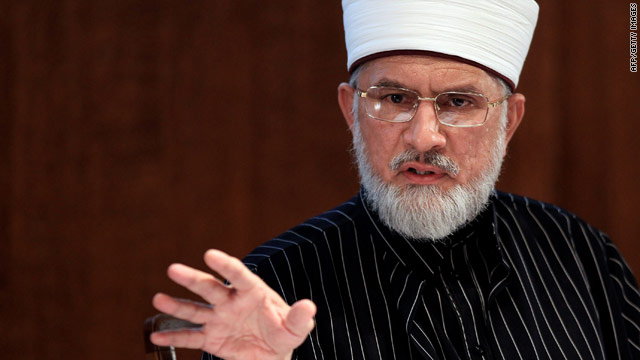
Tahir ul-Qadri, founder of the Minhaj-ul-Quran International,  announces his fatwa in London on Tuesday.

Tahir ul-Qadri, founder of the Minhaj-ul-Quran International, announces his fatwa in London on Tuesday.

STORY HIGHLIGHTS

  • A fatwa, issued Tuesday, called terrorism “haraam,” or forbidden
  • Tahir ul-Qadri: Previously, scholars had qualified their condemnations
  • This fatwa is an “absolute” condemnation, ul-Qadri says
  • Ruling may even sway individuals susceptible to radicalism, one scholar says

Islamabad, Pakistan (CNN) — A fatwa, or religious ruling, issued this week is roiling theological waters after it took aim at those notorious for targeting others: terrorists.

The anti-terrorism fatwa by renowned Muslim scholar Muhammad Tahir ul-Qadri pulled no punches, declaring that terrorism was “haraam,” or forbidden by the Quran, and that suicide bombers would be rewarded not by 72 virgins in heaven, as many terrorist recruiters promise, but with a suite in hell.

Qadri, the founder of the Minhaj-ul-Quran International, an Islamic movement with centers in 90 countries, told a news conference in London, England, on Tuesday that his decree categorically condemns terrorism and suicide bombings in the name of Islam.

“Until now, scholars who were condemning terrorism were conditional and qualified what they said,” Qadri said in a phone interview, noting that his 600-page ruling left no room for interpretation. “I didn’t leave a single, minor aspect that, in the mind of radicals or extremists, can take them to the direction of martyrdom.”

The 59-year-old Pakistani scholar called his fatwa an “absolute” condemnation, going as far as to label the terrorists themselves “kafirs,” a term in the Quran meaning “unbeliever.”

“This fatwa has the potential to be a highly significant step towards eradicating Islamist terrorism,” Quilliam, a counter-extremism think tank based in London, said in a statement.

Manan Ahmed, assistant professor of Islam in South and Southeast Asia at the Institute for Islamic Studies in Berlin, agreed, calling the fatwa “unprecedented.”

“This is a landmark theological study — a careful and systematic treatment of a thousand years of legal tradition dealing with armed resistance against the state, rules of engagement, aspects. The fatwa itself … is categorically and comprehensively against terrorism in any form and for any cause,” Ahmed said.

Many skeptics questioned whether an intellectual dismantling of al Qaeda’s religious philosophy could have any impact on recruiting terrorists in places like Pakistan, where many potential foot soldiers don’t have access to education, much less academic discourse.

Ahmed says it can.

I didn’t leave a single, minor aspect that, in the mind of radicals or extremists, can take them to the direction of martyrdom.
–Tahir ul-Qadri
var cnnRelatedTopicKeys = [];

RELATED TOPICS
  • cnnRelatedTopicKeys.push(‘Terrorism’); Terrorism
  • cnnRelatedTopicKeys.push(‘Islam’); Islam
  • cnnRelatedTopicKeys.push(‘Al_Qaeda’); Al Qaeda

“This is not an academic or an intellectual argument alone. This is a theological argument, based in the Qur’an and Sunnah [practice of the Prophet],” Ahmed said. “What it provides are easily available argumentation and proof for the millions of preachers across Pakistan, who can, in turn, incorporate this into their weekly sermons.”

Ahmed says where it will undoubtedly leave an indelible mark is online. Just this week, U.S. Army Brig. Gen. John Custer, head of intelligence at the U.S. military’s Central Command, told the CBS program “60 Minutes” that “without a doubt, the Internet is the single most important venue for the radicalization of Islamic youth.”

In the recent case involving five young Americans from the Virginia area, known as the “D.C. Five,” who are in a Pakistani jail potentially facing terrorism charges, the so-called ringleader Ramy Zamzam allegedly had contact with radical Islamist Web sites. Last week, 24 year-old Afghan-born American Najibullah Zazi pleaded guilty to conspiring to blow up high-density targets in New York City. Prosecutors allege he, too, communicated online with terrorists.

Salman Ahmad, the lead singer of the Pakistani rock band “Junoon” and author of “Rock & Roll Jihad: A Muslim Rock Star’s Revolution,” says it’s young men in the West who can be influenced the most by Qadri’s arguments.

“The fatwa by the Pakistani Islamic scholar is an important positive religious ruling and it has been made in the West, where a lot of young impressionable Muslim kids are being brainwashed by the terrorists to commit murder and suicide in the name of Islam,” Ahmad said.

“It’s about time Osama bin Laden and al Qaeda realize that Muslims will not allow their faith and identity to be hijacked by a bunch of thugs masquerading as holy men.”

March 3, 2010 5:39 p.m. ESTMarch 3, 2010 5:39 p.m. EST

Fatwa as significant blow to terrorist recruiting

Fatwa as significant blow to terrorist recruiting

By Kiran Khalid, CNNcnnAuthor = “By Kiran Khalid, CNN”;
if(location.hostname.indexOf( ‘edition.’ ) > -1) {document.write(‘March 3, 2010 — Updated 2239 GMT (0639 HKT)’);} else {document.write(‘March 3, 2010 5:39 p.m. EST’);}March 3, 2010 5:39 p.m. EST

var clickExpire = “-1”;

Tahir ul-Qadri, founder of the Minhaj-ul-Quran International,  announces his fatwa in London on Tuesday.

Tahir ul-Qadri, founder of the Minhaj-ul-Quran International, announces his fatwa in London on Tuesday.

STORY HIGHLIGHTS

  • A fatwa, issued Tuesday, called terrorism “haraam,” or forbidden
  • Tahir ul-Qadri: Previously, scholars had qualified their condemnations
  • This fatwa is an “absolute” condemnation, ul-Qadri says
  • Ruling may even sway individuals susceptible to radicalism, one scholar says

Islamabad, Pakistan (CNN) — A fatwa, or religious ruling, issued this week is roiling theological waters after it took aim at those notorious for targeting others: terrorists.

The anti-terrorism fatwa by renowned Muslim scholar Muhammad Tahir ul-Qadri pulled no punches, declaring that terrorism was “haraam,” or forbidden by the Quran, and that suicide bombers would be rewarded not by 72 virgins in heaven, as many terrorist recruiters promise, but with a suite in hell.

Qadri, the founder of the Minhaj-ul-Quran International, an Islamic movement with centers in 90 countries, told a news conference in London, England, on Tuesday that his decree categorically condemns terrorism and suicide bombings in the name of Islam.

“Until now, scholars who were condemning terrorism were conditional and qualified what they said,” Qadri said in a phone interview, noting that his 600-page ruling left no room for interpretation. “I didn’t leave a single, minor aspect that, in the mind of radicals or extremists, can take them to the direction of martyrdom.”

The 59-year-old Pakistani scholar called his fatwa an “absolute” condemnation, going as far as to label the terrorists themselves “kafirs,” a term in the Quran meaning “unbeliever.”

“This fatwa has the potential to be a highly significant step towards eradicating Islamist terrorism,” Quilliam, a counter-extremism think tank based in London, said in a statement.

Manan Ahmed, assistant professor of Islam in South and Southeast Asia at the Institute for Islamic Studies in Berlin, agreed, calling the fatwa “unprecedented.”

“This is a landmark theological study — a careful and systematic treatment of a thousand years of legal tradition dealing with armed resistance against the state, rules of engagement, aspects. The fatwa itself … is categorically and comprehensively against terrorism in any form and for any cause,” Ahmed said.

Many skeptics questioned whether an intellectual dismantling of al Qaeda’s religious philosophy could have any impact on recruiting terrorists in places like Pakistan, where many potential foot soldiers don’t have access to education, much less academic discourse.

Ahmed says it can.

I didn’t leave a single, minor aspect that, in the mind of radicals or extremists, can take them to the direction of martyrdom.
–Tahir ul-Qadri
var cnnRelatedTopicKeys = [];

RELATED TOPICS
  • cnnRelatedTopicKeys.push(‘Terrorism’); Terrorism
  • cnnRelatedTopicKeys.push(‘Islam’); Islam
  • cnnRelatedTopicKeys.push(‘Al_Qaeda’); Al Qaeda

“This is not an academic or an intellectual argument alone. This is a theological argument, based in the Qur’an and Sunnah [practice of the Prophet],” Ahmed said. “What it provides are easily available argumentation and proof for the millions of preachers across Pakistan, who can, in turn, incorporate this into their weekly sermons.”

Ahmed says where it will undoubtedly leave an indelible mark is online. Just this week, U.S. Army Brig. Gen. John Custer, head of intelligence at the U.S. military’s Central Command, told the CBS program “60 Minutes” that “without a doubt, the Internet is the single most important venue for the radicalization of Islamic youth.”

In the recent case involving five young Americans from the Virginia area, known as the “D.C. Five,” who are in a Pakistani jail potentially facing terrorism charges, the so-called ringleader Ramy Zamzam allegedly had contact with radical Islamist Web sites. Last week, 24 year-old Afghan-born American Najibullah Zazi pleaded guilty to conspiring to blow up high-density targets in New York City. Prosecutors allege he, too, communicated online with terrorists.

Salman Ahmad, the lead singer of the Pakistani rock band “Junoon” and author of “Rock & Roll Jihad: A Muslim Rock Star’s Revolution,” says it’s young men in the West who can be influenced the most by Qadri’s arguments.

“The fatwa by the Pakistani Islamic scholar is an important positive religious ruling and it has been made in the West, where a lot of young impressionable Muslim kids are being brainwashed by the terrorists to commit murder and suicide in the name of Islam,” Ahmad said.

“It’s about time Osama bin Laden and al Qaeda realize that Muslims will not allow their faith and identity to be hijacked by a bunch of thugs masquerading as holy men.”

March 3, 2010 5:39 p.m. ESTMarch 3, 2010 5:39 p.m. EST

Egypt to pay for restoration of all synagogues

Egypt to pay for restoration of all synagogues

CAIRO — Egypt will shoulder the costs of restoring the country’s Jewish houses of worship said the culture minister Tuesday, two days after a historic synagogue in Cairo’s ancient Jewish quarter was rededicated in a private ceremony.

Farouk Hosny said in a statement that his ministry views Jewish sites as much a part of Egypt’s culture as Muslim mosques or Coptic churches and the restorations would not require any foreign funding.

On Sunday, the Ben Maimon synagogue, named after the 12th century rabbi and intellectual Maimonides, was rededicated in a ceremony that included half a dozen Egyptian Jewish families that long ago fled the country.

Hosny committed his ministry to restoring all 11 synagogues across Egypt, three of which have already been renovated. The best-known synagogue that of Ben Ezra, is located in Cairo’s Christian quarter near a number of old churches and was restored years ago.

The ceremony at the Ben Maimon synagogue was closed to media but attendees said it was an emotional event, especially for the Egyptian-Jewish families invited, many of whom now live in Europe.

“There were some lectures on the Jewish sites in Egypt and the temple. It was nice, emotional and nostalgic,” said Raymond Stock, an American close to the Jewish community in Cairo who attended the three-day event.

A group of about 11 Hassidic Chabad-Lubavitch rabbis also came to Cairo from the United States and Israel and sang at the event.

Egypt’s Jewish community, which dates back millennia and at its peak in the 1940s numbered around 80,000, is down to several dozen, almost all of them elderly. The rest were driven out decades ago by mob violence and persecution tied in large part to the Arab-Israeli conflict.

Egypt and Israel fought a war every decade from the 1940s to the 1970s until the 1979 peace treaty was signed.

Despite that treaty, Egyptian sentiment remains deeply unfriendly to Israel, and anti-Semitic stereotypes still occasionally appear in the Egyptian media.

Last September, Hosny blamed a conspiracy “cooked up in New York” by the world’s Jews when he lost a bid from becoming the next head of the U.N.’s agency for culture and education.

At the time, Hosny’s candidacy raised an outcry because of a threat he made in the Egyptian parliament in 2008 to personally burn any Israeli book he found in the Alexandria Library.

While he later apologized and Israel said it had withdrawn its opposition to his candidacy, several prominent Jewish activists spoke out against him in the run-up to the vote.

Targeting Israeli Apartheid

Targeting Israeli Apartheid


By Stephen Lendman (about the author)     Page 1 of 3 page(s)

opednews.com     Permalink

For OpEdNews: Stephen Lendman – Writer

Targeting Israeli Apartheid – by Stephen Lendman

Reports like the Cape Town, South Africa-based Human Sciences Research Council’s (HSRC) May 2009 one titled, “Occupation, Colonialism, Apartheid” highlight what many others understand, including former UN Special Human Rights Rapporteur for Occupied Palestine, John Dugard, stating in January 2007:

“Israel is clearly in military occupation of the OPT (Occupied Palestinian Territories). At the same time, elements of the occupation constitute forms of colonialism and of apartheid, which are contrary to international law.”

Article 7(1)(j) of the Rome Statute of the International Criminal Court calls apartheid a crime, stating:

“For the purpose of this Statute, (a) ‘crime against humanity’ means any of the following acts when committed as part of a widespread or systematic attack directed against any civilian population, with knowledge of the attack:

The crime of apartheid” includes murder, extermination, enslavement, torture, arbitrary arrest, illegal imprisonment, denial of the right to life and liberty, cruel, inhuman and degrading treatment, and other abusive acts imposed by one group on another.

In 2008, writing for the Campaign to End Israeli Apartheid, Karine MacAllister said in her article titled, “Applicability of the Crime of Apartheid to Israel” that exclusivism is key to understanding the essence of the Israeli – Palestinian conflict. It:

“involves or necessitates the denial of the other; of their presence, rights and existence on the land and reconstruction of the past, namely that the land was empty before the advent of Zionist settlement, hence the movement’s slogan describing ‘a land without people for a people without land.’ “

As implemented, Zionism’s essence is “a sophisticated legal, social, economic and political regime of racial discrimination that has led to colonialism and apartheid as well as the dispossession and displacement of the Palestinian people.” Colonialism flourishes by separating indigenous people from their land and heritage.

Yet Fourth Geneva’s Article 49 states:

“Individual or mass forcible transfers, as well as deportation of protected persons from occupied territory to the territory of the Occupying Power or to that of any other country, occupied or not, are prohibited, regardless of the motive.” Neither shall “The Occupying Power….deport or transfer parts of its own civilian population into the territory it occupies.”

The Convention on the Suppression and Punishment of the Crime of Apartheid (the Apartheid Convention) defines it as:

“similar policies and practices of racial segregation and discrimination as practiced in southern Africa (for) the purpose of establishing and maintaining domination by one racial group of persons over any other racial group of persons and systematically oppressing them.”

Apartheid is one of the worst forms of racism.

The Convention on the Elimination of Racial Discrimination defines it as:

“any
distinction, exclusion, restriction or preference based on race, color,
descent, or national or ethnic origin which has the purpose or effect
of nullifying or impairing the recognition, enjoyment or exercise, on
an equal footing, of human rights and fundamental freedoms in the
political, economic, social, cultural or any other field of public
life.”

The 1977 Additional Protocol to the Geneva Conventions (Protocol I) includes among other grave breaches:

“practices
of apartheid and other inhuman and degrading practices involving
outrages upon personal dignity, based on racial discrimination.”

The
October 2008 “UNITED AGAINST Apartheid, Colonialism and Occupation
DIGNITY & JUSTICE for the Palestinian People” Palestinian Civil
Society’s Strategic Position Paper for the April 20 – 24, 2009 Durban
Review Conference called racism and foreign domination the root causes
of Palestinian suffering under decades of “settler-colonialism,
occupation and institutionalized racial discrimination.”

<!–
google_ad_client = “pub-1948223620
103741”;
google_ad_width = 300;
google_ad_height = 250;
google_ad_format = “300x250_as”;
google_ad_type = “text_image”;
//2007-01-25: Op
google_ad_channel = “2444761858”;
//–>

google_protectAndRun(“ads_core.google_render_ad”, google_handleError, google_render_ad);

It
affirmed the Durban Declaration’s “principles of equal rights and
self-determination of peoples and stress(ed) that states must protect
such equality as a matter of highest priority.”

It
acknowledged that “no derogation from the prohibition of racial
discrimination, genocide, the crime of apartheid and slavery is
permitted (and recognized them as) crimes against humanity (and) major
sources and manifestations of racism, racial discrimination, xenophobia
and related intolerance (and) wherever and whenever they occurred, they
must be condemned and their re-occurrence prevented.”

Israeli Apartheid Week (IAW)

Launched
in Toronto in 2005 by over 170 Palestinian civil society organizations,
it’s an annual series of university lectures, rallies, multimedia
events, cultural performances, films, and demonstrations held in cities
worldwide to educate people about the nature and destructiveness of
Israeli apartheid, and to strengthen the global Boycott, Divestment,
and Sanctions (BDS) movement.

From March 1 – 14, 2010, they’ll be held in 40 cities:

Abu
Dis in the West Bank, Amsterdam, Bard (NY), Berkeley (CA), Beirut,
Bethlehem, Bogota, Bologna, Boston, Cape Town, Caracas, Chicago,
Connecticut, Dundee (Scotland), Durban, Eastern Cape, Edinburgh,
Edmonton, Gaza, Glasgow, Guelph (Canada), Hamilton, Houston, Ireland,
Jenin, Johannesburg, Kingston, London (Canada), London (UK), Melbourne,
Montreal, New York, Ottawa, Oxford, Peterborough (UK), Pisa, Pretoria,
Providence, Puebla (Mexico), Rome, San Francisco, Seattle, Sudbury,
Tilburg (The Netherlands), Toronto, Utrecht (The Netherlands),
Vancouver, Waterloo (Canada), and Winnipeg.

Its
supporters call it an expression of Palestinian solidarity, a call to
boycott, divest and impose sanctions, and a demand that Israel be held
accountable for decades of oppressive occupation, imperial wars,
defiling international laws, expropriating Palestinian land, denying
self-determination, the right of return, targeted killings, torture,
illegal arrests and incarcerations, and the suppression of equal rights
and social, political and economic justice.

They’ll
also highlight apartheid’s environmental costs, the importance of
ending a colonial occupation, and a vision for equality, justice and
peace.

Media Reports

On
March 2, AlJazeera headlined, “Israeli Apartheid Week kicks off,”
explaining the annual event’s “condemnation of the Zionist regime’s
suppression of the Palestinians” through protests and a host of related
speeches and other activities.

Haaretz
ran several articles, including Salman Masalha’s March 3 commentary
headlined, “Israel’s apartheid doesn’t stop at the West Bank,” saying:

Since
Israel’s founding, it hasn’t “kept its promise “to preserve peace and
participate in the upbuilding of the State on the basis of full and
equal citizenship and due representation in all its provisional and
permanent institutions.”

Instead,
it “continues to conduct itself like a Zionist occupation regime on
every inch of the land. True,” Israeli Arabs have some free movement
“in their homeland and even send representatives to the Knesset (with
no power) – but this is the sum of the equality that was formulated and
promised,” in contrast to the OPT where there’s none.

On
the same day Haaretz’s Danna Harman headlined, “Universities across the
globe mark Israeli Apartheid Week,” highlighting Israeli participants
and calling the events “some of the most important (ones) in the
Palestine solidarity calendar, according to its organizers.

Harman
also quoted Britain’s Jewish Board of Deputies’ David Katz calling the
participation of Jews in the events “atrocious….They are free to do
as they please, but it’s atrocious. I think they don’t understand the
analogy they are making….which is insulting to those who suffered
under apartheid.”

Jewish South African immigrant Benjamin Pogrund agreed saying “Israelis (taking) part in this week should know better.”

<!–
google_ad_client = “pub-1948223620103741”;
google_ad_width = 300;
google_ad_height = 250;
google_ad_format = “300x250_as”;
google_ad_type = “text_image”;
//2007-01-25: Op
google_ad_channel = “2444761858”;
//–>

google_protectAndRun(“ads_core.google_render_ad”, google_handleError, google_render_ad);

The
Canadian Ontario legislature “unanimously condemned Israeli Apartheid
Week, voting for a resolution that denounced the campus events.” Will
Ottawa, London and Washington
be far behind?

Conservative
legislator Peter Shulman told Shalom Life, a Toronto Jewish web site:
“The use of the phrase ‘Israeli Apartheid Week’ is about as close to
hate speech as one can get without being arrested, and I’m not certain
it doesn’t actually cross over the line.”

The
Canadian Parliamentary Coalition to Combat Anti-Semitism (CPCCA), a
voluntary association of 22 MPs exploiting anti-semitism for political
purposes, calls “anti-Zionism….cover for anti-semitism,” and
perpetrators should be held criminally liable.

In
America, The New York Times was silent, but the Washington Post’s
Richard Cohen, an unabashed Israeli flack, said Israeli Apartheid Week
reflects anti-semitism and “imaginary” not “legitimate” grievances
“constructed out of lies about the Jewish state….denigrat(ing) the
Palestinian cause….Israel has its faults, but it is not motivated by
racism.”

A
Canada National Post commentary headlined, “A festival of bigotry
(featuring) rabid expressions of hatred against Israel and its Jewish
inhabitants….with extremist speakers whipping crowds into the sort of
frenzy one more usually sees in newsreel footage from the streets of
Cairo or Gaza City….IAW types don’t care about human rights. They
care about smearing the Jewish state.”

Pro-Israeli
organizations denounced IAW, the Anti-Defamation League (ADL) for one
highlighting the “extreme anti-Israel rhetoric….accusations of
Israeli racism and apartheid….and allegation that Israel is
committing war crimes and genocide against the Palestinian people,” the
ADL, of course, calling this hateful.

Organizers respond saying “Join us in making 2010 a year of struggle against apartheid and for justice, equality, and peace.”

Stephen
Lendman is a Research Associate of the Centre for Research on
Globalization. He lives in Chicago and can be reached at
lendmanstephen@sbcglobal.net.

Also
visit his blog site at sjlendman.blogspot.com and listen to
cutting-edge discussions with distinguished guests on the Progressive
Radio News Hour on the Progressive Radio Network Thursdays at 10AM US
Central time and Saturdays and Sundays at noon. All programs are
archived for easy listening.

google_protectAndRun(“ads_core.google_render_ad”, google_handleError, google_render_ad);google_protectAndRun(“ads_core.google_render_ad”, google_handleError, google_render_ad);google_protectAndRun(“ads_core.google_render_ad”, google_handleError, google_render_ad);google_protectAndRun(“ads_core.google_render_ad”, google_handleError, google_render_ad);

Gulbarg Society killings: High court urged to transfer case

Gulbarg Society killings: High court urged to transfer case | TwoCircles.net

Submitted by admin3 on 4 March 2010 – 10:43am.

* Indian Muslim

By IANS,

Ahmedabad: The Gujarat High Court here was petitioned Wednesday to transfer the 2002 Gulbarg Society massacre case, which left 69 people dead during the Gujarat riots, the affected families alleging a bias on the part of the special judge.

The petition by witnesses and riot victims comes after their plea filed before the principal sessions judge G.B. Shah for the transfer was dismissed on the premise that the special court was appointed by the Gujarat High Court.

The petitioners contend that the behaviour of special judge B.U Joshi during trial had led to erosion of faith in him and in the circumstances the case should be transferred to some other court.

They allege that after two witnesses — Imtiyaz Khan Pathan and Rupa Dara Modi — deposed, the judge disallowed further witnesses from stepping out of the witness box to identify the accused at the back of the courtroom, and overruled the objections raised by the witnesses through their advocates.

The special court was set up by the Gujarat High Court under directions of the Supreme Court for the trial of nine serious incidents of killings during the 2002 communal riots.

The 69 people who died in the Gulbarg Society massacre also included former Congress MP Ehsaan Jaffri.

The petition in the high court also comes a day after the special public prosecutor R.K. Shah and assistant public prosecutor Naina Bhatt sent in their resignations from the case to the Supreme Court appointed Special Investigation Team (SIT) probing it.

American Muslim Accuses Police of Bias in Hiring

Lawsuit
by Moroccan-American Muslim Accuses Police of Bias in Hiring

var articleToolsShareData = {“url”:”http://www.nytimes.com/2010/03/01/nyregion/01muslim.html”,”headline”:”Lawsuit by Moroccan-American Muslim Accuses Police of Bias in Hiring”,”description”:”In a federal lawsuit, Said Hajem says that he passed the written exam but that an officer reviewing his paperwork blackballed his application.”,”keywords”:”Hiring and Promotion,Discrimination,Muslim-Americans,Suits and Litigation,Islam,Police Department (NYC)”,”section”:”nyregion”,”sub_section”:null,”section_display”:”N.Y. / Region”,”sub_section_display”:null,”byline”:”By COLIN MOYNIHAN”,”pubdate”:”February 28, 2010″,”passkey”:null};
function getShareURL() {
return encodeURIComponent(articleToolsShareData.url);
}
function getShareHeadline() {
return encodeURIComponent(articleToolsShareData.headline);
}
function getShareDescription() {
return encodeURIComponent(articleToolsShareData.description);
}
function getShareKeywords() {
return encodeURIComponent(articleToolsShareData.keywords);
}
function getShareSection() {
return encodeURIComponent(articleToolsShareData.section);
}
function getShareSubSection() {
return encodeURIComponent(articleToolsShareData.sub_section);
}
function getShareSectionDisplay() {
return encodeURIComponent(articleToolsShareData.section_display);
}
function getShareSubSectionDisplay() {
return encodeURIComponent(articleToolsShareData.sub_section_display);
}
function getShareByline() {
return encodeURIComponent(articleToolsShareData.byline);
}
function getSharePubdate() {
return encodeURIComponent(articleToolsShareData.pubdate);
}
function getSharePasskey() {
return encodeURIComponent(articleToolsShareData.passkey);
}

As the New York Police Department has initiated and expanded
counterterrorism efforts in foreign countries over the last several
years, it
has also aggressively tried to recruit speakers
of Arabic and other languages
of countries where Islam holds sway.

Hiroko Masuike for The New York Times

Said Hajem says that a police officer reviewing his
application told him, “You may be a terrorist.”

But a Moroccan immigrant who applied to become a police officer as a
result of those efforts is suing the department, charging that he was
not hired because he was a Muslim and was born outside the United
States.

Lawyers for the city filed a motion asking that his claim be dismissed,
but on Jan. 29, Judge Richard J. Sullivan of United States District
Court in Manhattan ruled that there was enough evidence for the suit to
proceed.

The immigrant, Said Hajem, took the police exam in February 2006 and
said he scored 85.6, well above the passing grade. That June he received
a letter of congratulations from Commissioner Raymond W. Kelly and
began preparing to enter the Police Academy. Mr. Hajem said he had even
decided to delay his wedding, hoping to get married as a police officer.

“I started dreaming of becoming one of the Finest,” Mr. Hajem, 39, said
last month, as he sat in his lawyer’s office on lower Broadway, “an
important person who is going to save lives and stop terrorism.”

Now those hopes seem remote. It has been four years since Mr. Hajem
passed the exam, but his application has been suspended in bureaucratic
limbo.

Mr. Hajem, who said he became an American citizen in early 2006, said
the hiring process faltered for him in July 2006 when an officer
reviewing his paperwork, Ricardo Ramkissoon, told him that he
disapproved of people from “other countries” joining the department.

Mr. Hajem added that Officer Ramkissoon had also rejected references he
had provided from people with Middle Eastern names. “He told me, ‘I need
American names,’ ” Mr. Hajem said. “He said, ‘You may be a
terrorist.’ ”

Mr. Hajem’s lawsuit said he had been subjected to discrimination that
violated his constitutional rights.

In response, a lawyer for the city, Jessica Miller of the Law
Department, said in a statement: “We expect to prevail at trial.”

Deputy Commissioner Paul J. Browne, the Police Department’s chief
spokesman, declined to specifically address the statements that Mr.
Hajem attributed to Officer Ramkissoon, but said in an e-mail message
that “the allegations fly in the face of the N.Y.P.D.’s
well-established record of outreach and hiring” of recruits from
countries like Turkey, Bangladesh and Pakistan, which all are mainly
Muslim nations.

“We have actively and successfully recruited native speakers of Urdu,
Farsi, Arabic, Pashto and other languages,” Mr. Browne wrote. “Our
linguist program is the envy of law enforcement worldwide.”

Mr. Hajem’s lawyer, David B. Rankin, did not contest the department’s
claims of diversity. He contended, however, that Officer Ramkissoon had
sabotaged Mr. Hajem’s application by giving misleading and false
information to superiors.

On a department form dated July 2006, Officer Ramkissoon presented
several reasons not to hire Mr. Hajem, including that he had not
disclosed a summons received while he was working as a livery driver,
and that he had engaged in “tax evasion” from 2001 to 2005.

In court papers, Mr. Hajem included Internal
Revenue Service
documents; he said that he had earlier provided them
to Officer Ramkissoon and that they showed he had paid the proper
amounts in taxes.

And Mr. Hajem said the summons, issued for picking up a passenger who
hailed him from the sidewalk, was dismissed when he went to court.

Officer Ramkissoon did not respond to a request for comment.

Karadzic trial on again

Trial to resume for ‘Butcher of Bosnia’

Mon, 01 Mar 2010 08:41:01 GMT

Font size :

Karadzic, who has earned notoriety as ‘the butcher of the Bosnia,’ is charged with 11 counts of genocide and war crimes.

var images=new Array();images[0]=’

Karadzic, who has earned notoriety as 'the butcher of the Bosnia,' is charged with 11 counts of genocide and war crimes.

‘;images[1]=’

One of many Srebrenica mass graves, where the victims were shot to death, including children aged between 7 and 11.

‘;

The trial of the Bosnian Serb wartime leader Radovan Karadzic is set to resume before a UN court after a four-month-long suspension.

The hearings, which started in October 2009, have been adjourned since early November after the tribunal appointed a lawyer to represent Karadzic.

The infamous ex-leader has been conducting his own defense and has boycotted the trials once, claiming he needed more time to prepare.

Karadzic, who insists he’s innocent, is expected to outline his defense at the International Criminal Tribunal in The Hague on Monday.

The session will see its first witness on Wednesday.

Karadzic, known as the ‘Butcher of Bosnia’, is charged with 11 counts of genocide, war crimes and crimes against humanity during the 1992-95 Bosnian war.

They include the massacre of more than 7,000 Muslim men and boys at the UN-protected enclave of Srebrenica in July 1995.

The brutal slaughter is known as the ‘largest mass killing on European soil since World War II.’

The supreme commander of an ethnic cleansing campaign is also charged with responsibility for the 44-month siege of Sarajevo, which ended in November 1995 after some 10,000 people, many of them civilians, had been killed.

Karadzic was arrested in Belgrade in July 2008 after nearly 13 years on the run.

During his time in power, he was president of the self-styled Bosnian Serb Republic and commander of its army during the Bosnian conflict, which claimed about 100,000 lives, mostly Muslim and caused the displacement of 2.2 million people.