Peace Homes Aluva

Simplify Building Your Dream Home

Archives 2010

Islamic Influence in Spain

A-Z | Adhan | Arabic | Bookstores | Clothing | Etiquette | Food | Glossary | History | Islam | Living | Newspapers | Pearls | Ramadan | Ruling Family | Sadhew

Part 1 – The Great Mosque of Córdoba.

by John

Tariq surveyed the bleak landscape from his ship as he approached the shore. He was surrounded by a Muslim army, which had swept across North Africa, conquering all before it. Now he was crossing the Straits of Gibraltar. Little did he know, but he was the start of a movement that would dominate Spain for the next seven centuries and change its architecture, people and language forever.

A painting of Tariq, sword about to be drawn.

Tariq: the general who lead the Muslim armies into Spain.

The Arabic/Islamic influence in Andalucía is undisputed and unavoidable and indeed is one of the main draws for tourists. The very name comes from the Arabic “al-Andalus” and there can be little doubting the origin of the name Algeciras.

A Little History

After the death of Muhammad, the Muslim armies, under the rule of the Rashidoun, drove the Sassawd Persians out of Mesopotamia and then conquered the Byzantine provinces before sweeping on through North Africa.

In 711, a Muslim army landed at Algeciras under the Muslim general Tariq who, according to one historian, burned his ships behind him, stating:

Oh my warriors, whither would you flee? Behind you is the sea, before you, the enemy. You have left now only the hope of your courage and your constancy.

The Visigoth king of “Corduba”, Rodrigo, sent forces to Cádiz but they were routed by the Muslims and Tariq occupied Córdoba shortly afterwards.

Capital of al-Andalus.

Five years later, Córdoba, or “Qurtuba”, became capital of al-Andalus. In 755, Abd ar-Rahman, supposedly the only survivor of the Umayyid dynasty after their defeat by the Abbasids, arrived in Córdoba after fleeing Damascus, united the various discontented factions and defeated the Abbasid governor, who was weakened from 15 years of civil wars. He then proclaimed himself “Emir of al-Andalus”. As well as gaining control of all but the north of Spain, he started the building of the “Mezquita” – the Grand Mosque.

The Córdoban Emirate

The Córdoban Emirate declared itself independent of the Caliphate of Baghdad (to where power transferred from Damascus following the Abbasids victory over the Umayyads) and began to rival it in culture and power. Successive Emirs completed and extended the mosque, increased agricultural production by installing irrigation and promoted culture and learning.

The Height of Islamic Power

The zenith of Islamic power was reached under ar-Rahman III. This very self confident gentleman declared himself Caliph, meaning “supreme leader of Islam” thus not just declaring independence from Baghdad but challenging its supremacy.

Under his rule, Córdoba became the largest, richest and most culturally advanced city in Europe and yet he decided that he needed a new and finer city to rule from and so built Medina Azahara 8 km west of Córdoba.

The Great Mosque

From the outside the building looks more like a fort than a religious building. It’s Islamic origins are obvious in the design of the arches and the decoration around the many doors. When it was in use as a Mosque, all these doors would have been open and the building would have been light and airy.

The walls of the great mosque: seemingly built more for protection than for decoration

Forbidding walls line the exterior.

You enter the Mosque via “el Patio de los Naranjos” – the patio of the orange trees. Originally this was the place for ritual cleansing prior to praying in the Mosque. The “Moors” planted it with palm trees to provide shade but these were replaced with orange trees by the Christians. (Ironically, naranjo is a word of Arabic origin).

The patio still has an ambiance of peace and restfulness, in spite of the fact that there were a very large number of tourists sitting and standing around and the fact it is not crowded is a testament to the vast amount of space within it.

It is dominated by the tower, which was built over the minaret of Abd-ar-Rahman III and which is crowned by a sculpture of St. Raphael, the patron saint of Córdoba.

A tower juts into the blue Spanish sky.

The tower built over Rahman’s minaret.

Inside the Mosque

The first thing that strikes you when you enter the Mosque is the huge number of red and white striped arches and their supporting columns. These have been variously described as seeming like a continuation of the orange trees in the patio or as palm trees in the desert. Practically, they were needed to support the roof.

The red and white arches that support the roof.

The interior of the mosque: lined by red and white arches

The columns came from a variety of sources, many from Roman buildings in Córdoba but also from existing Visigoth and other buildings, which accounts for their different colours and materials. To gain further height, the famous red and white striped arches were built on top of the pillars, the effect being achieved by alternating brick and stone: a new and unique feature of the time.

The Maksura

The maksura was the space reserved for the Caliph, his family and senior members of court to pray. It contains the mihrab, which ind
icates the direction in which the faithful should face to pray.It also served to amplify the voice of the prayer leader. As might be expected, this is the most beautifully decorated part of the building. There are three bays, each with a dome with skylights, making it bright and emphasising the floral motive mosaics and the inscriptions from the Qur’an in gold, purple, green , blue and red.

An Anomaly Within an Enigma

The building is often described nowadays as the Mosque-Cathedral, for the simple reason that the Catholic hierarchy could not resist stamping their authority on the building after the reconquista and not only built a cathedral in the middle of the Mosque but covered the outside walls with dozens of chapels.

Cathedral interior, with a huge wall decorated with Christian paintings.

The interior of the Cathedral.

I have no intention of getting involved in religious arguments here but I can say that architecturally and aesthetically it is absolutely wrong. It also changes the atmosphere of the building from the original light and airy one to a gloomy half light.

The scale is also wrong, the “cathedral” part is much higher than the Mosque and looks even more out of place outside than it does inside. The lavish Catholic adornments clash with the subtle restraint of the Mosque. Entering the Cathedral part is like going through a space warp as there is an abrupt change of style, design and atmosphere.

Even Kings Get It Wrong

As stated, the Catholic Church was itching to “convert” the Mosque into a Cathedral and eventually, 3 centuries after the Christian take over, King Carlos V gave permission for the construction to take place, much against the will of the town council.

However, when he saw the results, he realised his error and said:

“I didn’t know that it was like this or I would not have permitted this. You have built what you and others might have built anywhere but you have destroyed something that was unique in the world.”

Unsurprisingly, there is no mention of this in the leaflet produced by the diocese – in fact, their leaflet is a blatant piece of propaganda. Their leaflet talks about “an ingenious integration,” but to me it is an idiosyncratic intrusion.

The Cathedral

The great mosque/cathedral as viewed from across river.

The Mosque/Cathedral at Cordoba

In spite of it being in the wrong place, the Cathedral has its own merits.

Both the main alter and those of the side chapels are, to my taste at least, over adorned and garish but the carving on the choir stalls is undoubtedly a work of art, if surprisingly dark and gloomy, although the main part is much lighter and brighter than the surrounding mosque has been made by it and by the chapels. The masonry and stone carving is also impressive.

A Place of Pilgrimage and Learning

Under the rule of Abd ar-Rahman III, Córdoba became a place of pilgrimage for Muslims as well as a centre of learning and culture with a University, famous for its library. It was an open society with Jewish, Christian and Muslim scholars welcomed.

At this time, Islamic culture, learning and medical knowledge were vastly superior to that of the Christian’s but they were also open to other cultures and ideas. Indeed, the subsequent withdrawal of Islam and the Arab nations and their cultural stagnation over a long period has been blamed on the crusades called for by Pope Urban II.

Visiting Córdoba

I found Córdoba a warm (at times literally) and friendly place to visit. (It’s a good idea to avoid summer if planning a trip as temperatures are not that much lower than Doha’s, often in excess of 40 degrees celsius.)

Although the Mosque is perhaps the main target for visitors, there is much more to see. It is famous for its Festival of Patios in May, when some of the Islamic inspired patios, covered in flowers, are open to the public. Leaflets giving three different routes to follow are available. Many of the “hostales” and hotels have their own patios, some very beautiful. Most of the hostales are modernised, clean and comfortable and quite reasonably priced.

There are also the impressive excavations of the site of Medina Azahara, the largest in Europe and the subject of another article on Islamic Influence in Andalucía.

A Roman bridge marches across the river perched on solid brick columms.

The Roman Road

Before the Muslims arrived Córdoba was Roman and then Visigoth. The pillars of a Roman temple remain, and the site of the Mosque was originally a Visigoth temple. City walls also remain, some Roman, some Muslim, some reconstructed.

The old part of the city is very attractive and there is an interesting “Juderia” showing that that religion was present too before they were driven out or forced to convert by Fernando, Isabel and the Inquisition, the crown seizing all unsold Jewish property.

Many activities and cultural events take place throughout the year and a good jazz cafe (jam sessions on Tuesdays, concerts on Wednesdays and Thursdays). Cordoba is a surprisingly green city and you can walk all the way from the railway station to the Mosque area through a park. The greenness of the surrounding countryside shows that the area has retained or restored much of the fertile agricultural land that first made the area the place of choice for the various civilisations that settled there.

A multitude of eateries add to the attraction of the area. Generally speaking, the further from the Mosque, the cheaper and in some cases better, but there did not seem to be a huge difference in price. Other areas are well worth exploring, though, and just walk around this city is like walking though history.

Part II – Madinat Al-Zahra – The “Shining City”.

Also see Islamic Influence in Andalucia: Part 1

by John Dunworth

Abd ar-Rhaman III surveyed the rich, fertile land of the Guadalquivir valley. He had just left the Great Mosque founded by his ancestor, Abd ar-Rahman I, having given thanks to God for blessing him and his subjects with this land and what they had achieved here. Here, they had founded the Mosque, which he was even now extending further, they had established the University – a seat of great learning – and built beautiful houses and palaces with shady patios against the summer heat.

Even so, he was not satisfied. This is a great city, he thought, and it suited my ancestors well as Emirs of al-Andalus but now I have made myself Caliph of all Islam I need something finer still. As he gazed across the valley, his eyes strayed to the hills opposite. There would be the place, in the foothills, protected from the north by the hills and giving fine views over the river and valley back towards Córdoba, which would give an early warning of any enemy attack.

The sky shines
 above the remains of the shining city.

Image by FR Antunes

The founding of Madinat al-Zahra.

So it was, in 936, that construction started in the foothills of the Sierra Morena, from which the stone was also extracted. Roads were built to carry the stone from the quarries and to connect the new city to Cordoba. Aquaducts to supply fresh water from springs in the hills and bridges to cross the rivers were constructed. With a recorded 10,000 labourers working on the project, the Caliph and his retinue were able to move there in 946, although construction continued for a further fifteen years until the death of Abd ar-Rahman III.

Madinat al-Zahra was a magnificent city. In addition to the local stone, marble was brought in from Almeria, as well as ivory, ebony and metals, including iron, gold and silver. The best architects were brought from Bagdad and Constantinople. The columns and red and white striped arches echoed the Grand Mosque of Cordoba. There were gardens and fish ponds, areas to hold court and accommodation for guards, court officials and ministers, as well as the Caliph’s palace.

Use was made of the natural slope of the foothills, which was terraced into three levels so that the Alcazar, containing the Royal suite, was built at the highest level, then the areas for holding court and government, at the middle level, the gardens and fish ponds, which can be seen towards the top right of the picture, taken from the upper level. The lowest level held the Mosque. This extensive excavation is one of the most important mediaeval archaeological sites in Europe and one of the largest although only about ten per cent of the total site has so far been uncovered.

The Upper Area – The Alcázar.

Islam in Spain.

Here was the Palace of the Caliph, with the rooms arranged around courtyards. To one side was the guardhouse, from where the soldiers could protect the Caliph and control access to the private rooms. Nearby was the residence of a high ranking official, the “House of Ya’far”. This is relatively well preserved and it can be seen that it was divided into private, service and official areas. To the left of the area shown in the foreground of the picture (the east, geographically) were the servants quarters and kitchen with a preserved oven.

Further east, was the entrance to the Alcázar, a row of arches which gave onto the parade ground. From a balcony, the Caliph could watch his troops parade below or carry out formal ceremonies.

The Central level – the Salón Califal and Gardens.

Throne room

The Salón de Abd ar-Rahman III is one of the most impressive buildings on the site, albeit much restored. This was the Throne Room of the Caliph, and where he would have carried out the affairs of state. The decorations here were lavish to impress the visitors. Only the finest materials were used in its construction and here again were the marble pillars, the characteristic horseshoe shaped arches, the walls covered with stone carved with Islamic designs. (When the other materials were robbed from the site, the thieves obviously had no use for this decoration, for tons of these facing blocks can be find all round the site, as well as in the site Museum.) In the centre of the hall stood a huge bowl of mercury, which, when rocked by a slave, would send reflections flashing around the walls and arches (obviously no H&S officials there then!) This magnificent hall opened up onto the gardens, arranged in the form of a cross. In the centre was another building, described as a pavilion, and around this were the four ponds.

The Lower Level – The Mezquita Aljama.

This was located on the lowest level and was outside the city walls. The Caliph had his own private, covered passageway to access it from within the walls. Its design echoed that of the Great Mosque of Córdoba, complete with red and white striped arches, although unlike its “big sister” it faced Mecca. Sadly, all that remains are the foundations and the lower part of the outer walls, the rest having been stolen to construct other buildings, including the nearby monastery.

Construction on the cheap!

This was the fate of all of Madinat al-Zahra. Its glory was short-lived. The destruction started in 1010 when the berber troops of Sulayman al-Mustain attacked and burnt the city. From then on, it was a ready source of building materials for anyone and everyone and the columns and ashlars were spread far and wide, used in the construction of churches and palaces. This sorry state of affairs was finally put to an end in 1911 when excavation of the site was begun. This still carries on now and there is a vast amount still to do.

Visits to the site

A visit is very much recommended if you are in the area. There are buses to the site from the centre of Córdoba which you book at the tourist information. The visitor centre is excellent and equipped with a cinema and museum. The cinema shows a half hour film in which virtual reality is used to show how the city would have looked. You see the site as it is today and then the walls are extended upwards to show how the building would have looked, even populated with soldiers and other people.

In the excellent museum are some of the better examples of the bas relief decoration and in here is the connection to Doha. A bronze deer is exhibited here – and its twin is in the Museum of Islamic Art in Doha.

I remembered seeing this in Doha and asked the curator how that had come about. He was very interested to hear I had seen it in Doha but could not tell me how it had come to be there.

Incidentally the visitor centre won the Aga Khan prize for architecture and was opened by the King and Queen of Spain. It is half buried and so does not intrude on the site.

The “Shining City” may not be gleaming any more, but you can still get an idea of how magnificent it once was and some idea of the artistry of the Islamic craftsmen.

The Islamic Museum in Doha

John found a surprising connection with another Islamic building – the Museum Islamic Arts in Qatar. Image by Ammar.

Links

Cordoba attractions map

Read more: http://www.qatarvisitor.com/index.php?cID=412&pID=1684#ixzz0zHWsv84M


Read more: http://www.qatarvisitor.com/index.php?cID=439&pID=1667#ixzz0zHWTA0TM

Build the mosque near ground zero; it’s the American way

Build the mosque near ground zero; it’s the American way

More News

They want to build a mosque two blocks from ground zero.

And the outrage burns like jet fuel, the argument billows like choking dust, the questions lacerate like flying glass: Is it right, is it decent, is it morally defensible, for developer Sharif el-Gamal of SoHo Properties to build a Muslim worship center called Cordoba House within walking distance of the place where Muslim men, acting from a perverse distortion of their religion, disintegrated thousands of lives — Muslim, Christian, Jewish, atheist and, we may presume, others.

Sally Regenhard, who lost her son in the Sept. 11 attacks, told The New York Times the idea was “sacrilege.” A man named Scott Wheeler produced an ad accusing Muslims of building the mosque to “celebrate” the murders. Sarah Palin called on moderate Muslims to “refudiate” — presumably she meant “repudiate” — the idea.

And then, there is Rabbi Yaakov Thompson. In an opinion piece for the South Florida Sun Sentinel, he accused Imam Feisal Abdul Rauf, leader of the group that would worship at the new facility, of taking chutzpah “to a new level,” even though, he added, “I realize that those behind Cordoba House have no connection to terrorism.”

That bears repeating. Though he acknowledges the people behind Cordoba House are not terrorists, the rabbi still demands New York tell them no. In so doing, he blithely legitimizes the idea that tribe is destiny, that you and I are each individually answerable for the crimes of those who merely look like, talk like, or pray like, us.

That being the case, one wonders how far from ground zero the rabbi would think it proper for Muslims to build? A mile? Twenty? A hundred? Or maybe nowhere within the borders of these United States.

We should not be without sympathy for those who cringe at the notion of a mosque so near ground zero. Memory of what happened there is burned into us all. To put a mosque there would be an unavoidably painful and provocative thing.

But the constitution does not carry an escape clause. We do not get to jettison our national ideals just because they cause pain or provoke. To the contrary, that is the time they are most severely tested and most desperately in need of defending.

And frankly, we ought to be troubled by the easy conflation of Islam and terror into which we have fallen over the last decade. Yes, we have been helped in that fall by manifold Islamic terrorists, from the Fort Hood shooter to the shoe bomber to the man who left a crude bomb in Times Square two months back. But we have also been helped in that fall by that xenophobic strain that was seemingly born in us and that, at some point or another in history, has caused us to regard Americans of Japanese, German, Iranian, Irish and French descent with the same suspicion and scorn we now reserve for Muslims.

But this blanket antipathy is now, as it was then, antithetical to what we claim to believe as Americans. How shameful was it that candidate Obama had to keep reassuring voters he wasn’t a Muslim and that no one — not the candidate, not the pundits — thought to say the obvious: What if he was?

Are Muslims not Americans, too? Is that what we’re saying now?

Yes, I fear terrorism. But I find I fear even more what my country has become in response to it — a nation where a “rabbi” (!) can blandly condemn someone, not for his own crimes but for the crimes of some of his tribesmen.

So yes, putting that building in that place might be painful and provocative, but it would also be a reminder of the very values the terrorists sought to kill. And we seem to need that reminder more everyday.

They want to build a mosque two blocks from ground zero? Let them.

©2010, The Miami Herald

E-mail Leonard Pitts Jr. at lpitts@miamiherald.com.

Japanese institutions go for Islamic financing

Japanese institutions go for Islamic financing

By MUSHTAK PARKER | ARAB NEWS

LONDON: After a hiatus of over three years largely due to inertia from regulators and head offices, Japanese institutions are finally going to the market to raise millions of dollars in Islamic financing. The good news is for Malaysia because much of this activity is centered in or out of Kuala Lumpur.

Over the last two weeks Nomura Holdings, Inc. appointed Kuwait Finance House (Malaysia) as the mandated lead arranger for its debut $100 million Sukuk Al-Ijara. The two-year issuance will be the first US dollar denominated issue by a Japanese corporation out of Malaysia.

Similarly Sumitomo Corporation, according to Malaysian banking sources, plans to go one step further by issuing the first yen-denominated Shariah-compliant paper in Japan. The paper will not be a classical Sukuk because Japanese regulations and tax laws do not facilitate the issuance of Sukuk currently, but may mirror an asset-backed Islamic bond type structure.

These developments follow the successful closure of Nomura’s $70 million syndicated commodity murabaha facility, which was lead, arranged by ABC Islamic Bank, the Islamic finance subsidiary of Arab Banking Corporation. Due to increased demand for both short-term investments and for investment grade Japanese risk, the issuance was increased from the original target of $50 million.

The Nomura issuance however is bound to set the pace for increased Japanese involvement in the Islamic finance industry. Not that Japanese institutions have been absent from the sector. Several Japanese sogo soshos have in the past accessed the odd commodity Murabaha structured primarily through London banks. Nomura itself was the fund manager for Al-Tawfeek Investment Company’s Islamic Japanese Equity Fund. Daiwa Securities two years ago launched an Islamic ETF (exchange-traded fund) which is listed on the Singapore Stock Exchange and which tracks the FTSE Asia Shariah 100 Index. In the Takaful sector, Tokyo Marine & Fire Insurance Company has a thriving joint venture in Malaysia with Hong Leong Islamic Bank and has a regional company in Dubai serving the GCC markets.

Japanese government agencies such as the Institute of Developing Economies have for the last two decades been studying Islamic finance and collating research on the industry. More recently the Islamic Financial Services Board (IFSB) organized the first Islamic banking seminars in Tokyo. Since then several have been held in Japan.

The Japan Bank for International Cooperation (JBIC) seriously raised expectations in 2007 when it announced that it plans to issue a debut Sukuk in Malaysian ringgit to fund its activities in Malaysia and the ASEAN region. JBIC appointed lead arrangers CIMB and Citigroup with the hope of attracting investors from both Asia and the GCC markets. Unfortunately, the proposed issuance was dragged out due to differences between the two lead arrangers over the appropriate Sukuk structure. Then the credit crunch and financial crisis set in which put paid to any JIBIC issuance.

However, privately, JBIC managers keen on tapping the Islamic finance market have been frustrated by the lack of Japanese government involvement and facilitation of Islamic finance in Japan and the lack of enthusiasm shown by the powers that be at JBIC itself. Because of Japan’s complex system of government, it seems that only the ruling prime minister can initiate changes in primary legislation to facilitate say the introduction of Sukuk and other Islamic finance products.

In the meantime, the Japanese Ministry of Finance in cooperation with the Bank of Japan, the central bank, did amend last year some of the provisions relating to the foreign subsidiaries of Japanese financial institutions, which are now allowed to conduct certain activities in the Islamic finance sector including the issuance of Sukuk in local currencies and the launching of investment funds.

With the global sukuk market now getting a second wind in the wake of the financial crisis and with Asia leading the way, does it mean that JBIC will also change its strategy, especially after the Nomura sukuk issuance and the planned one by Sumitomo?

Takumi Shibata, deputy president and chief operating officer of Nomura Holdings, could not be more to the point, stressing that “with this landmark transaction, Nomura has further diversified its funding sources and tapped the large and growing Islamic finance market for the first time. This issuance is part of Nomura’s ongoing push to diversify its funding sources to drive growth. Islamic investors and Islamic finance are a very important and rapidly growing sector globally and this transaction is highly significant for Nomura and for corporate Japan.”

The book for the issuance was opened on July 5 and closed the next day, according to Jamelah Jamaluddin, CEO, KFH (Malaysia). But Jamaluddin, a controversial doyen of the Malaysian Islamic finance sector and the first woman to head an Islamic bank in the world, RHB Islamic Bank, also threw down the gauntlet to other potential Japanese issuers: “I am pleased to inform you that this sukuk marks Nomura’s first step in diversifying its funding sources to include Islamic financial solutions. It involves financing the purchase of two aircrafts. I hope that Nomura’s sukuk will pave the way for more discerning Japanese clients, as well as other international corporations, to consider migrating or co-opting Islamic finance products in meeting their investment and financing requirements.”

The Nomura Sukuk is also listed on Bursa Malaysia, just becoming the second foreign listing on the bourse and the first sukuk listing by an Asian and a Japanese international entity. At the listing signing ceremony, Yusli Mohamed Yusoff, chief executive officer of Bursa Malaysia, explained that “Malaysia remains the world’s single most active corporate Sukuk market at present. We certainly have made great strides in the sukuk market and the listing of Nomura’s sukuk is a further demonstration of foreign players’ confidence toward Islamic securities and instruments issued out of Malaysia. The sukuk listing from Nomura will further strengthen Bursa Malaysia as a preferred Sukuk listing destination, elevating the overall position of Malaysia as an international Islamic financial hub.”

With this
listing, Bursa Malaysia’s total Sukuk listings amount to $20.9 billion comprising 15 sukuk listed by 13 issuers, of which two are international issuers.

Nomura is of course elated by the investor demand to its two forays into the Islamic market this month – the sukuk and the Murabaha facility. According to Takuya Furuya, chairman of Nomura Middle East and Africa, “It reflects the strength of the Nomura brand and its reputation in the region. The issuance is part of Nomura’s strategy to diversify funding both geographically and by product and comes at a time when we have simultaneously launched a Sukuk in Malaysia. This Murabaha facility marks the first Islamic funding exercise by a Japanese corporate in the region and we hope that it will strengthen the financial ties between the Far East and the Middle East.”

The Murabaha facility has a three-year tenor and offers a profit margin of 175 basis points per annum. The facility will be used for general liquidity management purposes. Participants in the syndication included ABC Islamic Bank, Islamic Development Bank (IDB), Samba Financial Group, Sumitomo Mitsui Banking Corporation Europe Limited and Ahli United Bank.

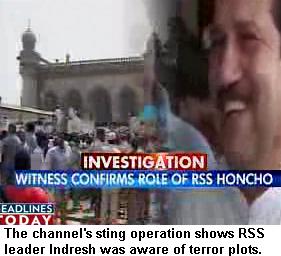
How does RSS and other Sangh Parivar outfits escape terrorist tag?

By Adnan Alavi

The TV Today group’s English channel Headlines Today aired the sting operation that showed top Rashtriya Swayamsevak Sangh (RSS) leader Indresh Kumar’s involvement with Hindutva-inspired fanatics.

Enraged, Sangh parivar workers attacked the channel’s office and went on rampage. The sting operation was more shocking as a former BJP member of parliament was also caught on camera and a failed plot to target Vice-President Hamid Ansari at a function in Jamia Millia University was mentioned.

The fact that Indresh is not a fringe activist but top leader and close to RSS chief makes it even more serious. The BJP, which is the main opposition party takes orders from the Sangh, and is always ready to shield its masters.

During the investigation into Mecca Masjid, Ajmer Dargah and Malegaon blasts, already role of several RSS workers was found. Since independence, starting from Gandhi’s killing, the RSS cadre was involved in numerous communal riots.

The report clearly shows that Pune-based chemistry professor held camps to impart training to radicals, a Delhi-based prominent doctor Dr RP Singh bought arms & ammunition and planned terror strikes while top RSS-BJP leaders were discussing that they had no faith in constitution.

Now once again, it’s proved that there is a strong militant and anti-national group in RSS. But why no one even dares to take on Sangh Parivar. Why it’s not termed a terror group? How its top leaders manage to get away by claiming that a few fringe persons may be involved when any other organisation that gets involved in one incident, is dubbed terror group.

Take for example the recent incident in Kerala where a newly floated political party PFI was demonized and almost dubbed as terror group for one incident in which a professor’s palm was chopped off by its activist. Despite PFI leaders openly condemning it, there were raids on party offices and a witch-hunt followed.

In case of RSS, Bajrang Dal and Shiv Sena there is never any raid or sustained interrogation. Ram Sene leader Pramod Muthalik was caught on camera claiming that he could set off a communal riot for a fee but there was no action against his group.

Babu Bajrangi became a face of militant Hindutva in Gujarat and confessed that he murdered women and raped them. But he wasn’t touched.

While Muthalik and Bajrangi were active in states ruled by BJP, the Shiv Sena and MNS have done the same in Congress-ruled Maharashtra where outsiders including Biharis and UP-ites have been targeted and yet the parties escaped the terror tag.

On Friday, a group of Shiv Sena activists brutally beat up Karnataka politician Syed Mansoor and other leaders of Seema Rakshan Vedike over the claim of Maharashtra on Belgaum district and blackened his face in a Zee TV channel’s office in Kolhapur. Shiv Sena leader Sanjay Raut termed the action as correct.

The offices of these groups aren’t raided, their connections are never investigated and their leaders who openly pour out venom are not booked. It is no surprise that the radicals are getting bolder and bolder by the day, so much that they are even targeting Vice-President and planning to overthrow the state.

If SIMI operatives were involved in terrorism and it was banned, why not RSS and Bajrang Dal after all they also have their activists involved in terror plots? PFI’s freedom march was banned but despite open display of arms, firing gunshots and holding training camps for years, Bajrang Dal or even Sanatan Sanstha is not reined in.

There are a host of reasons:

Firstly, today BJP has strong presence across the country and every step against RSS is strongly opposed by its workers. The party terms it political vendetta and goes out of the way to defend terror accused, just like its leaders targeted late Hemant Karkare.

Especially, when the Congress govt is firmly in saddle why should investigation be sped up as it may force BJP in a combative position or anger sections of majority community. A top bureaucrat had reportedly asked the investigators to go slow in Samjhata Express blast case.

There is a fear of the so-called Hindu votebank and the fact that a section of majorty community may not like strong action. Lack of activism among educated and secular middle-class is another reason. Besides, there are few NGOs or individuals who decide to file cases, take legal action against fanatic groups and then pursue the cases.

In the last several decades, pro-Hindutva elements have infiltrated several institutions. They includ
e agencies that are vital in keeping tab on the anti-national forces and destructive organisations within the country. A single officer posted at a key place can sabotage the entire investigation.

Journalist Ashish Khetan, who did the breaking story in Mail Today apart from the sting operation in Headlines Today, says that there were attempts to botch up investigation from various quarters and after ATS chief Hemant Karkare’s death, officers were reluctant to pursue cases because of the feeling that nobody wanted to burn their fingers.

The role of Saffron outfits in communal carnages like anti-Christian violence in Orissa’s Kandhamal, Karnataka and numerous anti-Muslim pogroms is well-known and documented. RSS and Bajrang Dal were running the risk of getting dubbed terrorist groups in America after attacks of churches.

It’s time that the government understands the seriousness of the issue. Just like SIMI, it should ban extremist Hindu organisations. BJP should also accept the reality, make its position clear and get rid of the fanatics from within the organisation.

Link to Headlines Today sting: Click for all videos

All Terrorists are Muslims…Except the 94% that Aren’t

,

All Terrorists are Muslims…Except the 94% that Aren’t

Posted on 20 January 2010 by Danios

terrorism_has_no_religion

CNN recently published an article entitled Study:
Threat of Muslim-American terrorism in U.S. exaggerated
; according
to a study released by Duke University and the University of North
Carolina at Chapel Hill, “the terrorist threat posed by radicalized
Muslim-Americans has been exaggerated.”

Yet, Americans continue to live in mortal fear of radical Islam, a
fear propagated and inflamed by right wing Islamophobes.  If one follows
the cable news networks, it seems as if all terrorists are Muslims.  It
has even become axiomatic in some circles to chant: “Not all Muslims
are terrorists, but nearly all terrorists are Muslims.” Muslims and
their “leftist dhimmi allies” respond feebly, mentioning Waco as the one
counter example, unwittingly affirming the belief that “nearly all
terrorists are Muslims.”

But perception is not reality.  The data simply does not support such
a hasty conclusion.  On the FBI’s official website, there exists a
chronological list of all terrorist attacks committed on U.S. soil from
the year 1980 all the way to 2005.  That list can be accessed here
(scroll down all the way to the bottom).

Terrorist Attacks on U.S. Soil by Group, From 1980 to 2005,
According to FBI Database

Terrorist Attacks on U.S. Soil by Group, From 1980 to 2005, According
to FBI Database

According to this data, there were more Jewish acts of terrorism
within the United States than Islamic (7% vs 6%).  These radical Jews
committed acts of terrorism in the name of their religion.  These were
not terrorists who happened to be Jews; rather, they were extremist Jews
who committed acts of terrorism based on their religious passions, just
like Al-Qaeda and company.

Yet notice the disparity in media coverage between the two.  It would
indeed be very interesting to construct a corresponding pie chart that
depicted the level of media coverage of each group.  The reason that
Muslim apologists and their “leftist dhimmi allies” cannot recall
another non-Islamic act of terrorism other than Waco is due to the fact
that the media gives menial (if any) coverage to such events.  If a
terrorist attack does not fit the “Islam is the perennial and
existential threat of our times” narrative, it is simply not paid much
attention to, which in a circuitous manner reinforces and “proves” the
preconceived narrative.  It is to such an extent that the average
American cannot remember any Jewish or Latino terrorist; why should he
when he has never even heard of the Jewish Defense League or the
Ejercito Popular Boricua Macheteros?  Surely what he does not know does
not exist!

The Islamophobes claim that Islam is intrinsically a terrorist
religion.  The proof?  Well, just about every terrorist attack is
Islamic, they retort.  Unfortunately for them, that’s not quite true. 
More like six percent.  Using their defunct logic, these right wingers
ought now to conclude that nearly all acts of terrorism are committed by
Latinos (or Jews).  Let them dare say it…they couldn’t; it would be
political and social suicide to say such a thing. Most Americans would
shut down such talk as bigoted; yet, similar statements continue to be
said of Islam, without any repercussions.

The Islamophobes live in a fantasy world where everyone is supposedly
too “politically correct” to criticize Islam and Muslims.  Yet, the
reality is the exact opposite: you can get away with saying anything
against the crescent.  Can you imagine the reaction if I said that
Latinos should be profiled because after all they are the ones who
commit the most terrorism in the country?  (For the record: I don’t
believe in such profiling, because I am–unlike the right wing nutters–a
believer in American ideals.)

The moral of the story is that Americans ought to calm down when it
comes to Islamic terrorism.  Right wingers always live in mortal fear–or
rather, they try to make you feel that way.  In fact, Pamela
Geller (the queen of internet Islamophobia) literally said her
mission was to “scare the bejeezus outta ya.”
Don’t be fooled, and
don’t be a wuss.  You don’t live in constant fear of radicalized Latinos
(unless you’re Lou Dobbs), even though they commit seven times more
acts of terrorism than Muslims in America.  Why then are you wetting
yourself over Islamic radicals?  In the words of Cenk Uygur: you’re at a
ten when you need to be at a four.  Nobody is saying that Islamic
terrorism is not a matter of concern, but it’s grossly exaggerated.

Related Posts:

Europol
report: All terrorists are Muslims…Except the 99.6% that aren’t

RAND
report: Threat of homegrown jihadism exaggerated, Zero U.S. civilians
killed since 9/11

Muslims the focus of misplaced fears

Muslims the focus of misplaced fears

Muslims the focus of misplaced fears
RACHEL WOODLOCK
February 20, 2010

There is no hidden agenda for sharia law; Western society is not under threat.

“F— Off We’re Full” is one of the more odious Facebook groups in which members regularly bemoan Muslim immigration to Australia. It is currently in its sixth incarnation, having been taken offline and then replaced by other similarly named groups. Still, the viral meme lives on. Jade encourages people to join a petition to ”send asylum boat people home”; Faye makes a joke offering ”Muslims, Lebs an Indians” free bungee jumps with ”no strings attached”; and Kris wonders why wherever Islam is, ”evil follows”.

The sentiment “don’t come here if you don’t like our way of life” means nothing when you consider that, at last count, 40 per cent of Muslims in Australia were not foreign immigrants but were born here. Lots of Mohammads and Aishas are true-blue, happy little Vegemites sitting next to our Jacks, Marias, Sanjeevs and Nguyens in school, and that percentage is sure to increase at the next census.

However, the thrust of their arguments, and the much milder variants that spring from the mouths of politicians and the pens of journalists, is that the demographic growth of Muslims in Australia and other Western nations is a worrying phenomenon that, if left unchecked, could destroy the very fabric of Western society.

There are a number of interrelated fears of Muslims that boil down to the prophecy that on attaining sizeable numbers, Muslims will seek to impose their religion on other Australians, either by force or by creeping Islamisation. Evidence for this grim fantasy is seen in everything from innocuous halal-certification for food to the myth of the Muslim eradication of Christmas from kindergartens and council premises.

But for those who worry about Muslims in their midst, nothing screams “Islam is coming” louder than the sight of heavily veiled women in supermarkets, libraries, parks and other public spaces.

It is little wonder that the French have pounced on Islamic female dress as the epitome of un-French. Veiled Muslim women are viewed both as aggressively intruding into hard-won French secularity, and at the same time embodying passive acquiescence to misogynist oppression.

The solution trumpeted by defenders of French identity, under the guise of women’s rights, is to substitute a perceived lack of freedom with an actual one.

A burqa ban would mean that Muslim men might no longer force their women to cover up through presumed social pressure, because the state will force them to uncover through legal proscription, all in the name of upholding liberty and equality.

There are some Australian commentators urging the same for our Muslims – fortunately few take them seriously.

In reality, the debate is not about women’s rights. It is about whether Muslim immigration and settlement will fundamentally and negatively alter the fabric of Western society. In other words, are Muslims a slow-growing cancer?

The evidence suggests that Muslim settlement and integration into Australian society is, by and large, successful. Contrary to the alarmist rhetoric of shock-jocks and pundits, political Islamism and the establishment of theocracy is not mainstream theology, nor is it how most Muslims interpret the role of religion in society.

It is simply untrue that Muslim Australians are interested in superimposing some overseas model of sharia law in Australia.

A good many of them (or their parents) fled totalitarian regimes in search of freedom and they tell us they have found it in Australia.

As part of an Australian Research Council Linkage project, 600 Muslim Australians were surveyed about their experiences of life in Australia. “Freedom” was rated as the top characteristic of Australian society when participants were presented with a mixed list of 20 Australian and un-Australian attributes.

Of 594 participants who answered the questions, 87 per cent agreed or strongly agreed they could be both a “good Muslim and a good Australian” at the same time. Only 5 per cent felt conflicted enough to disagree or strongly disagree with the notion, and this is partly due to a feeling that to be truly Australian means having British ancestry or doing things that conflict with Islam (such as drinking beer).

There are some problems: Muslims suffer for the want of good leadership (although the appointment of Sheikh Fehmi al-Imam as Mufti of Australia was a step in the right direction), and community infrastructure needs development. This has long been hindered by myopic local councils rejecting mosque and school proposals.

The success of Muslim settlement and inclusion in Australian society can be attributed in part to the way we construct an inclusive national identity and to the democratic freedoms – including religious freedom – that Australia offers its citizens.

This success would be imperilled by French-style bans and a shift to exclusivist, monocultural nationalism that is hindering European attempts to grapple with changing demographics.

Rachel Woodlock is a researcher and doctoral candidate at the Centre for Islam and the Modern World, Monash University.

Convert Petrol Cars to Electricity for Rs. 4.8 Lakh

June 9, 2010 | 12
comments

Steel City Project Converts Gasoline Cars to Run on Electricity

ChargeCar aims to create a kit that makes it easy for local auto
shops to convert conventional cars to electric.

By Saqib
Rahim
and Climatewire   


OAS_AD(“x81”);

CATALYTIC CONVERTER:
Instead of selling pricey new vehicles, the ChargeCar team wants to
create a kit that makes it easy for local auto shops to convert gasoline
cars to run on electricity.
ISTOCKPHOTO/sjlocke

aArticleImages = new Array;

aArticleImages[0] = new Object;
aArticleImages[0].title = “CATALYTIC CONVERTER:”;
aArticleImages[0].caption = “Instead of selling pricey new vehicles, the ChargeCar team wants to create a kit that makes it easy for local auto shops to convert gasoline cars to run on electricity.”;
aArticleImages[0].credit = “ISTOCKPHOTO/sjlocke”;
aArticleImages[0].url = “http://www.istockphoto.com/stock-photo-3474372-auto-repair.php”;
aArticleImages[0].alt = “”;
aArticleImages[0].src = “/media/inline/steel-city-project-converts-gas-cars-to-electric_1.jpg”;
aArticleImages[0].thisImageNumber = “1”;

.atools_holder {border:#e4e0dd 1px solid; width:78px; background-color:#e4e0dd; color:#999; text-align:center; margin:0 0 5px 5px;}
.atools_holder {text-align:-moz-center}
.atools {width:98%; padding:3px 1px 0 0}
.atools {text-align:-moz-center}

.atools img {margin-bottom:5px; display:block;}

.badge {padding: 2px; background-color:#fff; width:54px;margin-bottom:3px; left: 50%;}
#atools_sponsor {width:88px;}
#atools_sponsor span {font-size:8px !important; color:#999; font-family:Verdana, Arial, Helvetica, sans-serif !important; text-align:center}

var newURL = “”;
newURL = location.href.replace(/&[e|s]c=[A-Za-z0-9_]{2,15}/,”); //strip ec or sc codes
newURL = newURL.replace(/&page=[0-9]{1,2}/,”); //strip pagination from articles
newURL = newURL.replace(/&SID=mail/,”); //strip SID from mailarticle feature
var newTitle = document.title;
//alert(newURL)
digg_url = newURL;

e-mail

print

comment

0diggsdigg
stumble_url = newURL;

PITTSBURGH — Chuck Wichrowski remembers the first car he ever worked
on, when he was just a college graduate and knew nothing about cars:
His wife’s 1970 Chevy Nova.

The second? A 1964 Studebaker Wagonaire.

“I just sort of applied the college model, which is: You look the
things up, you get a book, and then you do it,” Wichrowski said.

As the years rolled by, Wichrowski put his wrench to the cars that
drove the Steel City through its industrial heyday. But times have
changed in Pittsburgh, and while he still runs Baum Boulevard
Automotive, his customers have moved on to mostly foreign cars, and
increasingly, hybrids.

Wichrowski used to run two gas stations, and he knows electric-drive
cars need less maintenance than the gas-driven ones. Yet he has loaned a
mechanic to a local university to help it design electric cars for
regular Pittsburghers, and he thinks his shop can cash in if the future
really is electric.

And for the team at Carnegie
Mellon University
, which is designing cars to get residents to
work without burning a pint of gas or even wasting an electron, the
future of electric cars is Pittsburgh.

Designers of the ChargeCar
project say that instead of selling pricey new vehicles, they want to
create a kit that makes it easy for local auto shops like Wichrowski’s
to convert a gasoline car to run on electricity.

“There’s a bunch of machine shops running idle in Pittsburgh,” said Illah Nourbakhsh, a robotics
professor at CMU and a co-director of ChargeCar. “There’s a ton of
shops that can do that kind of thing. There’s mechanical know-how in
this town like no other that I’ve seen.”

Electric-car conversions have been available for decades, whether
through small, independent companies or engineers tinkering in their
garages. But ChargeCar is likely the first effort to gut a gasoline car
and redesign it for a single purpose: the perfect commute.

When Nourbakhsh and his colleagues looked at how Pittsburghers
drive, they found that most trips are about half a dozen miles. Some
zoom along the highway, while others plod past stop signs and red
lights. Some drive on flat roads; others climb or coast down the city’s
hilly terrain.

The team reckoned a battery, combined with a gadget called a
supercapacitor
and controlled by software, could make most of these
miles electric-powered, at a price Pittsburghers could afford.

Fiddling and fact-finding
ChargeCar’s latest projects sit in a former gas station across the
street from Carnegie Mellon. One is a 2006 Honda Civic: Over the next
month, the team will convert it into a short-range, all-electric car.
Wichrowski’s mechanic will lend a hand and advise on how to make such
conversions as simple as possible for other auto repairers in
Pittsburgh.

The other car in the garage feels more like an airplane. From the
outside, it looks like a common Scion xB; surrounding the cockpit,
though, are scores of dials and gauges.

The car is an experiment.

As Nourbakhsh pulls onto the road, he points to wobbling needles and
flashing numbers on the computer screen. This car is powered by a
battery and a supercapacitor, and these gauges are constantly crunching
numbers: how much juice is left, how much power is flowing, how hot the
battery is.

He switches between using the supercapacitor and the battery. He
tries each one on hills, up and down. When he slows at a red light, he
can choose which device he wants to charge up.

As the professor fiddles, the team is learning important facts about
the most efficient way to power an electric car.

The reason has to do with how batteries work — and a major
technical challenge for automakers.

Custom-designed batteries?
Batteries are good at storing energy, but they degrade if they have to
take on, or release, too much power too quickly. To deal with that
degradation, automakers stuff cars with larger batteries, but that adds
cost and weight.

Unlike batteries, supercapacitors are built for abuse: They can take
a huge charge and discharge, thousands of times, without losing a step.

They’re not so good at holding a charge, Nourbakhsh says, so the
team decided to pair one with a battery.

Those Pittsburgh hills and traffic lights? They become energy
savers.

“When you’re stopping, all the current gets dumped into the
capacitor, therefore saving the energy so that you can reuse it, rather
than going into the battery, because putting it into the battery costs
battery life,” he says.

As the argument goes, if one knows exactly how someone drives, it’s
possible to come up with the perfect-size battery and supercapacitor for
that driver.

At www.chargecar.org, the
group is asking Web surfers to share information on their commutes in
gasoline cars, including every highway ride and stop at Starbucks.

A $10,000 price tag
Nourbakhsh and his team are at work on a computer program that can
predict where a driver speeds up, hits traffic and pauses for doughnuts
— all to make a battery system that’s the perfect size.

Over time, this program could even learn more about the driver,
firing up the capacitor or battery at precisely the right times to get
her to work.

Nourbakhsh says a regular battery may cost $8,000, but adding a
$1,000 capacitor to handle the sudden charges means the battery doesn’t
need to be as big, so the combo may cost only $2,000.

The total price of conversion? ChargeCar is targeting a $10,000 tag.

Paul Scott, vice president of advocacy group Plug-in America,
said such a system could be the “magic bullet” of energy storage in
cars, since it balances capacity and power.

Capacitors have already drawn interest from researchers, engineers
and even some of the automakers. A spokesman for Toyota said, however,
that the company has placed more focus on other electric technologies
because it found capacitors too costly.

Scott panned the idea of designing electric cars mainly geared to
the commute. “Everybody I know drives a car a lot of different ways,”
not just for commuting but also for going to the movies or visiting
friends, he said.

Mechanics say this is the future
“If you optimize a car for just one specific task, it may not work as
well for other tasks,” he said.

Nourbakhsh said the car doesn’t have to spend its last electron at
the office — it’s possible to design “headroom” for a specific commute
while still being efficient and saving on cost.

“But the point is, for the thing you do most frequently — that you
spend the most energy on — let’s have it be super-efficient at that,”
he said in an e-mail.

Some families might choose to have a ChargeCar and reserve a
gasoline car for longer trips, said Leland Thorpe, a master’s student at
Carnegie Mellon who’s on the ChargeCar team.

The project is recruiting local companies to sponsor the first wave
of car conversions. Nourbakhsh says that would be a uniquely Pittsburgh
solution, as companies “green” their reputations and Pittsburghers do
the work in auto shops.

Even if electric cars catch on in Pittsburgh, Wichrowski, the
manager of Baum Boulevard Automotive, isn’t worried about having to lay
off mechanics.

“Every hybrid car that we have also has conventional brakes,
conventional exhaust, other things that you really need to do to have a
regular car,” he said as customers milled in and out of the shop. “They
just have an added layer of the hybrid system bolted into the car
somewhere.”

He said today, some cars have up to a dozen computers
to control their systems: air conditioners, power steering and the
like.

The modern mechanic often has the equipment and know-how to work
with them, so electric cars shouldn’t be too much harder.

“This is something that all the technicians are going to have to
move into,” he says. “If you want to repair cars, you’re going to have
to be able to know how to do this.”

Reprinted from Climatewire with permission from Environment &
Energy Publishing, LLC. www.eenews.net,
202-628-6500

0diggsdigg

Keyboard Shortcuts

Gmail – Fwd: ҉ Kerala Friends ҉ General keyboard shortcuts – mohamediqbalp@gmail.com

Remember these keys!! when ur mouse is not working, this is very helpful.

General keyboard shortcuts

* CTRL+C (Copy)

* CTRL+X (Cut)

* CTRL+V (Paste)

* CTRL+Z (Undo)

* DELETE (Delete)

* SHIFT+DELETE (Delete the selected item permanently without placing the item in the Recycle Bin)

* CTRL while dragging an item (Copy the selected item)

* CTRL+SHIFT while dragging an item (Create a shortcut to the selected item)

* F2 key (Rename the selected item)

* CTRL+RIGHT ARROW (Move the insertion point to the beginning of the next word)

* CTRL+LEFT ARROW (Move the insertion point to the beginning of the previous word)

* CTRL+DOWN ARROW (Move the insertion point to the beginning of the next paragraph)

* CTRL+UP ARROW (Move the insertion point to the beginning of the previous paragraph)

* CTRL+SHIFT with any of the arrow keys (Highlight a block of text)

* SHIFT with any of the arrow keys (Select more than one item in a window or on the desktop, or select text in a document)

* CTRL+A (Select all)

* F3 key (Search for a file or a folder)

* ALT+ENTER (View the properties for the selected item)

* ALT+F4 (Close the active item, or quit the active program)

* ALT+ENTER (Display the properties of the selected object)

* ALT+SPACEBAR (Open the shortcut menu for the active window)

* CTRL+F4 (Close the active document in programs that enable you to have multiple documents open simultaneously)

* ALT+TAB (Switch between the open items)

* ALT+ESC (Cycle through items in the order that they had been opened)

* F6 key (Cycle through the screen elements in a window or on the desktop)

* F4 key (Display the Address bar list in My Computer or Windows Explorer)

* SHIFT+F10 (Display the shortcut menu for the selected item)

* ALT+SPACEBAR (Display the System menu for the active window)

* CTRL+ESC (Display the Start menu)

* ALT+Underlined letter in a menu name (Display the corresponding menu)

* Underlined letter in a command name on an open menu (Perform the corresponding command)

* F10 key (Activate the menu bar in the active program)

* RIGHT ARROW (Open the next menu to the right, or open a submenu)

* LEFT ARROW (Open the next menu to the left, or close a submenu)

* F5 key (Update the active window)

* BACKSPACE (View the folder one level up in My Computer or Windows Explorer)

* ESC (Cancel the current task)

* SHIFT when you insert a CD-ROM into the CD-ROM drive (Prevent the CD-ROM from automatically playing)

* CTRL+SHIFT+ESC (Open Task Manager)

Dialog box keyboard shortcuts

If you press SHIFT+F8 in extended selection list boxes, you enable extended selection mode. In this mode, you can use an arrow key to move a cursor without changing the selection. You can press CTRL+SPACEBAR or SHIFT+SPACEBAR to adjust the selection. To cancel extended selection mode, press SHIFT+F8 again. Extended selection mode cancels itself when you move the focus to another control.

* CTRL+TAB (Move forward through the tabs)

* CTRL+SHIFT+TAB (Move backward through the tabs)

* TAB (Move forward through the options)

* SHIFT+TAB (Move backward through the options)

* ALT+Underlined letter (Perform the corresponding command or select the corresponding option)

* ENTER (Perform the command for the active option or button)

* SPACEBAR (Select or clear the check box if the active option is a check box)

* Arrow keys (Select a button if the active option is a group of option buttons)

* F1 key (Display Help)

* F4 key (Display the items in the active list)

* BACKSPACE (Open a folder one level up if a folder is selected in the Save As or Open dialog box)

Microsoft natural keyboard shortcuts

* Windows Logo (Display or hide the Start menu)

* Windows Logo+BREAK (Display the System Properties dialog box)

* Windows Logo+D (Display the desktop)

* Windows Logo+M (Minimize all of the windows)

* Windows Logo+SHIFT+M (Restore the minimized windows)

* Windows Logo+E (Open My Computer)

* Windows Logo+F (Search for a file or a folder)

* CTRL+Windows Logo+F (Search for computers)

* Windows Logo+F1 (Display Windows Help)

* Windows Logo+ L (Lock the keyboard)

* Windows Logo+R (Open the Run dialog box)

* Windows Logo+U (Open Utility Manager)

Accessibility keyboard shortcuts

* Right SHIFT for eight seconds (Switch FilterKeys either on or off)

* Left ALT+left SHIFT+PRINT SCREEN (Switch High Contrast either on or off)

* Left ALT+left SHIFT+NUM LOCK (Switch the MouseKeys either on or off)

* SHIFT five times (Switch the StickyKeys either on or off)

* NUM LOCK for five seconds (Switch the ToggleKeys either on or off)

* Windows Logo +U (Open Utility Manager)

Windows Explorer keyboard shortcuts

* END (Display the bottom of the active window)

* HOME (Display the top of the active window)

* NUM LOCK+Asterisk sign (*) (Display all of the subfolders that are under the selected folder)

* NUM LOCK+Plus sign (+) (Display the contents of the selected folder)

* NUM LOCK+Minus sign (-) (Collapse the selected folder)

* LEFT ARROW (Collapse the current selection if it is expanded, or select the parent folder)

* RIGHT ARROW (Display the current selection if it is collapsed, or select the first subfolder)

Shortcut keys for Character Map

After you double-click a character on the grid of characters, you can move through the grid by using the keyboard shortcuts:

* RIGHT ARROW (Move to the right or to the beginning of the next line)

* LEFT ARROW (Move to the left or to the end of the previous line)

* UP ARROW (Move up one row)

* DOWN ARROW (Move down one row)

* PAGE UP (Move up one screen at a time)

* PAGE DOWN (Move down one screen at a time)

* HOME (Move to the beginning of the line)

* END (Move to the end of the line)

* CTRL+HOME (Move to the first character)

* CTRL+END (Move to the last character)

* SPACEBAR (Switch between Enlarged and Normal mode when a character is selected)

Microsoft Management Console (MMC) main window keyboard shortcuts

* CTRL+O (Open a saved console)

* CTRL+N (Open a new console)

* CTRL+S (Save the open console)

* CTRL+M (Add or remove a console item)

* CTRL+W (Open a new window)

* F5 key (Update the content of all console windows)

* ALT+SPACEBAR (Display the MMC window menu)

* ALT+F4 (Close the console)

* ALT+A (Display the Action menu)

* ALT+V (Display the View menu)

* ALT+F (Display the File menu)

* ALT+O (Display the Favorites menu)

MMC console window keyboard shortcuts

* CTRL+P (Print the current page or active pane)

* ALT+Minus sign (-) (Display the window menu for the active console window)

* SHIFT+F10 (D
isplay the Action shortcut menu for the selected item)

* F1 key (Open the Help topic, if any, for the selected item)

* F5 key (Update the content of all console windows)

* CTRL+F10 (Maximize the active console window)

* CTRL+F5 (Restore the active console window)

* ALT+ENTER (Display the Properties dialog box, if any, for the selected item)

* F2 key (Rename the selected item)

* CTRL+F4 (Close the active console window. When a console has only one console window, this shortcut closes the console)

Remote desktop connection navigation

* CTRL+ALT+END (Open the Microsoft Windows NT Security dialog box)

* ALT+PAGE UP (Switch between programs from left to right)

* ALT+PAGE DOWN (Switch between programs from right to left)

* ALT+INSERT (Cycle through the programs in most recently used order)

* ALT+HOME (Display the Start menu)

* CTRL+ALT+BREAK (Switch the client computer between a window and a full screen)

* ALT+DELETE (Display the Windows menu)

* CTRL+ALT+Minus sign (-) (Place a snapshot of the entire client window area on the Terminal server clipboard and provide the same functionality as pressing ALT+PRINT SCREEN on a local computer.)

* CTRL+ALT+Plus sign (+) (Place a snapshot of the active window in the client on the Terminal server clipboard and provide the same functionality as pressing PRINT SCREEN on a local computer.)

Microsoft Internet Explorer navigation

* CTRL+B (Open the Organize Favorites dialog box)

* CTRL+E (Open the Search bar)

* CTRL+F (Start the Find utility)

* CTRL+H (Open the History bar)

* CTRL+I (Open the Favorites bar)

* CTRL+L (Open the Open dialog box)

* CTRL+N (Start another instance of the browser with the same Web address)

* CTRL+O (Open the Open dialog box, the same as CTRL+L)

* CTRL+P (Open the Print dialog box)

* CTRL+R (Update the current Web page)

* CTRL+W (Close the current window)

Islamic Mortgages and Why They’re Not Just for Muslims

Islamic Mortgages and Why They’re Not Just for
Muslims

Islamic Mortgages and not just for Muslims which may come as a
suprise for some. However, an Islamic mortgage does have its
differences.

What is an Islamic Mortgage?

According to Islam, making money from money is “usury” and is not
permitted. This includes receiving or paying interest (it is wrong to
assist another in making money from money). prayer roomThis creates an obvious
problem for a muslim who wishes to own his own property. Buying outright
with cash will not be an option open to the vast majority and a
traditional interest based mortgage loan cannot be obtained with
compromising his religious beliefs. Islamic mortgages (also called
Shariah or Halal mortgages) were introduced to combat this problem and
provide a method of obtaining finance from a lending institution without
paying interest. Whilst the the main purpose of this method of
borrowing is to allow muslims to maintain their beliefs while leading
normal lives when living in non-Islamic countries, it has other
advantages which have nothing to do with religion.

How Do Banks Make a Profit?

Naturally banks still want to make a profit on the money they lend
and they do this by either buying the property from the seller at the
normal agreed price and selling it on the borrower for a higher price or
by buying the property and renting it to the borrower during the
continuance of the term.

How Do Islamic Mortgages Work?

There are two main types of Islamic Mortgage, Murabaha and Ijara:

Murabaha

With this arrangement the purchaser finds a property and agrees a
purchase price with the seller in the usual way.The bank then purchases
the property on behalf of the buyer and immediately sells it to the
buyer at a higher price. A percentage of the purchase price (the
deposit) is paid to the bank immediately and the remainder is paid in
monthly instalments over the term. The instalments are fixed over the
life of the term. The maximum amount of the purchase price the bank will
agree to defer will be 80%, in other words a minimum 20% deposit will
be required to obtain this type of mortgage so it is only suitable for
those buyer who have substantial capital to invest.

Ijara

Again, you will find a property and agree a purchase price and the
bank will buy the property, however with this arrangement the property
will be registered to the bank who will grant a lease to you and give
you a “promise to sell”.

google_protectAndRun(“ads_core.google_render_ad”, google_handleError, google_render_ad);

The term of the lease will be equal to the term of the mortgage. You
will make monthly payments which compromise a rent for the use of the
bank’s share of the property and a payment to acquire part of the bank’s
share. The rent payments will usually be reviewed each year, just as
rent on an assured shorthold tenancy might be. At the end of the term
you will have acquired all of the bank’s share and the bank will be
required to make good on its promise to sell by transferring the
freehold title to you. The lease term will have come to an end and it
will be extinguished. The advantage of this arrangement over Murabaha is
that a smaller deposit will be acceptable, perhaps 10%.

What if I Have an Islamic Mortgage and Want to Sell Before the End
of the Term?

There is no reason that you cannot sell before the end of the term
and repay the borrowing in full, and this can usually be done without
penalty. The bank’s promise to sell is simply enforced earlier. You
would only pay the bank the amount originally borrowed less any payments
already made, so that the bank does not get a share of any increase in
value.

Which Banks Provide Islamic Mortgages?

There are a number of banks which provide Islamic mortgage products,
including Bristol & West, HSBC and the Islamic Bank of Britain among
others.

Can I Get Repossessed if I Have an Islamic Mortgage?

Unfortunately yes, you always at risk of repossession if you purchase
a property with the benefit of a mortgage and fail to keep up
repayments.

I’ve Heard I Might Have to Pay Two Lots of Stamp Duty?

It used to be the case that with a Islamic mortgage, you had to pay
stamp duty once on the original purchase and again at the end of the
mortgage term when the bank transferred the property to you, but this
was remedied in the Finance Act 2003 and is no longer the case.

I’m Not a Muslim, So Why Would I Get an Islamic Mortgage?

One advantage of the Murabaha type of mortgage is that the payments
are fixed throughout the life of the term. This means you don’t have to
worry about your payments increasing to a level you can’t afford if
there is a sharp rise in interest rates, as would happen with a
conventional mortgage. Obviously the disadvantage is that you would not
benefit from any decrease in interest rates.

The monthly payments on this type of mortgage will be calculated
based on the interest rate prevailing at the time so while rates are
low, although initially the payments will be higher than a traditional
mortgage (the bank will set the payments higher because they know they
cannot be changed), over the life of the mortgage as interest rates but
your payments don’t, you may well end up better off.

With the Ijara type, payments are reviewed annually and will increase
and decrease in line with interest rates.

Photo by dynamosquito

Prince Charles speaks on Islam and the Environment

Associated Press Of Pakistan ( Pakistan’s Premier NEWS Agency ) – Prince Charles speaks on Islam and the Environment

 
LONDON, June 10 (APP)-The heir to the British throne Prince Charles of Wales has paid tribute to the role of faith communities in the UK and praised the work done by Oxford Centre for Islamic Studies (OXCIS) in particular the Young Muslim leadership programme.The Prince delivered a speech on ‘Islam and the Environment’ at OXCIS) where he was invited as Patron of Oxford Centre for Islamic Studies to help celebrate the centre’s 25th anniversary.‘This is a vital contribution to the process of boosting the self-esteem of young Muslims, about whom I care deeply,’ he told the gathering.

The Prince of Wales reaffirmed the need to help UK’s minority communities and faith groups integrate into British Society. The Prince has spent more than 25 years working on encouraging UK minority communities to integrate into British society and to build good relationships between all faith communities.His Royal Highness said:
‘Over the last twenty-five years, I have tried to find as many ways as possible to help integrate them into British society and to build good relationships between our faith communities. I happen to believe this is best achieved by emphasizing unity through diversity. Only in this way can we ensure fairness and build mutual respect in our country. And if we get it right here then perhaps we might be able to offer an example in the wider world.’
The Prince chose “Islam and the Environment” as the focus of his speech, bringing together two important strands of his work over three decades. Addressing the audience, The Prince spoke about the importance to realise the damage which Mankind is doing to the environment and take steps to halt it, before it is too late.
‘One of the many issues of commonality between the World’s great faiths is a strong focus on protection of the environment which is God’s creation,’ he said.
He encouraged the people of faith around the World to reconnect with their sacred teachings on this issue. His Royal Highness said that there was a current division between Man and Nature which was not only caused by industrialisation, technological development and the pursuit of economic growth, but also by attitudes to the relationship with Nature.
He said that a way of thinking had evolved over the last few centuries that he believed went against the grain of all the teachings of the world’s sacred traditions, including Islam. He said that all great faiths are rooted in an understanding of the fact that Man is a part of Nature, not apart from Nature, and must always live within Nature’s means and limits.
The Prince of Wales spoke about the great importance and respect the Islamic faith attaches to the preservation of the environment. He said: ‘From what I know of the Quran, again and again it describes the natural world as the handiwork of a unitary benevolent power. It very explicitly describes Nature as possessing an “intelligibility’ and that there is no separation between Man and Nature, precisely because there is no separation between the natural world and God. It offers a completely integrated view of the Universe where religion and science, mind and matter are all part of one living, conscious whole.
‘If I may quote the Quran, ‘Have you considered: if your water were to disappear into the Earth, who then could bring you gushing water?’
This is the Divine hospitality that offers us our provisions and our dwelling places, our clothing, tools and transport. The Earth is robust and prolific, but also delicate, subtle, complex and diverse and so our mark must always be gentle.’
The Prince also noted that these teachings were also evident in Judaism and in his own faith, Christianity and were well expressed in the writings of Islamic poets and scholars, and Western poets like Wordsworth.
Ending his speech, The Prince said: ‘There is a profound truth in that seemingly simple, old saying of the nomads ­ that “the best of all Mosques is Nature herself”.’