Peace Homes Aluva

Simplify Building Your Dream Home

Archives 2010

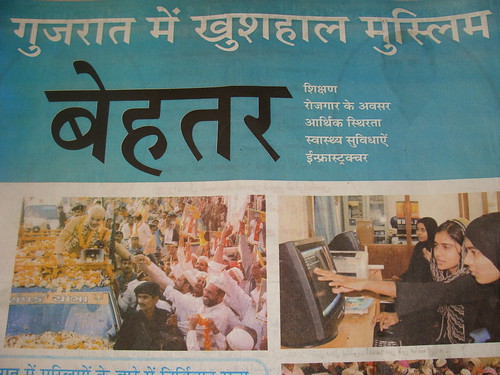
Modi Govt ad on ‘Muslims shining in Gujarat’ has picture from Azamgarh

By Mumtaz Alam Falahi, TwoCircles.net,

New Delhi: Yes, it is fact. Patna dailies today carried one-page
Gujarat Government ad on ‘prosperity’ and ‘good living’ of Muslims in
the land of Narendra Modi. But the photo that the ad carries to prove
the point has just been lifted from Internet. The photo of Muslim girls
learning computer is not from Gujarat, rather Azamgarh.

The full one-page ad that has published in various dailies here
today, one day before Modi reaches Patna to attend the two-day BJP
National Executive meet, has four pictures: one in which Modi shaking
hands with skull-capped Muslims, another showing young Muslim girls in
Hijab learning computer, another one showing Muslim children learning in
a madrasa and one big photo of the ‘iron man.’ As evidence of Muslims’
progress in Gujarat, the ad carries these pictures wherein Muslim girls
and children are shown learning. As the ad is about Muslims’ progress in
Gujarat one can expect the pictures are also from the state. But here
is the big lie.


Gujarat govt. ad published in Patna dailies on 10 June 2010

The picture of young Muslim girls learning computer is not from
Gujarat. Neither the girls are Gujarati, nor was the picture shot in
Gujarat. In fact, it is a picture of Azamgarh National Shibli College
girls attending a computer class in the college campus. The picture was
shot by this correspondent of TwoCircles.net during his visit to
Azamgarh in November 2008. The picture was used in the November 24, 2008
TCN story titled “Muslim girls in Azamgarh getting higher education, giving tough fight to boys

The title of the ad is: Muslims in Gujarat enjoy better education,
employment opportunities, financial stability, health facilities,
infrastructure. It says Muslims in the land of Modi are prosperous and
enjoying better life. But this one lie could be enough to expose the
lies of Gujarat Government about prosperity of Muslims in the state.

The ad has published in various dailies including Roznama Rashtriya
Sahara and Pindar (Urdu), Hindustan (Hindi), Times of India and
Hindustan Times (English). Here is another interesting point – a proof
of disrespect towards Urdu language that is second official language in
Bihar. While English dailies have carried the ad in English language and
Hindi in Hindi language but Urdu dailies were not given Urdu version of
the ad. Rather they were given the Hindi version of the ad which they
‘promptly’ carried.


This TCN photo was published in our story on 24 Nov. 2008

Cypriot Muslim and Pope embrace in UN Buffer Zone

The Muslim News

Cyprus/TRNC:

07-06-2010

NICOSIA, Cyprus,(Zenit.org).- Saturday in Nicosia Benedict, XVI met with an important figure among Cypriot Muslims, Shaykh Nazim al-Qubrusi al-Haqqani, 89, spiritual leader of a Sufi movement, and participant in interreligious dialogue.

The brief meeting took place outside the apostolic nunciature before the Pope went to celebrate Mass in the Church of the Holy Cross.

The two religious leaders met along the “Green Line,” the U.N. buffer zone, which, since the Turkish invasion of 1974, divides the Turkish Cypriot community and the Greek Cypriot community.

According to a Vatican Radio report, the Sufi leader lives behind the church in the north of Cyprus, and came to greet the Pontiff. He apologized for sitting down.

“I am very old,” Nazim said.

“I am very old, too,” the Pope responded.

Nazim then presented Benedict XVI with an ornate cane, a plaque inscribed with the Arabic word for peace and a Muslim rosary. The Pontiff, for his part, offered Nazim a medallion. They then embraced in a gesture of fraternal affection.

At the end of the meeting Nazim asked Benedict XVI to pray for him.

“I will certainly do so,” the Pope answered. “Let’s pray for each other.”

Afghans believe US is funding Taliban

Intellectuals and respected Afghan professionals are convinced the
west is prolonging conflict to maintain influence in the region

Daniella Peled

It’s near-impossible
to find anyone in Afghanistan who doesn’t believe the US are funding
the Taliban: and it’s the highly educated Afghan professionals, those
employed by ISAF, USAID, international media organisations – and even
advising US diplomats – who seem the most convinced.

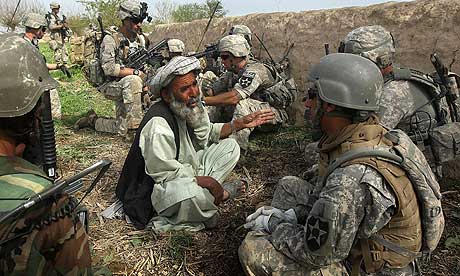
US troops
It is the common
belief among Afghans that the west has no intention of ending the
conflict in Afghanistan. (Photo: John Moore/Getty Images)

One Afghan friend, who speaks flawless English and likes to
quote Charles Dickens, Bertolt Brecht and Anton Chekhov, says the
reason is clear. “The US has an interest in prolonging the conflict so
as to stay in Afghanistan for the long term.”

The
continuing violence between coalition forces and the Taliban is simple
proof in itself.

“We say in this country, you need
two hands to clap,” he says, slapping his hands together in
demonstration. “One side can’t do it on its own.”

His
arguments are reasoned, although he slightly ruins the effect by
explaining to me that no Jews died in the Twin Towers. It’s not just the
natural assets of Afghanistan but its strategic position, the logic
goes. Commanding this country would give the US power over India,
Russia, Pakistan and China, not to mention all the central Asian states.

“The US uses Israel to threaten the Arab states, and they
want to make Afghanistan into the same thing,” he says. “Whoever
controls Asia in the future, controls the world.”

“Even
a child of five knows this,” one Kabuli radio journalist tells me,
holding his hand a couple of feet from the ground in illustration. Look
at Helmand, he says; how could 15,000 international and Afghan troops
fail to crush a couple of thousand of badly equipped Taliban?

And as for the British, apparently they want to stay in
Afghanistan even more than the Americans. The reason they want to talk
to the Taliban is to bring them into the government, thus consolidating
UK influence.

This isn’t just some vague prejudice or
the wildly conspiratorial theories so prevalent in the Middle East.
There is a highly structured if convoluted analysis behind this. If the
US really wanted to defeat the Taliban, person after person asks me, why
don’t they tackle them in Pakistan? The reason is simple, one friend
tells me. “As long as you don’t get rid of the nest, the problem will
continue. If they eliminate the Taliban, the US will have no reason to
stay here.”

The proof is manifold, they say (although
it does tend to include the phrase guaranteed to dismay every
journalist: “everybody knows that …”).

Among the
things everybody knows are that Afghan national army troops report
taking over Taliban bases to find identical rations and weapons to their
own US-supplied equipment. The US funds the madrasas both in
Afghanistan and in Pakistan, which produce the young Talibs. US army
helicopters regularly deliver supplies behind Taliban lines. The aid
organisations are nothing more than intelligence-collecting agencies,
going into regions the army cannot easily reach to obtain facts on the
ground. Even the humblest midwife-training project is a spying outfit.

One political scientist, who works as an advisor to US
agencies in the north of the country, recounts how people fear the
continuing influence of the warlords, illustrating his point with
descriptions of violence and corruption that extends into the realms of
banking, government and trade.

Afghans hate these
warlords, he says, but the US wants them kept in place. “If they were
removed, and competent and clean people brought in, we would bring in
revenues of our own. We could have our own economy, and demand foreign
investment with transparency. We would have a true army, to protect us
and serve Afghanistan.”

So why do these well-educated
Afghan professionals work for governments they are convinced want to
sink their claws into their country?

There’s nothing
contrived about their patriotism – with their skills they could easily
study or work abroad, but choose to stay to build a better future for
their country. Afghans have a historical suspicion towards any foreign
power involved in their country and maybe with the resilience of a
nation which has seen off one occupier after another, they are willing
to wait it out, confident the will of the US will break before their
own.

They don’t want Nato to leave for 15, maybe 20
years, anyway. It will take that long for Afghan institutions to be able
to survive independently. In the meantime, as my literature-loving
friend – who works for a number of US agencies – tells me, there is no
contradiction in survival. “I like Benjamin Franklin in my pocket,” he
smiles. So much for hearts and minds.

Publish on
The Guardian “comment is free” column on May 25, 2010.

Jews are related genetically to Palestinian Arabs?

Jews worldwide share genetic ties

But analysis also reveals close links to Palestinians and Italians.

Boy watching his father lighting Menorah on last day of Chanukah.A common ‘genetic thread’ runs through Jewish populations scattered across the globe.Shmulitk / iStockphoto

Different communities of Jews around the world share more than just religious or cultural practices — they also have strong genetic commonalities, according to the largest genetic analysis of Jewish people to date.

But the study also found strong genetic ties to non-Jewish groups, with the closest genetic neighbours on the European side being Italians, and on the Middle Eastern side the Druze, Bedouin and Palestinians.

Researchers in New York and Tel Aviv conducted a genome-wide analysis on 237 individuals from seven well-established Jewish communities around the world, hailing from Iran, Iraq, Italy, Greece, Turkey, Syria and eastern Europe. The team then compared these genetic profiles to those of non-Jews in the same geographic regions based on data from the Human Genome Diversity Project, a database of genomic information for individuals from populations worldwide. Each group of Jews is genetically distinct, but similarities between the groups weave them together with what the researchers describe as “genetic thread”.

“There has been this back and forth discussion over the course of a century or more — are these a people? Is this in the genome?” says Harry Ostrer, a geneticist at New York University, the study’s lead author. The new findings, he says, show that there “does seem to be a genetic basis to Jewishness”.

Several studies in the past decade have looked at the genetics of Jewish populations, using smaller numbers of individuals, or focusing on markers in mitochondrial DNA — which is passed down maternally — or on the Y chromosome, inherited paternally. The genetic ties identified in the present study, published in the June issue of theAmerican Journal of Human Genetics 1, are consistent with the results of previous work, says Sarah Tishkoff, a human geneticist at the University of Pennsylvania in Philadelphia, “but this is, I would say, the first study to put everything together into a big picture by looking at a large number of sites in the nuclear genome”.

Close neighbours

The researchers analysed single-letter differences in the genome called single nucleotide polymorphisms, longer segments of DNA shared between different Jewish groups, as well as deleted or duplicated stretches of DNA called copy-number variants. Although the groups had strong genetic commonalities, the results also showed a varying degree of genetic mixing with nearby non-Jewish populations. The most genetically distinct Jewish communities, compared both to other Jewish groups and to nearby non-Jews, were those from Iran and Iraq.

“We really see the events of the Jewish diaspora in the genomes of Jewish people.”


The study provides a genetic basis for confirming or debunking theories of Jewish origin and history, says Ostrer. For example, one theory proposes that Ashkenazi Jews (of eastern European origin) are largely descended from Khazars in eastern Europe who converted to Judaism, but the genetic closeness between Ashkenazi Jews and other non-European Jews does not support this idea.

The study also highlights how genetics can reflect history, Ostrer says, including evidence of the dispersal of Jewish populations throughout the Middle East and Europe. “We really see the events of the Jewish diaspora in the genomes of Jewish people.”

Using a computer simulation, the researchers estimate that the genetic split between Middle Eastern and European Jews occurred about 100–150 generations ago, or 2,500 years ago — when Jewish communities are thought to have become established in Persia and Babylon. They also trace a high level of genetic mixing between Ashkenazi Jews and nearby non-Jews to more recent times, corresponding to a period between the beginning of the fifteen century and the start of the nineteenth century when the Jewish population in Europe swelled from about 50,000 to 5 million.

Timing question

But constructing a timeline on the basis of genetic analysis is tricky, say others. “There are too many assumptions you have to make,” says David Goldstein, a geneticist at Duke University in Durham, North Carolina. “I don’t think we have the resolution right now in the genetics to time the events.”

Another tantalizing question that the study doesn’t address, he says, is the historical explanation for the shared genetics between the Jewish groups. Although the data point to a common ancestral origin in the Middle East, further details — such as when and how much diffe
rent populations intermixed — are impossible to glean. “That level of resolution is just not there,” he says.

Ostrer says that the researchers are extending their analysis to more Jewish populations. They also hope to apply the findings to medical research by focusing on some of the longer shared genetic markers that have been identified. The group is now studying the genetic susceptibility to breast and prostate cancers among Ashkenazi Jews, he says, and other groups are using genetic mapping techniques to study conditions such as Crohn’s disease and Parkinson’s disease. 

UN advice: circumcise to prevent HIV

International health agencies sing praises of surgical procedure.

Should health clinics in Africa advise circumcision?Should health clinics in Africa advise circumcision?WHO/Rapelang Radebe

The United Nations (UN) has recommended circumcision as a means of reducing the risk of HIV infection in heterosexual men. The announcement should pave the way for African governments to incorporate the practice into their AIDS-prevention strategies.

“The evidence is now really quite conclusive that male circumcision is effective in preventing HIV infection in heterosexually exposed males,” says Kevin De Cock, director of the World Health Organization’s (WHO) department of HIV/AIDS. “The effectiveness is approaching 60%.”

The practice could be particularly effective in southern and eastern Africa, where HIV is common, circumcision rates are low and transmission is mainly heterosexual, he adds.

“This is an exciting development,” says Catherine Hankins, chief scientific adviser at UNAIDS. “We haven’t had news like this for an extremely long time.” If governments can devise action plans, international agencies are willing to provide funding and technical support, she says.

But, she adds, circumcision must be added to the package of HIV-prevention measures, such as sex education and condoms, rather than be seen as a replacement.

“Individual countries have to take these recommendations and consider them,” says Kim Dickson, a medical officer working on HIV prevention at the WHO. “Countries will engage in their own consultations to make decisions on how they roll this out, and whether this is relevant to them.” They will need to address questions about how to target such programmes, provide training and equipment, ensure proper hygiene, and consider issues of consent and public attitudes to the practice.

Kindest cut

Researchers have been studying the effects of circumcision on disease transmission for some 20 years. By 2006 the evidence of its usefulness against HIV seemed overwhelming (see ‘Time for the chop‘). In the wake of this, the WHO and UNAIDS convened a meeting of about 70 researchers, policy-makers, and representatives of funding agencies, human rights groups and patient advocacy groups in Montreux, Switzerland from 6-8 March to discuss potential recommendations.

“We were really struck by the remarkable consistency of the data,” says de Cock. “It’s very unusual.” And with a cost of around US$50-100 per person, he adds, circumcision appears to be as cost effective, if not more so, than many other interventions

Still uncertain is whether circumcising HIV-positive men reduces transmission to their female partners, and whether circumcision reduces the transmission risk from anal sex. Preliminary data from Uganda suggest that men with an unhealed circumcision wound are more at risk of transmitting the virus to their female partners.


Another major uncertainty, says Hankins, is whether the young, sexually active men most at risk of HIV will queue up for circumcision. The prevalence of the practice, and attitudes towards it, vary widely between and within countries.

But they can also change rapidly. There are reports of African men seeking circumcision after hearing about the successes of earlier trials. And South Korea went from nearly no circumcision to more than 60% between the mid-1980s and mid-1990s.

‘ funerals


Al Jazeera’s Jamal Elshayyal reports from
Istanbul after being released by Israel following convoy raid

Turkish forensic experts have confirmed that the
nine activists killed during the Israeli raid on the Gaza aid flotilla
were shot with guns.

Eight were Turks and one a US national of Turkish origin, the
Anatolia news agency reported on Thursday as funerals got under way in
Istanbul.


The remaining activists, including some who were
injured in the Israeli raid, landed in the Turkish city early on
Thursday.

Al Jazeera’s Jamal Elshayyal, who reported from the ship as the raid
began, was also sent to Turkey by Israel after being released by the
Israelis.

Elshayyal said that he witnessed some of the
killings, and confirmed that at least “one person was shot through the
top of the head from [the helicopter] above”.

IN DEPTH

Our producer was on the top deck when the ship was attacked and said
that within a few minutes of seeing the Israeli helicopters, there were
shots being fired from above.

“The first shots [coming from Israeli boats at sea] were tear gas,
sounds grenades and rubber coated steel bullets,” Elshayyal said.

“Live
shots came five minutes after that. There was definetly live fire from
the air and from the sea as well.”

He confirmed that some passengers took apart some of the ship’s
railing bars to defend themselves as they saw the Israeli soldiers
approaching.

“After the shooting and the first deaths, people put up white flags
and signs in English and Hebrew,” he said.

“An Israeli [on the ship] asked the soldiers to take away the
injured, but they did not, and the injured died on the ship.”

Heroes welcome

Earlier three air ambulances landed at a military base in Ankara, the
Turkish capital, carrying wounded activists who were transferred to
hospitals in the city.

Activists
killed

  Turkish victims
  Ibrahim Bilgen
  Ali Haydar Bengi
  Cevdet Kiliçlar
  Çetin Topçuoglu
  Necdet Yildirim
  Fahri Yaldiz
  Cengiz Songür
  Cengiz Akyüz
  US victim
  Furkan Dogan

Hundreds of supporters including Bulent Arinc, Turkey’s deputy prime
minister, and several other Turkish politicians were at the airport in
Istanbul to welcome the returning activists.

“They faced barbarism and oppression but returned with pride,” Arinc
told hundreds of jubilant relatives and supporters outside the airport,
chanting “God is Great!”

A crowd of several thousand gathered in central Istanbul to celebrate
the activists’ return.

An aircraft carrying 31 Greek activists, together with three French
nationals and an American, flew into Athens airport in the early hours
of Thursday, the Israeli foreign ministry said.

Seven activists wounded in Monday’s clashes were still being treated
in an Israeli hospital, it said.

Three others – an Irishman and two women from Australia and Italy
– remained in Israel “for technical reasons”, the ministry said.

But Ayman Mohyeldin, Al Jazeera’s correspondent in Jerusalem, said
that four Palestinian-Israelis remain in prison.

Our correspondent said that Raed
Salah,
a leader of the Islamic Movement in Israel, was one of those
still being held.

Israel defiant

Israel has remained defiant about the raid and says it is ready to
intercept another aid ship, the Rachel Corrie, that organisers
of the Freedom Flotilla say is due to head for the Gaza Strip next week.

IN DEPTH


  Blog: Israel defending the indefensible
  Twitter: Sherine Tadros
  Pictures: Protests around the world
  Previous
activists killed by Israel
  Focus: On board the Freedom Flotilla
  Focus: Gaza’s
real humanitarian crisis
  Video: Israel’s Gaza PR offensive
  Programmes: Born in Gaza

Accusing international critics of “hypocrisy,” Binyamin Netanyahu,
the Israeli prime minister, defended the seizure of the aid ships on
Wednesday.

“This was not the Love Boat,” he said in a televised address to the
nation, referring to the vessel boarded by commandos. “It was a hate
boat.”

“These weren’t pacifists, these weren’t peace activists, they were
violent supporters of terrorism.”

Netanyahu said the aim of the flotilla was to break the blockade of
Gaza, not to bring aid.

He said that if the blockade ended, ships would bring in thousands of
missiles from Iran to be aimed at Israel and beyond, creating what he
said would be an Iranian port on the Mediterranean.

“The same countries that are criticising us today should know that
they would be targeted tomorrow,” Netanyahu said.

However, Ban Ki-moon, the UN secretary-general, said the flotilla
tragedy only highlights the serious underlying problem – namely, the
siege imposed on the Gaza.

He said that the siege was “counter-productive, unsustainable and
wrong”.

“It punishes innocent civilians,” he said.

Ban said the siege should be lifted immediately.

No mention of inquiry

Netanyahu’s comments came hours after Turkey warned it would cut off
diplomatic ties with Israel if its citizens killed and injured in the
Gaza flotilla raid were not returned by Wednesday night.

Mohyeldin said the Israeli prime minister’s address did not include
mention of an inquiry into the attack, as many have demanded.

“If the international community, or the Turkish government, were
waiting to hear Binyamin Netanyahu announce an independent investigation
to look into this deadly raid, it certainly did not come as expected,
or as the international community and the UN Security Council had
demanded,” Mohyeldin said.

Thousands of
protesters welcomed the activists’ return to Turkey [Reuters]

“Instead the Israeli prime minister once again defended the Israeli
course of action.”

Ahmet Davutoglu, Turkey’s foreign minister, has called for an
international commission into the raid.

“We have clearly stated that we would review our ties with Israel if
all Turks not released by the end of the day,” he said on Wednesday.

Davutoglu also said Turkey was ready to normalise ties with Israel if
it lifted its blockade on Gaza, saying “it was time calm replaces
anger”.

Relations between Turkey and Israel have deteriorated rapidly since
the deadly raid, with most of the bloodshed occurring on the Mavi
Marmara
, a Turkish-flagged ship carrying hundreds of
pro-Palestinian activists.

State media reported on Wednesday that Turkey’s justice ministry is
considering legal action against Israel.

Officials are looking into both domestic and international law to see
what action might be undertaken after Monday’s operation in
international waters, a report by the Anatolia news agency said.

Israel-Beginning of the End?

Turkey
will “never forgive” Israel

Al Jazeera’s Jamal Elshayyal reports from
Istanbul after being released by Israel following convoy raid

The Turkish president has said that Israel’s
military raid on civilian aid ships bound for the Gaza Strip has caused
“irreparable” damage to his country’s relations with Israel, and will
“never” be forgiven.

“From now on, Turkish-Israeli ties will never be the same. This
incident has left an irreparable and deep scar,” Abdullah Gul said in a
televised speech on Thursday, as thousands gathered in the streets of
Istanbul to pay their respects to the humanitarian activists killed
during the raid.


The raid “is not an issue that can be
forgotten… or be covered up… Turkey will never forgive this attack,”
he said. 

Nine people – eight Turks and a US national of Turkish origin- were
killed in Monday’s pre-dawn raid on the Mavi Mamara, which was
carrying aid to Gaza in a bid to break Israel’s strangling blockade of
the territory.

As their funerals got underway on Thursday,
thousands poured onto the streets around the Fatih Mosque in Istanbul,
chanting slogans condemning Israel and waving Turkish and Palestinian
flags.

IN DEPTH

Turkish media estimated the size of the crowd as between 15,000 and
20,000 people, a reflection of the depth of anger in Turkey over the
Israeli assault on the ships.

Several imams directed the mourners in prayer as eight of the
coffins, draped in Turkish and Palestinian flags, were laid on marble
stands for people to pay their respects.

Shot from above

The demonstration came as Turkish forensic experts confirmed that the
nine activists had been shot dead.

Al Jazeera’s Jamal Elshayyal, who reported from the ship during the
raid, confirmed that live ammunition had been used by Israeli commandos
as they stormed the ship.

He said that he witnessed some of the killings, and confirmed that at
least “one person was shot through the top of the head from [the
helicopter] above.”

Activists
killed

  Turkish victims
  Ibrahim Bilgen
  Ali Haydar Bengi
  Cevdet Kiliçlar
  Çetin Topçuoglu
  Necdet Yildirim
  Fahri Yaldiz
  Cengiz Songür
  Cengiz Akyüz
  US victim
  Furkan Dogan

Elshayyal was on the top deck when the ship was attacked and said
that within a few minutes of seeing the Israeli helicopters, there were
shots being fired from above.

“The first shots [coming from Israeli boats at sea] were tear gas,
sound grenades and rubber coated steel bullets,” said Eshayyal.

“Live shots came five minutes after that. There was definitely live
fire from the air and from the sea as well.”

He confirmed that some passengers took apart some of the ship’s
railings to defend themselves as they saw the Israeli soldiers
approaching.

“After the shooting and the first deaths, people put up white flags
and signs in English and Hebrew,” he said.

“An Israeli [on the ship] asked the soldiers to take away the
injured, but they did not and the injured died on the ship.”

Injured flown home

Earlier on Thursday, three air ambulances landed at a military base
in Ankara, the Turkish capital, carrying wounded activists who were
transferred from Israeli custody to hospitals in the city.

Hundreds of supporters, including Bulent Arinc, Turkey’s deputy prime
minister, and several other Turkish politicians, gathered at the
airport in Istanbul to welcome the returning activists.

“They faced barbarism and oppression but returned with pride,” Arinc
told hundreds of jubilant relatives and supporters outside the airport,
chanting “God is Great!”

Almost all of the detained passengers on board the flotilla have
now been released.

Seven activists wounded in Monday’s clashes were still being treated
in an Israeli hospital, the Israeli foreign ministry said.

Three others – an Irishman and two women from Australia and Italy –
remained in Israel “for technical reasons”, the ministry said.

But Ayman Mohyeldin, Al Jazeera’s correspondent in Jerusalem, said
that four Palestinian-Israelis also remain in prison.

Our correspondent said that Raed Salah, a leader of the Islamic
Movement in Israel, was one of those still being held.

Israel defiant

Israel has remained defiant about the raid, rejecting calls for a
international investigation into the incident, and warning it is ready
to intercept another aid ship, the Rachel Corrie, that is due
to head for Gaza next week.

IN DEPTH


  Blog: Israel defending the indefensible
  Twitter: Sherine Tadros
  Pictures: Protests around the world
  Previous
activists killed by Israel
  Focus: On board the Freedom Flotilla
  Focus: Gaza’s
real humanitarian crisis
  Video: Israel’s Gaza PR offensive
  Programmes: Born in Gaza

Accusing international critics of “hypocrisy,” Binyamin Netanyahu,
the Israeli prime minister, defended the seizure of the aid ships on
Wednesday.

“This was not the Love Boat,” he said in a televised address to the
nation, referring to the vessel boarded by commandos. “It was a hate
boat.”

“These weren’t pacifists, these weren’t peace activists, they were
violent supporters of terrorism.”

Netanyahu said the aim of the flotilla was to break the blockade of
Gaza, not to bring aid.

He said that if the blockade ended, ships would bring in thousands of
missiles from Iran to be aimed at Israel and beyond, creating what he
said would be an Iranian port on the Mediterranean.

“The same countries that are criticising us today should know that
they would be targeted tomorrow,” Netanyahu said.

However, Ban Ki-moon, the UN secretary-general, said the flotilla
tragedy only highlights the serious underlying problem – namely, the
siege imposed on the Gaza.

He said that the siege was “counter-productive, unsustainable and
wrong”.

“It punishes innocent civilians,” he said, calling for the siege to
be lifted immediately.

 Source: Al Jazeera and agencies

History repeats with a twist

By Andrew Wander in on June 2nd, 2010

The Exodus 1947
carried Jewish refugees bound for Palestine
The raid on the Mavi Mamara has
parallels with another chapter of history in the region.

It was a military raid on a civilian ship bound for Palestine,
carried out in the international waters of the Mediterranean to prevent
the boat from reaching its blockaded destination.
When the soldiers boarded they met with stiffer resistance than they
expected, and so they used force, killing some of the passengers and
injuring many others.
The commandeered ship was towed to port and the survivors were
detained, before being deported amid a storm of international
condemnation.
The year was 1947, and the boat – the Exodus
1947
– was carrying Jewish refugees seeking to land without the
permission of the British military force in charge of Palestine.
The incident, which left three dead, is now seen as a key event in
the lead up to the end of the British mandate in Palestine and the
establishment of the state of Israel.
Israeli historians will be hoping that this week’s raid on the
humanitarian flotilla that was bound for Gaza will not be Israel’s own Exodus
moment.
It is too early to tell whether the incident will change the way the
world sees Israel’s strangling blockade of the Gaza Strip. But the
parallels between this week’s events and those of 1947 will be enough to
worry Israeli historians.
In 1947, international sympathy for Holocaust-surviving Jews and
their quest for a homeland crystalised around the treatment of those on
board the Exodus, who were eventually sent, in a move of
stunning insensitivity given recent history, to detention camps in
Germany.
In 2010, it is the residents of Gaza, themselves stateless and
suffering in the aftermath of a brutal conflict, whose plight has been
highlighted by a misjudged military assualt.
The violence on board the Mavi Mamara is being seen as a
symptom of the blockade on Gaza, just as the events of 1947 were seen as
evidence of a deep unfairness in the treatment of refugee Holocaust
survivors.
Then, there was a recognition that the status quo was not tenable,
and a year later, the state of Israel was founded.
As a result of Israel’s raid on the Mavi Mamara, it is
today’s bitter status quo that is now being questioned. It is
unclear whether the incident will, like the Exodus did 63 years
ago, represent a tipping point, or just another sad milestone on a road
to further suffering.
There are as many differences as similarities between the two
situations. It would be wrong to make too much of the parallels.
But it would also be wrong to disregard them. Tipping points tend not
to be visible until they have been crossed.

Islam and Christianity are alien to India, so cannot get quota: BJP

Islam, Christianity alien, so cannot get quota: BJP

By IANS,

New Delhi : “Islam and Christianity are alien” to India and, therefore, the Bharatiya Janata Party (BJP) feels people from the minority groups, even if their socio-economic condition is low, should not be given the privilege of quota in jobs, legislative bodies and education, a party official said Friday.

At a press conference here, BJP’s newly-appointed spokesperson Ramnath Kovind called for scrapping of the Ranganath Misra commission report that recommends 15 percent quota in government jobs for socially and economically backward sections among religious and linguistic minorities in India.

The National Commission on Religious and Linguistic Minorities, headed by Justice Ranganath Misra, former chief justice of India, has in its report also recommended inclusion of Muslim and Christian converts as Scheduled Castes and given a quota to that category.

“No, that is not possible,” said Kovind. “Including Muslims and Christians in the Scheduled Castes category will be unconstitutional.”

Asked how Sikh Dalits were enjoying the quota privilege in the same category, Kovind said: “Islam and Christianity are alien to the nation.”

He said that “it is very well known” that convert Dalit Christians and Muslims get better education in convent schools.

“The educational level of Scheduled Caste children remains much lower than that of convert Dalits and Muslims. The children of converts will grab major share of reservation in government jobs. They would become eligible to contest elections on seats reserved for Scheduled Castes. This would encourage conversion and fatally destroy the fabric of Indian society,” he said.

“The Misra commission report should be scrapped because (its recommendations) will jeopardise the interests of Scheduled Castes,” he said.

The Misra panel report, which was tabled in parliament Dec 18, 2009, has defined religious and linguistic minorities as backward classes and recommended 15 percent reservation for all minorities in jobs, education and welfare schemes.

Of India’s 1.2 billion population, Muslims form the largest minority at close to 14 percent, followed by Christians at 2.3 percent, Sikhs at 1.9 percent, Buddhists at 0.8 percent, Jains at 0.4 percent and others including Parsis at 0.6 percent.

“Within the recommended 15 percent earmarked seats in institutions shall be 10 percent for the Muslims and the remaining 5 percent for the other minorities,” the report had suggested.

The recommendations have triggered a row with Hindu parties severely opposing it. The government itself is doubtful about the implementation of the recommendations.

However, the Supreme Court in a ruling Thursday gave legitimacy to minority reservation by allowing four percent quota in jobs for backward Muslims in Andhra Pradesh. This could give a push to the Congress to go ahead with implementing the Ranganath Misra report recommendations.

Malappuram student joins Geneva experiment

Kerala student joins Geneva experiment

var addthis_pub = “thehindu”; Abdul Latheef Naha

var min=8; var max=18; var min1=18; var max1=24; /* set cookie functions */ function setCookie (name,value,days) { if (days) { var date = new Date(); date.setTime(date.getTime()+(days*24*60*60*1000)); var expires = “; expires=”+date.toGMTString(); } else var expires = “”; document.cookie = name+”=”+value+expires+”; path=/”; } function getCookie (name) { var nameEQ = name + “=”; var ca = document.cookie.split(‘;’); for(var i=0;i < ca.length;i++) { var c = ca[i]; while (c.charAt(0)==' ') c = c.substring(1,c.length); if (c.indexOf(nameEQ) == 0) return c.substring(nameEQ.length,c.length); } return null; } function increaseFontSize() { var temp=document.getElementById('inc').innerHTML if(temp=="T-") decreaseFontSize(); else { var p = document.getElementsByTagName('p'); for(i=0;i<p.length;i++) { if(p[i].style.fontSize) { var s = parseInt(p[i].style.fontSize.replace("px","")); } else { var s = 18; } if(s!=max) { s = 18; } if(p[i].style.lineHeight) { var t = parseInt(p[i].style.lineHeight.replace("px","")); } else { var t = 24; } if(t!=max1) { t = 24; } p[i].style.fontSize = s+"px" p[i].style.lineHeight = t+"px" } document.getElementById('inc').innerHTML="T-"; } // save the font size in a cookie for one day setCookie('fontsize', s, 1); setCookie('lineheight', t, 1); } function decreaseFontSize() { var p = document.getElementsByTagName('p'); for(i=0;i<p.length;i++) { if(p[i].style.fontSize) { var s = parseInt(p[i].style.fontSize.replace("px","")); } else { var s = 14; } if(s!=min) { s =14; } if(p[i].style.lineHeight) { var t = parseInt(p[i].style.lineHeight.replace("px","")); } else { var t = 18; } if(t!=min1) { t = 18; } p[i].style.lineHeight = t+"px" p[i].style.fontSize = s+"px" } document.getElementById('inc').innerHTML="T+"; // save the font size in a cookie for one day setCookie('fontsize', s, 1); setCookie('lineheight', t, 1); } window.onload = function() { // if the cookie exists, restore the variable var fontsize = getCookie('fontsize'); var lineheight = getCookie('lineheight'); if (fontsize) { var p = document.getElementsByTagName('p'); for(i=0;i<p.length;i++) { document.getElementsByTagName('p')[i].style.fontSize = fontsize + 'px' } } if (lineheight) { var p = document.getElementsByTagName('p'); for(i=0;i<p.length;i++) { document.getElementsByTagName('p')[i].style.lineHeight = lineheight + 'px' } } } Share  ·   print  ·   <!– document.write('T+  ‘); –> T+   T+  ·   T-

C.V. Midhun, with the momento awarded by the  Malappuram District Pachayat. Photo: Special Arrangement
C.V. Midhun, with the momento awarded by the Malappuram District Pachayat. Photo: Special Arrangement

A Kerala college student, who had disputed the famous black hole theory of noted scientist Stephen Hawking, has become part of the Large Hadron Collider (LHC) experiment. The LHC, a gigantic instrument placed near Geneva, is studying the impact of particle collision.

C.V. Midhun, a second semester B.Sc. Physics student of the Majlis Arts and Science College at Puramannur in Valanchery, is taking part in the LHC experiment online from his home at Naduvattom.

Online access

Midhun was given online access to the experiment by the European Organisation for Nuclear Research (CERN), the world’s largest particle physics laboratory, following the “relativity theories” put forth by him. He had claimed that there would be no black hole when protons collide. He made his point by measuring the energy generated by the cosmic rays coming out of particle collision and comparing it with that of the cosmic rays from the sun.

“The energy of the sun’s cosmic rays has been found much more than that of the cosmic rays from particle collision,” he says. “As there is no black hole in the sun, it is unlikely that there will be a black hole when subatomic particle beams collide at very high energy inside the circular accelerator.”

Midhun, son of Vallabhan Namboothiri, a temple priest, and Sreedevi, a teacher, first sent his theory to the Indian Institute of Sciences (IISc) in Bangalore. The IISc scientists, realising the significance of his theories, directed him to the CERN.

Impressed by his theories, the CERN authorities inducted him into the LHC experiment. They made him part of the ATLAS collaboration, one of the six particle detector experiments of the LHC.

On Saturday, the Malappuram District Panchayat felicitated Midhun at a function. Union Minister of State for Railways E. Ahamed presented him with a memento and he was congratulated by a host of political leaders and people’s representatives.

$(function() { $(‘#articleKeywords a’).click( function() { var keyword = $(this).text(); if (keyword.indexOf(‘ ‘) != -1) $(‘input#searchString’).attr(“value”, ‘”‘ + keyword + ‘”‘); else $(‘input#searchString’).attr(“value”, keyword); $(‘#simpleSearchForm’).submit(); return false; }); });

T+