One Thousand Years of Missing History
|
|||||||||||||||||||||||||||||||||||||||||||||||||||||||||||||||||

Simplify Building Your Dream Home
|
|||||||||||||||||||||||||||||||||||||||||||||||||||||||||||||||||
|
Al-Jazari: The Mechanical Genius Professor Salim T S Al-Hassani * Al-Jazari was the most outstanding mechanical engineer of his time. His full name was Badi’ al-Zaman Abu-‘l-‘Izz Ibn Isma’il Ibn al-Razzaz al-Jazari. He lived in Diyar-Bakir (in Turkey) during the 6th century H (late 12th century-early 13th century CE).
He was called Al-Jazari after the place of his birth, Al-Jazira, the area lying between the Tigris and the Euphrates in Mesopotamia. Like his father before him, he served the Artuqid kings of Diyar-Bakir for several decades (at least between 570 and 597 H/1174-1200 CE) as a mechanical engineer. In 1206, he completed an outstanding book on engineering entitled Al-Jami’ bayn al-‘ilm wa-‘l-‘amal al-nafi’ fi sinat’at al-hiyal in Arabic. It was a compendium of theoretical and practical mechanics. George Sarton writes: "This treatise is the most elaborate of its kind and may be considered the climax of this line of Muslim achievement" (Introduction to the History of Science, 1927, vol. 2, p. 510).
Al-Jazari’s book is distinctive in its practical aspect because the author was a competent engineer and skilled craftsman. The book describes various devices in minute detail, providing hence an invaluable contribution in the history of engineering. British charter engineer and historian of Islamic technology Donald R. Hill (1974) who held a special interest in Al-Jazari’s achievements wrote:
"It is impossible to over emphasize the importance of Al-Jazari’s work in the history of engineering, it provides a wealth of instructions for design, manufacture and assembly of machines."
Al-Jazari described fifty mechanical devices in six different categories, including water clocks, hand washing device (wudhu’ machine) and machines for raising water, etc. Following the "World of Islam Festival" held in the United Kingdom in 1976, a tribute was paid to Al-Jazari when the London Science Museum showed a successfully reconstructed working model of his famous "Water Clock."
Donald R. Hill translated into English Al-Jazari’s book in 1974, seven centuries and 68 years after it was completed by its author. Al-Jazari’s encyclopedic treatise includes six main categories of machines and devices. Several of the machines, mechanisms and techniques first appear in this treatise, later entering the vocabulary of European mechanical engineering. Among these innovations, we mention the double acting pumps with suction pipes, the use of a crank shaft in a machine, accurate calibration of orifices, lamination of timber to reduce warping, static balancing of wheels, use of paper models to establish a design, casting of metals in closed mould boxes with green sand, etc. Al-Jazari also describes methods of construction and assembly in scrupulous detail of the fifty machines to enable future craftsmen to reconstruct them.
And he was successful in that, for many of his devices were constructed following his instructions. The work by Al-Jazari is also unique in the way that other writers often fail to give sufficient details, because – amongst other factors – they were not craftsmen themselves, or kept their secrets, or if they were craftsmen, they could have been illiterate. Al-Jazari in this respect was unique, and this gives his work immense value. His book, Hill states, is an absolute wealth of Islamic mechanical engineering. In their paper on "Mechanical Engineering during the Early Islamic Period" (published in I. Mech. E, The Chartered Mechanical Engineer, 1978, pp. 79-83), C. G. Ludlow and A. S. Bahrani have raised the important point that it is more than likely that there is more on the subject in some of the thousands of Arabic manuscripts in the world libraries which have not yet been inspected closely, and obviously require looking into. Hill, too, constantly raises the two major issues with respect to the history of engineering in general, and that of fine technology in particular. He first states the fact that the field, which is absolutely immense, is yet largely unexplored.
The other issue is related to fine technology. One of his concluding points states that "it is hoped that, as research proceeds, firmer evidence for the transmission of Islamic fine technology into Europe can be provided." Hill also offers some hints for such transmission. The most likely route was Spain. Such fine technology could have followed the same route as the astrolabe (itself part of this fine technology.) Apart from Spain, there were other possible lands of transfer: Sicily, Southern France, Italy, Byzantium and Syria during the Crusades. Hill is also right on a further account, that what will be seen in this work is just a fraction of the whole process, which, as with much else has hardly been explored. The animation presented in figure 7 shows a virtual model of one of Al-Jazari’s water raising pumps. The details of this unique pump were obtained from his manuscript and Hill’s diagrams. We see two suction pumps in synchronous motion driven by a paddle wheel, which is driven by a water stream.
The other animation is for a 3D model recreated from the description of the elephant clock as described by Al-Jazari (see below fig. 9). Full details of this animation are given in the works authored by the author and his collaborators published in the book 1001 Inventions: The Muslim Heritage in Our World (chief editor Salim al-Hassani, Manchester: FSTC, 2006) and in articles that can be consulted online on www.MuslimHeritage.com (see especially the two special folders devoted to Islamic technology: Al-Jazari and Taqi al-Din).
* Emeritus Professor at the University of Manchester and Chairman of The Foundation for Science, Technology and Civilisation (FSTC), Manchester, UK. by: Professor Salim Al-Hassani, Fri 09 February, 2001 |
 |
||||||||||||||||||||||||||||||||||||
 |
|||||||||||||||||||||||||||||||||||||
Related Articles: The List of Al-jazari Articles Published on MH.com by: FSTC Limited Some 800 years in the past, in 1206, a brilliant Muslim scholar died : Badi? al-Zaman Abu al-‘Izz ibn Isma?il ibn al-Razzaz al-Jazari. He was one of the most important inventors and mechanical engineers in the history of technology. His magnum opus book of mechanics, the famous Al-Jami? bayn al-?ilm wa ‘l-?amal al-nafi? fi sina?at al-hiyal (A Compendium on the Theory and Useful Practice of the Mechanical Arts) was the most significant treatise of the Islamic tradition of mechanical engineering and a ground breaking work in the history of mechanics. Al-Jazari: 800 Years After by: FSTC Limited Al-Jazari’s Castle Water Clock: Analysis of its Components and Functioning by: Professor Salim T. S. Al-Hassani Al-Jazari’s Third Water-Raising Device: Analysis of its Mathematical and Mechanical Principles by: FSTC Limited Al-Muqaddasi and Human Geography: An Early Contribution to Social Sciences by: FSTC Research Team FSTC Research Team Recent scholarly interest in the genesis of social sciences in Islamic culture is a noteworthy shift. Until recent times, the development of these fields was credited exclusively to the modern Western tradition, especially to the 19th century birth of humanities. The ground breaking contribution of Ibn Khaldun was recognized; however, the author of the Muqaddima stands as an isolated genius. In the following article, an attempt is made to broaden the field by highlighting the contributions of several other scholars in laying the foundation of social sciences in Islamic culture. After a short survey on Al-Biruni and Al-Raghib al-Isfahani, the focus of the article is dedicated to the 10th-century Palestinian geographer Al-Muqaddasi, who touched on various subjects of interest to the social sciences in his book Ahsan al-taqasim fi ma’rifat al-aqalim. Resources: References: |
|||||||||||||||||||||||||||||||||||||
Ecology and Islam: Review of Abdul-Matin’s “Green Deen” (2010) | Dissident Voice
<!–
google_ad_client = “ca-pub-3732368513453587”;
/* 728×90, created 07/01/10 */
google_ad_slot = “0492720593”;
google_ad_width = 728;
google_ad_height = 90;
//–>src=”http://pagead2.googlesyndication.com/pagead/show_ads.js”>
by Eric Walberg / January 14th, 2011Paperback: 264 pages
Publisher: Berrett-Koehler Publishers
(Nov 11 2010)
Language: EnglishMuslim Americans are slowly beginning to make their mark on their conflicted society. There are more Muslims than Jews in the US now — approximately 5 million. They are the most diverse of all American believers, 35 per cent born in the US (25 per cent Afro-American), the rest — immigrants from southeast Asia, Africa and the Middle East. Traditionally they have voted Republican, but have shifted to Democrat and Green parties in recent years.
Ibrahim Abdul-Matin is the son of black converts, raised in New York, a community organiser now environmental adviser to New York Mayor Michael Bloomberg. His book about Islam and the environment — Green Deen — is a stimulating overview of both the US environmental movement and how American Muslims are becoming part of it, bringing their own unique perspective.
Abdul-Matin sees the weakness of the environmental movement today in its secular, legalist approach to problems: pass enough laws and you can curb the negative practices of business and consumers, and push them along an environmentally-friendly path.
But this, as he shows here, is not enough. He interprets Islam’s focus on One Creator as giving “humankind the opportunity to be one and to have a common purpose”, to bring back ethical principles into our daily lives. He points to six principles which underlie Islam and shows how they relate to our relationship to the environment:
*understanding the Oneness of God and His creation (tawhid);
*seeing signs of God (ayat) everywhere;
*being a steward (khalifah) of the Earth;
*honouring the trust we have with God (amana) to be protectors of the planet;
*moving toward justice (adl); and
*living in balance with nature (mizan).
Deen or din, meaning religion in Arabic, is used in the Quran to refer both to the path along which righteous Muslims travel to comply with divine law (Sharia) and divine judgment or recompense, which all humanity must inevitably face — without intercessors — before God. The word probably derives from the Persian Zoroastrian concept Daena — insight, the Eternal Law. In Hebrew din means law or judgment. In Islam, the word implies an all-encompassing way of life lived in accordance with God’s divine purpose as expressed in the Quran and hadith.
The author recalls a moving childhood experience, hiking on Bear Mountain near New York, his first time in the wilds. He watched as his father cleared a spot in the forest to pray, explaining to him, “The Earth is a mosque.” He considered other religions as a youth but reaffirmed his father’s decision to follow the deen, “a living tradition that is spiritually nourishing and intellectually coherent”.
For Abdul-Matin, there is no conflict between religion and science – – humans are the best of God’s creation, and, as stewards blessed with intelligence and reason, have a responsibility towards the rest of God’s creation. He points to the verse, “Corruption has appeared on the land and in the sea because of what the hands of humans have wrought,” as proof that God warned people about their possible harmful impact on the planet, “a taste of the consequences of their misdeeds that perhaps they will turn to the path of right guidance”. (Quran 30:41) In this sura, The Romans, God warns humanity not to disturb the balance of Nature.
Green Deen is a refreshing mix of theory and practice. Concern for mizan translates as: “Where does your trash come from? Where does it go? How can you be actively involved in making the world a cleaner, less toxic place?”
Ayat are everywhere: “He has made subject to you the sun and the moon, both diligently following their courses; and the Night and the Day.” (Quran 14:32-3) While a hardnosed scientist might dismiss this as poetic license, the author interprets these ayat as indeed serving us every day, allowing us to travel, giving us heat and light, time to sleep and time to work. “To everything there is a season” is Ecclesiastes’ expression of this truth.
Stop using “energy from hell” — coal and oil, the latter associated with today’s wars, both devastating in their ecological footprint, and betraying both khalifa and amana. Use “energy from heaven” — solar power, wind energy. He could have mentioned woodchips, which can be burned efficiently and are bi-products, “waste”, from manufacture. (For a khalifah, there is no such thing as waste).
For someone with a more secular worldview, all this is still very relevant. In the past two centuries, science has reduced to the lifeless pursuit of technology. There is no poetry in this, only money and novelty. It is the very poetry of the Quran, this quaintness of the belief that Nature was made subject to humans, that is what is necessary for leading us to any change towards reincorporating morality into our lives, whether religious or secular, given our disconnect with Nature.
The author gives a brief overview of the development of ecological awareness, starting with the conservation president Theodore Roosevelt, who in some sense recognised his role as khalifah, and set up the system of national parks at the beginning of the twentieth century, making humans’ relationship to Nature part of America’s political dialogue. The next step forward was not until the 1950s, when the American Dream, which captured the world’s imagination, was accompanied by a sudden sharp decline in bird populations and an equally sharp rise in cancer rates.
The realisation that growth was not without “external economies” started a popular movement to regulate toxic chemicals. In the 1960s, the civil rights movement empowered marginalised communities to build on this foundation. Now, the generalised problem of global warming demands that everyone should transform their lifestyles, as we are all “marginalised” communities now.
These developments reflect the six principles of a Green Deen. “The environmental movement can be seen as an attempt to restore balance and justice to the Earth after the environmental destruction caused by overconsumption,” itself the result of an obsession with creating, producing, finding self-worth in consuming.
This is the heart of the problem for the author, a result of our 20th- century economic systems — both capitalist and socialist, the author claims — which reduce us to units of production. “We become relevant only by what we can create.” In contrast, Islam teaches that “we come with intrinsic value. We are also an ayat of Allah” and “do not need to consume or create to have worth.”
***
The author’s analysis breaks down at this point. He is limited in what he can say, given American biases. Damning socialism along with capitalism is a typical American cop-out, but socialism was the secular attempt to reintroduce morality into the economy, to fulfill the six principles that underlie Islam — minus God.
Socialism never had the chance to deal with the dilemma of over-consumption; the system, as identified with the Soviet Union, never had the luxury of luxury, always fighting for survival in the face of the more powerful capitalist world. Cuba is the only remnant of that socialist experiment and has a much better environmental record
than the West. Abdul-Matin makes no mention of its secular attempts to find mizan though they are encouraging and follow his by now standard recommendations: urban market gardens, solar energy, bicycling and walking, but above all, making do with less.Islam has a lot in common with socialism, a comparison Abdul- Matin implicitly makes in the principle of adl — social justice. Umm Kholthum boldly referred to the Prophet Mohamed as “the imam of socialism”. The Prophet’s wife Aisha related that, “He himself removed the lice from his clothing, milked his goats, and did all his work himself.” No need to exploit others to fulfill your needs.
The author can’t hide his own socialist leanings entirely — green jobs (minimising inputs, producing durable, environmentally friendly outputs) must be linked to adl – justice and equality — or they will just perpetuate the current inequalities. Water should not be sold for profit. The famous hadith about Uthman buying the Ruma Well and making it waste-free, responding to the Prophet’s call, is recounted.
The author also skirts around the issue of neocolonialism, considering the colonies liberated in the 20th century as “postcolonial”, though suffering from the “economic control of large corporations”. More tip-toeing through the US ideological minefield: America as the imperial ogre, the big waster, wreaking havoc around the world, does not make an appearance. Nor does the world’s worst polluter — the US military. Watch Avatar, set far into the future, to see that there is nothing “post” about so-called post-colonialism.
Traditional societies were not over-consumers. Their no-brainer philosophy was Eat in order to live, not Live in order to eat, as we do today. The Western disdain for the “primitive” inherently dismisses their natural wisdom.
Abdul-Matin’s defence of Islam implicitly asserts this wisdom, which is not unique to Islam. However, due to Islam’s care to conserve the original message of 15 centuries ago, it has not been erased, as it has from the other monotheisms, so successfully incorporated into the modern world. He provides a fascinating example of how Islam can be practised in the modern world in new ways. A Muslim community in Chiapas, Mexico lives off the grid, with organic farms, few cars, solar panels made of scrap metal, sun-drying their fruit. They have rediscovered how relevant “backward” ways of living are to today’s needs, giving “civilisation” a new meaning.
The root of the problem is not just over-consumption, but the colonisation of the world, which destroyed — and destroys — cultures based on religion with its moral truths and respect for nature. Instead of “What is a just price?” the question is “What can I get away with?” This negative freedom (freedom to do anything subject to constraints) has taken the place of positive freedom (freedom as defined by an understanding and willingness to follow a path in accord with divine law), as embodied in religion.
The various stages in environmental awareness in the West have tried to overcome this by regulations, the result of popular resistance — both community- and religious-based movements. The next step forward, according to the author, is an environmental justice movement, which he says is slowly coming about “as a response to the disconnection between people and planet” and which must incorporate the principles he outlines.
The author enthuses about the “smart grid” and other self-regulating systems, which use computer monitoring and feedback to adjust the various components in environmental systems (temperature, air quality, energy use) given the situation and needs. That is all well and good. But aren’t we still just consumers, even if more careful about our footprints?
The author’s intrinsic bias is still lifestyle-related: consume responsibly, but consume. Don’t rock the boat. Nowhere does the author address the economic mechanism that lies behind colonialism and its tendency to over-consume — the maximizing of the surplus we produce, profits — whether or not we need this material excess. As long as we put profit on a pedestal, we are slaves to the destructive logic undermining the ecological balance.
“Let there be no change in the work wrought by Allah: that is the true Religion. But most among mankind understand not.” (Quran 30:30) That ayat calls for us to minimise the surplus we extract from Nature in the form of profits. “Leave well enough alone.” As scientists of the economy and Nature do, we should maximise something worthwhile, like efficiency of production, green jobs, renewable energy use, clean air. In his care not to tread on capitalist-crazed American toes, the author misses the startling and highly relevant insight that Islam has for us: to seek balance, minimise consumption.
That is the hidden truth here, for both Muslims and non-Muslims, religious and secular minds alike. We are witnessing today environmental heedlessness in Westernised Muslim societies like Egypt, Saudi Arabia and the Gulf states. In Cairo the choking exhaust fumes, the casually disposed-of garbage on streets, the unthinking use and discarding of “free” plastic bags, the misuse of water — this behaviour surprises foreigners, already more “environmentally aware”. Sadly, Muslims are today “catching up” in the negative sense.
By abandoning socialism, embracing Western neoliberalism, Egypt lost what little (socialist, anti-imperialist) morality there was that held society together, morality which found deep and heart-felt response in the common people. True, Egypt’s socialist experiment was flawed. It suffered from paranoia — how to maintain power in the face of both Western Cold War intrigues and the difficulty of incorporating the greater truths of Islam in a largely secular movement — which eventually defeated it. There was no easy path to tread. Socialism’s professed secular nature was a stumbling block that eventually brought it down.
Perhaps the new awareness Abdul-Matin points to, sparked by the environmental movement in the West, will indeed find inspiration in Islam; and East and West will work together to revive the patient. A similar coming-together of activists in the West and the Muslim world is now trying to cure the other poison infecting the Middle East — Israel’s refusal to come to its senses and make peace with its neighbours. Westerners concerned with adl are finding eager allies in Muslims, who need no convincing about the evils of colonialism when it comes to Greater Israel. For both East and West, realising that the mentality behind colonialism also lies behind the ecological crisis is the real next step forward.
The author imagines another electricity blackout as happened most recently in 2003, and imagines houses of worship off the grid, “shining beacons of light in a sea of darkness”.
Eric Walberg is a journalist who worked in Uzbekistan and is now writing for Al-Ahram Weekly in Cairo. Read other articles by Eric, or visit Eric’s website.
This article was posted on Friday, January 14th, 2011 at 7:00am and is filed under Book Review, Capitalism, Cuba, Egypt, Environment, Global Warming, Israel/Palestine, Neoliberalism, Russia, Socialism. ShareThis
2 comments on this article so far …Comments RSS feed
1.
MichaelKenny said on January 14th, 2011 at 10:09am #
Interestingly, all of this is very familiar to anyone who went to Catholic school. The terminology is different, that’s all. The Catholic Church also condems both unbridled capitalism (the struggle of individuals) and marxism (the struggle of classes), and much of its social teaching is also essentially socialist. Indeed, when you separate socialism from marxism and communist fascism, it becomes a very natural worldview.
Report this comment
2.Rehmat said on Janu
ary 15th, 2011 at 5:47am #It’s interesting to note that the writer of the article is Jewish and the author of the book works for an agent of Israel Lobby, Bloomberg.
The book misquotes Muslim population of the US. Officially, it’s recognized over six millions, the largest religious minority followed by Jewish (5 millions). However, Muslim organizations like CAIR, estimate Muslim population to be over nine millions.
Islam has always been environment friendly. Unlike the followers of the other two Abrahamic religions (Judaism and Christianity), it refuses to get corrupted to attract more sheep and be accepted in the western so-called “modernization”.
Islam’s protection of environment is being applied in Misali Island for the perservation of under-water life. The Island located on the channel between Zanzibar and mainland Tanzania – is only 1 km in size.
<!–
google_ad_client = “ca-pub-3732368513453587”;
/* 728×90, created 07/01/10 */
google_ad_slot = “0492720593”;
google_ad_width = 728;
google_ad_height = 90;
//–>src=”http://pagead2.googlesyndication.com/pagead/show_ads.js”>
Israel clears out disputed site in Muslim quarter – Middle East, World – The Independent
By Catrina Stewart in Jerusalem
Friday, 14 January 2011
Israel has widened access to a revered Jewish site in the heart of the Jerusalem Old City’s Muslim quarter, a move that threatens to inflame tensions at one of the world’s most contested religious sites.
Municipal officials recently ordered the removal of scaffolding — which propped up an arch underneath Palestinian homes — to enlarge the courtyard in front of a small section of the ancient wall, claimed by Israel to be a remnant of the Second Temple destroyed in 70 AD, Israel’s Haaretz newspaper reported.
The clearance will allow more Jewish worshipers to pray at the site, which lies less than a hundred metres north of the Wailing Wall.
On the other side of the wall is the site once dominated by the two Jewish temples of antiquity, and Jews know it as Temple Mount. It is now the location of the Dome of the Rock and the Al Aqsa mosque, the third holiest site in Islam.
The municipality’s decision drew immediate condemnation from the Palestinians, who view such moves as an attempt by Israel to establish a dominant Jewish claim over the Old City, part of East Jerusalem, which was captured and annexed by Israel after the Six-Day War in 1967.
“Under international law, the occupying powers are not supposed to make changes, especially in places with specific cultural importance,” said Ghassan Khatib, spokesman for the Ramallah-based Palestinian Authority. “Such changes are a provocation and will contribute to already growing tension in occupied East Jerusalem.”
But the move appeared to signal a victory for Ateret Cohanim, a Jewish settler group which has long campaigned for the removal of the scaffolding and which leads prayer groups at the site every Friday.
Their pleas have previously carried little weight. Teddy Kollek, Jerusalem’s mayor from 1965 to 1993, rejected religious groups’ appeals to remove the scaffolding because of the sensitivity of the site, Haaretz cited a former advisor to Mr Kollek as saying.
His fears were not unfounded. In 1996, the Old City erupted in deadly clashes when Israel opened a tunnel leading to the complex of the Al Aqsa mosque. And it was then opposition leader Ariel Sharon’s visit to the site in 2000 to assert Israeli sovereignty there that triggered the Second Intifada, the mass Palestinian uprising.
It is for that reason that many are wary of any acts that could be viewed as provocations.
“I see the Old City as a delicate ecosystem,” said Danny Seidemann, a lawyer and expert on East Jerusalem. “It is this kind of problematic move [to change access] that makes Jerusalem erupt.”
Some Palestinians still believe that the Jews intend to raze the mosques to make way for a Third Temple, which according to Jewish tradition will be built with the coming of the Messiah. Jewish groups have at times played on those insecurities, most recently with an advertising campaign that superimposed the Third Temple over the Al Aqsa mosque.
The Waqf, the Muslim council, had threatened a robust response if any changes were made to the so-called little Western Wall, next to which 17 Palestinian families live. The families, who have objected in the past to the removal of the scaffolding, said they were not consulted ahead of the alterations.
The municipality could not be reached for comment.

Dana Kennedy
Contributor
The report, titled “A Minority Within a Minority,” was issued by the Faith Matters organization and conducted by Kevin Brice, an office administrator at Swansea University.
Using figures drawn from the 2001 Scottish census, Brice estimates that
the number of converts to Islam in the U.K. may have risen from around
60,000 in 2001 to up to 100,000 in 2010.

A key area of the study involved a survey of 122 converts in August and
September. About 56 percent were white British and 62 percent were
women.
The majority (66 percent) said that their families reacted badly to
their conversions but that their attitudes softened in time and became
more accepting.
The release of the findings comes just less than three months after
former Prime Minister Tony Blair’s sister-in-law, broadcaster Lauren Booth, shocked the country by converting to Islam at the age of 43.
“I think what the survey shows is that people who converted to Islam are
normal people,” Brice told AOL News today. “They’re not a group of
people trying to undermine the Western world. They feel that being a
Muslim goes hand in hand with their British identity.”
Brice, a white British national, said he converted to Islam in 1990.
One of the questions respondents were asked in the survey was whether
their conversion had occurred because they felt their lifestyle was
“bad,” “sinful” or “lost.” About 59 percent said they had indeed felt
“lost” before deciding to embrace Islam.
Brice said that “media cliches” about Muslim extremism did not show up in answers given by those who were polled.
For example, only a very few said they thought that celebrating a
birthday, listening to music or reading fiction goes against Islam.
Fewer than 10 percent said that attending a family Christmas dinner
would be forbidden.
Most of the women polled said they wore more modest clothing after converting and many adopted the hijab, or headscarf.
Most women disagreed with the niqab, or face veil, but supported the right to wear it.
“The report shows there is a vibrant and growing Muslim convert
community that feels at ease living in the U.K. and being Muslim,” said
Fiyaz Mughal, the founder and director of Faith Matters.
Currently, white British people make up 80 percent of the population of Britain, Brice said.
Dana Kennedy
Contributor
The report, titled “A Minority Within a Minority,” was issued by the Faith Matters organization and conducted by Kevin Brice, an office administrator at Swansea University.
Using figures drawn from the 2001 Scottish census, Brice estimates that
the number of converts to Islam in the U.K. may have risen from around
60,000 in 2001 to up to 100,000 in 2010.
A key area of the study involved a survey of 122 converts in August and
September. About 56 percent were white British and 62 percent were
women.
The majority (66 percent) said that their families reacted badly to
their conversions but that their attitudes softened in time and became
more accepting.
The release of the findings comes just less than three months after
former Prime Minister Tony Blair’s sister-in-law, broadcaster Lauren Booth, shocked the country by converting to Islam at the age of 43.
“I think what the survey shows is that people who converted to Islam are
normal people,” Brice told AOL News today. “They’re not a group of
people trying to undermine the Western world. They feel that being a
Muslim goes hand in hand with their British identity.”
Brice, a white British national, said he converted to Islam in 1990.
One of the questions respondents were asked in the survey was whether
their conversion had occurred because they felt their lifestyle was
“bad,” “sinful” or “lost.” About 59 percent said they had indeed felt
“lost” before deciding to embrace Islam.
Brice said that “media cliches” about Muslim extremism did not show up in answers given by those who were polled.
For example, only a very few said they thought that celebrating a
birthday, listening to music or reading fiction goes against Islam.
Fewer than 10 percent said that attending a family Christmas dinner
would be forbidden.
Most of the women polled said they wore more modest clothing after converting and many adopted the hijab, or headscarf.
Most women disagreed with the niqab, or face veil, but supported the right to wear it.
“The report shows there is a vibrant and growing Muslim convert
community that feels at ease living in the U.K. and being Muslim,” said
Fiyaz Mughal, the founder and director of Faith Matters.
Currently, white British people make up 80 percent of the population of Britain, Brice said.


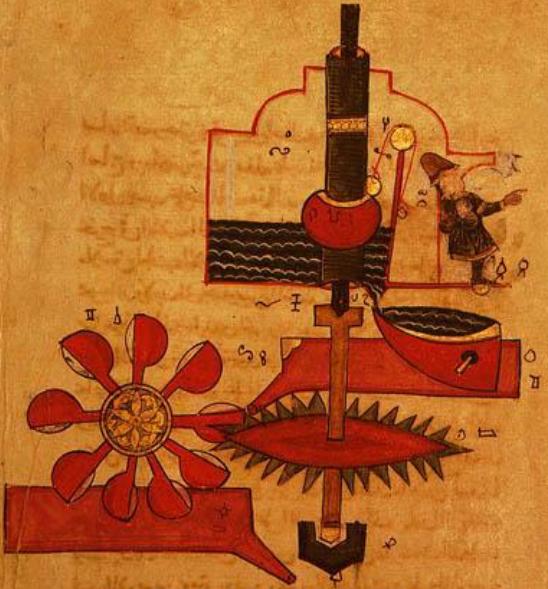


 Al-Jazari’s Water Pump


