Peace Homes Aluva

Simplify Building Your Dream Home

Archives 2012

Muslims Have Least Sex Outside Marriage, Study Suggests

Muslims Have Least Sex Outside Marriage, Study Suggests
Date: 18 October 2012 Time: 12:52 PM ET


Muslims Have Least Sex Outside Marriage, Study Suggests

Muslims Have Least Sex Outside Marriage, Study Suggests
Date: 18 October 2012 Time: 12:52 PM ET


Obesity Causing Pathogen Discovered by Chinese Scientists

An opportunistic pathogen isolated from the gut of an obese human causes obesity in germfree mice
Open

Na Fei1 and Liping Zhao1,2

  1. 1State Key Laboratory of Microbial Metabolism and School of Life Sciences and Biotechnology, Shanghai Jiao Tong University, Shanghai, China
  2. 2Shanghai Centre for Systems Biomedicine, Shanghai Jiao Tong University, Shanghai, China

Correspondence: L Zhao, State Key Laboratory of Systems Biomedicine, Shanghai Centre for Systems Biomedicine, Shanghai Jiao Tong University, Room 3-517, Biology Building, 800 Dongchuan Road, Minhang Campus, Shanghai 200240, China. E-mail: lpzhao3517@gmail.com orlpzhao@sjtu.edu.cn

Received 1 August 2012; Revised 24 October 2012; Accepted 28 October 2012
Advance online publication 13 December 2012

Top

Abstract

Lipopolysaccharide endotoxin is the only known bacterial product which, when subcutaneously infused into mice in its purified form, can induce obesity and insulin resistance via an inflammation-mediated pathway. Here we show that one endotoxin-producing bacterium isolated from a morbidly obese human’s gut induced obesity and insulin resistance in germfree mice. The endotoxin-producing Enterobacter decreased in relative abundance from 35% of the volunteer’s gut bacteria to non-detectable, during which time the volunteer lost 51.4kg of 174.8kg initial weight and recovered from hyperglycemia and hypertension after 23 weeks on a diet of whole grains, traditional Chinese medicinal foods and prebiotics. A decreased abundance of endotoxin biosynthetic genes in the gut of the volunteer was correlated with a decreased circulating endotoxin load and alleviated inflammation. Mono-association of germfree C57BL/6J mice with strain Enterobacter cloacae B29 isolated from the volunteer’s gut induced fully developed obesity and insulin resistance on a high-fat diet but not on normal chow diet, whereas the germfree control mice on a high-fat diet did not exhibit the same disease phenotypes. The Enterobacter-induced obese mice showed increased serum endotoxin load and aggravated inflammatory conditions. The obesity-inducing capacity of this human-derived endotoxin producer in gnotobiotic mice suggests that it may causatively contribute to the development of obesity in its human host.

Keywords: 

gut microbiota; germfree mice; endotoxin-producing bacterium; obesity; insulin resistance; high-fat diet

The role of the gut microbiota in the pathogenesis of obesity has emerged into an important research area (Backhed et al., 2004). Gram-negative opportunistic pathogens in the gut may be pivotal in obesity (Schumann et al., 1990Zhang et al., 20102012). Lipopolysaccharide (LPS) endotoxin purified from Escherichia coliinduced obese and insulin-resistant phenotypes when subcutaneously infused into mice at a concentration comparable to what can be found in a mouse model of high-fat diet (HFD)-induced obesity (Cani et al., 2007). Endotoxin-induced inflammation seems to be essential for the development of obese and insulin-resistant phenotypes in the mouse model involving LPS infusion, as CD14-knockout mice did not develop these phenotypes after endotoxin infusion (Cani et al., 2007). Epidemiological studies show increased population of endotoxin producers and elevated endotoxin load in various obese cohorts (Lepper et al., 2007Ruiz et al., 2007Moreno-Navarrete et al., 2011), but experimental evidence of endotoxin producers having a causative role in human obesity is lacking.

During our clinical studies, we found that Enterobacter, a genus of opportunistic, endotoxin-producing pathogens (Sanders and Sanders, 1997), made up 35% of the gut bacteria in a morbidly obese volunteer (weight 174.8kg, body mass index 58.8kgm−2) suffering from diabetes, hypertension and other serious metabolic deteriorations (Table 1). The volunteer lost 30.1kg after 9 weeks, and 51.4kg after 23 weeks, on a diet composed of whole grains, traditional Chinese medicinal foods and prebiotics (WTP diet, Supplementary Information; Supplementary Figure 1), with continued amelioration of hyperinsulinemia, hyperglycemia and hypertension until most metabolic parameters improved to normal ranges (Table 1). After 9 weeks on the WTP diet, this Enterobacter population in the volunteer’s gut reduced to 1.8%, and became undetectable by the end of the 23-week trial, as shown in the clone library analysis (Table 1; Supplementary Figures 2 and 3). The serum–endotoxin load, measured as LPS-binding protein (Schumann et al., 1990), dropped markedly during weight loss, along with substantial improvement of inflammation, decreased level of interleukin-6 and increased adiponectin (Table 1). Metagenomic sequencing of the volunteer’s fecal samples at 0, 9 and 23 weeks on the WTP diet confirmed that during weight loss, the Enterobacteriaceae family was the most significantly reduced population (Supplementary Figure 4). The abundance of 25 KEGG Orthologies involved in the LPS biosynthetic pathway diminished considerably, together indicating a significant reduction of the endotoxin-producing capacity of the volunteer’s gut microbiota after the intervention (Supplementary Figures 5–7). In light of previous reports of the pivotal role that endotoxins have in metabolic diseases in mice (Cani et al., 2007), we hypothesized that this endotoxin-producing Enterobacter population may have a causative role in the metabolic deteriorations of its human host. To confirm the causative role it may have in obesity development, we confirm Koch’s postulate in an experimental host with an isolated strain of this Enterobacter population (Evans, 1976). We then obtained one clinical isolate (B29) from the volunteer’s fecal sample via a ‘sequence-guided isolation’ scheme (Rappé et al., 2002; Supplementary Figure 8), and identified it as Enterobacter cloacae through biochemical tests and 16S ribosomal RNA gene sequencing (Supplementary Table 1). We performed whole-genome sequencing on B29, and phylogenetic analysis using CVTree (Qi et al., 2004) and identified its nearest neighbor as E. cloacaesubsp. cloacae ATCC 13047 (Supplementary Information). A limulus amebocyte lysate test showed that B29 LPS has strong endotoxin activity (Supplementary Figure 9), and the draft genome sequence revealed LPS biosynthesis genes similar to those in the metagenome from the day 0 fecal sample (Supplementary Figure 10).


Previous studies show that germfree mice are resistant to HFD-induced obesity (Backhed et al., 2007Ding et al., 2010Rabot et al., 2010). To test whether B29 can overcome this resistance to obesity by colonizing the gut of germfree mice (Supplementary Figure 11), we inoculated 1010 cells of B29 every day for the first week into 6- to 10-week-old germfree C57BL/6J mice (n=7 per group) under either normal chow diet (NCD) or HFD. We observed a slight body weight reduction among the mice during the inoculation period (Supplementary Figures 11–14). One mouse in each group died during inoculation because of the translocation of B29 into various organs (Sanders and Sanders, 1997; Supplementary Table 2). After the first week, the HFD-fed gnotobiotic mice inoculated with B29 (HFD+B29) showed a steady weight gain until eventually reaching an obese state comparable to that of the HFD-fed conventional mice (n=8 per group; Figures1a–c; Supplementary Figures 14–17). The excessive fat accumulation in the HFD+B29 gnotobiotic mice was associated with an altered lipometabolism including a leptin-resistant phenotype, reduced expression of fasting-induced adipose factor in the ileum, and increased expression of acetyl-CoA carboxylase 1, fatty acid synthase and peroxisome proliferator-activated receptor-gamma genes in the liver (Supplementary Figures 18–19; Backhed et al., 20042007). The HFD+B29 gnotobiotic mice developed the most significant insulin-resistant phenotype as shown in the oral glucose tolerance test and 2h post load insulin levels at the end of the trial (Figures 1d and e). This group also had the greatest increases in liver and spleen weights and the greatest decrease in cecum weight (Supplementary Table 3). The NCD-fed mice inoculated with either B29 (NCD+B29) or Luria–Bertani (LB) medium (NCD+LB) both remained lean throughout the trial (Figures 1a–c). The HFD-fed germfree mice inoculated with LB (HFD+LB) experienced significant weight gain over the first 9 weeks but eventually became no different, based on the obesity parameters tested, from the NCD-fed groups by the end of the 16-week trial, except for a moderately increased epididymal fat pad and a low level of insulin resistance (Supplementary Figure 14; Figures 1b and d). Our repeat of the animal test with HFD-fed gnotobiotic mice mono-associated with B29 confirmed that a single endotoxin producer such as B29 can function in the capacity of the whole microbiota for inducing obese and insulin-resistant phenotypes (Supplementary Figure 20). Inoculating 6- to 10-week-old germfree mice (n=4–6 per group) with a strain of Bifidobacterium animals via alternation of NCD and HFD feeding did not induce the same obese phenotype (Supplementary Figure 21), suggesting that obesity cannot be induced by introducing any bacteria in the germfree mice under HFD feeding.

Figure 1.

Figure 1 - Unfortunately we are unable to provide accessible alternative text for this. If you require assistance to access this image, please contact help@nature.com or the author

Gnotobiotic mice mono-associated with E. cloacae B29 become obese and insulin resistant with increased endotoxin load and provoked systemic inflammation under HFD feeding (data collected at the end of 16 weeks after inoculation). (a) Body weight; (b) mass of epididymal, mesenteric, subcutaneous inguinal and retroperitoneal fat pad; (c) abdominal photographs; (d) oral glucose tolerance test (OGTT) and the areas under the curve (AUC) for the plasma glucose; (e) serum 2h post load insulin; (f) enzyme-linked immunosorbent assay (ELISA) analysis of serum LPS-binding protein (LBP); (g) serum amyloid A (SAA); and (h) adiponectin corrected for bodyweight. The two-way analysis of variance (ANOVA) revealed a significant effect of the diet (P<0.01), a significant effect of B29 (P<0.01) and a significant diet × B29 interaction effect (P<0.01) on body weight, mass of epididymal, mesenteric, subcutaneous inguinal and retroperitoneal fat pad, serum LBP; a significant effect of the diet (P<0.01) and a significant effect of B29 (P<0.01) on OGTT; a significant effect of B29 (P<0.05) on serum 2h post load insulin. Data are shown as means±s.e.m. (n=6). NS, no significant difference; *P<0.05; **P<0.01. Color code for animal groups: NCD+LB, blue slash; NCD+B29, blue; HFD+LB, red slash; HFD+B29, red. LB, Luria–Bertani medium.

Full figure and legend (325K)


A slightly increased endotoxin load can induce a low-grade, chronic inflammation as a driving force for insulin resistance and altered lipometabolism in mice (Hotamisligil et al., 1996Cani et al., 2007). The serum LPS-binding protein was significantly higher in the HFD+B29 gnotobiotic mice than in the NCD+B29 gnotobiotic mice (Figure 1f), despite the fact that B29 reached a significantly greater population size in the gut of the NCD-fed gnotobiotic mice (Supplementary Figure 13). As B29 was the only LPS producer in the gnotobiotic-mouse gut (Supplementary Figure 22), the increased serum–endotoxin load in the HFD+B29 gnotobiotic mice could only come from B29. As the gene expression levels of the two tight junction proteins occludin and ZO-1 (Cani et al., 2008) in the ileum were not significantly different among the groups (Supplementary Figure 23), the high amount of endotoxin translocation from the gut to the serum in the HFD+B29 gnotobiotic mice may be facilitated by chylomicrons induced by long-chain fatty acids in the HFD (Cani et al., 2007Ghoshal et al., 2009), rather than by impaired gut barrier function (Cani et al., 2007Zhang et al., 20102012). In accordance with the increased endotoxin load, the HFD+B29 gnotobiotic mice had the greatest increase in serum amyloid A protein levels and the greatest decrease in adiponectin secretion, suggesting that these mice had the greatest increase in systemic inflammation (Figures 1g and h). The expression of the tumor necrosis factor-alpha, interleukin-1β, interleukin-6, I kappa B kinase epsilon and Toll-like receptor 4 pro-inflammatory genes increased significantly in the liver and epididymal fat pad but not in the ileum of the HFD+B29 gnotobiotic mice (Supplementary Figure 24), indicating local inflammation induced in the former two tissues but not in the gut, in contrast to a previous report (Ding et al., 2010). The HFD+LB germfree mice had moderately higher levels of serum serum amyloid A and liver tumor necrosis factor-alpha expression than the NCD-fed groups, suggesting that the HFD induced some host inflammation (Tripathy et al., 2003), which is, however, much lower than that induced by B29. Taken together, our results suggest that endotoxin-induced inflammation may have a pivotal role in obesity induced by E. cloacae B29, supporting the existence of a putative chain of causation from endotoxin producers in the gut to the obesity end points.

Germfree mice have been extensively used for obesity studies. For example, Gordon et al. showed that co-inoculation of germfree mice with the plant polysaccharide-fermenting Bacteroides thetaiotaomicron and the methane-producing Methanobrevibacter smithii significantly increased the epididymal fat pad but not the total bodyweight (Samuel and Gordon, 2006). As a step forward, our study has followed a procedure modified from Koch’s Postulates (Evans, 1976) and, for the first time, established a gnotobiotic-mouse obesity model combining HFD with a human-originated endotoxin producer. This work suggests that the overgrowth of an endotoxin-producing gut bacterium is a contributing factor to, rather than a consequence of, the metabolic deteriorations in its human host. In fact, this strain B29 is probably not the only contributor to human obesity in vivo, and its relative contribution needs to be assessed. Nevertheless, by following the protocol established in this study, we hope to identify more such obesity-inducing bacteria from various human populations, gain a better understanding of the molecular mechanisms of their interactions with other members of the gut microbiota, diet and host for obesity, and develop new strategies for reducing the devastating epidemic of metabolic diseases.

Top

References

  1. Backhed F, Ding H, Wang T, Hooper LV, Koh GY, Nagy A et al. (2004). The gut microbiota as an environmental factor that regulates fat storage. Proc Natl Acad Sci USA 101: 15718–15723. | Article | PubMed | CAS |
  2. Backhed F, Manchester JK, Semenkovich CF, Gordon JI. (2007). Mechanisms underlying the resistance to diet-induced obesity in germ-free mice. Proc Natl Acad Sci USA 104: 979–984. | Article | PubMed | CAS |
  3. Cani PD, Amar J, Iglesias MA, Poggi M, Knauf C, Bastelica D et al. (2007). Metabolic endotoxemia initiates obesity and insulin resistance. Diabetes 56: 1761–1772. | Article | PubMed | ISI | CAS |
  4. Cani PD, Bibiloni R, Knauf C, Waget A, Neyrinck AM, Delzenne NM et al. (2008). Changes in gut microbiota control metabolic endotoxemia-induced inflammation in high-fat diet-induced obesity and diabetes in mice. Diabetes57: 1470–1481. | Article | PubMed | ISI | CAS |
  5. Ding S, Chi MM, Scull BP, Rigby R, Schwerbrock NM, Magness S et al. (2010). High-fat diet: bacteria interactions promote intestinal inflammation which precedes and correlates with obesity and insulin resistance in mouse.PLoS One 5: e12191. | Article | PubMed | CAS |
  6. Evans AS. (1976). Causation and disease: the Henle-Koch postulates revisited. Yale J Biol Med 49: 175–195. | PubMed | ISI | CAS |
  7. Ghoshal SJ, Witta J, Zhong J, de Villiers W, Eckhardt E. (2009). Chylomicrons promote intestinal absorption of lipopolysaccharides. J Lipid Res 50: 90–97. | Article | PubMed | ISI | CAS |
  8. Hotamisligil GS, Peraldi P, Budavari A, Ellis R, White MF, Spiegelman BM et al. (1996). IRS-1-mediated inhibition of insulin receptor tyrosine kinase activity in TNF-alpha- and obesity-induced insulin resistance. Science 271: 665–668. | Article | PubMed | ISI | CAS |
  9. Lepper PM, Schumann C, Triantafilou K, Rasche FM, Schuster T, Frank H et al. (2007). Association of lipopolysaccharide-binding protein and coronary artery disease in men. J Am Coll Cardiol 50: 25–31. | Article | PubMed | ISI |
  10. Moreno-Navarrete JM, Ortega F, Serino M, Luche E, Waget A, Pardo G et al. (2011). Circulating lipopolysaccharide-binding protein (LBP) as a marker of obesity-related insulin resistance. Int J Obes (Lond) 36: 1442–1449. | Article | PubMed |
  11. Qi J, Luo H, Hao B. (2004). CVTree: a phylogenetic tree reconstruction tool based on whole genomes. Nucleic Acids Res 32: 45–47. | Article | PubMed |
  12. Rabot S, Membrez M, Bruneau A, Gerard P, Harach T, Moser M et al. (2010). Germ-free C57BL/6J mice are resistant to high-fat-diet-induced insulin resistance and have altered cholesterol metabolism. FASEB J 24: 4948–4959. | Article | PubMed | ISI | CAS |
  13. Rappé MS, Connon SA, Vergin KL, Giovannoni SJ. (2002). Cultivation of the ubiquitous SAR 11 marine bacterioplankton clade. Nature 418: 630–633. | Article | PubMed | ISI | CAS |
  14. Ruiz AG, Casafont F, Crespo J, Cayon A, Mayorga M, Estebanez A et al. (2007). Lipopolysaccharide-binding protein plasma levels and liver TNF-alpha gene expression in obese patients: evidence for the potential role of endotoxin in the pathogenesis of non-alcoholic steatohepatitis. Obes Surg17: 1374–1380. | Article | PubMed |
  15. Samuel BS, Gordon JI. (2006). A humanized gnotobiotic mouse model of host-archaeal-bacterial mutualism. Proc Natl Acad Sci USA 103: 10011–10016. | Article | PubMed | CAS |
  16. Sanders J. WE, Sanders CC. (1997). Enterobacter spp.: pathogens poised to flourish at the turn of the century. Clin Microbiol Rev 10: 220–241. | PubMed |
  17. Schumann RR, Leong SR, Flaggs GW, Gray PW, Wright SD, Mathison JC et al. (1990). Structure and function of lipopolysaccharide binding protein.Science 249: 1429–1431. | Article | PubMed | ISI | CAS |
  18. Tripathy D, Mohanty P, Dhindsa S, Syed T, Ghanim H, Aljada A et al. (2003). Elevation of free fatty acids induces inflammation and impairs vascular reactivity in healthy subjects. Diabetes 52: 2882–2887. | Article | PubMed | ISI | CAS |
  19. Zhang C, Zhao Y, Zhang M, Pang X, Wang L, Zhao L. (2012). Structural resilience of the gut microbiota in adult mice under high-fat dietary perturbations. ISME J 6: 1848–1857. | Article | PubMed |
  20. Zhang C, Zhang M, Wang S, Han R, Cao Y, Hua W et al. (2010). Interactions between gut microbiota, host genetics and diet relevant to development of metabolic syndromes in mice. ISME J 4: 232–241. | Article | PubMed | ISI | CAS |
Top

Acknowledgements

We appreciate Professor R. Losick, L Neuhauser, M Obin and M Pop for critical reading of the manuscript and kind suggestions. We are also grateful to the following individuals for their kind assistance during the study: S Xiao, J Shen, X Pang, M Zhang, XJ Zhang, Y Zhao, L Wang, J Wang, Y Zhang, G Wu, G Wang, H Ou, J Qi, JJ Wang, X Zhang, R Wang, M Song, J Xu, H Tang, T Liu, Q Zhang, N Zhao, C Zhang, Y Fan, S Liu, YZ Fan, T Wang, Z Hu, R Xi, XY Zhang, C Liu, H Wu, X Guo, X Li, G Ning, S Yang and G Zhao.

This work was supported by Project 30730005 of the National Nature Science Foundation of China (NSFC), 863 Projects 2008AA02Z315 and 2009AA02Z310, Key Projects 2007DFC30450 and 075407001 of International Cooperation Program Grants and Project in the National Science and Technology Pillar Program 2006BAI11B08.

Supplementary Information accompanies the paper on The ISME Journal website

This work is licensed under the Creative Commons Attribution-NonCommercial-No Derivative Works 3.0 Unported License. To view a copy of this license, visithttp://creativecommons.org/licenses/by-nc-nd/3.0/.

Microsoft Blocks Linux from running on Windows 8 PCs

Microsoft to stop Linux, older Windows, from running on Windows 8 PCs | ZDNet

Summary: It doesn’t take much reading between the lines to see that Microsoft is going to try to keep Linux, older versions of Windows, and other operating systems off Windows 8 PCs.
Steven J. Vaughan-Nichols

By Steven J. Vaughan-Nichols for Linux and Open Source | September 23, 2011 — 07:55 GMT (00:55 PDT)

[The Microsoft Death Star is back in orbit and firing.] Thanks to Mary Jo Foley, we now know that in the name of “security,” Microsoft will be trying to use UEFI (Unified Extensible Firmware Interface) to block Linux, older versions of Windows, and other alternative operating systems from booting on Windows 8 PCs. Thanks Microsoft we appreciate it.

In a new Microsoft blog, Building Windows 8, by Steven Sinofsky, Microsoft’s president of the Windows division, Linux isn’t mentioned, and he tries to place the blame on the UEFI security protocol. Behind all his dodging, the facts are that Microsoft UEFI secure boot is requirement for Windows 8 certification and that, while “OEMs [original equipment manufacturers) are free to choose how to enable this support,” they still have to have it. In turn, that will make it harder for OEMs to support alternative operating systems and, if the OEM does bow down to Microsoft’s demands, it will make it almost impossible for end-users to run Linux, older versions of Windows, or other alternative operating systems on Windows 8 certified PCs.

In short, if Microsoft has its way, all Windows 8 PCs will be even more locked into their pre-installed operating systems than Macs are into Mac OS X. Indeed, a better comparison would be how phone companies lock you into their smartphone operating systems. Just like them the Windows 8 PC you buy in 2013 will be permanently locked into Windows 8. And, like smartphones, only expert firmware hackers will be able to switch out operating systems or even enable dual-booting operating systems.

This isn’t the first time Microsoft has tried to lock out competitors from Windows PCs. In the early 2000s, Microsoft tried to combine Windows and the BIOS with a Digital Right Management (DRM) scheme called Next Generation Secure Computing Base (NGSCB), AKA Palladium. At the time, the point wasn’t so much as to block operating systems as it was to build DRM into PCs so you couldn’t play any music or video content unless you had a license for it. That effort failed.

That isn’t stopping Microsoft from once more trying to stop you from using your computer the way you want to use it though.

Matthew Garrett, the Red Hat engineer who first spotted Microsoft’s new sneak attack on alternative operating systems, has taken a new look at Microsoft’s latest announcements and Garrett and Red Hat after “discussing the problem with other Linux vendors, hardware vendors and BIOS vendors [to make] sure that we understood the ramifications of the policy in order to avoid saying anything that wasn’t backed up by facts. These are the facts:”

Windows 8 certification requires that hardware ship with UEFI secure boot enabled.
Windows 8 certification does not require that the user be able to disable UEFI secure boot, and we’ve already been informed by hardware vendors that some hardware will not have this option.
Windows 8 certification does not require that the system ship with any keys other than Microsoft’s.
A system that ships with UEFI secure boot enabled and only includes Microsoft’s signing keys will only securely boot Microsoft operating systems.

Garrett explains that this is a problem “Because there’s no central certification authority for UEFI signing keys. Microsoft can require that hardware vendors include their keys. Their competition can’t. A system that ships with Microsoft’s signing keys and no others will be unable to perform secure boot of any operating system other than Microsoft’s. No other vendor has the same position of power over the hardware vendors. Red Hat is unable to ensure that every OEM carries their signing key. Nor is Canonical. Nor is Nvidia, or AMD or any other PC component manufacturer. Microsoft’s influence here is greater than even Intel’s.”

Indeed Microsoft still owns the desktop market. Macs still have less than 5% of the world desktop market according to Gartner and the Linux desktop has proven to be a non-starter, PC vendors will have little choice but to kowtow to Microsoft’s Windows 8 demands.

“What does this mean for the end user?” continued Garrett. “Microsoft claims that the customer is in control of their PC. That’s true, if by ‘customer’ they mean ‘hardware manufacturer.’ The end user is not guaranteed the ability to install extra signing keys in order to securely boot the operating system of their choice. The end user is not guaranteed the ability to disable this functionality. The end user is not guaranteed that their system will include the signing keys that would be required for them to swap their graphics card for one from another vendor, or replace their network card and still be able to netboot, or install a newer SATA controller and have it recognize their hard drive in the firmware. The end user is no longer in control of their PC.”

Garrett concluded, “So, the truth is that Microsoft’s move removes control from the end user and places it in the hands of Microsoft and the hardware vendors. The truth is that it makes it more difficult to run anything other than Windows. The truth is that UEFI secure boot is a valuable and worthwhile feature that Microsoft [is] misusing to gain tighter control over the market. And the truth is that Microsoft [hasn’t] even attempted to argue otherwise.”

Garrett is, understandably, most concerned about how this will effect desktop Linux. I wonder though if what Microsoft really wants is to avoid a repeat of the Vista fiasco by making sure OEMs and end-users can’t go back to Windows 7 or XP. As Windows 7’s slow adoption and Vista’s flop has shown, users really haven’t been that interested in moving off Windows XP. Since Windows 8’s Metro interface adds an entirely new level of complications for both independent software vendors (ISV)s and end-users, I can see why Sinofsky would want to force Windows 8 down the throats of Windows users “for their own good.”

So what does it all boil down to? As it stands now Microsoft is saying OEMs don’t have to do it. They just have to do it if they want to sell PCs with Windows on them. Paging the anti-trust lawyers, I think Microsoft’s latest attempt to abuse their PC monopoly power bears investigation. Welcome back Evil Empire, I knew you couldn’t really be that far away.

AutoCAD with .NET 2

Lesson 2: Getting to Know your Development Environment

In
the previous lesson, you saw how you can increase productivity in
AutoCAD by implementing a plug-in built from a small amount of Visual
Basic .NET code.

.NET (or
the .NET Framework) is a technology created by Microsoft that enables
programmers to create and extend software applications. A programmer may
use the ,NET Framework to create a new software application from
scratch, to implement communication or interoperability between two
software applications, or to extend a software application by
implementing a plug-in for it (as you are doing here for AutoCAD). If
you are interested in learning more, you will find information in the Additional Topics section.

You will now look more closely at what happened when you built and executed the code in the previous lesson.

Provide Feedback: Please provide feedback about this AutoCADTraining or this lesson via email: myfirstplugin@autodesk.com

What does it mean to “build” code?

The code you typed into Visual Basic Express in Lesson 1 was a set of human-readable instructions (source
code) that needed to be converted into code that could be understood
and executed by the computer. The “build” you performed did just that:
it packaged up the resulting executable code into a DLL (Dynamic-Link Library) that can be loaded into AutoCAD.

The
following screenshot shows the output in DLL form along with the
associated program debug database (which provides additional information
when troubleshooting the DLL) that you built using Visual Basic Express
in Lesson 1. The path to where the DLL gets compiled is specified in
the Visual Basic Express project settings and is set, by default, to the
binRelease or binDebug sub-folder of the Visual Basic Express project
folder (depending if you’re building a Release or Debug version of your
DLL – we’ll talk about that later).

Choosing a Programming Language and Development Tool

Just
as humans use different languages to communicate, you have various
language options available to you when creating an AutoCAD plug-in:  for
the purposes of this guide we have chosen Visual Basic .NET, a strong
general-purpose programming language. Visual Basic .NET is particularly
popular with people learning to program, because the language syntax is
more easily readable than many other languages (such as C# or C++).

There
are a number of tools available for developing Visual Basic .NET code.
They range from open source tools such as SharpDevelop and MonoDevelop
to Microsoft’s flagship, professional development environment, Visual
Studio. This tutorial assumes you’re using Visual Basic Express, a free
version of Visual Studio for building Visual Basic .NET applications.

Visual Basic Express is an Integrated Development Environment (IDE) because it is composed of various tools, menus and toolbars which ease the creation and management of your code.

The project system in Visual Basic Express comprises Solution and Project files as well as Project Items,
the individual files belonging to projects. A solution is a container
for one or more projects. Each project can in turn be considered a
container for project items – such as source files, icons, etc. – most
of which get compiled into the resultant executable file (EXE or DLL).
Visual Basic Express provides a Solution Explorer that organizes and
displays the contents of the loaded solution in a tree-view format:

The
Visual Basic Express interface also contains a text editor and
interface designer. These are displayed in the main window depending on
the type of file being edited. The text editor is where you will enter
the Visual Basic .NET code for your AutoCAD plug-in. This editor
provides advanced features such as IntelliSense and collapsible code
sections along with the more classic text-editing features such as
bookmarks and the display of line numbers.

IntelliSense
is an extremely valuable feature of the Visual Studio family that
greatly improves programmer productivity: it automatically provides
suggestions for the code being written based on the objects available
and the letters that are being typed. You will have already seen IntelliSense at work if you typed in the code in Lesson 1. That is one reason we suggested you didn’t copy and paste.

Clearly
one of the key features of Visual Basic Express is its ability to build
Visual Basic .NET code into an executable file. During the build
process, the language compiler performs various checks and analyses on
the code. One such check is to ensure the code conforms to the
syntactical rules of the Visual Basic .NET language. The compiler also
performs various other checks, such as whether a variable has been
appropriately defined or not. Detected errors are reported via the Error
List window, typically found at the bottom of the main window. If you
made a mistake typing in the code in lesson 1, you may already have seen
this when you tried to build your plug-in.

Reviewing your use of Visual Basic Express

In
this section, you will review the steps performed using Visual Basic
Express from the previous lesson. However, we will put them in the
context of what you have just learned about programming in general and
building your code.

  1. In the first step, you simply launched Visual Basic Express.
  2. You then created a new Visual Basic .NET project of type AutoCAD plug-in. This project template was added when you installed the AutoCAD .NET Wizards.

    Since
    the development language used for this guide is Visual Basic .NET, you
    are working with Visual Basic Express, and therefore you see Visual Basic under the Installed Templates portion of the New Project dialog. The AutoCAD plug-in template is essentially a Class Library template, but with some additional settings.

    In
    the middle section of this dialog, you saw various types of
    applications that can be created; you select the template according to
    the type of application you wish to create.

    The nam
    e you entered at the bottom of the dialog is used to identify the project within the solution.

  3. Your
    blank project was created, containing a few standard project references
    to core .NET components along with references to the two files that
    define the AutoCAD API (AcMgd.dll and AcDbMgd.dll). The project also
    includes two Visual Basic .NET class files (MyCommands.vb and MyPlugin.vb – you may have optionally deleted the MyPlugin.vb
    file from the project because it’s not needed for this tutorial). These
    files contained some simple boilerplate code. Clicking on one of those
    files in Solution Explorer displays the code it contains in the text
    editor window.
  4. You looked at the References section of the ‘My Project’ project settings and checked that AcDbMgd.dll and AcMgd.dll were correctly referenced (and AcCoreMdg.dll for AutoCAD 2013 and higher).
  5. Saving
    the solution created physical files representing the contents of your
    project on the computer’s hard drive, allowing you to open and edit it
    at another time in the future. You closed and reopened the project to
    ensure Visual Basic Express had correctly parsed the project files.
  6. AcMgd.dll and AcDbMgd.dll
    contain definitions of the AutoCAD APIs you will most commonly use in
    your plug-ins. You will always reference these two files in your AutoCAD
    plug-in projects. You will sometimes reference others too.
    • AcMgd.dll contains the APIs for controlling the AutoCAD application itself – defining custom commands
      opening and closing documents, plotting, etc.
    • AcDbMgd.dll contains the APIs for creating, editing or querying the contents of a DWG file.
    • From
      AutoCAD 2013, the APIs in AcMdg.dll were split between AcMgd.dll and
      AcCoreMgd.dll. AcCoreMgd.dll contains APIs related to the AutoCAD
      application login (such as selections set, comamnds and keywords), and
      AcMgd.dll contains ‘User Interface’ related APIs (such as dialogs).

    When
    you created your AutoCAD plug-in project, the AutoCAD .NET Wizard
    Configurator dialog had these selected by default (you can’t unselect
    them). There were options to include other API definition files that we
    ignored.

  7. Next you added Visual Basic .NET code using the
    AutoCAD API into your project. In other words providing AutoCAD with
    instructions on how to modify how a block attribute behaves when it is
    rotated.

While developing code, it’s a good idea to build
the solution from time to time, to check whether errors have been
introduced in the code. The code does not necessarily have to be
complete or functional when building the solution. This approach can
help avoid potentially lengthy troubleshooting once the code is
complete, and has the side benefit of automatically saving any edited
source files before the build starts.

To build a solution inside Visual Basic Express, select Build Solution from the Debug pull-down menu.

If the build process was successful, you would see a Build Succeeded
status in the bottom left corner of the Visual Basic Express
application frame. If there was an error in your code, Visual Basic
Express will display an error list explaining the errors it has found.
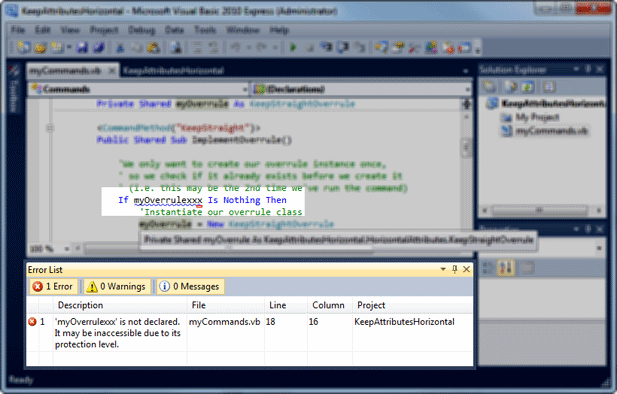
It will also underline the error in your code in blue.  Here’s an
example where we deliberately added a mistake to the code you typed in
lesson one:

In
this lesson you took a brief look at what happens when you build a
project, as well as some background information on Visual Basic .NET and
Visual Basic Express. You reviewed the steps you had taken in the
previous lesson to build your basic AutoCAD plug-in, putting it in the
context of what you have learned about programming.

Additional Topics

Visual Basic Express vs. Visual Studio Professional

In
this guide, you are using Visual Basic Express. This is a free version
of Visual Studio and so it’s a great tool to start learning with.
Microsoft has targeted the Express editions of Visual Studio at
students, hobbyists and other part-time programmers. While it provides
most of the features of Visual Studio Professional, such as
IntelliSense, it does have certain limitations. For instance, it
contains fewer project templates and has limited options for debugging
and troubleshooting your code. If you are serious about plug-in
development beyond this introductory guide – and particularly if you
want to start developing commercial plug-ins – we recommend investing in
one of the more fully-featured members of the Visual Studio product
family.

*There are several ‘professional’ versions of Visual Studio. Visit the Microsoft Visual Studio website for more information.

What is .NET?

The
remainder of this lesson includes quite a bit of technical jargon.
Don’t worry if you don’t completely understand it all when you first
read it. It will make more sense once you’ve become more familiar with
.NET after writing a few of your own plug-ins.

The
.NET Framework is a software framework that sits on top of the
Microsoft® Windows® operating system* and provides the underlying
platform, libraries and services for all .NET applications. The services
include memory management, garbage collection, common type system,
class libraries, etc.

* Subsets of .NET are also available on
other operating systems, whether via the open source Mono project or via
Microsoft® Silverlight®, but these are not topics for this guide. You
will focus solely on using.NET on Microsoft Windows.

What does the .NET Framework Contain?

The framework contains two main components:

  1. Common Language Runtime (CLR)This
    is the agent (or execution engine) in the .NET Framework responsible
    for managing the execution of code. Which is why code written to target
    this runtime is also known as managed code. All managed code runs under
    the supervision of the CLR, but what does this mean? The CLR manages
    code by providing core services such as memory management (which
    includes automatically releasing the computer’s memory for reuse on
    other tasks when it is no longer needed), error (or exception) handling,
    managing the use of multiple threads of execution and ensuring rules
    around the use of different types of object are adhered to. The CLR is
    really the foundation of the .NET Framework.
  2. .NET Framework Class LibraryAs
    the name suggests, this is a library or collection of object types that
    can be used from your own code when developing .NET applications. These
    .NET applications are targeted fo
    r Windows (whether command-prompt
    based or with a graphical user interface), the web or mobile devices.
    This library is available to all languages using the .NET Framework.

As
mentioned above, the CLR improves code robustness by making sure the
executing code conforms to a common type system (CTS). The CTS ensures
that all .NET (or managed) code – irrespective of the language – uses a
similar set of object types and can work together in the same
environment. It is this feature that makes it possible for you to write
applications in the development language of your choice and yet make use
of components/code written by programmers using other .NET languages.

Building Executables

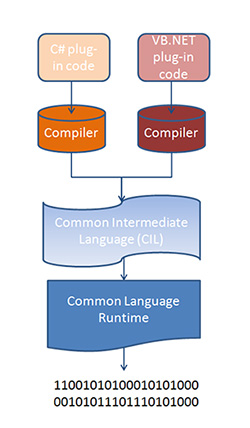
When
you built your code into an EXE, it was compiled into Common
Intermediate Language (CIL – also known as MSIL) code using the
language-specific compiler. CIL is a CPU-independent set of instruction
that can be executed by the CLR on Windows operating systems. CIL is
typically portable across 32- and 64-bit systems and even – to some
extent – to non-Windows operating systems. The CIL code generated from
your VB source code was then packaged into a .NET assembly. Such an
assembly is a library of CIL code stored in Portable Executable (PE)
format (which contains both the CIL and its associated metadata).
Assemblies can either be process assemblies (EXEs) or library assemblies
(DLLs).

During the course of this
guide, you will focus on developing a particular type of AutoCAD
plug-in: a process assembly (EXE) which communicates with AutoCAD.
Because of the overhead associated with developing them, you will not
spend time looking at AutoCAD AddIns, which are usually library
assemblies (DLLs) that get loaded into and executed within the memory
space of AutoCAD. One reason that implementing an EXE to work with
AutoCAD is simpler than developing an AddIn is related to its user
interface: Executables do not need to integrate seamlessly with the
AutoCAD user interface by adding ribbon buttons (for instance).

Running Executables

During
execution of a .NET assembly, CIL (residing in the assembly) is passed
through the CLR’s just-in-time (JIT) compiler to generate native (or
machine) code. JIT compilation of the CIL to native code occurs when the
application is executed. As not all of the code is required during
execution, the JIT compiler only converts the CIL when it is needed,
thus saving time and memory. It also stores any generated code in
memory, making it available for subsequent use without the need to
recompile.

In the last step of this process, the native code gets executed by the computer’s processor.

If you would like more details on the process of building .NET applications, please refer to the MSDN Library

Boycott Israel Campaign 2012


Boycott Israel Campaign 2012

Last Updated 4th June 2012


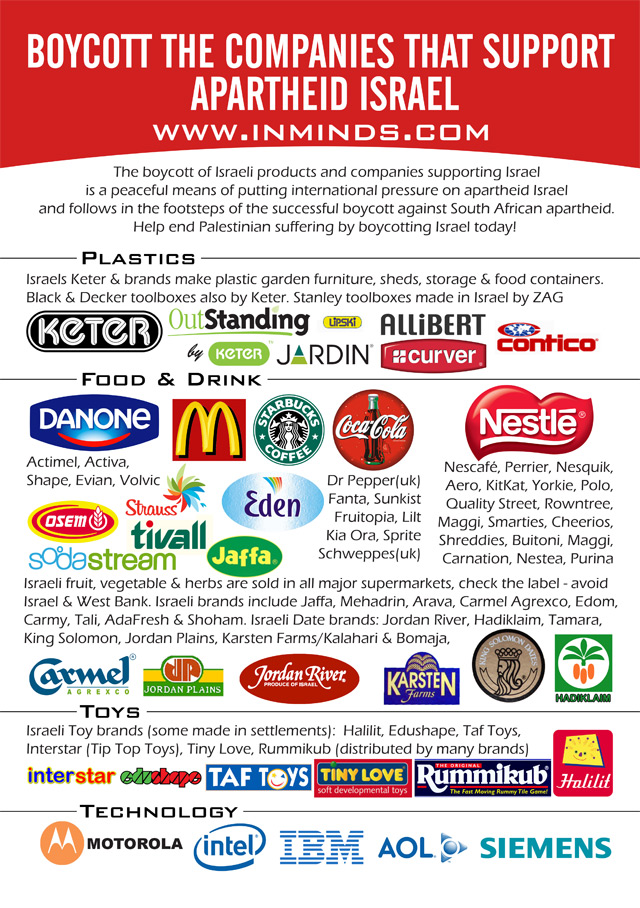
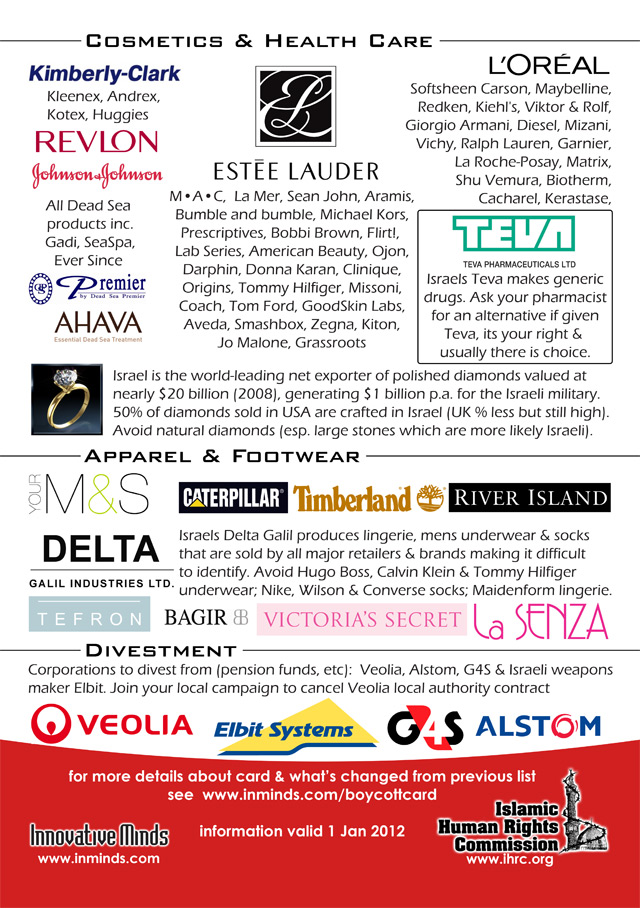
The boycott of Israeli products and companies supporting Israel is a peaceful means of putting international pressure on apartheid Israel and follows in the footsteps of the successful boycott against South African apartheid. Help end Palestinian suffering by boycotting Israel today!


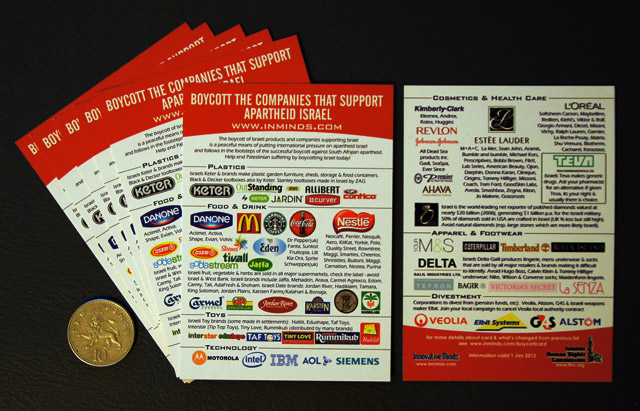
The guilty companies (Boycott Israel card [front])

The guilty companies (Boycott Israel card [back])


Why are these companies on the boycott list?

Summary of how each company on the boycott list is supporting Israel:


PLASTICS

Keter

Israels Keter Group is one of the world’s leading manufacturers and marketers of plastic consumer products. The Israeli plastics giant is privately owned by the Sagol family, and has a turnover of $1.1 billion, 90% of which is derived from overseas sales.


Its product range includes garden furniture, outdoor storage solutions and sheds, shelving systems and utility cabinets, tool boxes and storage products for the DIY market, household products, baby and toddler products.

Its brands, subsidiaries, and sister companies (all owned by the Sagol family) include ‘OutStanding Solutions’ (Keter garden storage), Lipski (plumbing accessories), Allibert (bathroom accessories), Curver (plastic home & food storage), Jardin (garden furniture), and Contico Europe (plastic storage boxes). Keter products are also sold under the Black & Decker, B&Q and Homebase brands.

Whilst the profits end up in Israel, not all the products are produced in Israel, for example Allibert has factories in France & Belgium, whilst Curver has factories in Poland & Hungary. Keter has 12 factories in Israel, 2 of which are in the illegal settlements.

Stanley toolboxes are also made in Israel by Israeli plastics company ZAG (90% owned by Stanley).

For more information see the Shopping Can Kill campaign.


FOOD & DRINK

Strauss

The Straus Group is Israels second largest food company with a turnover $1.8 billion in 2010 and 13,500 employees operating twenty-five production sites in twenty-one countries around the world. Its brands in the USA include Sabra (hummus dips) and Max Brenner (chocolate cafes). Strauss Coffee is currently the fifth-largest coffee company in the world, dominating the central and eastern European markets (Doncafe) as well as Brazil.


The Strauss Group on its website, on the page on “Corporate Responsibility – Community Involvement” reveal their deep rooted support for the Israeli army, and in particular the infamous Golani platoon, known for its brutality, which the Strauss group has “adopted” for over 30 years.

Danone

In July 1998 Danone opened its R&D facility in Israel – the Danone Insitute, and later the same year in October 1998 Mr. Franck Riboud, on behalf of Danone received the Jubilee Award by the Israeli Prime Minister Netanyahu.[Jubilee Award]


Danone owns a 20% share of Israel’s second largest food company, the Strauss Group. Danaone Israel is the hub supplying Danone products to the whole Middle-East including Turkey, Greece, Egypt and Jordan.

Tivall

Israeli food company Tivall is one of the world’s leading suppliers of meat-substitute products. It has a turnover of $74 million and has 451 employees[59] It has a manufacturing base at Kibbutz Lochamei Hagetaot in Northern Israel, and a new facility in the Czech Republic.


Tivall brand products can mainly be found in health food stores – their website mentions Holland & Barrett, Fresh & Wild, and Planet Organic. But most of their sales are through the supermarkets who rebrand Tivall products as part of their own frozen “Meat-free” range. This includes Tesco, Asda, Morrisons and Sainsbury’s. Morrisons also stocks Tivall brand Frankfurter. Waitrose online site Ocado sells a full range of Tivall products.

Osem

Osem is Israels 4th largest food & beverages company (by turnover) after Tnuva, Strauss and Coca-Cola. It has a turnover of $712 million and nearly 5000 employees with 14 factories in Israel.


Its brands include Beit Hashitah (pickles), Of Tov (frozen meat products), Habait (ready made cakes) and Sabra Salads (ready-made salads and spreads). Osem also owns 58% of meat-substitute manufacturer Tivall Foods.

According to Osem’s website its products are sold in Marks & Spencer, Tesco, Sainsbury and Morrison, with each store marketing them under their own label. Waitrose online site Ocado sells a range of Osem products from soups, crackers and croutons. Tesco online sells a range of Osem cakes.

In April 2009, Osem UK announced its acquisition of Yarden GB. Yarden GB’s product range includes chilled meats and Yarden wines from the Golan Heights Winery, located in Katzrin on the occupied Syrian Golan Heights. Golan Heights Winery exports 38% of all Israeli wines, its wine brands also include Gamla and Golan. According to Yarden GB’s website its products are available in Tesco, Asda, Sainsbury, Morrisons, Budgens, Somerfield, Waitrose and Harrods. Waitrose online site Ocado sells a range of Yarden meat and houmous products.

Nestlé

Nestlé is the world’s largest food company, it owns 53.8% share of leading Israeli food manufacturer Osem, an investment worth over $850 million.


In 1998, Mr. Peter Brabeck-Letmathe on behalf of Nestle, received the Jubilee Award by the Israeli Prime Minister Netanyahu [Jubilee Award]. Following the award in June 2002 Nestle opened its Research & Development Centre in Israel, in Sderot. And since then it has steadily increased its investment in Israel, its initial 10% stake in Osem has now grown to a controlling 53.8%. Nestle also owns Nespresso Israel Ltd in Tel Aviv which supplies coffee brewing equipment. In 2010 Nestle acquired a 51% stake in Israeli babyfood company Materna Laboratories for $72 million.

Nestle has 9 factories in Israel, which after China(18) and Russia(11) is the highest number in any country in Asia – disproportionately high when one considers its size and population. And in May 2011, Nestle announced plans to build another factory in Israel, an ice cream plant worth $40 million.

Nestlé also owns 30% stake in L’Oréal, another company on the boycott list.

Coca Cola

A detailed account of Coca-Cola’s links to Israel is provided here:


http://www.inminds.com/boycott-coca-cola.html

A summary:

From 1966 Coca-Cola has been a staunch supporter of Israel. In 1997 the Government of Israel Economic Mission honored Coca-Cola at the Israel Trade Award Dinner for its continued support of Israel for the last 30 years and for refusing to abide by the Arab League boycott of Israel.

Every year Coca Cola bankrolls the American-Israel Chamber of Commerce Awards which honors companies that have contributed most to the Israeli economy. In 2009 a Coca-Cola sponsored award went to Israel’s Lobby AIPAC for its successful lobbying of the Senate to reject of the UN call for “immediate ceasefire” and endorse the continuation of the Israel military assault on Gaza.

In 2008 Coca-Cola tasked the Israeli venture capital Challenge Fund to locate suitable investments in Israel with a promise of “a blank cheque” . This agreement is exceptional in the Israeli venture capital industry.

In 2009 Coca-Cola hosted a special reception at the Coca-Cola world headquarters to honour Brigadier-General Ben-Eliezer. Ben-Eliezer is a wanted war criminal, during the Six-Day War his unit was responsible for the execution of over 300 Egyptian POWs. Under Sharon, Ben-Eliezer served as Defence Minister presiding over the massacre at Jenin.

For the past two decades, nearly every year, Coca-Cola has sponsored the JCC Maccabi Games whose stated aim is to cultivate Jewish youth in an informal setting to “encourage their identification with the state of Israel”. As part of this, Coca Cola has sponsored young children to visit Israeli military bases and spend time with war criminals in order to engender empathy, in their own words “visit an air force base.. talk with the pilots that are the elite Israel Defense Force units..meet fighters of the army.”.

Coca-Cola Israel, Israel’s third largest food & beverages company, owns dairy farms in the illegal Israeli settlements of Shadmot Mechola in the Jordan Valley and a plant in the industrial zone of Katzerin in the occupied Golan Heights.

Eden Springs

Eden Springs is an Israeli water cooler company that in Israel steals water from the Salukia spring in the the illegally occupied Syrian Golan Heights. This is in violation of UN resolution 242 and Article 55 of the Hague Regulations which specify that you cannot acquire territory by war and that you cannot plunder the natural resources of occupied territory. To clarify, the water in Eden Springs Coolers found in the UK is sourced locally, but the profits go back to Israel to finance its illegal activities.


Sodastream

SodaStream is an Israeli company manufacturing and distributing home carbonating devices and flavorings for soft drinks. The company’s main plant is located in the industrial zone of Mishor Edomim which is an illegal Israeli settlement in the West Bank. Kav LaOved, the NGO committed to protecting the rights of disadvantaged workers in Israeli companies, has reported that SodaStream factory workers, in particular Palestinians, are paid less than half the minimum wage and has described the working conditions in the factory as “one of the worst”, with workers being fired if they complain of the conditions.


SodaStream brands include: SodaStream, Soda-Club, AlcoJet, Sprudelino, Aquabar, Gazoz, Aquafizz, Aquabubbler, Penguin, Sodamaker, Fountain Jet and Edition1. Its products are available in Argos, Asda, Comets, Currys, Harvey Nichols, Homebase, John Lewis, Robert Dyas, Selfridges and House of Fraser.

Starbucks

Howard Schultz, the founder, chairman, president and chief executive officer of Starbucks who also owns 31.6 million shares of Starbucks stock (worth around $1.4 billion in Nov 2011) is an active zionist.


In 1998 he was honoured by the Jerusalem Fund of Aish HaTorah with “The Israel 50th Anniversary Friend of Zion Tribute Award” for his services to the zionist state in “playing a key role in promoting close alliance between the United States and Israel”. The ultra-right wing Jerusalem Fund of Aish HaTorah funds Israeli arms fairs chaired by the butcher of Jenin, General Shaul Mofaz, and the zionist media pressure group honestreporting.com, they were also implicated in the production and distribution of the infamous islamophobic film ‘Obesession’. Starbucks proudly displayed the award on the company’s website under the section of ‘awarda and accolades’ the Starbucks company has won, however, once the boycott started to bite the award mysteriously disappeared from its website.

Howard Shultz work as a propagandist for Israel has been praised by the Israeli Foreign Ministry as being key to Israel’s long-term PR success. On April 4th 2002, whilst the Israeli army was slaughtering Palestinians in Jenin Howard Shultz made a provocative speech blaming the Palestinians, suggesting the intifada was a manifestation of anti- Semitism, and asked people to unite behind Israel. Starbucks also sponsors fund raisers for Israel.

At a time when other businesses were desperately pulling out of Israel, Starbucks decided to help Israel’s floundering economy and open Starbucks in Israel. The venture failed but Shultz has vowed Starbucks will “return to Israel in due course”.

Starbucks has opened outlets in US bases in Afghanistan and Iraq, and at the illegal torture centre in Guantanamo Bay. Customer Relations say “Starbucks has the deepest respect and admiration for U.S. military.. who risk their lives to protect Americans and our values of freedom and democracy”. Petty Officer Barry Tate who is serving in Guantanamo Bay agrees that Starbucks is helping “lift the morale” of the guards and interrogator’s at Guantanamo Bay.

McDonald’s


McDonald’s Corporation is a major corporate partner of the Jewish United Fund and Jewish Federation. According to the Jewish United Fund, through its Israel Commission it “works to maintain American military, economic and diplomatic support for Israel; monitors and, when necessary, responds to media coverage of Israel”. The Jewish United Fund also runs “Fun-filled Summer Family Missions to Israel” where families get to “visit an army base and meet with Israeli soldiers” and “visit our sister city, Kiryat Gat and see the important work we are doing there”. Kiryat Gat is built on stolen Palestinian land – the lands of the villages of Iraq Al Manshiya and Al-Faluja whose residents were ethnically cleansed in 1949 in contravention of International Law. Through its “Partnership to Israel” programme, the Jewish United Fund provides $1.3 million annually to help further settlement and development of Kiryat Gat. The Jewish Federation, through its Israel Action Network is tasked to fight “efforts to boycott Israeli products” and “campaigns, such as equating Israel with apartheid South Africa”.

Another way McDonald’s supports the Jewish United Fund is by running a partnership scheme whereby they will match any donation an employee make to the Jewish United Fund with its own equal size donation.

McDonald’s first restaurant in the Middle East was in Israel, opened in 1993, since then it has 160 restaurants in Israel (1996) with a 60% market share, employing around 4000 Israelis. Since April 2009 McDonald’s has also opened 15 branches of McCafe chain in Israel, with plans to open 10 new branches every year.

McDonalds discriminates against its Arab workers, in 2004 it sacked an Arab worker in Israel because she was caught speaking arabic to another Arab employee. Arabic, along with Hebrew, is the official language of Israel spoken by 20% of the population.

According to the American Jewish Committee (AJC), whose Executive Director “regularly meets with Israeli Prime Minister Benjamin Netanyahu”, McDonald’s in July 2001 immediately pulled an advertising campaign in Egypt when the ADC contacted them to complaint that the singer featured in the advert had in the past performed a song critical of Israel. Within 24 hours of the complaint, the advert was cancelled and according to the Egyptian franchise of McDonald’s “all copies of the tapes were whisked ‘back to the main offices'”!


Israeli Fresh Produce

In 2010 exports of Israeli fresh agricultural produce was worth $1.41 billion and most of it, some 87% was exported to Europe (UN Commodity Trade Statistics). Fruit, vegetables and herbs grown in Israel and on its settlements in the West Bank can be seen on sale at all the major supermarkets and greengrocers. Always check the label – avoid Israel and West Bank.


Until recently the main player was Israeli state owned company Carmel Agrexco, responsible for about 60-70% of all Israel’s agricultural exports. But in September 2011 Agrexco went bankrupt. This was due in part to fact that Agrexco has been the target of a sustained international boycott campaign. It has been recently reported that the Israeli Bickel Export Group has acquired Agrexco with plans to revive it in 2012 (target sales 50 million euros).

With the privately owned Israeli company Mehadrin Tnuport Export (MTEX) set to take Agrexco’s place as Israel’s biggest agricultural exporter the focus of the international boycott campaign is now firmly on MTEX with actions already having taken place (Nov 2011) outside its UK headquarters in Borehamwood and its French headquarters in Chateaurenard.

MTEX is Israel’s largest grower and exporter of citrus fruit responsible for 65% of overseas sales of Israel’s most recognisable brand on the supermarket shelves – JAFFA. They supply most of the supermarkets including Tesco and Sainsburys. MTEX ownes 50% of Miriam Shoham Ltd whose mangoes and pomegranates are available in Tescos and Asda.

Hadiklaim, the Israeli Date Growers Cooperative, which includes illegal settler plantations in the Jordan Valley, sells 65% of all Israeli dates. Its dates have brand names King Solomon, Jordan River, Tamara, Karsten Farms / Kalahari and Bomaja. Agrexco date brands include Jordan Plains and Jordan Valley.

Most supermarkets sell fresh herbs sourced from the illegal Israeli settlements on the West Bank. These include basil, sage, chives, rosemary, parsely, sorrel, marjoram, mint, thyme and tarragon. They are labelled ‘West Bank’ or ‘Israel’. ‘West Bank’ never refers to Palestinian goods as they don’t make it past the military checkpoints. Often settlements goods are labelled ‘Produce of Israel’ to avoid payment of tariffs when entering the EU – according to the EU-Israel Association Agreement goods produced outside the recognised borders of Israel (ie on the Israeli settlements on the Palestinian Occupied Territories) are not exhempt from import duties. A July 2008 Channel 4 news report revealed herbs grown on the illegal No’omi settlement on the West Bank, destined for the UK, were being mislabelled ‘produce of Israel’ in breach of the EU-Israel Association Agreement.

Other Israeli fresh produce brands to avoid include Edom (peppers, tomatoes and mangoes), Carmy (sweet potatoes), AdaFresh (herbs), Arava (peppers, Tomatoes, herbs) and Tali (table grapes).

..Information on other companies to follow shortly..


[Jubilee Award]On October 14, 1998, Israeli Prime Minister Netanyahu presented a select group of international business people with the highest tribute ever awarded by the “State of Israel”. The Jubilee Award, marking Israel’s fiftieth year of independence, recognizes those individuals and organizations, that through their investments and trade relationships, have done the most to strengthen the Israeli economy.


Frequently Asked Question

Why so many companies?

Our strategy is to have a focused campaign where individual Israeli companies are targeted wherever possible rather than wide boycotts of whole stores. This means that whilst there are more brands on the list, they are actually easier to boycott. So for example whilst B&Q and Homebase are major sellers of Israeli plastic giant Keter’s products we are calling for a focused boycott of each Keter related brand – OutStanding, Lipski, Jardin, Allibert, Curver and Contico, rather than a blanket boycott of these stores.


Why are some of the brands in the previous Boycott Israel Campaign missing from this campaign?

Over time many companies have reconsidered their support for Israel and some have divested from Israel due to many reasons including the accumulated pressure of the boycott. These changes are reflected in the new card.


Disney

Disney, working with the Israeli embassy, was given 1.8 million dollars by Israel to promote Jerusalem as the capital of Israel at a special exhibition at its Epcot centre in Florida, strategically positioned so that every visitor to the centre would have to walk through the exhibition in order to reach the exit. Jerusalem is an illegally occupied Palestinian city and under international law can NEVER be the capital of Israel. The exhibition has since been removed so Disney is no longer on the boycott list.


Sara Lee

Sara Lee has divested its large stake in the Israeli textile giant Delta Galil so it along with its two dozen plus brands have all been removed from the boycott list.


Nokia

Nokia Ventures Organization which had so heavily invested in Israel is no longer part of Nokia and is now called BlueRun Ventures and has many investors now. Note that Nokia is still one of its investors, but its stake in Israel is now no more prominent than countless other technology companies who are not on the boycott list, so Nokia has also been removed from the list.


Arsenal FC

Following a concerted campaign, Arsenal Football Club’s contract with the Israeli Tourism board to promote Israel as the teams “official and exclusive travel destination” on its digital perimeter boards (to an estimated 700 million viewers in 198 countries) was not renewed. Subsequently, Arsenal FC has been removed from the boycott list. Note that Arsenal still runs ‘Arsenal in the Galilee’ coaching project in Israel.


Selfridges

Selfridges flagship store in London was picketed for stocking a range of settlement products including Ahava and soon a boycott of the store followed. It no longer sells Ahava Dead Sea products on its website, although it does advertise Estee Lauder Origins ‘body scrubs’ which include Dead Sea salts. As part of our strategy of a more focused boycott campaign where individual Israeli brands like Ahava are targeted, Selfridges in no longer on the boycott list.


Danone

Whilst Danone is still on the boycott list, it has gone through some changes and lost some of its famous brands and these are no longer on the boycott list. Jacob biscuits is now owned by United Biscuits; HP foods and Lea & Perrins is now owned by H.J. Heinz; and similarly Galbani and LU Biscuits are also no longer owned by Danone.


What is the Boycott Israel card and how can I get one?


The Boycott Israel card is a handy sized card listing the companies that give support to apartheid Israel. The card is designed to be carried in your wallet or purse so that when you are out shopping you know what products to avoid.

Over the past 10 years, in conjunction with the Islamic Human Rights Commission (IHRC), we have published many versions of the Boycott Israel card. They began with credit card size to the now familiar A7 size, each version has seen many, many print runs, with perhaps a total distribution in excess of one million cards worldwide. This latest version was launched on 2nd December 2011.


Get Your Copy

If you would like copies of the card for local distribution ( in your community, solidarity group, Mosque or for your Palestine stall) please use the form below to order your free cards or telephone IHRC on (44)2089044222 (please remember to give them your email address as well as postal details):


Order Your Free Leaflets
Boycott Israeli Dates
(A5 Leaflets)
How many do you want?
 0 leaflets 250 leaflets 500 leaflets 1000 leaflets 2000 leaflets 
Boycott Israel Cards
(A7 cards)
These list which companies and brands to boycott, its small size is designed to fit in your wallet or purse.
How many do you want?
 0 cards 250 cards 500 cards 1000 cards 2000 cards 
Distribution area (eg which Mosque, Campus or Town are you distributing in)
Email:
Name:
Telephone:
Delivery Address:
Additional Notes
(for example if you want a different quantity than the options shown)
COPY VERIFICATION CODEcopy this code —>


Boycott Israel Campaign
Support Us

If you agree with our work then please support us.

Give one time donation:
£ 
Setup monthly donation:
£ 

INMINDS Facebook Live Feed
Palestinian Prisoners Campaign Group
Featured Video’s
Why boycott Israel on Campus[1:50:05]

12 London universities discuss need for BDS on campuses. Speakers include Rafeef Ziadeh, Ilan Pappe, Karma Nabulsi & Mike Cushman

Love Letters to Gaza[31:08]

A unique theatrical event using personal messages of love, support and hope from people of all ages and all walks of life to the people of Gaza.

John Pilger[7:55]
journalist and documentary maker

Antiwar Mass Assembly 8 Oct 2011

Julian Assange[7:07]
founder of WikiLeaks

Antiwar Mass Assembly 8 Oct 2011

Lauren Booth, Sami Ramadani & Yvonne Ridley[6:28]
Reading the names of the dead

Antiwar Mass Assembly 8 Oct 2011

George Galloway[6:39]

Antiwar Mass Assembly 8 Oct 2011

Jemima Khan[8:42]

Antiwar Mass Assembly 8 Oct 2011

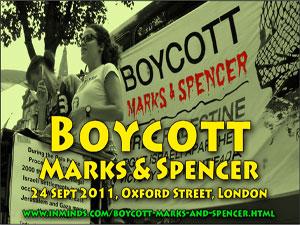
Why Boycott Marks & Spencer 2011?[23:29]

Demo outside M&S Oxford Street(24 Sept 2011)

Sean Clinton[4:59]
Israeli Blood Diamonds Campaign

Al Quds Day rally, Trafalgar Square (31 Aug 2011)

Lauren Booth[5:24]

Al Quds Day rally, Trafalgar Square (31 Aug 2011)

Lauren Booth – Prayer for Gaza[2:46]

Al Quds Day rally, Trafalgar Square (31 Aug 2011)

Benny Morris – Historian or Racist?[34:07]

Activists oppose visit of racist Israeli historian Benny Morris who justifies ethnic cleansing and genocide.

Is Israel applying apartheid?[2:12:56]

Speakers: Yael Kahn, Jody McIntyre and Ghada Karmi (5 May 2011)

Karen Mitchell[48:27]
Partner at Thompsons Solicitors

Life changing visit to Palestine in 2008 (21 Feb 2011)

Ramzy Baroud[1:59:32]
Editor-in-chief of the Palestine Chronicle

“My Father Was A Freedom Fighter – Gaza’s Untold Story” (25 Mar 2011)

Women United in the Intifada[2:31:36]

Speakers: Lizzie Cocker, Ewa Jasiewcz, Alaa Kassim, Yvonney Ridley, Isis Amlak, Sukant Chandan, Ramzy Baroud (14 Mar 2011)

George Galloway[1:01:48]

Solidarity with the Middle-East Revolution, support the people – oppose US/UK intervention (SOAS, 11 Mar 2011)

Omar Barghouti[55:08]
BDS Movement co-founder

“Boycott, Divestment, Sanctions” book launch (7 Mar 2011)

Shir Hever[1:49:09]
Alternative Information Centre

The Political Economy of Israel’s Occupation, Kings College London (17 Feb 2011)

Why academic boycott of Israel[1:29:37]

Speakers: Mohammed Abuabdou(PSCABI), Mike Cushman(BRICUP), Jodey McIntyre(activist) (8 Feb 2011)

Dashed Hopes – Gaza Blockade[1:23:08]

Mohammed-Ali Abu Najela (Oxfam), Andrea Becker (MAP), Ewa Jasiewicz (Free Gaza Movement) (1 Feb 2011)

Jordan Valley: Apartheid[1:17:12]

Sarah Cobham(Brighton Jordan Valley Solidarity), Chris Osmond (Corporate Watch) (House of Commons, 1 Feb 2011)

Dump Veolia Demo[7:00]

Protesting at settlement supporter Veolia’s sponsership of exhibit at the Natural History Museum (23 Oct 2010)

Boycott Israeli Dates [1/2][9:11]

Are you financing Israels brutal occupation this Ramadan?

Boycott Israeli Dates [2/2][9:05]

Are you financing Israels brutal occupation this Ramadan?

Lee Jasper [1/2][10:13]

[4 of 8] Genocide Memorial Day 2010 Session One, 17-1-2010

Lee Jasper [2/2][9:51]

[5 of 8] Genocide Memorial Day 2010 Session One, 17-1-2010

One Oppressor One Bullet[8:11]

Imam Achmad Cassiem, veteran of the armed struggle against apartheid in South Africa, speaks at the StW rally (London, 19 Feb 2005)

Salwa Alenat [1/2][9:56]
KavLaOved (Workers Rights hotline)

[1 of 8] Israel’s Occupation – Abuse of Palestinian Workers (LSE 19 Nov 2009)

Salwa Alenat [2/2][8:57]
KavLaOved (Workers Rights hotline)

[2 of 8] Isra

Tesla

2013 Automobile of the Year: Tesla Model S

vehicle research center

Check out photos, specifications and pricing for all vehicles in our buyer’s guide.
  Research & ReviewsDealer PricingLoan QuoteInsurance Rates
  Year20132012
  Make
  Model

Last summer, Automobile Magazine editors had the opportunity to interview Elon Musk, CEO of Tesla, as the company launched its all-new electric sedan. A well-known industry insider warned us not to fall for Musk’s smooth talk. “Don’t bring any cash,” he said. “Because you’ll be offering to give it to him twenty minutes into the interview.”

To say there’s healthy skepticism regarding Tesla and its new wundercar is an understatement: in many industry circles, it borders on outright hostility. We understand why. Building a car — any car — is really hard. Musk, the PayPal billionaire whose automotiv
e accomplishments were limited to converting 2350 Lotus Elises to run on batteries, was not only proposing a class-leading sport sedan, but he promised it would have a more advanced electric powertrain than anything global automakers could muster.

Tesla Model S Front Right Side View Tesla Model S Left Side View Tesla Model S Rear Right Side View Tesla Model S Dash Tesla Model S Gauges Tesla Model S Interior

He was doing this with our money — your money — courtesy of a $465 million loan from the Department of Energy, and he claimed to be doing it for our own good: “Since we are not appropriately pricing the CO2 capacity of the oceans and atmosphere, then the only way I could think to address that was with innovation.”

We believe the proper business term to describe such a gambit is chutzpah.

We left the interview with our wallets no lighter, eager to see how the Model S would perform in the real world, removed from Musk’s spin and Tesla’s chaperones. As it happened, that opportunity arrived at our Automobile of the Year exercise. That’s a rather intimidating environment to make a first impression, especially given that this year’s field was the strongest in recent memory. We weren’t expecting much from the Tesla other than some interesting dinner conversation as we considered “real” candidates like the Subaru BRZ and the Porsche Boxster. In fact, the Tesla blew them, and us, away.

Actually, the Model S can blow away almost anything. “It’s the performance that won us over,” admits editor-in-chief Jean Jennings. “The crazy speed builds silently and then pulls back the edges of your face. It had all of us endangering our licenses.” Our Model S was of Signature Performance spec, which means its AC induction motor puts out 416 hp and that it blasts to 60 mph in 4.3 seconds. Even those numbers — positively absurd for a large sedan that uses not a lick of gasoline — fail to communicate how crazy it actually feels. “It’s alarming to jam the accelerator of such a big car and have it surge forward so quickly and so quietly,” says copy editor Rusty Blackwell. Like most electric cars, the Model S generates its torque almost instantly. Unlike most electric cars, Tesla’s torque amounts to a prodigious 443 lb-ft, all of which goes to the rear wheels. The only indicators of your stunning momentum are the rush of scenery around you, a faint whine, and the digital speedometer’s difficulty keeping pace. “Driving the Model S is decidedly not like piloting a Nissan Leaf or an electric Smart,” notes road test editor Christopher Nelson. Contributor Ezra Dyer, meanwhile, was so impressed that he arranged an informal drag race to 100 mph with a 560-hp BMW M5. The Model S won. “It bears repeating: this thing is silly quick,” he concluded.

Of course, straight-line speed is hardly our only qualification for Automobile of the Year. Tesla’s first car, the two-seat Roadster, was even quicker but never made a serious bid for our award. That car was something of a one-trick pony — everything else about the $100,000 Roadster felt like the $50,000 Lotus Elise on which it was based. The Model S, developed by Tesla from the ground up and assembled at its factory in Fremont, California, is a holistic and incredibly novel experience.

The Model S looks conventional enough — somewhat disappointingly so. But that impression fades as soon as you walk up to it and the flush door handle powers out to meet your touch. Climb into the Tesla for the first time, and you’re liable to spend a few minutes searching for the ignition button. You won’t find it — the car turned on when you sat down, and it’s now waiting for you to shift into drive and glide away. The cabin is airy, modern, spacious, and impeccably trimmed in leather and wood. A flat battery pack and a rear-mounted motor yield a completely flat floor and a large, useful center-console storage area (the Model S uses a column-mounted shift lever supplied by Mercedes-Benz). Additional storage areas, such as map pockets in the door panels, might be nice but would spoil the interior’s appealing, Bauhaus simplicity.

An absolutely enormous, seventeen-inch touchscreen dominates the dashboard and features the controls for everything from the radio to the steering effort. That sounds like a recipe for disaster, but here it works wonderfully. Oh, yeah, and you can surf the Web on it, as well. “We turned a lot of preconceived notions on their head and said, ‘Why does it have to be that way?'” says Tesla lead designer Franz von Holzhausen. Of course, practically e
very new car claims to be revolutionary. But this one actually feels like it is, to the point that many of us were reaching outside the automotive lexicon to describe it. “It reminds me of the first time I used an iPhone,” gasped associate web editor Ben Timmins.

Tesla Model S Detail Tesla Model S Door Handle Tesla Model S Wheel Tesla Model S Interior Detail Tesla Model S Brake Tesla Model S Trunk Tesla Model S Plug Tesla Model S Left Side View 2 Tesla Model S Front Right Side View 2

There’s much about the Model S, which Musk himself refers to as “Tesla’s Macintosh,” that has an innovative, Apple flavor. As with the tech giant’s slickest products, there’s a sense that even the smallest details here have been lavished with attention in order to be as distinctive and elegant as possible. To open the panoramic sunroof, for instance, one brings up an overhead image of the car on the touchscreen and literally drags the roof as far back as desired. Why didn’t anyone think of that before? Then there’s Tesla’s controversial but intriguing strategy of distributing its products through company-owned boutiques rather than conventional dealers. It’s being run by George Blankenship, who set up those posh Apple stores. Finally, it’s hard to ignore that Tesla has in Musk a Steve Jobs-like figure, a relentless leader who guides the company’s direction. “They’re both brilliant, both thinking about things that other people won’t be thinking about for twenty years,” Blankenship says.

For all its high-tech novelty, the Model S does an exceptional job at the things we expect any high-priced sport sedan to do well. The electric power steering is nuanced and well-weighted, with natural buildup just off-center. Through corners, the Model S exhibits impressive body control and vacuumlike grip despite weighing more than 4500 pounds. Editors also raved about the suspension’s ability to soak up bumps that tortured other test cars. It was just as impressive on the racetrack — yes, we took it on the track. “All that speed, along with powerful braking, superflat handling, and sharp steering, gives you the sense that you’re invincible,” marvels Jennings. And although the exterior may be lacking in gotta-have-it character, it deserves credit for achieving a claimed 0.24 coefficient of drag — better than a Toyota Prius or a Chevrolet Volt — without those cars’ gawky styling. The only concession to weirdness and egotism are the optional rear-facing third-row seats, which Musk wanted so he could ferry around his many children.

The car’s professionalism owes to the fact that, despite its Silicon Valley sheen, Tesla employs plenty of people who know a lot about building cars. That begins with von Holzhausen, who penned the Pontiac Solstice, our 2006 Design of the Year, before moving on to Mazda. He joined Tesla’s design team four years ago — when Tesla basically didn’t have a design team. “There was nothing here,” he says. Huibert Mees of the Ford GT program led development of the Model S’s chassis components, and the steering was likewise developed by Ford and Lotus veterans. Despite Musk’s domineering reputation, the employees we’ve spoken to say he has a relatively hands-off management style. Continuing the comparison with the famously involved Jobs, Blankenship notes, “Steve hired incredibly bright people to get done what he wanted to get done. I think Elon hires incredible people and expects them to do what they were hi
red to do.”

You’ll note that we haven’t even discussed Tesla’s raison d’etre, which is, in Musk’s words, “To accelerate the advent of electric cars.” That’s another credit to the Model S’s overall execution and seductive powers. “The electric motor does not define this car,” says Nelson. But it is, at the end of the day, what makes this very good sport sedan an absolute game changer. The Model S’s range, rated by the EPA at 265 miles with the largest battery, finally fits the American conception of driving. Want to take the family from Washington, D.C., to New York? No problem. Stop for an hour at one of Tesla’s Supercharger stations being installed throughout the country, and you can travel on to Boston. The even bigger psychological advantage, though, is the freedom to go about your daily life, with all its spontaneity and last-minute shopping trips, without the fear of running low. Electric cars that participated in past Automobile of the Year competitions have required special testing procedures — shorter drive routes, strict guidelines against aggressive driving, industrial charging trucks. The Model S wore no such kid gloves. We plugged it in at night and then drove it all day — and drove it hard.

Granted, this freedom doesn’t come cheap. A Model S with an 85-kilowatt-hour battery, like the one we tested, starts at $78,750 (before a $7500 tax break). Less expensive versions have smaller batteries and shorter ranges, starting with $58,570 for 160 miles (again, before deductions). Put another way, though, the cheapest 85-kWh Model S offers more than three times the range of a Nissan Leaf for little more than twice the price. The battery pack should also be rather durable thanks to liquid cooling. But the most important factor here is that, more than any electric car that has come before it, the Model S feels and drives like a gasoline car of the same price. “There’s still a lot of novelty in driving an EV,” says senior editor Eric Tingwall, “but with the Model S, that’s no longer the only reason to drive one.” Design editor Robert Cumberford is more succinct: “I would happily own one.”

But you might not be able to get one. Only 250 sedans have been delivered to customers as of this writing — a rounding error for any mainstream automaker (some 13,000 customers have put down at least $5000 as a reservation). Musk himself admits that Tesla’s path to viability is far from complete. “There have been car company start-ups before. The real challenge is to ramp up production. Then we’re a real car company.”

We can’t say for certain whether Tesla will be able to make that happen. The auto industry is tough enough for a giant like General Motors. What we can say with this award is that Tesla deserves to succeed. It has managed to blend the innovation of a Silicon Valley start-up, the execution of a world-class automaker, and, yes, the chutzpah of its visionary leader. The result is the Model S. It’s not vaporware. It’s our Automobile of the Year.

Tesla Model S Front View Tesla Model S Rear Right View Tesla Model S Rear Seating Tesla Model S Frame Tesla Model S Body Frame

An 85-kWh battery puts the Model S’s range on par with conventional cars, but recharging still can’t match the speed and convenience of pumping gasoline. Despite that, Tesla intends to make long-distance, multi-charge road trips possible with a network of high-speed chargers that can inject 150 miles of range into the battery in thirty minutes. These Superchargers bypass the car’s onboard equipment and feed 400 volts of direct-current electricity straight to the battery through a thick, vinelike cord. Interestingly, the hardware that transforms the electricity from alternating current to direct current is the same as what’s carried in the car for 120- and 240-volt charging. The difference is that a Model S has one or two 10-kW chargers onboard, while the stationary Supercharger system uses a stack of twelve units that can produce a total of 120 kW.

Tesla Model S Front View Tesla Model S Rear View Tesla Model S Interior

Supercharger hardware comes standard on the 85-kWh Model S, and it’s a $2000 option on 60-kWh models. Either way, owners are entitled to free electricity from the Superchargers for the life of their car.

Some Supercharger stations will be paired with solar-panel-clad carports supplied by SolarCity, another Musk outfit. This arrangement gives owners a clear conscience when it comes to the environmental impact of their electricity sources, as Tesla claims the photovoltaic panels will feed more electricity into the grid than the Superchargers will to cars. Today, there are just six Superchargers scattered throughout California, but Tesla claims that owners will be able to drive from San Diego to Vancouver, Miami to Montreal, and Los Angeles to New York, stopping at Superchargers along the way, by next year.


Electric cars


The long, (mostly) slow struggle.

//1830s The first rudimentary electric vehicles emerge, powered by one-use power-storage units. The four-stroke gasoline engine is still four decades away.

//1859 Rechargeable lead-acid storage batteries are invented in France.

//circa 1890 William Morrison of Des Moines, Iowa, produces the first American electric car. Powered by 24 batteries, it has 4 hp and can go 20 mph — double the top speed of Karl Benz’s gas-powered Patent-Motorwagen. Maximum range is 40 to 50 miles.

//1899 Belgian Camille Jenatzy hits 65.8 mph in La Jamais Contente, his missile-shaped electric car.

//1900 Electric cars account for more than a third of all sales in the fledgling U.S. auto market and prove especially popular in cities.

//1909 Thomas Edison perfects his nickel-iron battery and markets it to automakers.

//1912 Electric cars lose their most compelling advantage — convenience — when Cadillac introduces “the car that has no crank.”

//1913 A Detroit Electric travels 211 miles on a single charge, setting a new record. Range of 80 miles is more typical. Prices start at about $2650, equivalent to $61,300 in today’s dollars.

//by 1920 High cost, limited range, and cheap oil contribute to a sharp decline in electric-car sales.

//1940 Detroit Electric, which had shifted to commercial vehicles and outlasted all of its competitors, finally goes out of business.

//1974 The Florida-built CitiCar debuts and offers about 30 miles of range. It’s relatively popular, finding more than 2000 buyers in its first two years. But the homely, plastic-bodied two-seater does nothing to improve the greater perception of electric cars.

//1996 General Motors begins leasing the EV1, the first modern electric car. Range starts at 70 to 100 miles. An upgraded version with nickel-metal-hydride batteries goes on sale three years later with 100 to 140 miles of range.

//2003 The California Air Resources Board ends its initiative to require zero-emissions vehicles. GM, along with Toyota and others, ceases production of electric vehicles soon thereafter. Meanwhile, in Silicon Valley, Tesla is born.

//2008 Despite several fits and starts, the Lotus Elise-based, lithium-ion-battery-powered Tesla Roadster goes on sale. Then-chairman Elon Musk promises a scratchbuilt BMW 5-series competitor within three years.

//2009 Tesla, along with several other firms, receives millions of dollars in funding from the U.S. Department of Energy. It uses the loan to develop the “Whitestar” (the Model S) and to acquire Toyota’s shuttered plant in Fremont, California.

//2010 The Nissan Leaf brings the electric car to the mainstream. We name the plug-in hybrid Chevrolet Volt the 2011 Automobile of the Year.

//2011 The Fisker Karma wins our 2012 Design of the Year.

//2012 The introductions of an electrified Honda Fit and Ford Focus, a Tesla-powered Toyota RAV4, and, of course, the Model S, make for the busiest year in electric cars since the early twentieth century.


Fifty years at Fremont


From Chevys to Toyotas to Teslas

by Ronald Ahrens

The factory in Fremont, California, where the Tesla Model S is built, has always been cutting-edge, with operations continually tinged by government involvement. Constructed near San Francisco Bay’s backwaters in 1962, the “four-in-one” Fremont Assembly Plant represented General Motors’ greatest effort to avoid monopoly prosecution. If GM made Chevrolets alongside Buicks, Oldsmobiles, and Pontiacs, how could the Justice Department carry out its threat to spin off Chevy as a separate company?

Two years after job one, GM head Frederic Donner came to Fremont, announcing a $2 billion worldwide manufacturing expansion. Governor Pat Brown also attended and delivered “quite a political talk and tossed out figures that were a great deal bigger,” Chevy chief Semon “Bunkie” Knudsen wrote.

But GM proved a vulnerable monopoly. Fremont closed in 1982. Thanks to a GM/Toyota joint venture, it reopened in 1984 as New United Motor Manufacturing, Inc. Toyota used NUMMI to evade import restrictions threatened by Congress. Meanwhile, GM learned lean manufacturing practices. The Toyota Corolla (rebadged as the Chevy Nova and the Geo Prizm), the Toyota Matrix, and the Pontiac Vibe were among roughly eight million vehicles produced before the partnership ended in 2009. Toyota subsequently struck a deal with Tesla that included factory space, California offered tax incentives, and Tesla landed a $465 million federal loan.

Tesla paid $42 million for the factory in May of 2010 and an additional $17 million for machine tools and spare parts.

“We had this megafactory, and we wanted to take full advantage of the infrastructure in order to manufacture at very low cost,” said Gilbert Passin, Tesla’s vice president of manufacturing. He noted that Tesla also salvaged tooling at bargain prices elsewhere in the distressed auto industry. While a new plant at a greenfield site typically represents an investment of at least $1 billion, Tesla probably has less than one-third that amount tied up in Fremont. Passin said 95 percent of all Model S parts are made in-house, an uncommonly high amount in an industry that relies heavily on outside suppliers.

Visiting last summer, we saw that only a portion of the five million square feet of floor space was in use. In an upstairs clean room, about 350 employees — some of whom formerly worked for NUMMI — put together battery packs and electric-drive components on two shifts, while another 450 workers sporadically assembled bodies and chassis on ground level. (Corporate headquarters lies across the Bay, in Palo Alto, and the design center is in Southern California.) The Tesla factory’s innovative modular assembly process relies on so-called “smart carts” to carry the bodies through assembly, automatically raising or lowering as needed and periodically recharging while traversing the line. This method turns away from the traditional use of overhead conveyors, saving millions of dollars. Meanwhile, each newly purchased robot typically performs five different tasks, and advanced artificial intelligence allows one to install the Model S’s panoramic roof by analyzing a digital image.

Tesla hoped to ramp up to eighty cars per shift by the end of 2012, but during our walk-through, it was quiet enough to hear a silver dollar drop.

Island on a yacht

island yacht”
Description: cid:1.1158327334@web46201.mail.sp1.yahoo.com

Yes you read it right, a whole amazing island built right on a beautiful yacht. Created by UK-based yacht design company Yacht Island Designs, bringing a whole island onto a yacht.

The design as you can see is inspired by tropical islands, with huts, a pool and to top of that, a whole volcano that is sure not to erupt. Since this is a yacht, it comes packed with special VIP rooms, arcades, gym, lounges, spas and even a helipad. The volcano adds a lot of beauty to the whole look of the yacht, it also happens to have water flowing out of it onto the pool creating this amazing river complementing the whole tropical look.

.Description: cid:2.1158327334@web46201.mail.sp1.yahoo.com
Description: cid:3.1158327334@web46201.mail.sp1.yahoo.com
Description:  cid:4.1158327334@web46201.mail.sp1.yahoo.com
Description: cid:5.1158327334@web46201.mail.sp1.yahoo.com
Description:  cid:6.1158327334@web46201.mail.sp1.yahoo.com
Description:  cid:7.1158327334@web46201.mail.sp1.yahoo.com
Description:    cid:8.1158327334@web46201.mail.sp1.yahoo.com 


The back of the yacht has a retractable beach deck where structures float on the sea making the sea accessible to swim in and of course grant access to various water activities such as wake boarding and jet-skis. The whole concept is pure genius and the result looks even better

Fine Tuned Human Virus to Assassinate Specific Ethnic Groups?

Below is a story from Marc Goodman, extended further, it could mean a horrible new method for genocide.

Hacking the President’s DNA

The U.S. government is surreptitiously collecting the DNA of world leaders, and is reportedly protecting that of Barack Obama. Decoded, these genetic blueprints could provide compromising information. In the not-too-distant future, they may provide something more as well—the basis for the creation of personalized bioweapons that could take down a president and leave no trace.


By ANDREW HESSELMARC GOODMAN and STEVEN KOTLER

Miles Donovan


This is how the future arrived. It began innocuously, in the early 2000s, when businesses started to realize that highly skilled jobs formerly performed in-house, by a single employee, could more efficiently be crowd-sourced to a larger group of people via the Internet. Initially, we crowd-sourced the design of T‑shirts (Threadless.com) and the writing of encyclopedias (Wikipedia.com), but before long the trend started making inroads into the harder sciences. Pretty soon, the hunt for extraterrestrial life, the development of self-driving cars, and the folding of enzymes into novel proteins were being done this way. With the fundamental tools of genetic manipulation—tools that had cost millions of dollars not 10 years earlier—dropping precipitously in price, the crowd-sourced design of biological agents was just the next logical step.

In 2008, casual DNA-design competitions with small prizes arose; then in 2011, with the launch of GE’s $100 million breast-cancer challenge, the field moved on to serious contests. By early 2015, as personalized gene therapies for end-stage cancer became medicine’s cutting edge, virus-design Web sites began appearing, where people could upload information about their disease and virologists could post designs for a customized cure. Medically speaking, it all made perfect sense: Nature had done eons of excellent design work on viruses. With some retooling, they were ideal vehicles for gene delivery.

Soon enough, these sites were flooded with requests that went far beyond cancer. Diagnostic agents, vaccines, antimicrobials, even designer psychoactive drugs—all appeared on the menu. What people did with these bio-designs was anybody’s guess. No international body had yet been created to watch over them.

So, in November of 2016, when a first-time visitor with the handle Cap’n Capsid posted a challenge on the viral-design site 99Virions, no alarms sounded; his was just one of the 100 or so design requests submitted that day. Cap’n Capsid might have been some consultant to the pharmaceutical industry, and his challenge just another attempt to understand the radically shifting R&D landscape—really, he could have been anyone—but the problem was interesting nonetheless. Plus, Capsid was offering $500 for the winning design, not a bad sum for a few hours’ work.

Later, 99Virions’ log files would show that Cap’n Capsid’s IP address originated in Panama, although this was likely a fake. The design specification itself raised no red flags. Written in SBOL, an open-source language popular with the synthetic-biology crowd, it seemed like a standard vaccine request. So people just got to work, as did the automated computer programs that had been written to “auto-evolve” new designs. These algorithms were getting quite good, now winning nearly a third of the challenges.

Within 12 hours, 243 designs were submitted, most by these computerized expert systems. But this time the winner, GeneGenie27, was actually human—a 20-year-old Columbia University undergrad with a knack for virology. His design was quickly forwarded to a thriving Shanghai-based online bio-marketplace. Less than a minute later, an Icelandic synthesis start‑up won the contract to turn the 5,984-base-pair blueprint into actual genetic material. Three days after that, a package of 10‑milligram, fast-dissolving microtablets was dropped in a FedEx envelope and handed to a courier.

Two days later, Samantha, a sophomore majoring in government at Harvard University, received the package. Thinking it contained a new synthetic psychedelic she had ordered online, she slipped a tablet into her left nostril that evening, then walked over to her closet. By the time Samantha finished dressing, the tab had started to dissolve, and a few strands of foreign genetic material had entered the cells of her nasal mucosa.

Some party drug—all she got, it seemed, was the flu. Later that night, Samantha had a slight fever and was shedding billions of virus particles. These particles would spread around campus in an exponentially growing chain reaction that was—other than the mild fever and some sneezing—absolutely harmless. This would change when the virus crossed paths with cells containing a very specific DNA sequence, a sequence that would act as a molecular key to unlock secondary functions that were not so benign. This secondary sequence would trigger a fast-acting neuro-destructive disease that produced memory loss and, eventually, death. The only person in the world with this DNA sequence was the president of the United States, who was scheduled to speak at Harvard’s Kennedy School of Government later that week. Sure, thousands of people on campus would be sniffling, but the Secret Service probably wouldn’t think anything was amiss.

It was December, after all—cold-and-flu season.

The scenario we’ve just sketched may sound like nothing but science fiction—and, indeed, it does contain a few futuristic leaps. Many members of the scientific community would say our time line is too fast. But consider that since the beginning of this century, rapidly accelerating technology has shown a distinct tendency to turn the impossible into the everyday in no time at all. Last year, IBM’s Watson, an artificial intelligence, understood natural language well enough to whip the human champion Ken Jennings on Jeopardy. As we write this, soldiers with bionic limbs are returning to active duty, and autonomous cars are driving down our streets. Yet most of these advances are small in comparison with the great leap forward currently under way in the biosciences—a leap with consequences we’ve only begun to imagine.

Personalized bioweapons are a subtler and less catastrophic threat than accidental plagues or WMDs. Yet they will likely be unleashed much more readily.

More to the point, consider that the DNA of world leaders is already a subject of intrigue. According to Ronald Kessler, the author of the 2009 book In the President’s Secret Service, Navy stewards gather bedsheets, drinking glasses, and other objects the president has touched—they are later sanitized or destroyed—in an effort to keep would‑be malefactors from obtaining his genetic material. (The Secret Service would neither confirm nor deny this practice, nor would it comment on any other aspect of this article.) And according to a 2010 release of secret cables by WikiLeaks, Secretary of State Hillary Clinton directed our embassies to surreptitiously collect DNA samples from foreign heads of state and senior United Nations officials. Clearly, the U.S. sees strategic advantage in knowing the specific biology of world leaders; it would be surprising if other nations didn’t feel the same.

While no use of an advanced, genetically targeted bio-weapon has been reported, the authors of this piece—including an expert in genetics and microbiology (Andrew Hessel) and one in global security and law enforcement (Marc Goodman)—are convinced we are drawing close to this possibility. Most of the enabling technologies are in place, already serving the needs of academic R&D groups and commercial biotech organizations. And these technologies are becoming exponentially more powerful, particularly those that allow for the easy manipulation of DNA.

The evolution of cancer treatment provides one window into what’s happening. Most cancer drugs kill cells. Today’s chemotherapies are offshoots of chemical-warfare agents: we’ve turned weapons into cancer medicines, albeit crude ones—and as with carpet bombing, collateral damage is a given. But now, thanks to advances in genetics, we know that each cancer is unique, and research is shifting to the development of personalized medicines—designer therapies that can exterminate specific cancerous cells in a specific way, in a specific person; therapies focused like lasers.

To be sure, around the turn of the millennium, significant fanfare surrounded personalized medicine, especially in the field of genetics. A lot of that is now gone. The prevailing wisdom is that the tech has not lived up to the talk, but this isn’t surprising. Gartner, an information-technology research-and-advisory firm, has coined the term hype cycle to describe exactly this sort of phenomenon: a new technology is introduced with enthusiasm, only to be followed by an emotional low when it fails to immediately deliver on its promise. But Gartner also discovered that the cycle doesn’t typically end in what the firm calls “the trough of disillusionment.” Rising from those ashes is a “slope of enlightenment”—meaning that when viewed from a longer-term historical perspective, the majority of these much-hyped groundbreaking developments do, eventually, break plenty of new ground.

As George Church, a geneticist at Harvard, explains, this is what is now happening in personalized medicine. “The fields of gene therapies, viral delivery, and other personalized therapies are progressing rapidly,” Church says, “with several clinical trials succeeding into Phase 2 and 3,” when the therapies are tried on progressively larger numbers of test subjects. “Many of these treatments target cells that differ in only one—rare—genetic variation relative to surrounding cells or individuals.” The Finnish start-up Oncos Therapeutics has already treated close to 300 cancer patients using a scaled-down form of this kind of targeted technology.

These developments are, for the most part, positive—promising better treatment, new cures, and, eventually, longer life. But it wouldn’t take much to subvert such therapies and come full circle, turning personalized medicines into personalized bioweapons. “Right now,” says Jimmy Lin, a genomics researcher at Washington University in St. Louis and the founder of Rare Genomics, a nonprofit organization that designs treatments for rare childhood diseases based on individual genetic analysis, “we have drugs that target specific cancer mutations. Examples include Gleevec, Zelboraf, and Xalkori. Vertex,” a pharmaceutical company based in Massachusetts, “has famously made a drug for cystic-fibrosis patients with a particular mutation. The genetic targeting of individuals is a little farther out. But a state-sponsored program of the Stuxnet variety might be able to accomplish this in a few years. Of course, this work isn’t very well known, so if you tell most people about this, they say that the time frame sounds like science fiction. But when you’re familiar with the research, it’s really feasible that a well-funded group could pull this off.” We would do well to begin planning for that possibility sooner rather than later.

If you really want to understand what’s happening in the biosciences, then you need to understand the rate at which information technology is accelerating. In 1965, Gordon Moore famously realized that the number of integrated-circuit components on a computer chip had been doubling roughly every year since the invention of the integrated circuit in the late 1950s. Moore, who would go on to co-found Intel, predicted that the trend would continue “for at least 10 years.” He was right. The trend did continue for 10 years, and 10 more after that. All told, his observation has remained accurate for five decades, becoming so durable that it’s now known as “Moore’s Law” and used by the semi-conductor industry as a guide for future planning.

Moore’s Law originally stated that every 12 months (it is now 24 months), the number of transistors on an integrated circuit will double—an example of a pattern known as “exponential growth.” While linear growth is a slow, sequential proposition (1 becomes 2 becomes 3 becomes 4, etc.), exponential growth is an explosive doubling (1 becomes 2 becomes 4 becomes 8, etc.) with a transformational effect. In the 1970s, the most powerful supercomputer in the world was a Cray. It required a small room to hold it and cost roughly $8 million. Today, the iPhone in your pocket is more than 100 times faster and more than 12,000 times cheaper than a Cray. This is exponential growth at work.

In the years since Moore’s observation, scientists have discovered that the pattern of exponential growth occurs in many other industries and technologies. The amount of Internet data traffic in a year, the number of bytes of computer data storage available per dollar, the number of digital-camera pixels per dollar, and the amount of data transferable over optical fiber are among the dozens of measures of technological progress that follow this pattern. In fact, so prevalent is exponential growth that researchers now suspect it is found in all information-based technology—that is, any technology used to input, store, process, retrieve, or transmit digital information.

Over the past few decades, scientists have also come to see that the four letters of the genetic alphabet—A (adenine), C (cytosine), G (guanine), and T (thymine)—can be transformed into the ones and zeroes of binary code, allowing for the easy, electronic manipulation of genetic information. With this development, biology has turned a corner, morphing into an information-based science and advancing exponentially. As a result, the fundamental tools of genetic engineering, tools designed for the manipulation of life—tools that could easily be co-opted for destructive purposes—are now radically falling in cost and rising in power. Today, anyone with a knack for science, a decent Internet connection, and enough cash to buy a used car has what it takes to try his hand at bio-hacking.

These developments greatly increase several dangers. The most nightmarish involve bad actors creating weapons of mass destruction, or careless scientists unleashing accidental plagues—very real concerns that urgently need more attention. Personalized bioweapons, the focus of this story, are a subtler and less catastrophic threat, and perhaps for that reason, society has barely begun to consider them. Yet once available, they will, we believe, be put into use much more readily than bioweapons of mass destruction. For starters, while most criminals might think twice about mass slaughter, murder is downright commonplace. In the future, politicians, celebrities, leaders of industry—just about anyone, really—could be vulnerable to attack-by-disease. Even if fatal, many such attacks could go undetected, mistaken for death by natural causes; many others would be difficult to pin on a suspect, especially given the passage of time between exposure and the appearance of symptoms.

Moreover—as we’ll explore in greater detail—these same scientific developments will pave the way, eventually, for an entirely new kind of personal warfare. Imagine inducing extreme paranoia in the CEO of a large corporation so as to gain a business advantage, for example; or—further out in the future—infecting shoppers with the urge to impulse-buy.

We have chosen to focus this investigation mostly on the president’s bio-security, because the president’s personal welfare is paramount to national security—and because a discussion of the challenges faced by those charged with his protection will illuminate just how difficult (and different) “security” will be, as biotechnology continues to advance.

direct assault against the president’s genome requires first being able to decode genomes. Until recently, this was no simple matter. In 1990, when the U.S. Department of Energy and the National Institutes of Health announced their intention to sequence the 3 billion base pairs of the human genome over the next 15 years, it was considered the most ambitious life-sciences project ever undertaken. Despite a budget of $3 billion, progress did not come quickly. Even after years of hard work, many experts doubted that the time and money budgeted would be enough to complete the job.

This started to change in 1998, when the entrepreneurial biologist J. Craig Venter and his company, Celera, got into the race. Taking advantage of the exponential growth in biotechnology, Venter relied on a new generation of gene sequencers and a novel, computer-intensive approach called shotgun sequencing to deliver a draft human genome (his own) in less than two years, for $300 million.

Venter’s achievement was stunning; it was also just the beginning. By 2007, just seven years later, a human genome could be sequenced for less than $1 million. In 2008, some labs would do it for $60,000, and in 2009, $5,000. This year, the $1,000 barrier looks likely to fall. At the current rate of decline, within five years, the cost will be less than $100. In the history of the world, perhaps no other technology has dropped in price and increased in performance so dramatically.

Still, it would take more than just a gene sequencer to build a personally targeted bioweapon. To begin with, prospective attackers would have to collect and grow live cells from the target (more on this later), so cell-culturing tools would be a necessity. Next, a molecular profile of the cells would need to be generated, involving gene sequencers, micro-array scanners, mass spectrometers, and more. Once a detailed genetic blueprint had been built, the attacker could begin to design, build, and test a pathogen, which starts with genetic databases and software and ends with virus and cell-culture work. Gathering the equipment required to do all of this isn’t trivial, and yet, as researchers have upgraded to new tools, as large companies have merged and consolidated operations, and as smaller shops have run out of money and failed, plenty of used lab equipment has been dumped onto the resale market. New, the requisite gear would cost well over $1 million. On eBay, it can be had for as little as $10,000. Strip out the analysis equipment—since those processes can now be outsourced—and a basic cell-culture rig can be cobbled together for less than $1,000. Chemicals and lab supplies have never been easier to buy; hundreds of Web resellers take credit cards and ship almost anywhere.

Biological knowledge, too, is becoming increasingly democratized. Web sites like JoVE (Journal of Visualized Experiments) provide thousands of how-to videos on the techniques of bioscience. MIT offers online courses. Many journals are going open-access, making the latest research, complete with detailed sections on materials and methods, freely available. If you wanted a more hands-on approach to learning, you could just immerse yourself in any of the dozens of do-it-yourself-biology organizations, such as Genspace and BioCurious, that have lately sprung up to make genetic engineering into something of a hobbyist’s pursuit. Bill Gates, in a recent interview, told a reporter that if he were a kid today, forget about hacking computers: he’d be hacking biology. And for those with neither the lab nor the learning, dozens of Contract Research and Manufacturing Services (known as CRAMS) are willing to do much of the serious science for a fee.

From the invention of genetic engineering in 1972 until very recently, the high cost of equipment, and the high cost of education to use that equipment effectively, kept most people with ill intentions away from these technologies. Those barriers to entry are now almost gone. “Unfortunately,” Secretary Clinton said in a December 7, 2011, speech to the Biological and Toxin Weapons Convention Review Conference, “the ability of terrorists and other non-state actors to develop and use these weapons is growing. And therefore, this must be a renewed focus of our efforts … because there are warning signs, and they are too serious to ignore.”

The radical expansion of biology’s frontier raises an uncomfortable question: How do you guard against threats that don’t yet exist? Genetic engineering sits at the edge of a new era. The old era belonged to DNA sequencing, which is simply the act of reading genetic code—identifying and extracting meaning from the ordering of the four chemicals that make up DNA. But now we’re learning how to write DNA, and this creates possibilities both grand and terrifying.

Again, Craig Venter helped to usher in this shift. In the mid‑1990s, just before he began his work to read the human genome, he began wondering what it would take to write one. He wanted to know what the minimal genome required for life looked like. It was a good question. Back then, DNA-synthesis technology was too crude and expensive for anyone to consider writing a minimal genome for life or, more to our point, constructing a sophisticated bioweapon. And gene-splicing techniques, which involve the tricky work of using enzymes to cut up existing DNA from one or more organisms and stitch it back together, were too unwieldy for the task.

Exponential advances in biotechnology have greatly diminished these problems. The latest technology—known as synthetic biology, or “synbio”—moves the work from the molecular to the digital. Genetic code is manipulated using the equivalent of a word processor. With the press of a button, code representing DNA can be cut and pasted, effortlessly imported from one species into another. It can be reused and repurposed. DNA bases can be swapped in and out with precision. And once the code looks right? Simply hit Send. A dozen different DNA print shops can now turn these bits into biology.

In May 2010, with the help of these new tools, Venter answered his own question by creating the world’s first synthetic self-replicating chromosome. To pull this off, he used a computer to design a novel bacterial genome (of more than 1 million base pairs in total). Once the design was complete, the code was e‑mailed to Blue Heron Biotechnology, a Seattle-area company that specializes in synthesizing DNA from digital blueprints. Blue Heron took Venter’s A’s, T’s, C’s, and G’s and returned multiple vials filled with frozen plasmid DNA. Just as one might load an operating system into a computer, Venter then inserted the synthetic DNA into a host bacterial cell that had been emptied of its own DNA. The cell soon began generating proteins, or, to use the computer term popular with today’s biologists, it “booted up”: it started to metabolize, grow, and, most important, divide, based entirely on the code of the injected DNA. One cell became two, two became four, four became eight. And each new cell carried only Venter’s synthetic instructions. For all practical purposes, it was an altogether new life form, created virtually from scratch. Venter called it “the first self-replicating species that we’ve had on the planet whose parent is a computer.”

But Venter merely grazed the surface. Plummeting costs and increasing technical simplicity are allowing synthetic biologists to tinker with life in ways never before feasible. In 2006, for example, Jay D. Keasling, a biochemical engineer at the University of California at Berkeley, stitched together 10 synthetic genes made from the genetic blueprints of three different organisms to create a novel yeast that can manufacture the precursor to the antimalarial drug artemisinin, artemisinic acid, natural supplies of which fluctuate greatly. Meanwhile, Venter’s company Synthetic Genomics is working in partnership with ExxonMobil on a designer algae that consumes carbon dioxide and excretes biofuel; his spin-off company Synthetic Genomics Vaccines is trying to develop flu-fighting vaccines that can be made in hours or days instead of the six-plus months now required. Solazyme, a synbio company based in San Francisco, is making biodiesel with engineered micro-algae. Material scientists are also getting in on the action: DuPont and Tate & Lyle, for instance, have jointly designed a highly efficient and environmentally friendly organism that ingests corn sugar and excretes propanediol, a substance used in a wide range of consumer goods, from cosmetics to cleaning products.

Bill Gates, in a recent interview, told a reporter that if he were a kid today, forget about hacking computers: he’d be hacking biology.

Other synthetic biologists are playing with more-fundamental cellular mechanisms. The Florida-based Foundation for Applied Molecular Evolution has added two bases (Z and P) to DNA’s traditional four, augmenting the old genetic alphabet. At Harvard, George Church has supercharged evolution with his Multiplex Automated Genome Engineering process, which randomly swaps multiple genes at once. Instead of creating novel genomes one at a time, MAGE creates billions of variants in a matter of days.

Finally, because synbio makes DNA design, synthesis, and assembly easier, we’re already moving from the tweaking of existing genetic designs to the construction of new organisms—species that have never before been seen on Earth, species birthed entirely by our imagination. Since we can control the environments these organisms will live in—adjusting things like temperature, pressure, and food sources while eliminating competitors and other stresses—we could soon be generating creatures capable of feats impossible in the “natural” world. Imagine organisms that can thrive on the surface of Mars, or enzymes able to change simple carbon into diamonds or nanotubes. The ultimate limits to synthetic biology are hard to discern.

All of this means that our interactions with biology, already complicated, are about to get a lot more troublesome. Mixing together code from multiple species or creating novel organisms could have unintended consequences. And even in labs with high safety standards, accidents happen. If those accidents involve a containment breach, what is today a harmless laboratory bacterium could tomorrow become an ecological catastrophe. A 2010 synbio report by the Presidential Commission for the Study of Bioethical Issues said as much: “Unmanaged release could, in theory, lead to undesired cross-breeding with other organisms, uncontrolled proliferation, crowding out of existing species, and threats to biodiversity.”

Just as worrisome as bio-error is the threat of bioterror. Although the bacterium Venter created is essentially harmless to humans, the same techniques could be used to construct a known pathogenic virus or bacterium or, worse, to engineer a much deadlier version of one. Viruses are particularly easy to synthetically engineer, a fact made apparent in 2002, when Eckard Wimmer, a Stony Brook University virologist, chemically synthesized the polio genome using mail-order DNA. At the time, the 7,500-nucleotide synthesis cost about $300,000 and took several years to complete. Today, a similar synthesis would take just weeks and cost a few thousand dollars. By 2020, if trends continue, it will take a few minutes and cost roughly $3. Governments the world over have spent billions trying to eradicate polio; imagine the damage terrorists could do with a $3 pathogen.

During the 1990s, the Japanese cult Aum Shinrikyo, infamous for its deadly 1995 sarin-gas attack on the Tokyo subway system, maintained an active and extremely well-funded bioweapons program, which included anthrax in its arsenal. When police officers eventually raided its facilities, they found proof of a years-long research effort costing an estimated $30 million—demonstrating, among other things, that terrorists clearly see value in pursuing bioweaponry. Although Aum did manage to cause considerable harm, it failed in its attempts to unleash a bioweapon of mass destruction. In a 2001 article for Studies in Conflict & Terrorism, William Rosenau, a terrorism expert then at the Rand Corporation, explained:

Aum’s failure suggests that it may, in fact, be far more difficult to carry out a deadly bioterrorism attack than has sometimes been portrayed by government officials and the press. Despite its significant financial resources, dedicated personnel, motivation, and freedom from the scrutiny of the Japanese authorities, Aum was unable to achieve its objectives.

That was then; this is now. Today, two trends are changing the game. The first began in 2004, when the International Genetically Engineered Machine (iGEM) competition was launched at MIT. In this competition, teams of high-school and college students build simple biological systems from standardized, interchangeable parts. These standardized parts, now known as BioBricks, are chunks of DNA code, with clearly defined structures and functions, that can be easily linked together in new combinations, a little like a set of genetic Lego bricks. iGEM collects these designs in the Registry of Standard Biological Parts, an open-source database of downloadable BioBricks accessible to anyone.

Viruses are particularly easy to synthetically engineer. In 2002, Eckard Wimmer synthesized the polio genome from mail-order DNA.

Over the years, iGEM teams have pushed not only technical barriers but creative ones as well. By 2008, students were designing organisms with real-world applications; the contest that year was won by a team from Slovenia for its designer vaccine againstHelicobacter pylori, the bacterium responsible for most ulcers. The 2011 grand-prize winner, a team from the University of Washington, completed three separate projects, each one rivaling the outputs of world-class academics and the biopharmaceutical industry. Teams have turned bacterial cells into everything from photographic film to hemoglobin-producing blood substitutes to miniature hard drives, complete with data encryption.

As the sophistication of iGEM research has risen, so has the level of participation. In 2004, five teams submitted 50 potential BioBricks to the registry. Two years later, 32 teams submitted 724 parts. By 2010, iGEM had mushroomed to 130 teams submitting 1,863 parts—and the registry database was more than 5,000 components strong. As The New York Times pointed out:

iGEM has been grooming an entire generation of the world’s brightest scientific minds to embrace synthetic biology’s vision—without anyone really noticing, before the public debates and regulations that typically place checks on such risky and ethically controversial new technologies have even started.

(igem itself does require students to be mindful of any ethical or safety issues, and encourages public discourse on these questions.)

The second trend to consider is the progress that terrorist and criminal organizations have made with just about every other information technology. Since the birth of the digital revolution, some early adopters have turned out to be rogue actors. Phone phreakers like John Draper (a k a “Captain Crunch”) discovered back in the 1970s that AT&T’s telephone network could be fooled into allowing free calls with the help of a plastic whistle given away in cereal boxes (thus Draper’s moniker). In the 1980s, early desktop computers were subverted by a sophisticated array of computer viruses for malicious fun—then, in the 1990s, for information theft and financial gain. The 2000s saw purportedly uncrackable credit-card cryptographic algorithms reverse-engineered and smartphones repeatedly infected with malware. On a larger scale, denial-of-service attacks have grown increasingly destructive, crippling everything from individual Web sites to massive financial networks. In 2000, “Mafiaboy,” a Canadian high-school student acting alone, managed to freeze or slow down the Web sites of Yahoo, eBay, CNN, Amazon, and Dell.

In 2007, Russian hackers swamped Estonian Web sites, disrupting financial institutions, broadcasting networks, government ministries, and the Estonian parliament. A year later, the nation of Georgia, before the Russian invasion, saw a massive cyberattack paralyze its banking system and disrupt cellphone networks. Iraqi insurgents subsequently repurposed SkyGrabber—cheap Russian software frequently used to steal satellite television—to intercept the video feeds of U.S. Predator drones in order to monitor and evade American military operations.

Lately, organized crime has taken up crowd-sourcing parts of its illegal operations—printing up fake credit cards, money laundering—to people or groups with specialized skills. (In Japan, the yakuzahas even begun to outsource murder, to Chinese gangs.) Given the anonymous nature of the online crowd, it is all but impossible for law enforcement to track these efforts.

The historical trend is clear: Whenever novel technologies enter the market, illegitimate uses quickly follow legitimate ones. A black market soon appears. Thus, just as criminals and terrorists have exploited many other forms of technology, they will surely soon turn to synthetic biology, the latest digital frontier.

In 2005, as part of its preparation for this threat, the FBI hired Edward You, a cancer researcher at Amgen and formerly a gene therapist at the University of Southern California’s Keck School of Medicine. You, now a supervisory special agent in the Weapons of Mass Destruction Directorate within the FBI’s Biological Countermeasures Unit, knew that biotechnology had been expanding too quickly for the bureau to keep pace, so he decided the only way to stay ahead of the curve was to develop partnerships with those at the leading edge. “When I got involved,” You says, “it was pretty clear the FBI wasn’t about to start playing Big Brother to the life sciences. It’s not our mandate, and it’s not possible. All the expertise lies in the scientific community. Our job has to be outreach education. We need to create a culture of security in the synbio community, of responsible science, so the researchers themselves understand that they are the guardians of the future.”

Toward that end, the FBI started hosting free bio-security conferences, stationed WMD outreach coordinators in 56 field offices to network with the synbio community (among other responsibilities), and became an iGEM partner. In 2006, after reporters at The Guardiansuccessfully mail-ordered a crippled fragment of the genome for the smallpox virus, suppliers of genetic materials decided to develop self-policing guidelines. According to You, the FBI sees the organic emergence of these guidelines as proof that its community-based policing approach is working. However, we are not so sure these new rules do much besides guarantee that a pathogen isn’t sent to a P.O. box.

In any case, much more is necessary. An October 2011 report by the WMD Center, a nonprofit organization led by former Senators Bob Graham (a Democrat) and Jim Talent (a Republican), said a terrorist-sponsored WMD strike somewhere in the world was probable by the end of 2013—and that the weapon would most likely be biological. The report specifically highlighted the dangers of synthetic biology:

As DNA synthesis technology continues to advance at a rapid pace, it will soon become feasible to synthesize nearly any virus whose DNA sequence has been decoded … as well as artificial microbes that do not exist in nature. This growing ability to engineer life at the molecular level carries with it the risk of facilitating the development of new and more deadly biological weapons.

Malevolent non-state actors are not the only danger to consider. Forty nations now host synbio research, China among them. The Beijing Genomics Institute, founded in 1999, is the largest genomic-research organization in the world, sequencing the equivalent of roughly 700,000 human genomes a year. (In a recent Science article, BGI claimed to have more sequencing capacity than all U.S. labs combined.) Last year, during a German E. coli outbreak, when concerns were raised that the disease was a new, particularly deadly strain, BGI sequenced the culprit in just three days. To put that in perspective, SARS—the deadly pneumonia variant that panicked the world in 2003—was sequenced in 31 days. And BGI appears poised to move beyond DNA sequencing and become one of the foremost DNA synthesizers as well.

BGI hires thousands of bright young researchers each year. The training is great, but the wages are reportedly low. This means that many of its talented synthetic biologists may well be searching for better pay and greener pastures each year, too. Some of those jobs will undoubtedly appear in countries not yet on the synbio radar. Iran, North Korea, and Pakistan will almost certainly be hiring.

In the run-up to Barack Obama’s inauguration, threats against the incoming president rose markedly. Each of those threats had to be thoroughly investigated. In his book on the Secret Service, Ronald Kessler writes that in January 2009, for example, when intelligence emerged that the Somalia-based Islamist group al‑Shabaab might try to disrupt Obama’s inauguration, the Secret Service’s mandate for that day became even harder. In total, Kessler reports, the Service coordinated some 40,000 agents and officers from 94 police, military, and security agencies. Bomb-sniffing dogs were deployed throughout the area, and counter-sniper teams were stationed along the parade route. This is a considerable response capability, but in the future, it won’t be enough. A complete defense against the weapons that synbio could make possible has yet to be invented.

The range of threats that the Secret Service has to guard against already extends far beyond firearms and explosive devices. Both chemical and radiological attacks have been launched against government officials in recent years. In 2004, the poisoning of the Ukrainian presidential candidate Viktor Yushchenko involved TCCD, an extremely toxic dioxin compound. Yushchenko survived, but was severely scarred by chemically induced lesions. In 2006, Alexander Litvinenko, a former officer of the Russian security service, was poisoned to death with the radioisotope polonium 210. And the use of bioweapons themselves is hardly unknown; the 2001 anthrax attacks in the United States nearly reached members of the Senate.

The Kremlin, of course, has been suspected of poisoning its enemies for decades, and anthrax has been around for a while. But genetic technologies open the door for a new threat, in which a head of state’s own DNA could be used against him or her. This is particularly difficult to defend against. No amount of Secret Service vigilance can ever fully secure the president’s DNA, because an entire genetic blueprint can now be produced from the information within just a single cell. Each of us sheds millions and millions of cells every day. These can be collected from any number of sources—a used tissue, a drinking glass, a toothbrush. Every time President Obama shakes hands with a constituent, Cabinet member, or foreign leader, he’s leaving an exploitable genetic trail. Whenever he gives away a pen at a bill-signing ceremony, he gives away a few cells too. These cells are dead, but the DNA is intact, allowing for the revelation of potentially compromising details of the president’s biology.

To build a bioweapon, living cells would be the true target (although dead cells may suffice as soon as a decade from now). These are more difficult to recover. A strand of hair, for example, is dead, but if that hair contains a follicle, it also contains living cells. A sample gathered from fresh blood or saliva, or even a sneeze, caught in a discarded tissue, could suffice. Once recovered, these living cells can be cultured, providing a continuous supply of research material.

Even if Secret Service agents were able to sweep up all the shed cells from the president’s current environs, they couldn’t stop the recovery of DNA from the president’s past. DNA is a very stable molecule, and can last for millennia. Genetic material remains present on old clothes, high-school papers—any of the myriad objects handled and discarded long before the announcement of a presidential candidacy. How much attention was dedicated to protecting Barack Obama’s DNA when he was a senator? A community organizer in Chicago? A student at Harvard Law? A kindergartner? And even if presidential DNA were somehow fully locked down, a good approximation of the code could be made from cells of the president’s children, parents, or siblings, living or not.

Presidential DNA could be used in a variety of politically sensitive ways, perhaps to fabricate evidence of an affair, fuel speculation about birthplace and heritage, or identify genetic markers for diseases that could cast doubt on leadership ability and mental acuity. How much would it take to unseat a president? The first signs of Ronald Reagan’s Alzheimer’s may have emerged during his second term. Some doctors today feel the disease was then either latent or too mild to affect his ability to govern. But if information about his condition had been genetically confirmed and made public, would the American people have demanded his resignation? Could Congress have been forced to impeach him?

For the Secret Service, these new vulnerabilities conjure attack scenarios worthy of a Hollywood thriller. Advances in stem-cell research make any living cell transformable into many other cell types, including neurons or heart cells or even in vitro–derived (IVD) “sperm.” Any live cells recovered from a dirty glass or a crumpled napkin could, in theory, be used to manufacture synthetic sperm cells. And so, out of the blue, a president could be confronted by a “former lover” coming forward with DNA evidence of a sexual encounter, like a semen stain on a dress. Sophisticated testing could distinguish an IVD fake sperm from the real thing—they would not be identical—but the results might never be convincing to the lay public. IVD sperm may also someday prove capable of fertilizing eggs, allowing for “love children” to be born using standard in vitro fertilization.

In the hope of mounting the best defense, one option is radical transparency: release the president’s DNA.

As mentioned, even modern cancer therapies could be harnessed for malicious ends. Personalized therapies designed to attack a specific patient’s cancer cells are already moving into clinical trials. Synthetic biology is poised to expand and accelerate this process by making individualized viral therapies inexpensive. Such “magic bullets” can target cancer cells with precision. But what if these bullets were trained to attack healthy cells instead? Trained against retinal cells, they would produce blindness. Against the hippocampus, a memory wipe may result. And the liver? Death would follow in months.

The delivery of this sort of biological agent would be very difficult to detect. Viruses are tasteless and odorless and easily aerosolized. They could be hidden in a perfume bottle; a quick dab on the attacker’s wrist in the general proximity of the target is all an assassination attempt would require. If the pathogen were designed to zero in specifically on the president’s DNA, then nobody else would even fall ill. No one would suspect an attack until long after the infection.

Pernicious agents could be crafted to do their damage months or even years after exposure, depending on the goals of the designer. Several viruses are already known to spark cancers. New ones could eventually be designed to infect the brain with, for instance, synthetic schizophrenia, bipolar disorder, or Alzheimer’s. Stranger possibilities exist as well. A disease engineered to amplify the production of cortisol and dopamine could induce extreme paranoia, turning, say, a peace-seeking dove into a warmongering hawk. Or a virus that boosts the production of oxytocin, the chemical likely responsible for feelings of trust, could play hell with a leader’s negotiating abilities. Some of these ideas aren’t new. As far back as 1994, the U.S. Air Force’s Wright Laboratory theorized about chemical-based pheromone bombs.

Of course, heads of state would not be the only ones vulnerable to synbio threats. Al‑Qaeda flew planes into buildings to cripple Wall Street, but imagine the damage an attack targeting the CEOs of a number of Fortune 500 companies could do to the world economy. Forget kidnapping rich foreign nationals for ransom; kidnapping their DNA might one day be enough. Celebrities will face a new kind of stalker. As home-brew biology matures, these technologies could end up being used to “settle” all sorts of disputes, even those of the domestic variety. Without question, we are near the dawn of a brave new world.

How might we protect the president in the years ahead, as biotech continues to advance? Despite the acceleration of readily exploitable biotechnology, the Secret Service is not powerless. Steps can be taken to limit risks. The agency would not reveal what defenses are already in place, but establishing a crack scientific task force within the agency to monitor, forecast, and evaluate new biotechnological risks would be an obvious place to start. Deploying sensing technologies is another possibility. Already, bio-detectors have been built that can sense known pathogens in less than three minutes. These can get better—a lot better—but even so, they might be limited in their effectiveness. Because synbio opens the door to new, finely targeted pathogens, we’d need to detect that which we’ve never seen before. In this, however, the Secret Service has a big advantage over the Centers for Disease Control and Prevention or the World Health Organization: its principal responsibility is the protection of one specific person. Bio-sensing technologies could be developed around the president’s actual genome. We could use his living cells to build an early-warning system with molecular accuracy.

Cultures of live cells taken from the president could also be kept at the ready—the biological equivalent to data backups. The Secret Service reportedly already carries several pints of blood of the president’s type in his motorcade, in case an emergency transfusion becomes necessary. These biological backup systems could be expanded to include “clean DNA”—essentially, verified stem-cell libraries that would allow bone-marrow transplantation or the enhancement of antiviral or antimicrobial capabilities. As so-called tissue-printing technologies improve, the president’s cells could even be turned, one day, into ready-made standby replacement organs.

Yet even if the Secret Service were to implement some or all of these measures, there is no guarantee that the presidential genome could be completely protected. Anyone truly determined to get the president’s DNA would probably succeed, no matter the defenses. And the Secret Service might have to accept that it can’t fully counter all bio-threats, any more than it can guarantee that the president will never catch a cold.

In the hope of mounting the best defense against an attack, one possible solution—not without its drawbacks—is radical transparency: release the president’s DNA and other relevant biological data, either to a select group of security-cleared bioscience researchers or (the far more controversial step) to the public at large. These ideas may seem counterintuitive, but we have come to believe that open-sourcing this problem—and actively engaging the American public in the challenge of protecting its leader—might turn out to be the best defense.

One practical reason is cost. Any in-house protection effort would be exceptionally pricey. Certainly, considering what’s at stake, the country would bear the expense, but is that the best solution? After all, over the past five years, DIY Drones, a nonprofit online community of autonomous aircraft hobbyists (working for free, in their spare time), produced a $300 unmanned aerial vehicle with 90 percent of the functionality of the military’s $35,000 Raven. This kind of price reduction is typical of open-sourced projects.

Moreover, conducting bio-security in-house means attracting and retaining a very high level of talent. This puts the Secret Service in competition with industry—a fiscally untenable position—and with academia, which offers researchers the freedom to tackle a wider range of interesting problems. But by tapping the collective intelligence of the life-sciences community, the agency would enlist the help of the group best prepared to address this problem, at no cost.

Open-sourcing the president’s genetic information to a select group of security-cleared researchers would bring other benefits as well. It would allow the life sciences to follow in the footsteps of the computer sciences, where “red-team exercises,” or “penetration testing,” are extremely common practices. In these exercises, the red team—usually a group of faux-black-hat hackers—attempts to find weaknesses in an organization’s defenses (the blue team). A similar testing environment could be developed for biological war games.

One of the reasons this kind of practice has been so widely instituted in the computer world is that the speed of development far exceeds the ability of any individual security expert, working alone, to keep pace. Because the life sciences are now advancing faster than computing, little short of an internal Manhattan Project–style effort could put the Secret Service ahead of this curve. The FBI has far greater resources at its disposal than the Secret Service; almost 36,000 people work there, for instance, compared with fewer than 7,000 at the Secret Service. Yet Edward You and the FBI reviewed this same problem and concluded that the only way the bureau could keep up with biological threats was by involving the whole of the life-sciences community.

So why go further? Why take the radical step of releasing the president’s genome to the world instead of just to researchers with security clearances? For one thing, as the U.S. State Department’s DNA-gathering mandate makes clear, the surreptitious collection of world leaders’ genetic material has already begun. It would not be surprising if the president’s DNA has already been collected and analyzed by America’s adversaries. Nor is it unthinkable, given our increasingly nasty party politics, that the president’s domestic political opponents are in possession of his DNA. In the November 2008 issue of The New England Journal of Medicine, Robert C. Green and George J. Annas warned of this possibility, writing that by the 2012 election, “advances in genomics will make it more likely that DNA will be collected and analyzed to assess genetic risk information that could be used for or, more likely, against presidential candidates.” It’s also not hard to imagine the rise of a biological analog to the computer-hacking group Anonymous, intent on providing a transparent picture of world leaders’ genomes and medical histories. Sooner or later, even without open-sourcing, a president’s genome will end up in the public eye.

So the question becomes: Is it more dangerous to play defense and hope for the best, or to go on offense and prepare for the worst? Neither choice is terrific, but even beyond the important issues of cost and talent attraction, open-sourcing—as Claire Fraser, the director of the Institute for Genome Sciences at the University of Maryland School of Medicine, points out—“would level the playing field, removing the need for intelligence agencies to plan for every possible worst-case scenario.”

It would also let the White House preempt the media storm that would occur if someone else leaked the president’s genome. In addition, constant scrutiny of the president’s genome would allow us to establish a baseline and track genetic changes over time, producing an exceptional level of early detection of cancers and other metabolic diseases. And if such diseases were found, an open-sourced genome could likewise accelerate the development of personalized therapies.

The largest factor to consider is time. In 2008, some 14,000 people were working in U.S. labs with access to seriously pathogenic materials; we don’t know how many tens of thousands more are doing the same overseas. Outside those labs, the tools and techniques of genetic engineering are accessible to many other people. Back in 2003, a panel of life-sciences experts, convened by the National Academy of Sciences for the CIA’s Strategic Assessments Group, noted that because the processes and techniques needed for the development of advanced bio agents can be used for good or for ill, distinguishing legitimate research from research for the production of bioweapons will soon be extremely difficult. As a result, “most panelists argued that a qualitatively different relationship between the government and life sciences communities might be needed to most effectively grapple with the future BW threat.”

In our view, it’s no longer a question of “might be.” Advances in biotechnology are radically changing the scientific landscape. We are entering a world where imagination is the only brake on biology, where dedicated individuals can create new life from scratch. Today, when a difficult problem is mentioned, a commonly heard refrain is There’s an app for that. Sooner than you might believe, an app will be replaced by an organism when we think about the solutions to many problems. In light of this coming synbio revolution, a wider-ranging relationship between scientists and security organizations—one defined by open exchange, continual collaboration, and crowd-sourced defenses—may prove the only way to protect the president. And, in the process, the rest of us.

Andrew Hessel is a faculty member and a former co-chair of bioinformatics and biotechnology at Singularity University, and a fellow at the Institute for Science, Society, and Policy at the University of Ottawa. Marc Goodman investigates the impact of advancing technologies on global security, advising Interpol and the U.S. government. He is the founder of the Future Crimes Institute and Chair for Policy, Law & Ethics at Silicon Valley’s Singularity University. Steven Kotler is a New York Times–best-selling author and an award-winning journalist.

Fine Tuned Human Virus to Assassinate Specific Ethnic Groups?

Below is a story from Marc Goodman, extended further, it could mean a horrible new method for genocide.

Hacking the President’s DNA

The U.S. government is surreptitiously collecting the DNA of world leaders, and is reportedly protecting that of Barack Obama. Decoded, these genetic blueprints could provide compromising information. In the not-too-distant future, they may provide something more as well—the basis for the creation of personalized bioweapons that could take down a president and leave no trace.


By ANDREW HESSELMARC GOODMAN and STEVEN KOTLER

Miles Donovan


This is how the future arrived. It began innocuously, in the early 2000s, when businesses started to realize that highly skilled jobs formerly performed in-house, by a single employee, could more efficiently be crowd-sourced to a larger group of people via the Internet. Initially, we crowd-sourced the design of T‑shirts (Threadless.com) and the writing of encyclopedias (Wikipedia.com), but before long the trend started making inroads into the harder sciences. Pretty soon, the hunt for extraterrestrial life, the development of self-driving cars, and the folding of enzymes into novel proteins were being done this way. With the fundamental tools of genetic manipulation—tools that had cost millions of dollars not 10 years earlier—dropping precipitously in price, the crowd-sourced design of biological agents was just the next logical step.

In 2008, casual DNA-design competitions with small prizes arose; then in 2011, with the launch of GE’s $100 million breast-cancer challenge, the field moved on to serious contests. By early 2015, as personalized gene therapies for end-stage cancer became medicine’s cutting edge, virus-design Web sites began appearing, where people could upload information about their disease and virologists could post designs for a customized cure. Medically speaking, it all made perfect sense: Nature had done eons of excellent design work on viruses. With some retooling, they were ideal vehicles for gene delivery.

Soon enough, these sites were flooded with requests that went far beyond cancer. Diagnostic agents, vaccines, antimicrobials, even designer psychoactive drugs—all appeared on the menu. What people did with these bio-designs was anybody’s guess. No international body had yet been created to watch over them.

So, in November of 2016, when a first-time visitor with the handle Cap’n Capsid posted a challenge on the viral-design site 99Virions, no alarms sounded; his was just one of the 100 or so design requests submitted that day. Cap’n Capsid might have been some consultant to the pharmaceutical industry, and his challenge just another attempt to understand the radically shifting R&D landscape—really, he could have been anyone—but the problem was interesting nonetheless. Plus, Capsid was offering $500 for the winning design, not a bad sum for a few hours’ work.

Later, 99Virions’ log files would show that Cap’n Capsid’s IP address originated in Panama, although this was likely a fake. The design specification itself raised no red flags. Written in SBOL, an open-source language popular with the synthetic-biology crowd, it seemed like a standard vaccine request. So people just got to work, as did the automated computer programs that had been written to “auto-evolve” new designs. These algorithms were getting quite good, now winning nearly a third of the challenges.

Within 12 hours, 243 designs were submitted, most by these computerized expert systems. But this time the winner, GeneGenie27, was actually human—a 20-year-old Columbia University undergrad with a knack for virology. His design was quickly forwarded to a thriving Shanghai-based online bio-marketplace. Less than a minute later, an Icelandic synthesis start‑up won the contract to turn the 5,984-base-pair blueprint into actual genetic material. Three days after that, a package of 10‑milligram, fast-dissolving microtablets was dropped in a FedEx envelope and handed to a courier.

Two days later, Samantha, a sophomore majoring in government at Harvard University, received the package. Thinking it contained a new synthetic psychedelic she had ordered online, she slipped a tablet into her left nostril that evening, then walked over to her closet. By the time Samantha finished dressing, the tab had started to dissolve, and a few strands of foreign genetic material had entered the cells of her nasal mucosa.

Some party drug—all she got, it seemed, was the flu. Later that night, Samantha had a slight fever and was shedding billions of virus particles. These particles would spread around campus in an exponentially growing chain reaction that was—other than the mild fever and some sneezing—absolutely harmless. This would change when the virus crossed paths with cells containing a very specific DNA sequence, a sequence that would act as a molecular key to unlock secondary functions that were not so benign. This secondary sequence would trigger a fast-acting neuro-destructive disease that produced memory loss and, eventually, death. The only person in the world with this DNA sequence was the president of the United States, who was scheduled to speak at Harvard’s Kennedy School of Government later that week. Sure, thousands of people on campus would be sniffling, but the Secret Service probably wouldn’t think anything was amiss.

It was December, after all—cold-and-flu season.

The scenario we’ve just sketched may sound like nothing but science fiction—and, indeed, it does contain a few futuristic leaps. Many members of the scientific community would say our time line is too fast. But consider that since the beginning of this century, rapidly accelerating technology has shown a distinct tendency to turn the impossible into the everyday in no time at all. Last year, IBM’s Watson, an artificial intelligence, understood natural language well enough to whip the human champion Ken Jennings on Jeopardy. As we write this, soldiers with bionic limbs are returning to active duty, and autonomous cars are driving down our streets. Yet most of these advances are small in comparison with the great leap forward currently under way in the biosciences—a leap with consequences we’ve only begun to imagine.

Personalized bioweapons are a subtler and less catastrophic threat than accidental plagues or WMDs. Yet they will likely be unleashed much more readily.

More to the point, consider that the DNA of world leaders is already a subject of intrigue. According to Ronald Kessler, the author of the 2009 book In the President’s Secret Service, Navy stewards gather bedsheets, drinking glasses, and other objects the president has touched—they are later sanitized or destroyed—in an effort to keep would‑be malefactors from obtaining his genetic material. (The Secret Service would neither confirm nor deny this practice, nor would it comment on any other aspect of this article.) And according to a 2010 release of secret cables by WikiLeaks, Secretary of State Hillary Clinton directed our embassies to surreptitiously collect DNA samples from foreign heads of state and senior United Nations officials. Clearly, the U.S. sees strategic advantage in knowing the specific biology of world leaders; it would be surprising if other nations didn’t feel the same.

While no use of an advanced, genetically targeted bio-weapon has been reported, the authors of this piece—including an expert in genetics and microbiology (Andrew Hessel) and one in global security and law enforcement (Marc Goodman)—are convinced we are drawing close to this possibility. Most of the enabling technologies are in place, already serving the needs of academic R&D groups and commercial biotech organizations. And these technologies are becoming exponentially more powerful, particularly those that allow for the easy manipulation of DNA.

The evolution of cancer treatment provides one window into what’s happening. Most cancer drugs kill cells. Today’s chemotherapies are offshoots of chemical-warfare agents: we’ve turned weapons into cancer medicines, albeit crude ones—and as with carpet bombing, collateral damage is a given. But now, thanks to advances in genetics, we know that each cancer is unique, and research is shifting to the development of personalized medicines—designer therapies that can exterminate specific cancerous cells in a specific way, in a specific person; therapies focused like lasers.

To be sure, around the turn of the millennium, significant fanfare surrounded personalized medicine, especially in the field of genetics. A lot of that is now gone. The prevailing wisdom is that the tech has not lived up to the talk, but this isn’t surprising. Gartner, an information-technology research-and-advisory firm, has coined the term hype cycle to describe exactly this sort of phenomenon: a new technology is introduced with enthusiasm, only to be followed by an emotional low when it fails to immediately deliver on its promise. But Gartner also discovered that the cycle doesn’t typically end in what the firm calls “the trough of disillusionment.” Rising from those ashes is a “slope of enlightenment”—meaning that when viewed from a longer-term historical perspective, the majority of these much-hyped groundbreaking developments do, eventually, break plenty of new ground.

As George Church, a geneticist at Harvard, explains, this is what is now happening in personalized medicine. “The fields of gene therapies, viral delivery, and other personalized therapies are progressing rapidly,” Church says, “with several clinical trials succeeding into Phase 2 and 3,” when the therapies are tried on progressively larger numbers of test subjects. “Many of these treatments target cells that differ in only one—rare—genetic variation relative to surrounding cells or individuals.” The Finnish start-up Oncos Therapeutics has already treated close to 300 cancer patients using a scaled-down form of this kind of targeted technology.

These developments are, for the most part, positive—promising better treatment, new cures, and, eventually, longer life. But it wouldn’t take much to subvert such therapies and come full circle, turning personalized medicines into personalized bioweapons. “Right now,” says Jimmy Lin, a genomics researcher at Washington University in St. Louis and the founder of Rare Genomics, a nonprofit organization that designs treatments for rare childhood diseases based on individual genetic analysis, “we have drugs that target specific cancer mutations. Examples include Gleevec, Zelboraf, and Xalkori. Vertex,” a pharmaceutical company based in Massachusetts, “has famously made a drug for cystic-fibrosis patients with a particular mutation. The genetic targeting of individuals is a little farther out. But a state-sponsored program of the Stuxnet variety might be able to accomplish this in a few years. Of course, this work isn’t very well known, so if you tell most people about this, they say that the time frame sounds like science fiction. But when you’re familiar with the research, it’s really feasible that a well-funded group could pull this off.” We would do well to begin planning for that possibility sooner rather than later.

If you really want to understand what’s happening in the biosciences, then you need to understand the rate at which information technology is accelerating. In 1965, Gordon Moore famously realized that the number of integrated-circuit components on a computer chip had been doubling roughly every year since the invention of the integrated circuit in the late 1950s. Moore, who would go on to co-found Intel, predicted that the trend would continue “for at least 10 years.” He was right. The trend did continue for 10 years, and 10 more after that. All told, his observation has remained accurate for five decades, becoming so durable that it’s now known as “Moore’s Law” and used by the semi-conductor industry as a guide for future planning.

Moore’s Law originally stated that every 12 months (it is now 24 months), the number of transistors on an integrated circuit will double—an example of a pattern known as “exponential growth.” While linear growth is a slow, sequential proposition (1 becomes 2 becomes 3 becomes 4, etc.), exponential growth is an explosive doubling (1 becomes 2 becomes 4 becomes 8, etc.) with a transformational effect. In the 1970s, the most powerful supercomputer in the world was a Cray. It required a small room to hold it and cost roughly $8 million. Today, the iPhone in your pocket is more than 100 times faster and more than 12,000 times cheaper than a Cray. This is exponential growth at work.

In the years since Moore’s observation, scientists have discovered that the pattern of exponential growth occurs in many other industries and technologies. The amount of Internet data traffic in a year, the number of bytes of computer data storage available per dollar, the number of digital-camera pixels per dollar, and the amount of data transferable over optical fiber are among the dozens of measures of technological progress that follow this pattern. In fact, so prevalent is exponential growth that researchers now suspect it is found in all information-based technology—that is, any technology used to input, store, process, retrieve, or transmit digital information.

Over the past few decades, scientists have also come to see that the four letters of the genetic alphabet—A (adenine), C (cytosine), G (guanine), and T (thymine)—can be transformed into the ones and zeroes of binary code, allowing for the easy, electronic manipulation of genetic information. With this development, biology has turned a corner, morphing into an information-based science and advancing exponentially. As a result, the fundamental tools of genetic engineering, tools designed for the manipulation of life—tools that could easily be co-opted for destructive purposes—are now radically falling in cost and rising in power. Today, anyone with a knack for science, a decent Internet connection, and enough cash to buy a used car has what it takes to try his hand at bio-hacking.

These developments greatly increase several dangers. The most nightmarish involve bad actors creating weapons of mass destruction, or careless scientists unleashing accidental plagues—very real concerns that urgently need more attention. Personalized bioweapons, the focus of this story, are a subtler and less catastrophic threat, and perhaps for that reason, society has barely begun to consider them. Yet once available, they will, we believe, be put into use much more readily than bioweapons of mass destruction. For starters, while most criminals might think twice about mass slaughter, murder is downright commonplace. In the future, politicians, celebrities, leaders of industry—just about anyone, really—could be vulnerable to attack-by-disease. Even if fatal, many such attacks could go undetected, mistaken for death by natural causes; many others would be difficult to pin on a suspect, especially given the passage of time between exposure and the appearance of symptoms.

Moreover—as we’ll explore in greater detail—these same scientific developments will pave the way, eventually, for an entirely new kind of personal warfare. Imagine inducing extreme paranoia in the CEO of a large corporation so as to gain a business advantage, for example; or—further out in the future—infecting shoppers with the urge to impulse-buy.

We have chosen to focus this investigation mostly on the president’s bio-security, because the president’s personal welfare is paramount to national security—and because a discussion of the challenges faced by those charged with his protection will illuminate just how difficult (and different) “security” will be, as biotechnology continues to advance.

direct assault against the president’s genome requires first being able to decode genomes. Until recently, this was no simple matter. In 1990, when the U.S. Department of Energy and the National Institutes of Health announced their intention to sequence the 3 billion base pairs of the human genome over the next 15 years, it was considered the most ambitious life-sciences project ever undertaken. Despite a budget of $3 billion, progress did not come quickly. Even after years of hard work, many experts doubted that the time and money budgeted would be enough to complete the job.

This started to change in 1998, when the entrepreneurial biologist J. Craig Venter and his company, Celera, got into the race. Taking advantage of the exponential growth in biotechnology, Venter relied on a new generation of gene sequencers and a novel, computer-intensive approach called shotgun sequencing to deliver a draft human genome (his own) in less than two years, for $300 million.

Venter’s achievement was stunning; it was also just the beginning. By 2007, just seven years later, a human genome could be sequenced for less than $1 million. In 2008, some labs would do it for $60,000, and in 2009, $5,000. This year, the $1,000 barrier looks likely to fall. At the current rate of decline, within five years, the cost will be less than $100. In the history of the world, perhaps no other technology has dropped in price and increased in performance so dramatically.

Still, it would take more than just a gene sequencer to build a personally targeted bioweapon. To begin with, prospective attackers would have to collect and grow live cells from the target (more on this later), so cell-culturing tools would be a necessity. Next, a molecular profile of the cells would need to be generated, involving gene sequencers, micro-array scanners, mass spectrometers, and more. Once a detailed genetic blueprint had been built, the attacker could begin to design, build, and test a pathogen, which starts with genetic databases and software and ends with virus and cell-culture work. Gathering the equipment required to do all of this isn’t trivial, and yet, as researchers have upgraded to new tools, as large companies have merged and consolidated operations, and as smaller shops have run out of money and failed, plenty of used lab equipment has been dumped onto the resale market. New, the requisite gear would cost well over $1 million. On eBay, it can be had for as little as $10,000. Strip out the analysis equipment—since those processes can now be outsourced—and a basic cell-culture rig can be cobbled together for less than $1,000. Chemicals and lab supplies have never been easier to buy; hundreds of Web resellers take credit cards and ship almost anywhere.

Biological knowledge, too, is becoming increasingly democratized. Web sites like JoVE (Journal of Visualized Experiments) provide thousands of how-to videos on the techniques of bioscience. MIT offers online courses. Many journals are going open-access, making the latest research, complete with detailed sections on materials and methods, freely available. If you wanted a more hands-on approach to learning, you could just immerse yourself in any of the dozens of do-it-yourself-biology organizations, such as Genspace and BioCurious, that have lately sprung up to make genetic engineering into something of a hobbyist’s pursuit. Bill Gates, in a recent interview, told a reporter that if he were a kid today, forget about hacking computers: he’d be hacking biology. And for those with neither the lab nor the learning, dozens of Contract Research and Manufacturing Services (known as CRAMS) are willing to do much of the serious science for a fee.

From the invention of genetic engineering in 1972 until very recently, the high cost of equipment, and the high cost of education to use that equipment effectively, kept most people with ill intentions away from these technologies. Those barriers to entry are now almost gone. “Unfortunately,” Secretary Clinton said in a December 7, 2011, speech to the Biological and Toxin Weapons Convention Review Conference, “the ability of terrorists and other non-state actors to develop and use these weapons is growing. And therefore, this must be a renewed focus of our efforts … because there are warning signs, and they are too serious to ignore.”

The radical expansion of biology’s frontier raises an uncomfortable question: How do you guard against threats that don’t yet exist? Genetic engineering sits at the edge of a new era. The old era belonged to DNA sequencing, which is simply the act of reading genetic code—identifying and extracting meaning from the ordering of the four chemicals that make up DNA. But now we’re learning how to write DNA, and this creates possibilities both grand and terrifying.

Again, Craig Venter helped to usher in this shift. In the mid‑1990s, just before he began his work to read the human genome, he began wondering what it would take to write one. He wanted to know what the minimal genome required for life looked like. It was a good question. Back then, DNA-synthesis technology was too crude and expensive for anyone to consider writing a minimal genome for life or, more to our point, constructing a sophisticated bioweapon. And gene-splicing techniques, which involve the tricky work of using enzymes to cut up existing DNA from one or more organisms and stitch it back together, were too unwieldy for the task.

Exponential advances in biotechnology have greatly diminished these problems. The latest technology—known as synthetic biology, or “synbio”—moves the work from the molecular to the digital. Genetic code is manipulated using the equivalent of a word processor. With the press of a button, code representing DNA can be cut and pasted, effortlessly imported from one species into another. It can be reused and repurposed. DNA bases can be swapped in and out with precision. And once the code looks right? Simply hit Send. A dozen different DNA print shops can now turn these bits into biology.

In May 2010, with the help of these new tools, Venter answered his own question by creating the world’s first synthetic self-replicating chromosome. To pull this off, he used a computer to design a novel bacterial genome (of more than 1 million base pairs in total). Once the design was complete, the code was e‑mailed to Blue Heron Biotechnology, a Seattle-area company that specializes in synthesizing DNA from digital blueprints. Blue Heron took Venter’s A’s, T’s, C’s, and G’s and returned multiple vials filled with frozen plasmid DNA. Just as one might load an operating system into a computer, Venter then inserted the synthetic DNA into a host bacterial cell that had been emptied of its own DNA. The cell soon began generating proteins, or, to use the computer term popular with today’s biologists, it “booted up”: it started to metabolize, grow, and, most important, divide, based entirely on the code of the injected DNA. One cell became two, two became four, four became eight. And each new cell carried only Venter’s synthetic instructions. For all practical purposes, it was an altogether new life form, created virtually from scratch. Venter called it “the first self-replicating species that we’ve had on the planet whose parent is a computer.”

But Venter merely grazed the surface. Plummeting costs and increasing technical simplicity are allowing synthetic biologists to tinker with life in ways never before feasible. In 2006, for example, Jay D. Keasling, a biochemical engineer at the University of California at Berkeley, stitched together 10 synthetic genes made from the genetic blueprints of three different organisms to create a novel yeast that can manufacture the precursor to the antimalarial drug artemisinin, artemisinic acid, natural supplies of which fluctuate greatly. Meanwhile, Venter’s company Synthetic Genomics is working in partnership with ExxonMobil on a designer algae that consumes carbon dioxide and excretes biofuel; his spin-off company Synthetic Genomics Vaccines is trying to develop flu-fighting vaccines that can be made in hours or days instead of the six-plus months now required. Solazyme, a synbio company based in San Francisco, is making biodiesel with engineered micro-algae. Material scientists are also getting in on the action: DuPont and Tate & Lyle, for instance, have jointly designed a highly efficient and environmentally friendly organism that ingests corn sugar and excretes propanediol, a substance used in a wide range of consumer goods, from cosmetics to cleaning products.

Bill Gates, in a recent interview, told a reporter that if he were a kid today, forget about hacking computers: he’d be hacking biology.

Other synthetic biologists are playing with more-fundamental cellular mechanisms. The Florida-based Foundation for Applied Molecular Evolution has added two bases (Z and P) to DNA’s traditional four, augmenting the old genetic alphabet. At Harvard, George Church has supercharged evolution with his Multiplex Automated Genome Engineering process, which randomly swaps multiple genes at once. Instead of creating novel genomes one at a time, MAGE creates billions of variants in a matter of days.

Finally, because synbio makes DNA design, synthesis, and assembly easier, we’re already moving from the tweaking of existing genetic designs to the construction of new organisms—species that have never before been seen on Earth, species birthed entirely by our imagination. Since we can control the environments these organisms will live in—adjusting things like temperature, pressure, and food sources while eliminating competitors and other stresses—we could soon be generating creatures capable of feats impossible in the “natural” world. Imagine organisms that can thrive on the surface of Mars, or enzymes able to change simple carbon into diamonds or nanotubes. The ultimate limits to synthetic biology are hard to discern.

All of this means that our interactions with biology, already complicated, are about to get a lot more troublesome. Mixing together code from multiple species or creating novel organisms could have unintended consequences. And even in labs with high safety standards, accidents happen. If those accidents involve a containment breach, what is today a harmless laboratory bacterium could tomorrow become an ecological catastrophe. A 2010 synbio report by the Presidential Commission for the Study of Bioethical Issues said as much: “Unmanaged release could, in theory, lead to undesired cross-breeding with other organisms, uncontrolled proliferation, crowding out of existing species, and threats to biodiversity.”

Just as worrisome as bio-error is the threat of bioterror. Although the bacterium Venter created is essentially harmless to humans, the same techniques could be used to construct a known pathogenic virus or bacterium or, worse, to engineer a much deadlier version of one. Viruses are particularly easy to synthetically engineer, a fact made apparent in 2002, when Eckard Wimmer, a Stony Brook University virologist, chemically synthesized the polio genome using mail-order DNA. At the time, the 7,500-nucleotide synthesis cost about $300,000 and took several years to complete. Today, a similar synthesis would take just weeks and cost a few thousand dollars. By 2020, if trends continue, it will take a few minutes and cost roughly $3. Governments the world over have spent billions trying to eradicate polio; imagine the damage terrorists could do with a $3 pathogen.

During the 1990s, the Japanese cult Aum Shinrikyo, infamous for its deadly 1995 sarin-gas attack on the Tokyo subway system, maintained an active and extremely well-funded bioweapons program, which included anthrax in its arsenal. When police officers eventually raided its facilities, they found proof of a years-long research effort costing an estimated $30 million—demonstrating, among other things, that terrorists clearly see value in pursuing bioweaponry. Although Aum did manage to cause considerable harm, it failed in its attempts to unleash a bioweapon of mass destruction. In a 2001 article for Studies in Conflict & Terrorism, William Rosenau, a terrorism expert then at the Rand Corporation, explained:

Aum’s failure suggests that it may, in fact, be far more difficult to carry out a deadly bioterrorism attack than has sometimes been portrayed by government officials and the press. Despite its significant financial resources, dedicated personnel, motivation, and freedom from the scrutiny of the Japanese authorities, Aum was unable to achieve its objectives.

That was then; this is now. Today, two trends are changing the game. The first began in 2004, when the International Genetically Engineered Machine (iGEM) competition was launched at MIT. In this competition, teams of high-school and college students build simple biological systems from standardized, interchangeable parts. These standardized parts, now known as BioBricks, are chunks of DNA code, with clearly defined structures and functions, that can be easily linked together in new combinations, a little like a set of genetic Lego bricks. iGEM collects these designs in the Registry of Standard Biological Parts, an open-source database of downloadable BioBricks accessible to anyone.

Viruses are particularly easy to synthetically engineer. In 2002, Eckard Wimmer synthesized the polio genome from mail-order DNA.

Over the years, iGEM teams have pushed not only technical barriers but creative ones as well. By 2008, students were designing organisms with real-world applications; the contest that year was won by a team from Slovenia for its designer vaccine againstHelicobacter pylori, the bacterium responsible for most ulcers. The 2011 grand-prize winner, a team from the University of Washington, completed three separate projects, each one rivaling the outputs of world-class academics and the biopharmaceutical industry. Teams have turned bacterial cells into everything from photographic film to hemoglobin-producing blood substitutes to miniature hard drives, complete with data encryption.

As the sophistication of iGEM research has risen, so has the level of participation. In 2004, five teams submitted 50 potential BioBricks to the registry. Two years later, 32 teams submitted 724 parts. By 2010, iGEM had mushroomed to 130 teams submitting 1,863 parts—and the registry database was more than 5,000 components strong. As The New York Times pointed out:

iGEM has been grooming an entire generation of the world’s brightest scientific minds to embrace synthetic biology’s vision—without anyone really noticing, before the public debates and regulations that typically place checks on such risky and ethically controversial new technologies have even started.

(igem itself does require students to be mindful of any ethical or safety issues, and encourages public discourse on these questions.)

The second trend to consider is the progress that terrorist and criminal organizations have made with just about every other information technology. Since the birth of the digital revolution, some early adopters have turned out to be rogue actors. Phone phreakers like John Draper (a k a “Captain Crunch”) discovered back in the 1970s that AT&T’s telephone network could be fooled into allowing free calls with the help of a plastic whistle given away in cereal boxes (thus Draper’s moniker). In the 1980s, early desktop computers were subverted by a sophisticated array of computer viruses for malicious fun—then, in the 1990s, for information theft and financial gain. The 2000s saw purportedly uncrackable credit-card cryptographic algorithms reverse-engineered and smartphones repeatedly infected with malware. On a larger scale, denial-of-service attacks have grown increasingly destructive, crippling everything from individual Web sites to massive financial networks. In 2000, “Mafiaboy,” a Canadian high-school student acting alone, managed to freeze or slow down the Web sites of Yahoo, eBay, CNN, Amazon, and Dell.

In 2007, Russian hackers swamped Estonian Web sites, disrupting financial institutions, broadcasting networks, government ministries, and the Estonian parliament. A year later, the nation of Georgia, before the Russian invasion, saw a massive cyberattack paralyze its banking system and disrupt cellphone networks. Iraqi insurgents subsequently repurposed SkyGrabber—cheap Russian software frequently used to steal satellite television—to intercept the video feeds of U.S. Predator drones in order to monitor and evade American military operations.

Lately, organized crime has taken up crowd-sourcing parts of its illegal operations—printing up fake credit cards, money laundering—to people or groups with specialized skills. (In Japan, the yakuzahas even begun to outsource murder, to Chinese gangs.) Given the anonymous nature of the online crowd, it is all but impossible for law enforcement to track these efforts.

The historical trend is clear: Whenever novel technologies enter the market, illegitimate uses quickly follow legitimate ones. A black market soon appears. Thus, just as criminals and terrorists have exploited many other forms of technology, they will surely soon turn to synthetic biology, the latest digital frontier.

In 2005, as part of its preparation for this threat, the FBI hired Edward You, a cancer researcher at Amgen and formerly a gene therapist at the University of Southern California’s Keck School of Medicine. You, now a supervisory special agent in the Weapons of Mass Destruction Directorate within the FBI’s Biological Countermeasures Unit, knew that biotechnology had been expanding too quickly for the bureau to keep pace, so he decided the only way to stay ahead of the curve was to develop partnerships with those at the leading edge. “When I got involved,” You says, “it was pretty clear the FBI wasn’t about to start playing Big Brother to the life sciences. It’s not our mandate, and it’s not possible. All the expertise lies in the scientific community. Our job has to be outreach education. We need to create a culture of security in the synbio community, of responsible science, so the researchers themselves understand that they are the guardians of the future.”

Toward that end, the FBI started hosting free bio-security conferences, stationed WMD outreach coordinators in 56 field offices to network with the synbio community (among other responsibilities), and became an iGEM partner. In 2006, after reporters at The Guardiansuccessfully mail-ordered a crippled fragment of the genome for the smallpox virus, suppliers of genetic materials decided to develop self-policing guidelines. According to You, the FBI sees the organic emergence of these guidelines as proof that its community-based policing approach is working. However, we are not so sure these new rules do much besides guarantee that a pathogen isn’t sent to a P.O. box.

In any case, much more is necessary. An October 2011 report by the WMD Center, a nonprofit organization led by former Senators Bob Graham (a Democrat) and Jim Talent (a Republican), said a terrorist-sponsored WMD strike somewhere in the world was probable by the end of 2013—and that the weapon would most likely be biological. The report specifically highlighted the dangers of synthetic biology:

As DNA synthesis technology continues to advance at a rapid pace, it will soon become feasible to synthesize nearly any virus whose DNA sequence has been decoded … as well as artificial microbes that do not exist in nature. This growing ability to engineer life at the molecular level carries with it the risk of facilitating the development of new and more deadly biological weapons.

Malevolent non-state actors are not the only danger to consider. Forty nations now host synbio research, China among them. The Beijing Genomics Institute, founded in 1999, is the largest genomic-research organization in the world, sequencing the equivalent of roughly 700,000 human genomes a year. (In a recent Science article, BGI claimed to have more sequencing capacity than all U.S. labs combined.) Last year, during a German E. coli outbreak, when concerns were raised that the disease was a new, particularly deadly strain, BGI sequenced the culprit in just three days. To put that in perspective, SARS—the deadly pneumonia variant that panicked the world in 2003—was sequenced in 31 days. And BGI appears poised to move beyond DNA sequencing and become one of the foremost DNA synthesizers as well.

BGI hires thousands of bright young researchers each year. The training is great, but the wages are reportedly low. This means that many of its talented synthetic biologists may well be searching for better pay and greener pastures each year, too. Some of those jobs will undoubtedly appear in countries not yet on the synbio radar. Iran, North Korea, and Pakistan will almost certainly be hiring.

In the run-up to Barack Obama’s inauguration, threats against the incoming president rose markedly. Each of those threats had to be thoroughly investigated. In his book on the Secret Service, Ronald Kessler writes that in January 2009, for example, when intelligence emerged that the Somalia-based Islamist group al‑Shabaab might try to disrupt Obama’s inauguration, the Secret Service’s mandate for that day became even harder. In total, Kessler reports, the Service coordinated some 40,000 agents and officers from 94 police, military, and security agencies. Bomb-sniffing dogs were deployed throughout the area, and counter-sniper teams were stationed along the parade route. This is a considerable response capability, but in the future, it won’t be enough. A complete defense against the weapons that synbio could make possible has yet to be invented.

The range of threats that the Secret Service has to guard against already extends far beyond firearms and explosive devices. Both chemical and radiological attacks have been launched against government officials in recent years. In 2004, the poisoning of the Ukrainian presidential candidate Viktor Yushchenko involved TCCD, an extremely toxic dioxin compound. Yushchenko survived, but was severely scarred by chemically induced lesions. In 2006, Alexander Litvinenko, a former officer of the Russian security service, was poisoned to death with the radioisotope polonium 210. And the use of bioweapons themselves is hardly unknown; the 2001 anthrax attacks in the United States nearly reached members of the Senate.

The Kremlin, of course, has been suspected of poisoning its enemies for decades, and anthrax has been around for a while. But genetic technologies open the door for a new threat, in which a head of state’s own DNA could be used against him or her. This is particularly difficult to defend against. No amount of Secret Service vigilance can ever fully secure the president’s DNA, because an entire genetic blueprint can now be produced from the information within just a single cell. Each of us sheds millions and millions of cells every day. These can be collected from any number of sources—a used tissue, a drinking glass, a toothbrush. Every time President Obama shakes hands with a constituent, Cabinet member, or foreign leader, he’s leaving an exploitable genetic trail. Whenever he gives away a pen at a bill-signing ceremony, he gives away a few cells too. These cells are dead, but the DNA is intact, allowing for the revelation of potentially compromising details of the president’s biology.

To build a bioweapon, living cells would be the true target (although dead cells may suffice as soon as a decade from now). These are more difficult to recover. A strand of hair, for example, is dead, but if that hair contains a follicle, it also contains living cells. A sample gathered from fresh blood or saliva, or even a sneeze, caught in a discarded tissue, could suffice. Once recovered, these living cells can be cultured, providing a continuous supply of research material.

Even if Secret Service agents were able to sweep up all the shed cells from the president’s current environs, they couldn’t stop the recovery of DNA from the president’s past. DNA is a very stable molecule, and can last for millennia. Genetic material remains present on old clothes, high-school papers—any of the myriad objects handled and discarded long before the announcement of a presidential candidacy. How much attention was dedicated to protecting Barack Obama’s DNA when he was a senator? A community organizer in Chicago? A student at Harvard Law? A kindergartner? And even if presidential DNA were somehow fully locked down, a good approximation of the code could be made from cells of the president’s children, parents, or siblings, living or not.

Presidential DNA could be used in a variety of politically sensitive ways, perhaps to fabricate evidence of an affair, fuel speculation about birthplace and heritage, or identify genetic markers for diseases that could cast doubt on leadership ability and mental acuity. How much would it take to unseat a president? The first signs of Ronald Reagan’s Alzheimer’s may have emerged during his second term. Some doctors today feel the disease was then either latent or too mild to affect his ability to govern. But if information about his condition had been genetically confirmed and made public, would the American people have demanded his resignation? Could Congress have been forced to impeach him?

For the Secret Service, these new vulnerabilities conjure attack scenarios worthy of a Hollywood thriller. Advances in stem-cell research make any living cell transformable into many other cell types, including neurons or heart cells or even in vitro–derived (IVD) “sperm.” Any live cells recovered from a dirty glass or a crumpled napkin could, in theory, be used to manufacture synthetic sperm cells. And so, out of the blue, a president could be confronted by a “former lover” coming forward with DNA evidence of a sexual encounter, like a semen stain on a dress. Sophisticated testing could distinguish an IVD fake sperm from the real thing—they would not be identical—but the results might never be convincing to the lay public. IVD sperm may also someday prove capable of fertilizing eggs, allowing for “love children” to be born using standard in vitro fertilization.

In the hope of mounting the best defense, one option is radical transparency: release the president’s DNA.

As mentioned, even modern cancer therapies could be harnessed for malicious ends. Personalized therapies designed to attack a specific patient’s cancer cells are already moving into clinical trials. Synthetic biology is poised to expand and accelerate this process by making individualized viral therapies inexpensive. Such “magic bullets” can target cancer cells with precision. But what if these bullets were trained to attack healthy cells instead? Trained against retinal cells, they would produce blindness. Against the hippocampus, a memory wipe may result. And the liver? Death would follow in months.

The delivery of this sort of biological agent would be very difficult to detect. Viruses are tasteless and odorless and easily aerosolized. They could be hidden in a perfume bottle; a quick dab on the attacker’s wrist in the general proximity of the target is all an assassination attempt would require. If the pathogen were designed to zero in specifically on the president’s DNA, then nobody else would even fall ill. No one would suspect an attack until long after the infection.

Pernicious agents could be crafted to do their damage months or even years after exposure, depending on the goals of the designer. Several viruses are already known to spark cancers. New ones could eventually be designed to infect the brain with, for instance, synthetic schizophrenia, bipolar disorder, or Alzheimer’s. Stranger possibilities exist as well. A disease engineered to amplify the production of cortisol and dopamine could induce extreme paranoia, turning, say, a peace-seeking dove into a warmongering hawk. Or a virus that boosts the production of oxytocin, the chemical likely responsible for feelings of trust, could play hell with a leader’s negotiating abilities. Some of these ideas aren’t new. As far back as 1994, the U.S. Air Force’s Wright Laboratory theorized about chemical-based pheromone bombs.

Of course, heads of state would not be the only ones vulnerable to synbio threats. Al‑Qaeda flew planes into buildings to cripple Wall Street, but imagine the damage an attack targeting the CEOs of a number of Fortune 500 companies could do to the world economy. Forget kidnapping rich foreign nationals for ransom; kidnapping their DNA might one day be enough. Celebrities will face a new kind of stalker. As home-brew biology matures, these technologies could end up being used to “settle” all sorts of disputes, even those of the domestic variety. Without question, we are near the dawn of a brave new world.

How might we protect the president in the years ahead, as biotech continues to advance? Despite the acceleration of readily exploitable biotechnology, the Secret Service is not powerless. Steps can be taken to limit risks. The agency would not reveal what defenses are already in place, but establishing a crack scientific task force within the agency to monitor, forecast, and evaluate new biotechnological risks would be an obvious place to start. Deploying sensing technologies is another possibility. Already, bio-detectors have been built that can sense known pathogens in less than three minutes. These can get better—a lot better—but even so, they might be limited in their effectiveness. Because synbio opens the door to new, finely targeted pathogens, we’d need to detect that which we’ve never seen before. In this, however, the Secret Service has a big advantage over the Centers for Disease Control and Prevention or the World Health Organization: its principal responsibility is the protection of one specific person. Bio-sensing technologies could be developed around the president’s actual genome. We could use his living cells to build an early-warning system with molecular accuracy.

Cultures of live cells taken from the president could also be kept at the ready—the biological equivalent to data backups. The Secret Service reportedly already carries several pints of blood of the president’s type in his motorcade, in case an emergency transfusion becomes necessary. These biological backup systems could be expanded to include “clean DNA”—essentially, verified stem-cell libraries that would allow bone-marrow transplantation or the enhancement of antiviral or antimicrobial capabilities. As so-called tissue-printing technologies improve, the president’s cells could even be turned, one day, into ready-made standby replacement organs.

Yet even if the Secret Service were to implement some or all of these measures, there is no guarantee that the presidential genome could be completely protected. Anyone truly determined to get the president’s DNA would probably succeed, no matter the defenses. And the Secret Service might have to accept that it can’t fully counter all bio-threats, any more than it can guarantee that the president will never catch a cold.

In the hope of mounting the best defense against an attack, one possible solution—not without its drawbacks—is radical transparency: release the president’s DNA and other relevant biological data, either to a select group of security-cleared bioscience researchers or (the far more controversial step) to the public at large. These ideas may seem counterintuitive, but we have come to believe that open-sourcing this problem—and actively engaging the American public in the challenge of protecting its leader—might turn out to be the best defense.

One practical reason is cost. Any in-house protection effort would be exceptionally pricey. Certainly, considering what’s at stake, the country would bear the expense, but is that the best solution? After all, over the past five years, DIY Drones, a nonprofit online community of autonomous aircraft hobbyists (working for free, in their spare time), produced a $300 unmanned aerial vehicle with 90 percent of the functionality of the military’s $35,000 Raven. This kind of price reduction is typical of open-sourced projects.

Moreover, conducting bio-security in-house means attracting and retaining a very high level of talent. This puts the Secret Service in competition with industry—a fiscally untenable position—and with academia, which offers researchers the freedom to tackle a wider range of interesting problems. But by tapping the collective intelligence of the life-sciences community, the agency would enlist the help of the group best prepared to address this problem, at no cost.

Open-sourcing the president’s genetic information to a select group of security-cleared researchers would bring other benefits as well. It would allow the life sciences to follow in the footsteps of the computer sciences, where “red-team exercises,” or “penetration testing,” are extremely common practices. In these exercises, the red team—usually a group of faux-black-hat hackers—attempts to find weaknesses in an organization’s defenses (the blue team). A similar testing environment could be developed for biological war games.

One of the reasons this kind of practice has been so widely instituted in the computer world is that the speed of development far exceeds the ability of any individual security expert, working alone, to keep pace. Because the life sciences are now advancing faster than computing, little short of an internal Manhattan Project–style effort could put the Secret Service ahead of this curve. The FBI has far greater resources at its disposal than the Secret Service; almost 36,000 people work there, for instance, compared with fewer than 7,000 at the Secret Service. Yet Edward You and the FBI reviewed this same problem and concluded that the only way the bureau could keep up with biological threats was by involving the whole of the life-sciences community.

So why go further? Why take the radical step of releasing the president’s genome to the world instead of just to researchers with security clearances? For one thing, as the U.S. State Department’s DNA-gathering mandate makes clear, the surreptitious collection of world leaders’ genetic material has already begun. It would not be surprising if the president’s DNA has already been collected and analyzed by America’s adversaries. Nor is it unthinkable, given our increasingly nasty party politics, that the president’s domestic political opponents are in possession of his DNA. In the November 2008 issue of The New England Journal of Medicine, Robert C. Green and George J. Annas warned of this possibility, writing that by the 2012 election, “advances in genomics will make it more likely that DNA will be collected and analyzed to assess genetic risk information that could be used for or, more likely, against presidential candidates.” It’s also not hard to imagine the rise of a biological analog to the computer-hacking group Anonymous, intent on providing a transparent picture of world leaders’ genomes and medical histories. Sooner or later, even without open-sourcing, a president’s genome will end up in the public eye.

So the question becomes: Is it more dangerous to play defense and hope for the best, or to go on offense and prepare for the worst? Neither choice is terrific, but even beyond the important issues of cost and talent attraction, open-sourcing—as Claire Fraser, the director of the Institute for Genome Sciences at the University of Maryland School of Medicine, points out—“would level the playing field, removing the need for intelligence agencies to plan for every possible worst-case scenario.”

It would also let the White House preempt the media storm that would occur if someone else leaked the president’s genome. In addition, constant scrutiny of the president’s genome would allow us to establish a baseline and track genetic changes over time, producing an exceptional level of early detection of cancers and other metabolic diseases. And if such diseases were found, an open-sourced genome could likewise accelerate the development of personalized therapies.

The largest factor to consider is time. In 2008, some 14,000 people were working in U.S. labs with access to seriously pathogenic materials; we don’t know how many tens of thousands more are doing the same overseas. Outside those labs, the tools and techniques of genetic engineering are accessible to many other people. Back in 2003, a panel of life-sciences experts, convened by the National Academy of Sciences for the CIA’s Strategic Assessments Group, noted that because the processes and techniques needed for the development of advanced bio agents can be used for good or for ill, distinguishing legitimate research from research for the production of bioweapons will soon be extremely difficult. As a result, “most panelists argued that a qualitatively different relationship between the government and life sciences communities might be needed to most effectively grapple with the future BW threat.”

In our view, it’s no longer a question of “might be.” Advances in biotechnology are radically changing the scientific landscape. We are entering a world where imagination is the only brake on biology, where dedicated individuals can create new life from scratch. Today, when a difficult problem is mentioned, a commonly heard refrain is There’s an app for that. Sooner than you might believe, an app will be replaced by an organism when we think about the solutions to many problems. In light of this coming synbio revolution, a wider-ranging relationship between scientists and security organizations—one defined by open exchange, continual collaboration, and crowd-sourced defenses—may prove the only way to protect the president. And, in the process, the rest of us.

Andrew Hessel is a faculty member and a former co-chair of bioinformatics and biotechnology at Singularity University, and a fellow at the Institute for Science, Society, and Policy at the University of Ottawa. Marc Goodman investigates the impact of advancing technologies on global security, advising Interpol and the U.S. government. He is the founder of the Future Crimes Institute and Chair for Policy, Law & Ethics at Silicon Valley’s Singularity University. Steven Kotler is a New York Times–best-selling author and an award-winning journalist.