|
The first process step in any air separation plant is filtering, compressing, and cooling the incoming air.
In most cases the air is compressed to somewhere between 5 and 8 bar, depending upon the intended product mix and desired product pressures. The compressed air is cooled, and much of the water vapor in the inc
oming air is condensed and removed, as the air passes through a series of interstage coolers plus an aftercooler following the final stage of compression.
Because the final temperature of the compressed air is limited by the temperature of the available cooling medium, which in almost all cases is limited by the wet or dry bulb temperature of the air, the temperature of the compressed air is sometimes well above optimum for maximizing the efficiency of downstream unit operations.
Consequently, the compressed air is often cooled to a somewhat lower temperature in a mechanical refrigeration system. In addition to lowering and stabilizing the inlet temperature to downstream compression and heat exchange systems, which enhances the efficiency and stability of the overall air separation process, reducing the compressed air temperature allows removal of additional water vapor by condensation, reducing the water-removal load in molecular sieve pre-purification equipment. with a mechanical refrigeration system or, In some cases, cooling may be accomplished with a direct contact aftercooler system (DCAC) instead of mechanical refrigeration. DCAC systems utilize cool, dry waste gas to chill a a circulating cooling water stream in a “chill tower”, and then use the chilled water stream to cool the compressed air in a second tower.
The next major step is removal of impurities, in particular, but not limited to, residual water vapor plus carbon dioxide.
These components of air must be removed to meet product quality specifications. In addition, they must be removed prior the air entering the distillation portion of the plant; because very low temperatures would cause the water and carbon dioxide to freeze and deposit on the surfaces within the process equipment.
There are two basic approaches to removing the water vapor and carbon dioxide – “molecular sieve units” and “reversing exchangers”.
- Most new air separation plants employ a “molecular sieve” “pre-purification unit” (PPU) to remove carbon dioxide and water from the incoming air by adsorbing these molecules onto the surface of “molecular sieve” materials at near-ambient temperature. The pre-purification units can also be designed to remove other contaminants, such as hydrocarbons, which may be found in an industrial environment. The adsorbent materials are typically contained in two identical vessels. One vessel is used to purify the air while the other is being regenerated. The two beds switch service at frequent intervals. Molecular sieve pre-purification is the natural choice when a high ratio of nitrogen recovery is desired.
-
The other approach is to use “reversing” heat exchangers to remove water and CO2. Reversing exchangers can be more cost effective for smaller production rate nitrogen or oxygen plants. In plants utilizing reversing heat exchangers, the cool-down of the compressed air feed is done in two sets of brazed aluminum heat exchangers.
In the “warm end” heat exchangers, the incoming air is cooled to a low enough temperature that the water vapor and carbon dioxide freeze out onto the walls of the heat exchanger air passages. At frequent intervals, a set of valves reverse the duty of the the air and waste gas passages. After a passage in the heat exchanger is switched from incoming air cooling to waste gas warming service, the very dry, partially-warmed waste gas evaporates the water and sublimes the carbon dioxide ices that were deposited during the last air cooling period. These gases return to the atmosphere, and after they have been fully removed, the passage is return to incoming air cooling service.
When reversing heat exchangers are used, cold absorption units are installed to remove any hydrocarbons which make their way into the distillation system. (When a molecular sieve “front end” is used, hydrocarbons are removed along with water vapor and carbon dioxide in the PPU.)
The next step is additional heat transfer against product and waste gas streams to bring the air feed to cryogenic temperature (approximately -300 degrees Fahrenheit or -185 degrees Celsius).
This cooling is done in brazed aluminum heat exchangers which allow the exchange of heat between the incoming air feed and cold product and waste gas streams exiting the separation process. The exiting gas streams are warmed to close-to-ambient air temperature. Recovering refrigeration from the gaseous product streams and waste stream minimizes the amount of refrigeration that must be produced by the plant.
The very cold temperatures needed for cryogenic distillation are created by a refrigeration process that includes expansion of one or more elevated pressure process streams.
The next step in the air separation / product purification process is distillation, which separates the air into desired products.
To make oxygen as a product, the distillation system uses two distillation columns in series, which are commonly called the “high” and “low” pressure columns. Nitrogen plants may have only one column, although many have two. Nitrogen leaves the top of each distillation column; oxygen leaves from the bottom. Impure oxygen produced in the initial (higher pressure) column is further purified in the second, lower pressure column.
Argon has a boiling point similar to that of oxygen and will preferentially stay with the oxygen product. If high purity oxygen is required, argon must be removed from the distillation system.
Argon removal takes place at a point in the low pressure column where the concentration of argon is its highest level. The argon which is removed is usually processed in an additional “side-draw” crude argon distillation column that is integrated with the low pressure column. Crude argon may be vented, further processed on site, or collected as liquid and shipped to a remote “argon refinery”. The choice depends upon the quantity of argon available and economic analysis of the various alternatives.
Pure argon is typically produced from crude argon by a multi-step process. The traditional approach is removal of the two to three percent oxygen present in the crude argon in a “de-oxo” unit. These small units chemically combine the oxyg
en with hydrogen in a catalyst-containing vessel. The resultant water is easily removed (after cooling) in a molecular sieve drier. The oxygen-free argon stream is further processed in a “pure argon” distillation column to remove residual nitrogen and unreacted hydrogen.
Advances in packed-column distillation technology have created a second argon production option, totally cryogenic argon recovery that uses a very tall (but small diameter) distillation column to make the difficult argon/ oxygen separation. The amount of argon that can be produced by a plant is limited by the amount of oxygen processed in the distillation system; plus a number of other variables that affect the recovery percentage. These include the amount of oxygen produced as liquid and the steadiness of plant operating conditions. Due to the naturally-occurring ratio of gases in air, argon production cannot exceed 4.4% of the oxygen feed rate (by volume) or 5.5% by weight.
The cold gaseous products and waste streams that emerge from the air separation columns are routed back through the front end heat exchangers. As they are warmed to near-ambient temperature, they chill the incoming air. As noted previously, the heat exchange between feed and product streams minimizes the net refrigeration load on the plant and, therefore, energy consumption.
Refrigeration is produced at cryogenic temperature levels to compensate for heat leak into the cold equipment and for imperfect heat exchange between incoming and outgoing gaseous streams.
Air separation plants use a refrigeration cycle that is similar, in principle, to that used in home and automobile air conditioning systems. One or more elevated pressure streams (which may be nitrogen, waste gas, feed gas, or product gas, depending upon the type of plant) are reduced in pressure, which chills the stream. To maximize chilling and plant energy efficiency, the pressure reduction (or expansion) takes place inside an expander (a form of turbine). Removing energy from the gas stream reduces its temperature more than would be the case with simple expansion across a valve. The energy produced by the expander is put to use to drive a process compressor, an electrical generator, or other energy-consuming device such as an oil pump or air blower.
Gaseous products typically exit the cold box (the insulated vessel containing the distillation columns and other equipment operating at very low temperatures) at relatively low pressures, often just over one atmosphere (absolute). In general, the lower the delivery pressure, the higher the efficiency of the separation and purification process.
When products will be used at relatively low gauge pressure (up to several atmospheres) plants can be designed and operated to produce product at the required pressure. In many cases, however, it is more cost effective to produce the product at low pressure and compress the product gas to the required delivery pressure(s).
If gaseous oxygen is required at moderate pressure, a process option is to use a “LOX boil” or “pumped LOX” cycle. These process cycles vaporize liquid oxygen at just above delivery pressure, against incoming air which has been boosted in pressure to allow it to partially condense against the vaporizing liquid oxygen. These cycles have appeal because they effectively substitute additional stages of air compression and a cryogenic pump for an oxygen compressor; which can result in a more compact and less expensive plant.
“Pumped LOX” systems are most applicable when there is fairly constant product demand. The heat for vaporizing and warming the vaporized LOX is drawn from the air feed, which is partially condensed and sent to the distillation system, Rapid changes in oxygen demand will negatively affect plant performance, as each sudden change will tend to “bounce” the distillation columns.
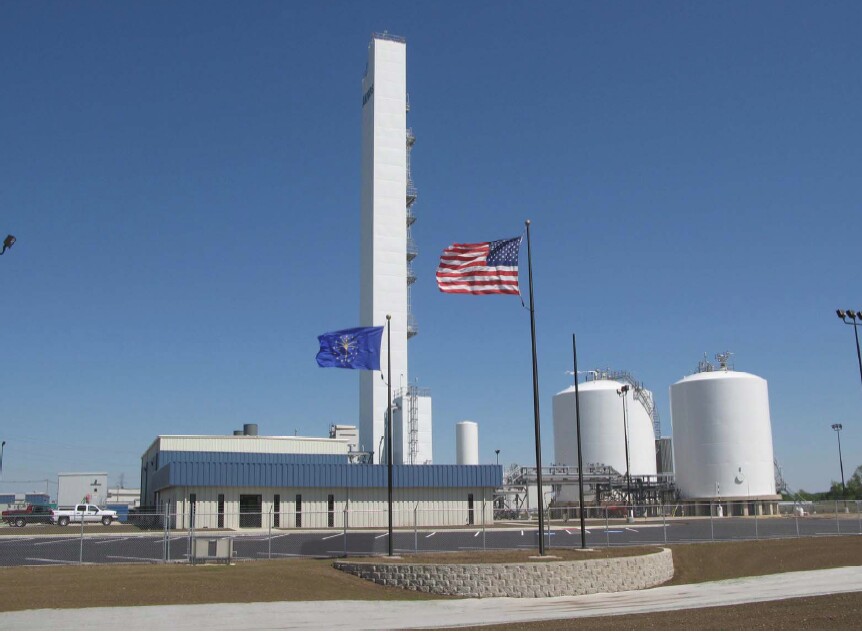
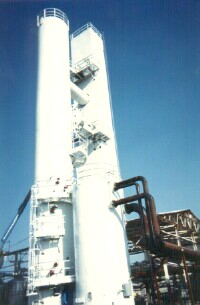
The portions of the cryogenic air separation process that operate at very low temperatures, i.e., the distillation columns, heat exchangers and cold interconnecting piping, must be well insulated. These items are located inside sealed (and nitrogen purged) “cold boxes”, which are relatively tall structures that may be either rectangular or round in cross section. Cold boxes are “packed” with rock wool or perlite to provide insulation and minimize convection currents. Depending on plant type and capacity, cold boxes may measure 2 to 4 meters on a side and have a height of 15 to 60 meters. They may be totally shop fabricated for rapid field erection, or the distillation columns, heat exchangers, and their interconnecting manifolds may shop fabricated for field assembly and erection. This is done when a shop fabricated box would be too large or heavy to ship to the site.
LIN assist plants are a special kind of cryogenic plant that can cost-effectively produce gaseous nitrogen at relatively low production rates. They differ from “normal” cryogenic plants in that they do not have their own mechanical refrigeration system. They effectively “import” the refrigeration required for on-site nitrogen production from a remote high-volume, high efficiency merchant liquid plant. They accomplish this by continuously injecting a small amount of liquid nitrogen into the distillation process, where the “imported” LIN provides reflux for distillation, then vaporizes and mixes with the locally-produced gaseous nitrogen, becoming part of the final product stream. Use of LIN-assist instead of a mechanical refrigeration system simplifies the plant design, makes the system somewhat more compact, reduces capital cost and can, under the right conditions, provide better overall economics than either an all-bulk-liquid supply or a new cryogenic nitrogen plant with a standard internal refrigeration cycle.
|


 His probably
  “The
“The  Alfred
  his company’s