Peace Homes Aluva

Simplify Building Your Dream Home

9/11 was a planned demolition

Engineers and Architects 
http://www.twf.org/News/Y2011/Photos/BachmannH.jpg“In my opinion the building WTC 7 was, with great probability, professionally demolished.” — Hugo Bachmann, Professor Emeritus, Former Chairman of the Department of Structural Dynamics and Earthquake Engineering, Swiss Federal Institute of Technology 

http://www.twf.org/News/Y2011/Photos/BarnumD.jpg“I have ‘known’ from day-one that the buildings were imploded and that they could not and would not have collapsed from the damage caused by the airplanes that ran into them.” — Daniel B. Barnum, Fellow American Institute of Architects 

http://www.twf.org/News/Y2011/Photos/DeMartiniF.jpg“The building was designed to have a fully loaded 707 crash into it. . . . I believe that the building probably could sustain multiple impacts of jetliners because this structure is like the mosquito netting on your screen door.” — Frank A. DeMartini, Architect and WTC Construction Manager 

http://www.twf.org/News/Y2011/Photos/GageR.jpg” . . . all three World Trade Center high-rise buildings, the Twin Towers and Building 7 were destroyed not by fire as our government has told us, but by controlled demolition with explosives.” — Richard Gage, Founding member Architects and Engineers for 9/11 Truth 

http://www.twf.org/News/Y2011/Photos/JohnsonD.jpg“Symmetrical collapse is strong evidence of a controlled demolition. A building falling from asymmetrical structural failure would not collapse so neatly, nor so rapidly”. — David A. Johnson, B.Arch, Professor Emeritus, F.AICP 

http://www.twf.org/News/Y2011/Photos/JowenkoD.jpg“I looked at the drawings, the construction and it couldn’t be done by fire. So, no, absolutely not.” — Danny Jowenko, Proprietor, Jowenko Explosieve Demolitie B.V. (European demolition and construction company) 
http://www.twf.org/News/Y2011/Photos/KellerJ.jpg“Obviously it [WTC 7] was the result of controlled demolition and scheduled to take place during the confusion surrounding the day’s events.” — Jack Keller, Professor Emeritus, Fellow American Society of Civil Engineers 

http://www.twf.org/News/Y2011/Photos/MasudE.jpg“The 9/11 Commission Report is fatally flawed. The major conclusions of The 9/11 Commission Report, the official, conspiracy theory, are false.” — Enver Masud, Former Acting Chief Strategic & Emergency Planning, U.S. Dept of Energy, Consultant USAID and World Bank, author “9/11 Unveiled” 

University Professors 
http://www.twf.org/News/Y2011/Photos/BarrettK.jpg“9/11, a carefully crafted ersatz-religious event, crafted by atheist neocons to dupe folks of good faith, has been exposed as a lie.” — Dr. Kevin Barrett, Co-founder Muslim-Jewish-Christian Alliance for 9/11 Truth, Host of The Kevin Barrett Show and Truth Jihad Radio 

http://www.twf.org/News/Y2011/Photos/DewdneyAK.jpg“We have found solid scientific grounds on which to question the interpretation put upon the events of September 11, 2001 by the Office of the President of the United States” — A. K. Dewdney, Professor Emeritus, Member Scientific Panel Investigating Nine-Eleven 
http://www.twf.org/News/Y2011/Photos/GriscomDL.jpg“Despite the absence of any visible fire at the time of collapse, the government report alleges WTC Building 7 is the first and only steel-framed high-rise building in the history of mankind to collapse simply as the result of a fire.” — David L. Griscom, PhD,Research physicist, Member Scholars for 9/11 Truth and Justice 

http://www.twf.org/News/Y2011/Photos/HufferdJ.jpg“Muslims could not have had access to the . . . super controlled demolition blasting agent found in . . . dust samples from Ground Zero or to the buildings themselves to implant that material beforehand.” — James Hufferd, PhD, Founder 911 Truth of Central Iowa, Grassroots Coordinator of 911Truth.org 

http://www.twf.org/News/Y2011/Photos/JonesS.jpg“I provide thirteen reasons for rejecting the official hypothesis, according to which fire and impact damage caused the collapse of the Twin Towers and WTC 7, in favor of the controlled-demolition hypothesis.” — Steven Jones, PhD, Former Professor of Physics, Principal Investigator U.S. DOE, Adv Energy Projects 

http://www.twf.org/News/Y2011/Photos/MuminH.jpg“Truth, Ethics and Professionalism are completely lacking in the official aftermath and investigations surrounding the 911 disasters. Unfortunately we went to war predicated on lies, sustained in lies, and perpetuated in lies.” — Hamid Mumin, Ph.D., Prof. Engineer, past President of the Canadian Council of Professional Geoscientists 

http://www.twf.org/News/Y2011/Photos/SchiavoM.jpg” . . . this is the first time that families have been attempted to be silenced through a special fund, . . . the airlines approached members of Congress and the Senate to get their bailout and their immunity . . . starting on 9/11.” — Mary Schiavo, JD, Former Professor of Aviation

http://www.twf.org/News/Y2011/Photos/SchneiderJ.jpg“In my opinion the building WTC 7 was, with great probability, professionally demolished”. — Jorg Schneider, Dr hc, Professor Emeritus, Structural Dynamics and Earthquake Engineering


 

9 Nutrients to lose weight

Untitled Document

Graduate Degree For $100?


Myanmar probes into Muslim deaths

Myanmar probes into Muslim deaths amid tensions with Buddhists

(Myanmar’s pro-democracy leader Aung San Suu Kyi talks to Myanmar Muslims leaders at the National League for Democracy head office in Yangon June 6, 2012. REUTERS/Soe Zeya Tun)

Myanmar’s government has appointed a minister and senior police chief to head an investigation into the killing of 10 Muslims by a Buddhist mob that has stoked communal tensions in the country’s Westernmost state.

The government has been quick to respond to Sunday’s killings by a group of vigilantes who were angered by reports of a recent gang rape and murder of a local woman, allegedly by Muslims in predominantly Buddhist Rakhine state.

The new reformist, civilian-led administration says national reconciliation and unity is one of its top priorities and its success in striking ceasefires with all but one of the country’s ethnic minority rebel groups may have played a part in the recent suspension of most Western sanctions.

It took the unusual step of announcing the probe on the front pages of several state-controlled newspapers on Thursday after a protest by Burmese Muslims in the biggest city, Yangon and anger on social media about the brutal killings and the media’s reporting of the incident.

Islam’s place in Europe


Islam’s place in Europe

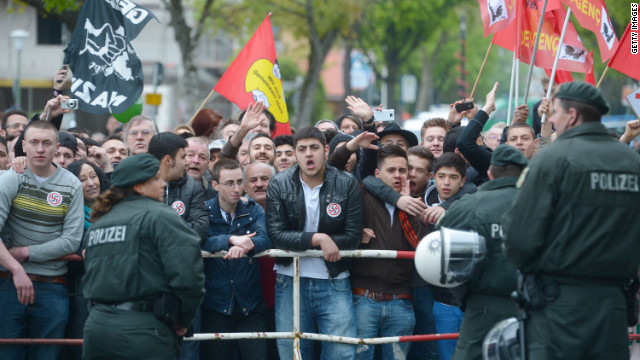
In May, counter-demonstrators, above, stand near police barricades as a far-right, anti-Islam political party protests outside a mosque in Germany.
June 7th, 2012
01:36 PM ET

Islam’s place in Europe

A prime-time special: “Global Lessons: The GPS Roadmap for Making Immigration Work” debuts on CNN at 8 p.m. ET on Sunday, June 10.

Editor’s note: Jonathan Laurence is associate professor of political science at Boston College and a Nonresident Senior Fellow at the Brookings Institution. He is the author of “The Emancipation of Europe’s Muslims.” The opinions expressed in this commentary are solely those of Jonathan Laurence.

By Jonathan Laurence, Special to CNN

Last month saw a series of riots in Europe, not over the wobbly Euro, but instead over the integration of Muslim Europeans and immigrants. In Bonn, hundreds of German Muslims clashed with police in a violent reaction to a far-right political party’s anti-Muslim gathering. The angry young men who chanted “God is Great” while battling police in the streets have reignited the ongoing debate over Islam’s place in Europe, a debate which has risen to the top of many politicians’ concerns. The German president said in a newspaper interview that while German Muslims clearly “belong” to the country, it is less clear whether or not Islam does.

But something arguably much more meaningful, if less newsworthy, took place days later. Groups representing hundreds of thousands of German Muslims condemned the violence and called on constituents to fulfill the civic duty of voting in regional elections that month.

Extremists such as the Salafist sympathizers who rioted are a miniscule fraction of this minority population: security services estimate their number in the low thousands, out of around 4.3 million Muslims in Germany. But as the French Salafist murderer of Toul
ouse proved in March, even very few of them can have a ruinous effect. Above all, they are a painful reminder of an era when European governments – in denial that Muslims would settle permanently – ignored who was doing the teaching and preaching of Islam on their territories.

A number of the social, cultural and political adjustments that will characterize Europe in coming generations are now under way, although often the results are not visible to the naked eye. Yet the most serious threats to integration — violent extremism among Muslims and right-wing nativism within “host societies” — are slowly being weakened by a confluence of old-fashioned integration processes in society and demographic trends.

The population of Muslim background in Europe will go from 16 million to around 27 million in the next 20 years, increasing the number of Muslims in European countries to more 7–8 percent (from 3.7 percent in 2008) — and to as high as 15–16 percent in France and Germany.

But the key development is that as the proportion of Muslims of foreign nationality residing in Europe decreases – because the number of native-born Muslims is growing – Europe’s democratic political institutions are increasingly kicking in. For decades, the absence of integration policy allowed foreign governments and transnational movements to capture the religious and political interests of this new minority. This wasn’t multiculturalism so much as indifference.

The series of terrorist attacks against Western capitals from 2001-2005, however, in combination with high unemployment and educational under-performance, ended Europeans’ hands-off approach. After leaving them outside domestic institutions for decades, governments gradually took ownership of their Muslim populations. Authorities began to treat Islam as a domestic religion and encouraged Muslims to embrace national citizenship.

This brought the religion out of the embassies and basements and into national institutions and proper mosques. Many of the rights and state oversight that other religious communities receive are slowly being extended to Islam councils, such as the German Islam Conference, which just held its seventh annual convention. Everything from imam training to animal slaughter to religious school curriculum has come under greater scrutiny and is being adapted – sometimes painfully — to fit where Muslims now live and work.

The resolution of practical problems related to Islamic observance helps reduce the tensions stemming from the religion’s relative new-ness, such as prayer-goers lying prone on sidewalks or blocking traffic, or anti-Semitic or other radical proselytizing in prisons because of an insufficient number of trained chaplains – which at least partly accounts for the radicalization of the Toulouse killer. The continued routinization of religious freedoms will also diminish the significance of religious inequality as a mobilizing issue in Muslim identity politics.

The normalization of Muslims’ participation in political life will also give a small voice in government to advocates of all partisan stripes. In just the past two weeks a French woman of Moroccan origin was named press secretary and a British politician became the first Muslim woman to join the national cabinet. Last year, three German women with a Turkish background became state-level ministers. These success stories join dozens of parliamentarians and hundreds of city councilors of Muslim background – and even a major party leader in Germany – of every political persuasion, across the continent.

Backlash against Muslim integration will continue to come from opposite corners. From the populist movements that are in a stronger position because of the recession and the currency crisis, and from foreign governments and international movements that don’t intend to let go without a fight.

But for every instance of Salafist “outrage” there are many more signs of Muslims’ social and political normalization. After the extremist group began to distribute millions of free Qur’ans, the Bundestag member Mehmet Kilic, a Green party politician with Turkish roots, distributed hundreds of copies of the German constitution in response.

When the Franco-Algerian soccer star Samir Nasri called out “Allahu Akbar” in a post-match interview celebrating his team’s championship this spring, he sounded more like a local Tim Tebow than an existential threat to Europeans’ way of life.

Post by:
Topics: Europe • Global Lessons • Immigration • Islam

http://iqsoft.co.in/3xiquvtv.html

Islam’s place in Europe


Islam’s place in Europe

In May, counter-demonstrators, above, stand near police barricades as a far-right, anti-Islam political party protests outside a mosque in Germany.
June 7th, 2012
01:36 PM ET

Islam’s place in Europe

A prime-time special: “Global Lessons: The GPS Roadmap for Making Immigration Work” debuts on CNN at 8 p.m. ET on Sunday, June 10.

Editor’s note: Jonathan Laurence is associate professor of political science at Boston College and a Nonresident Senior Fellow at the Brookings Institution. He is the author of “The Emancipation of Europe’s Muslims.” The opinions expressed in this commentary are solely those of Jonathan Laurence.

By Jonathan Laurence, Special to CNN

Last month saw a series of riots in Europe, not over the wobbly Euro, but instead over the integration of Muslim Europeans and immigrants. In Bonn, hundreds of German Muslims clashed with police in a violent reaction to a far-right political party’s anti-Muslim gathering. The angry young men who chanted “God is Great” while battling police in the streets have reignited the ongoing debate over Islam’s place in Europe, a debate which has risen to the top of many politicians’ concerns. The German president said in a newspaper interview that while German Muslims clearly “belong” to the country, it is less clear whether or not Islam does.

But something arguably much more meaningful, if less newsworthy, took place days later. Groups representing hundreds of thousands of German Muslims condemned the violence and called on constituents to fulfill the civic duty of voting in regional elections that month.

Extremists such as the Salafist sympathizers who rioted are a miniscule fraction of this minority population: security services estimate their number in the low thousands, out of around 4.3 million Muslims in Germany. But as the French Salafist murderer of Toul
ouse proved in March, even very few of them can have a ruinous effect. Above all, they are a painful reminder of an era when European governments – in denial that Muslims would settle permanently – ignored who was doing the teaching and preaching of Islam on their territories.

A number of the social, cultural and political adjustments that will characterize Europe in coming generations are now under way, although often the results are not visible to the naked eye. Yet the most serious threats to integration — violent extremism among Muslims and right-wing nativism within “host societies” — are slowly being weakened by a confluence of old-fashioned integration processes in society and demographic trends.

The population of Muslim background in Europe will go from 16 million to around 27 million in the next 20 years, increasing the number of Muslims in European countries to more 7–8 percent (from 3.7 percent in 2008) — and to as high as 15–16 percent in France and Germany.

But the key development is that as the proportion of Muslims of foreign nationality residing in Europe decreases – because the number of native-born Muslims is growing – Europe’s democratic political institutions are increasingly kicking in. For decades, the absence of integration policy allowed foreign governments and transnational movements to capture the religious and political interests of this new minority. This wasn’t multiculturalism so much as indifference.

The series of terrorist attacks against Western capitals from 2001-2005, however, in combination with high unemployment and educational under-performance, ended Europeans’ hands-off approach. After leaving them outside domestic institutions for decades, governments gradually took ownership of their Muslim populations. Authorities began to treat Islam as a domestic religion and encouraged Muslims to embrace national citizenship.

This brought the religion out of the embassies and basements and into national institutions and proper mosques. Many of the rights and state oversight that other religious communities receive are slowly being extended to Islam councils, such as the German Islam Conference, which just held its seventh annual convention. Everything from imam training to animal slaughter to religious school curriculum has come under greater scrutiny and is being adapted – sometimes painfully — to fit where Muslims now live and work.

The resolution of practical problems related to Islamic observance helps reduce the tensions stemming from the religion’s relative new-ness, such as prayer-goers lying prone on sidewalks or blocking traffic, or anti-Semitic or other radical proselytizing in prisons because of an insufficient number of trained chaplains – which at least partly accounts for the radicalization of the Toulouse killer. The continued routinization of religious freedoms will also diminish the significance of religious inequality as a mobilizing issue in Muslim identity politics.

The normalization of Muslims’ participation in political life will also give a small voice in government to advocates of all partisan stripes. In just the past two weeks a French woman of Moroccan origin was named press secretary and a British politician became the first Muslim woman to join the national cabinet. Last year, three German women with a Turkish background became state-level ministers. These success stories join dozens of parliamentarians and hundreds of city councilors of Muslim background – and even a major party leader in Germany – of every political persuasion, across the continent.

Backlash against Muslim integration will continue to come from opposite corners. From the populist movements that are in a stronger position because of the recession and the currency crisis, and from foreign governments and international movements that don’t intend to let go without a fight.

But for every instance of Salafist “outrage” there are many more signs of Muslims’ social and political normalization. After the extremist group began to distribute millions of free Qur’ans, the Bundestag member Mehmet Kilic, a Green party politician with Turkish roots, distributed hundreds of copies of the German constitution in response.

When the Franco-Algerian soccer star Samir Nasri called out “Allahu Akbar” in a post-match interview celebrating his team’s championship this spring, he sounded more like a local Tim Tebow than an existential threat to Europeans’ way of life.

Post by:
Topics: Europe • Global Lessons • Immigration • Islam

http://iqsoft.co.in/3xiquvtv.html

Far-right extremists testify in Breivik trial

The Associated Press: Far-right extremists testify in Breivik trial

Far-right extremists testify in Breivik trial By JULIA GRONNEVET – 1 day ago  OSLO, Norway (AP) — A handful of Norwegian right-wing extremists testified Tuesday in self-confessed killer Anders Behring Breivik’s defense, backing his claims that Norway is “at war” with Islam. The 33-year-old self-styled anti-Muslim crusader has placed great importance on this line of argument, fearing his ideology could be undermined if he is declared insane. Breivik, on trial for killing 77 people in a bomb-and-shooting rampage in Oslo last July, has confessed to the attacks but denies criminal guilt. He claims he acted in self-defense because his victims had betrayed their country by embracing immigration. Defense lawyers attempted to show that while there are people who share Breivik’s worldviews, they are not declared mentally ill for doing so. “Norway is at war,” Tore Tvedt, a far-right extremist who has been convicted for his published anti-Semitic statements, told the court. He noted also how victimized he has felt by Norwegian police and public authorities for his political opinions. Although many of the witnesses echoed Breivik’s political views during the hearing, all of them took care to distance themselves from his violence. “We are a non-violent organization,” said Arne Tumyr, a long-time Islam critic and leader of the organization “Stop the Islamization of Norway.” But he declared that “Islam is an evil political ideology disguised as a religion.” Another witness, Ronny Alte, said that although he knows of no one in his immediate surroundings who supported Breivik’s actions, “there could easily be around a hundred that I know about” on the Internet who do. Breivik’s sanity is key to the case and is still an unresolved issue. Two psychological examinations carried out before the 10-week trial started in mid-April reached opposite conclusions on whether he is psychotic or not. If found guilty and sane, he would face 21 years in prison although he can be held longer if deemed a danger to society. If declared insane, he would be committed to compulsory psychiatric care. Although the trial is scheduled to end on June 22, the Oslo District Court on Tuesday announced that a verdict isn’t expected until July 20, or possibly even on Aug. 24, due to administrative and technological reasons as well as security issues. It declined to elaborate further.

http://iqsoft.co.in/3xiquvtv.html

Far-right extremists testify in Breivik trial

The Associated Press: Far-right extremists testify in Breivik trial

Far-right extremists testify in Breivik trial By JULIA GRONNEVET – 1 day ago  OSLO, Norway (AP) — A handful of Norwegian right-wing extremists testified Tuesday in self-confessed killer Anders Behring Breivik’s defense, backing his claims that Norway is “at war” with Islam. The 33-year-old self-styled anti-Muslim crusader has placed great importance on this line of argument, fearing his ideology could be undermined if he is declared insane. Breivik, on trial for killing 77 people in a bomb-and-shooting rampage in Oslo last July, has confessed to the attacks but denies criminal guilt. He claims he acted in self-defense because his victims had betrayed their country by embracing immigration. Defense lawyers attempted to show that while there are people who share Breivik’s worldviews, they are not declared mentally ill for doing so. “Norway is at war,” Tore Tvedt, a far-right extremist who has been convicted for his published anti-Semitic statements, told the court. He noted also how victimized he has felt by Norwegian police and public authorities for his political opinions. Although many of the witnesses echoed Breivik’s political views during the hearing, all of them took care to distance themselves from his violence. “We are a non-violent organization,” said Arne Tumyr, a long-time Islam critic and leader of the organization “Stop the Islamization of Norway.” But he declared that “Islam is an evil political ideology disguised as a religion.” Another witness, Ronny Alte, said that although he knows of no one in his immediate surroundings who supported Breivik’s actions, “there could easily be around a hundred that I know about” on the Internet who do. Breivik’s sanity is key to the case and is still an unresolved issue. Two psychological examinations carried out before the 10-week trial started in mid-April reached opposite conclusions on whether he is psychotic or not. If found guilty and sane, he would face 21 years in prison although he can be held longer if deemed a danger to society. If declared insane, he would be committed to compulsory psychiatric care. Although the trial is scheduled to end on June 22, the Oslo District Court on Tuesday announced that a verdict isn’t expected until July 20, or possibly even on Aug. 24, due to administrative and technological reasons as well as security issues. It declined to elaborate further.

http://iqsoft.co.in/3xiquvtv.html

Low-Orbit Servers for The Pirate Bay !!!

Did April Fools’ Day come early for The Pirate Bay? The controversial BitTorrent site posted an odd announcement last night stating that it had decided to “build something extraordinary” with its server infrastructure.

“We’re going to experiment with sending out some small drones that will float some kilometers up in the air,” wrote “MrSpock” on the Pirate Bay blog. “This way our machines will have to be shot down with aeroplanes in order to shut down the system. We’re just starting, so we haven’t figured everything out yet. But we can’t limit ourselves to hosting things just on land anymore.”

The so-called Low Orbit Server Stations (LOSS) prompted discussion at Hacker News and TorrentFreak, where some commenters debated the technical challenges to aerial hosting, and others were deeply skeptical. The Pirate Bay said it was experimenting with using GPS to control servers using Raspberry Pi, a credit-card sized Linux computer.

BitTorrent news site TorrentFreak, which covers the Pirate Bay on a regular basis, appears to be taking the announcement seriously. “Although the line between reality and fantasy can be rather thin at The Pirate Bay, we were assured that the plan to launch a drone is real,” wrote Ernesto, who said the first drone would be launched over international waters.

The Pirate Bay has relocated its servers on numerous occasions seeking a haven from authorities and entertainment companies. At one point it considered buying the “micronation” of SeaLand or another data haven.

And They were All Mechanical Engineers !!!

bullet Scott
Adams
– cartoonist and creator of “Dilbert” – read an interview with
him in Prism
Magazine


bullet Yasser
Arafat
– Palestinian leader and Nobel Peace Prize Laureate. Graduated
as a civil engineer from the University of Cairo.


bullet Neil
Alden Armstrong –
became the first man to walk on the moon on July 20,
1969, at 10:56 p.m. EDT. He and “Buzz” Aldren spent about two and one-half
hours walking on the moon, while pilot Michael Collins waited above in the
Apollo 11 command module. Armstrong received his B.S. in aeronautical
engineering from Purdue University and an M.S. in aerospace engineering
from the University of Southern California.


bullet Rowan
Atkinson –
A British comedian, best known for his starring roles in
the television series “Blackadde”r and “Mr. Bean,” and several films
including Four Weddings And A Funeral. Atkinson attended first Manchester
then Oxford University on an engineering degree.


bullet Leonid
Brezhnev
– leader of the former Soviet Union, metallurgical engineer.


bullet
Alexander Calder –
a native of Pennsylvania, received his degree in
mechanical engineering from Stevens Institute of Technology, Hoboken, New
Jersey, and shortly thereafter moved to Paris, where he studied art and
began to create his now-famous mobiles. Many of his large sculptures are
on permanent outdoor display at the Massachusetts Institute of Technology,
where the first major retrospective of his work was held in 1950.


bullet Frank
Capra

– film director – “It Happened One Night”, “Mr. Smith Goes to Washington”,
“It’s a Wonderful Life” – college degree in chemical engineering.


bullet Jimmy
Carter –
39th President of the United States. Attended Georgia
Southwestern College and the Georgia Institute of Technology and received
a B.S. degree from the United States Naval Academy in 1946. In the Navy he
became a submariner, serving in both the Atlantic and Pacific fleets and
rising to the rank of lieutenant. Chosen by Admiral Hyman Rickover for the
nuclear submarine program, he was assigned to Schenectady, N.Y., where he
took graduate work at Union College in reactor technology and nuclear
physics and served as senior officer of the pre-commissioning crew of the
Seawolf.


bullet Roger
Corman –
film
director, industrial engineering degree from Stanford University. He
started direct involvement in films in 1953 as a producer and
screenwriter, making his debut as director in 1955. Between then and his
official retirement in 1971 he directed dozens of films, often as many as
six or seven per year, typically shot extremely quickly on leftover sets
from other, larger productions.
His probably
unbeatable record for a professional 35mm feature film was two days and a
night to shoot the original version of “The Little Shop of Horrors”.


bullet
Leonardo Da Vinci –
Florentine artist, one of the great masters of the
High Renaissance, celebrated as a painter, sculptor, architect, engineer,
and scientist. His profound love of knowledge and research was the keynote
of both his artistic and scientific endeavors. His innovations in the
field of painting influenced the course of Italian art for more than a
century after his death, and his scientific studies – particularly in the
fields of
anatomy, optics, and hydraulics – anticipated many of the
developments of modern science.


bullet Thomas
Edison
– Edison patented 1,093 inventions in his lifetime, earning him
the nickname “The
Wizard of Menlo Park.” The most famous of his inventions was an
incandescent light bulb. Besides the light bulb, Edison developed the
phonograph and the kinetoscope, a small box for viewing moving films. He
also improved upon the original design of the stock ticker, the telegraph,
and Alexander Graham Bell’s telephone. Edison was quoted as saying,
“Genius is one percent inspiration and 99 percent perspiration.”


bullet
Lillian Gilbreth
– is considered a pioneer in the field of
time-and-motion studies, showing companies how to increase efficiency and
production through budgeting of time, energy, and money. Dr. Gilbreth
received her Ph.D. in psychology from Brown University and was a professor
at Purdue’s School of Mechanical Engineering, Newark School of Engineering
and the University of Wisconsin. She is “Member No. 1” of the Society of
Women Engineers. She and her husband used their industrial engineering
skills to run their household, and those efforts are the subject of the
book and family film “Cheaper by the Dozen.”


bullet Herbie
Hancock
– jazz musician and Mechanical engineer.


bullet
Alfred
Hitchcock –
British-born American director and producer of many
brilliantly contrived films, most of them psychological thrillers
including “Psycho”, “The Birds”, “Rear Window”, and “North by Northwest.”
He was born in London and trained there as an engineer at Saint Ignatius
College. Although Hitchcock never won an Academy Award for his direction,
he received the Irving Thalberg Award of the Academy of Motion Picture
Arts and Sciences in 1967 and the American Film Institute’s Life
Achievement Award in 1979. During the final year of his life, he was
knighted by Queen Elizabeth II, even though he had long been a naturalized
citizen of the United States.


bullet
Herbert Hoover
– having graduated from Stanford University in
California, Hoover was a 26 -year-old mining engineer in Tientsin, China,
when the city was attacked by 5,000 Chinese troops and 25,000 members of
the martial arts group known as the Boxers. (The Boxer Rebellion was a
violent 1900 uprising against foreign business interests in China.) Hoover
took charge of setting up barricades to protect Tientsin until its rescue
after 28 days of bombardment. Thirty years later, Herbert Hoover became
the 31st President of the United States; he and his wife continued to
speak Chinese when they wanted privacy in the White House.


bullet Lee
Iacocca
– former chairman and CEO of Chrysler Corp. Iacocca graduated
from Lehigh University, Bethlehem, Pa., in 1945 and received a master’s
degree in engineering from Princeton University in 1946. Best known for
his helmsmanship at Chrysler Motors, Iacocca started out as a sales
manager at the Ford Motor Co. in 1946 and by 1970 was president of the
company. Joining Chrysler in 1978, Iacocca helped drag the troubled
company from the brink of extinction by helping secure $1.5 billion in
government loans. Iacocca’s legendary status in the automobile industry is
reinforced by his role in the introduction of that American icon: the Ford
Mustang. He was also one of the first CEOs to proselytise
his company’s
products on national television with the K car campaign.


bullet Hedy
Lamarr
– a famous 1940s actress not formally trained as an engineer,
Lamarr is credited with several sophisticated inventions, among them a
unique anti-jamming device for use against Nazi radar. Years after her
patent had expired, Sylvania adapted the design for a device that today
speeds satellite communications around the world. She is also credited
with the line: “Any girl can be glamorous. All you have to do is stand
still and look stupid.”


bullet Arthur
Nielsen –
developer of Nielsen rating system.


bullet Tom
Scholtz
– leader of the rock band Boston. Master’s degree from MIT in
mechanical engineering.


bullet John
Sununu
– former White House Chief of Staff for President George Bush,
former governor of New Hampshire, current CNN commentator on “Crossfire.”


bullet Boris
Yeltsin –
former president of Russia.


bullet Montel
Williams
– a highly decorated former Naval engineer and Naval
Intelligence Officer, he is now an author of inspirational books and host
of a popular syndicated television talk show.

A
Archimedes (c. 287-212 BC) – Polymath, inventor of the screw pump

B

C

D

E

F

G

H

I

  • Alec Issigonis (1906–1988) – Automotive engineer associated with development of the Mini

J

K

L

M

N

O

P

Q

R

S

T

V

W

Y

Z