Peace Homes Aluva

Simplify Building Your Dream Home

Blog

Al-Jazari: The Mechanical Genius

Al-Jazari: The Mechanical Genius

Professor Salim T S Al-Hassani *

Al-Jazari was the most outstanding mechanical engineer of his time. His full name was Badi’ al-Zaman Abu-‘l-‘Izz Ibn Isma’il Ibn al-Razzaz al-Jazari. He lived in Diyar-Bakir (in Turkey) during the 6th century H (late 12th century-early 13th century CE).

Large image

Figure 1: Wash-basin in the form of a peacock described by Al-Jazari in Kitab fi Ma’rifat al-Hiyal al-Handisayya. Manuscript copied in Sha’ban 6002/ March 1205. (Source).

Large image

Large image

Figure 2 a-b:

He was called Al-Jazari after the place of his birth, Al-Jazira, the area lying between the Tigris and the Euphrates in Mesopotamia. Like his father before him, he served the Artuqid kings of Diyar-Bakir for several decades (at least between 570 and 597 H/1174-1200 CE) as a mechanical engineer. In 1206, he completed an outstanding book on engineering entitled Al-Jami’ bayn al-‘ilm wa-‘l-‘amal al-nafi’ fi sinat’at al-hiyal in Arabic. It was a compendium of theoretical and practical mechanics. George Sarton writes: "This treatise is the most elaborate of its kind and may be considered the climax of this line of Muslim achievement" (Introduction to the History of Science, 1927, vol. 2, p. 510).

Large image

Figure 3: Model of a blood letting device as described by Al-Jazari and reconstructed in 1977. It measured the blood lost during phlebotomy (blood-letting) sessions, a popular therapy in the Islamic medieval world. Two scribes are seated above the device and their actions describe the amount of blood to be let. Currently on display in The Science and Art of Medicine (inventory number : 1981-1710). (Source).

Al-Jazari’s book is distinctive in its practical aspect because the author was a competent engineer and skilled craftsman. The book describes various devices in minute detail, providing hence an invaluable contribution in the history of engineering. British charter engineer and historian of Islamic technology Donald R. Hill (1974) who held a special interest in Al-Jazari’s achievements wrote:

Large image

Figure 4: Al-Jazari’s water powered scribe clock brought back to life after 800 years by FSTC. The clock stands 1 metre high and half a metre wide; the scribe with his pen is synonymous to the hour hand of a modern clock. Click here to see the animation. (Source).

"It is impossible to over emphasize the importance of Al-Jazari’s work in the history of engineering, it provides a wealth of instructions for design, manufacture and assembly of machines."

Large image

Figure 5: Picture of the internal structure of an automata for dispensating liquids. © JC Heuden at Virtual Worlds. (Source).

Al-Jazari described fifty mechanical devices in six different categories, including water clocks, hand washing device (wudhu’ machine) and machines for raising water, etc. Following the "World of Islam Festival" held in the United Kingdom in 1976, a tribute was paid to Al-Jazari when the London Science Museum showed a successfully reconstructed working model of his famous "Water Clock."

Large image

Figure 6: The original drawing of the double action or reciprocating pump from Al-Jazari’s manuscript. Topkapi Palace Museum Library, Ahmet III, MS 3472. (Source).

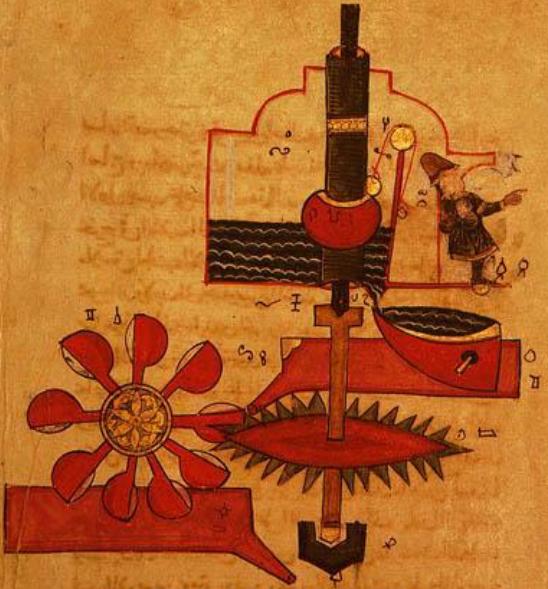
Donald R. Hill translated into English Al-Jazari’s book in 1974, seven centuries and 68 years after it was completed by its author. Al-Jazari’s encyclopedic treatise includes six main categories of machines and devices. Several of the machines, mechanisms and techniques first appear in this treatise, later entering the vocabulary of European mechanical engineering. Among these innovations, we mention the double acting pumps with suction pipes, the use of a crank shaft in a machine, accurate calibration of orifices, lamination of timber to reduce warping, static balancing of wheels, use of paper models to establish a design, casting of metals in closed mould boxes with green sand, etc. Al-Jazari also describes methods of construction and assembly in scrupulous detail of the fifty machines to enable future craftsmen to reconstruct them.

Large image

Figure 7: 3D model recreated by FSTC of the double action pump of Al-Jazari. Click here to view the animation. ©FSTC 2009.

And he was successful in that, for many of his devices were constructed following his instructions. The work by Al-Jazari is also unique in the way that other writers often fail to give sufficient details, because – amongst other factors – they were not craftsmen themselves, or kept their secrets, or if they were craftsmen, they could have been illiterate. Al-Jazari in this respect was unique, and this gives his work immense value. His book, Hill states, is an absolute wealth of Islamic mechanical engineering.

In their paper on "Mechanical Engineering during the Early Islamic Period" (published in I. Mech. E, The Chartered Mechanical Engineer, 1978, pp. 79-83), C. G. Ludlow and A. S. Bahrani have raised the important point that it is more than likely that there is more on the subject in some of the thousands of Arabic manuscripts in the world libraries which have not yet been inspected closely, and obviously require looking into.

Hill, too, constantly raises the two major issues with respect to the history of engineering in general, and that of fine technology in particular. He first states the fact that the field, which is absolutely immense, is yet largely unexplored.

Large image

Figure 8: View of The Elephant Clock: Leaf from a manuscript of Al-Jazari’s Kitab fi macrifat al-hiyal al-handasiyya dated 715 H/1315 CE. (Source).

The other issue is related to fine technology. One of his concluding points states that "it is hoped that, as research proceeds, firmer evidence for the transmission of Islamic fine technology into Europe can be provided." Hill also offers some hints for such transmission. The most likely route was Spain. Such fine technology could have followed the same route as the astrolabe (itself part of this fine technology.) Apart from Spain, there were other possible lands of transfer: Sicily, Southern France, Italy, Byzantium and Syria during the Crusades. Hill is also right on a further account, that what will be seen in this work is just a fraction of the whole process, which, as with much else has hardly been explored.

The animation presented in figure 7 shows a virtual model of one of Al-Jazari’s water raising pumps. The details of this unique pump were obtained from his manuscript and Hill’s diagrams. We see two suction pumps in synchronous motion driven by a paddle wheel, which is driven by a water stream.

Large image

Figure 9: 3D model recreated by FSTC of the Elephant clock. Click here to view the animation. ©FSTC 2009.

The other animation is for a 3D model recreated from the description of the elephant clock as described by Al-Jazari (see below fig. 9). Full details of this animation are given in the works authored by the author and his collaborators published in the book 1001 Inventions: The Muslim Heritage in Our World (chief editor Salim al-Hassani, Manchester: FSTC, 2006) and in articles that can be consulted online on www.MuslimHeritage.com (see especially the two special folders devoted to Islamic technology: Al-Jazari and Taqi al-Din).

Large image

Figure 10: A table device automaton designed by Al-Jazari. Manuscript dated from the early 14th century (1315), copied in Syria by Farrukh ibn Abd al-Latif. Opaque watercolor, ink and gold on paper. © The Smithsonian Institution, Washington. (Source).

Large image

Figure 11: A large ewer held by a kneeling female attendant in a domed pavilion designed by Al-Jazari: once the bird whistles, water pours into a basin below; a duck then drinks the used water and releases it through its tail into a container hidden under the platform. © The Smithsonian Institution, Washington. (Source).

* Emeritus Professor at the University of Manchester and Chairman of The Foundation for Science, Technology and Civilisation (FSTC), Manchester, UK.

by: Professor Salim Al-Hassani, Fri 09 February, 2001


Related Articles:
The List of Al-jazari Articles Published on MH.com by: FSTC Limited
Some 800 years in the past, in 1206, a brilliant Muslim scholar died : Badi? al-Zaman Abu al-‘Izz ibn Isma?il ibn al-Razzaz al-Jazari. He was one of the most important inventors and mechanical engineers in the history of technology. His magnum opus book of mechanics, the famous Al-Jami? bayn al-?ilm wa ‘l-?amal al-nafi? fi sina?at al-hiyal (A Compendium on the Theory and Useful Practice of the Mechanical Arts) was the most significant treatise of the Islamic tradition of mechanical engineering and a ground breaking work in the history of mechanics.

Al-Jazari: 800 Years After by: FSTC Limited
Some 800 years in the past, in 1206, a brilliant Muslim scholar died : Badi? al-Zaman Abu al-‘Izz ibn Isma?il ibn al-Razzaz al-Jazari. He was one of the most important inventors and mechanical engineers in the history of technology. His magnum opus book of mechanics, the famous Al-Jami? bayn al-?ilm wa ‘l-?amal al-nafi? fi sina?at al-hiyal (A Compendium on the Theory and Useful Practice of the Mechanical Arts) was the most significant treatise of the Islamic tradition of mechanical engineering and a ground breaking work in the history of mechanics.

Al-Jazari’s Castle Water Clock: Analysis of its Components and Functioning by: Professor Salim T. S. Al-Hassani
The first machine described by al-Jazari in his famous treatise of mechanics Al-Jami‘ bayn al-‘ilm wa ‘l-‘amal al-nafi‘ fi sina‘at al-hiyal (A Compendium on the Theory and Useful Practice of the Mechanical Arts) is a monumental water clock known as the castle clock.

Al-Jazari’s Third Water-Raising Device: Analysis of its Mathematical and Mechanical Principles by: FSTC Limited
Five pumps or water-raising machines are described by al-Jazari in his monumental treatise of mechanics Al-Jami’ bayn al-‘ilm wa ‘l-‘amal al-nafi’ fi sina’at al-hiyal (A Compendium on the Theory and Useful Practice of the Mechanical Arts). The following long article is a detailed study of the third of these water-raising devices. The study presents a detailed analysis of the mathematical and mechanical principles of this sophisticated machine and explains its functioning. Further, the various components of the pump are reconstructed via computer assisted design. A profusion of 3D graphics and 3D animations show the device in different angles and helps in viewing it in operational mode.

Al-Muqaddasi and Human Geography: An Early Contribution to Social Sciences by: FSTC Research Team

FSTC Research Team

Recent scholarly interest in the genesis of social sciences in Islamic culture is a noteworthy shift. Until recent times, the development of these fields was credited exclusively to the modern Western tradition, especially to the 19th century birth of humanities. The ground breaking contribution of Ibn Khaldun was recognized; however, the author of the Muqaddima stands as an isolated genius. In the following article, an attempt is made to broaden the field by highlighting the contributions of several other scholars in laying the foundation of social sciences in Islamic culture. After a short survey on Al-Biruni and Al-Raghib al-Isfahani, the focus of the article is dedicated to the 10th-century Palestinian geographer Al-Muqaddasi, who touched on various subjects of interest to the social sciences in his book Ahsan al-taqasim fi ma’rifat al-aqalim.

Resources:
Al-Jazari’s Water Pump, by: FSTC
The animation shows a virtual model of one of al-Jazari’s water raising pumps. The details of this unique pump were obtained from his manuscript and D.Hill diagrams. We see two suction pumps in synchronous motion driven by a paddle wheel.

References:
The Book of Ingenious Mechanical Devices of Al-Jazri by: Donald Hill
Al-Jazri Mechanical Devices, First published in 1974

Ecology and Islam: Review of Abdul-Matin’s “Green Deen” (2010)

Ecology and Islam: Review of Abdul-Matin’s “Green Deen” (2010) | Dissident Voice

<!–
google_ad_client = “ca-pub-3732368513453587”;
/* 728×90, created 07/01/10 */
google_ad_slot = “0492720593”;
google_ad_width = 728;
google_ad_height = 90;
//–>

src=”http://pagead2.googlesyndication.com/pagead/show_ads.js”>
by Eric Walberg / January 14th, 2011

Paperback: 264 pages
Publisher: Berrett-Koehler Publishers
(Nov 11 2010)
Language: English

Muslim Americans are slowly beginning to make their mark on their conflicted society. There are more Muslims than Jews in the US now — approximately 5 million. They are the most diverse of all American believers, 35 per cent born in the US (25 per cent Afro-American), the rest — immigrants from southeast Asia, Africa and the Middle East. Traditionally they have voted Republican, but have shifted to Democrat and Green parties in recent years.

Ibrahim Abdul-Matin is the son of black converts, raised in New York, a community organiser now environmental adviser to New York Mayor Michael Bloomberg. His book about Islam and the environment — Green Deen — is a stimulating overview of both the US environmental movement and how American Muslims are becoming part of it, bringing their own unique perspective.

Abdul-Matin sees the weakness of the environmental movement today in its secular, legalist approach to problems: pass enough laws and you can curb the negative practices of business and consumers, and push them along an environmentally-friendly path.

But this, as he shows here, is not enough. He interprets Islam’s focus on One Creator as giving “humankind the opportunity to be one and to have a common purpose”, to bring back ethical principles into our daily lives. He points to six principles which underlie Islam and shows how they relate to our relationship to the environment:

*understanding the Oneness of God and His creation (tawhid);

*seeing signs of God (ayat) everywhere;

*being a steward (khalifah) of the Earth;

*honouring the trust we have with God (amana) to be protectors of the planet;

*moving toward justice (adl); and

*living in balance with nature (mizan).

Deen or din, meaning religion in Arabic, is used in the Quran to refer both to the path along which righteous Muslims travel to comply with divine law (Sharia) and divine judgment or recompense, which all humanity must inevitably face — without intercessors — before God. The word probably derives from the Persian Zoroastrian concept Daena — insight, the Eternal Law. In Hebrew din means law or judgment. In Islam, the word implies an all-encompassing way of life lived in accordance with God’s divine purpose as expressed in the Quran and hadith.

The author recalls a moving childhood experience, hiking on Bear Mountain near New York, his first time in the wilds. He watched as his father cleared a spot in the forest to pray, explaining to him, “The Earth is a mosque.” He considered other religions as a youth but reaffirmed his father’s decision to follow the deen, “a living tradition that is spiritually nourishing and intellectually coherent”.

For Abdul-Matin, there is no conflict between religion and science – – humans are the best of God’s creation, and, as stewards blessed with intelligence and reason, have a responsibility towards the rest of God’s creation. He points to the verse, “Corruption has appeared on the land and in the sea because of what the hands of humans have wrought,” as proof that God warned people about their possible harmful impact on the planet, “a taste of the consequences of their misdeeds that perhaps they will turn to the path of right guidance”. (Quran 30:41) In this sura, The Romans, God warns humanity not to disturb the balance of Nature.

Green Deen is a refreshing mix of theory and practice. Concern for mizan translates as: “Where does your trash come from? Where does it go? How can you be actively involved in making the world a cleaner, less toxic place?”

Ayat are everywhere: “He has made subject to you the sun and the moon, both diligently following their courses; and the Night and the Day.” (Quran 14:32-3) While a hardnosed scientist might dismiss this as poetic license, the author interprets these ayat as indeed serving us every day, allowing us to travel, giving us heat and light, time to sleep and time to work. “To everything there is a season” is Ecclesiastes’ expression of this truth.

Stop using “energy from hell” — coal and oil, the latter associated with today’s wars, both devastating in their ecological footprint, and betraying both khalifa and amana. Use “energy from heaven” — solar power, wind energy. He could have mentioned woodchips, which can be burned efficiently and are bi-products, “waste”, from manufacture. (For a khalifah, there is no such thing as waste).

For someone with a more secular worldview, all this is still very relevant. In the past two centuries, science has reduced to the lifeless pursuit of technology. There is no poetry in this, only money and novelty. It is the very poetry of the Quran, this quaintness of the belief that Nature was made subject to humans, that is what is necessary for leading us to any change towards reincorporating morality into our lives, whether religious or secular, given our disconnect with Nature.

The author gives a brief overview of the development of ecological awareness, starting with the conservation president Theodore Roosevelt, who in some sense recognised his role as khalifah, and set up the system of national parks at the beginning of the twentieth century, making humans’ relationship to Nature part of America’s political dialogue. The next step forward was not until the 1950s, when the American Dream, which captured the world’s imagination, was accompanied by a sudden sharp decline in bird populations and an equally sharp rise in cancer rates.

The realisation that growth was not without “external economies” started a popular movement to regulate toxic chemicals. In the 1960s, the civil rights movement empowered marginalised communities to build on this foundation. Now, the generalised problem of global warming demands that everyone should transform their lifestyles, as we are all “marginalised” communities now.

These developments reflect the six principles of a Green Deen. “The environmental movement can be seen as an attempt to restore balance and justice to the Earth after the environmental destruction caused by overconsumption,” itself the result of an obsession with creating, producing, finding self-worth in consuming.

This is the heart of the problem for the author, a result of our 20th- century economic systems — both capitalist and socialist, the author claims — which reduce us to units of production. “We become relevant only by what we can create.” In contrast, Islam teaches that “we come with intrinsic value. We are also an ayat of Allah” and “do not need to consume or create to have worth.”

***

The author’s analysis breaks down at this point. He is limited in what he can say, given American biases. Damning socialism along with capitalism is a typical American cop-out, but socialism was the secular attempt to reintroduce morality into the economy, to fulfill the six principles that underlie Islam — minus God.

Socialism never had the chance to deal with the dilemma of over-consumption; the system, as identified with the Soviet Union, never had the luxury of luxury, always fighting for survival in the face of the more powerful capitalist world. Cuba is the only remnant of that socialist experiment and has a much better environmental record
than the West. Abdul-Matin makes no mention of its secular attempts to find mizan though they are encouraging and follow his by now standard recommendations: urban market gardens, solar energy, bicycling and walking, but above all, making do with less.

Islam has a lot in common with socialism, a comparison Abdul- Matin implicitly makes in the principle of adl — social justice. Umm Kholthum boldly referred to the Prophet Mohamed as “the imam of socialism”. The Prophet’s wife Aisha related that, “He himself removed the lice from his clothing, milked his goats, and did all his work himself.” No need to exploit others to fulfill your needs.

The author can’t hide his own socialist leanings entirely — green jobs (minimising inputs, producing durable, environmentally friendly outputs) must be linked to adl – justice and equality — or they will just perpetuate the current inequalities. Water should not be sold for profit. The famous hadith about Uthman buying the Ruma Well and making it waste-free, responding to the Prophet’s call, is recounted.

The author also skirts around the issue of neocolonialism, considering the colonies liberated in the 20th century as “postcolonial”, though suffering from the “economic control of large corporations”. More tip-toeing through the US ideological minefield: America as the imperial ogre, the big waster, wreaking havoc around the world, does not make an appearance. Nor does the world’s worst polluter — the US military. Watch Avatar, set far into the future, to see that there is nothing “post” about so-called post-colonialism.

Traditional societies were not over-consumers. Their no-brainer philosophy was Eat in order to live, not Live in order to eat, as we do today. The Western disdain for the “primitive” inherently dismisses their natural wisdom.

Abdul-Matin’s defence of Islam implicitly asserts this wisdom, which is not unique to Islam. However, due to Islam’s care to conserve the original message of 15 centuries ago, it has not been erased, as it has from the other monotheisms, so successfully incorporated into the modern world. He provides a fascinating example of how Islam can be practised in the modern world in new ways. A Muslim community in Chiapas, Mexico lives off the grid, with organic farms, few cars, solar panels made of scrap metal, sun-drying their fruit. They have rediscovered how relevant “backward” ways of living are to today’s needs, giving “civilisation” a new meaning.

The root of the problem is not just over-consumption, but the colonisation of the world, which destroyed — and destroys — cultures based on religion with its moral truths and respect for nature. Instead of “What is a just price?” the question is “What can I get away with?” This negative freedom (freedom to do anything subject to constraints) has taken the place of positive freedom (freedom as defined by an understanding and willingness to follow a path in accord with divine law), as embodied in religion.

The various stages in environmental awareness in the West have tried to overcome this by regulations, the result of popular resistance — both community- and religious-based movements. The next step forward, according to the author, is an environmental justice movement, which he says is slowly coming about “as a response to the disconnection between people and planet” and which must incorporate the principles he outlines.

The author enthuses about the “smart grid” and other self-regulating systems, which use computer monitoring and feedback to adjust the various components in environmental systems (temperature, air quality, energy use) given the situation and needs. That is all well and good. But aren’t we still just consumers, even if more careful about our footprints?

The author’s intrinsic bias is still lifestyle-related: consume responsibly, but consume. Don’t rock the boat. Nowhere does the author address the economic mechanism that lies behind colonialism and its tendency to over-consume — the maximizing of the surplus we produce, profits — whether or not we need this material excess. As long as we put profit on a pedestal, we are slaves to the destructive logic undermining the ecological balance.

“Let there be no change in the work wrought by Allah: that is the true Religion. But most among mankind understand not.” (Quran 30:30) That ayat calls for us to minimise the surplus we extract from Nature in the form of profits. “Leave well enough alone.” As scientists of the economy and Nature do, we should maximise something worthwhile, like efficiency of production, green jobs, renewable energy use, clean air. In his care not to tread on capitalist-crazed American toes, the author misses the startling and highly relevant insight that Islam has for us: to seek balance, minimise consumption.

That is the hidden truth here, for both Muslims and non-Muslims, religious and secular minds alike. We are witnessing today environmental heedlessness in Westernised Muslim societies like Egypt, Saudi Arabia and the Gulf states. In Cairo the choking exhaust fumes, the casually disposed-of garbage on streets, the unthinking use and discarding of “free” plastic bags, the misuse of water — this behaviour surprises foreigners, already more “environmentally aware”. Sadly, Muslims are today “catching up” in the negative sense.

By abandoning socialism, embracing Western neoliberalism, Egypt lost what little (socialist, anti-imperialist) morality there was that held society together, morality which found deep and heart-felt response in the common people. True, Egypt’s socialist experiment was flawed. It suffered from paranoia — how to maintain power in the face of both Western Cold War intrigues and the difficulty of incorporating the greater truths of Islam in a largely secular movement — which eventually defeated it. There was no easy path to tread. Socialism’s professed secular nature was a stumbling block that eventually brought it down.

Perhaps the new awareness Abdul-Matin points to, sparked by the environmental movement in the West, will indeed find inspiration in Islam; and East and West will work together to revive the patient. A similar coming-together of activists in the West and the Muslim world is now trying to cure the other poison infecting the Middle East — Israel’s refusal to come to its senses and make peace with its neighbours. Westerners concerned with adl are finding eager allies in Muslims, who need no convincing about the evils of colonialism when it comes to Greater Israel. For both East and West, realising that the mentality behind colonialism also lies behind the ecological crisis is the real next step forward.

The author imagines another electricity blackout as happened most recently in 2003, and imagines houses of worship off the grid, “shining beacons of light in a sea of darkness”.

Eric Walberg is a journalist who worked in Uzbekistan and is now writing for Al-Ahram Weekly in Cairo. Read other articles by Eric, or visit Eric’s website.

This article was posted on Friday, January 14th, 2011 at 7:00am and is filed under Book Review, Capitalism, Cuba, Egypt, Environment, Global Warming, Israel/Palestine, Neoliberalism, Russia, Socialism. ShareThis
2 comments on this article so far …

Comments RSS feed

1.

MichaelKenny said on January 14th, 2011 at 10:09am #

Interestingly, all of this is very familiar to anyone who went to Catholic school. The terminology is different, that’s all. The Catholic Church also condems both unbridled capitalism (the struggle of individuals) and marxism (the struggle of classes), and much of its social teaching is also essentially socialist. Indeed, when you separate socialism from marxism and communist fascism, it becomes a very natural worldview.

Report this comment
2.

Rehmat said on Janu
ary 15th, 2011 at 5:47am #

It’s interesting to note that the writer of the article is Jewish and the author of the book works for an agent of Israel Lobby, Bloomberg.

The book misquotes Muslim population of the US. Officially, it’s recognized over six millions, the largest religious minority followed by Jewish (5 millions). However, Muslim organizations like CAIR, estimate Muslim population to be over nine millions.

Islam has always been environment friendly. Unlike the followers of the other two Abrahamic religions (Judaism and Christianity), it refuses to get corrupted to attract more sheep and be accepted in the western so-called “modernization”.

Islam’s protection of environment is being applied in Misali Island for the perservation of under-water life. The Island located on the channel between Zanzibar and mainland Tanzania – is only 1 km in size.
<!–
google_ad_client = “ca-pub-3732368513453587”;
/* 728×90, created 07/01/10 */
google_ad_slot = “0492720593”;
google_ad_width = 728;
google_ad_height = 90;
//–>

src=”http://pagead2.googlesyndication.com/pagead/show_ads.js”>

Israel clears out disputed site in Muslim quarter

Israel clears out disputed site in Muslim quarter – Middle East, World – The Independent

By Catrina Stewart in Jerusalem

Friday, 14 January 2011

Israel has widened access to a revered Jewish site in the heart of the Jerusalem Old City’s Muslim quarter, a move that threatens to inflame tensions at one of the world’s most contested religious sites.

Municipal officials recently ordered the removal of scaffolding — which propped up an arch underneath Palestinian homes — to enlarge the courtyard in front of a small section of the ancient wall, claimed by Israel to be a remnant of the Second Temple destroyed in 70 AD, Israel’s Haaretz newspaper reported.

The clearance will allow more Jewish worshipers to pray at the site, which lies less than a hundred metres north of the Wailing Wall.

On the other side of the wall is the site once dominated by the two Jewish temples of antiquity, and Jews know it as Temple Mount. It is now the location of the Dome of the Rock and the Al Aqsa mosque, the third holiest site in Islam.

The municipality’s decision drew immediate condemnation from the Palestinians, who view such moves as an attempt by Israel to establish a dominant Jewish claim over the Old City, part of East Jerusalem, which was captured and annexed by Israel after the Six-Day War in 1967.

“Under international law, the occupying powers are not supposed to make changes, especially in places with specific cultural importance,” said Ghassan Khatib, spokesman for the Ramallah-based Palestinian Authority. “Such changes are a provocation and will contribute to already growing tension in occupied East Jerusalem.”

But the move appeared to signal a victory for Ateret Cohanim, a Jewish settler group which has long campaigned for the removal of the scaffolding and which leads prayer groups at the site every Friday.

Their pleas have previously carried little weight. Teddy Kollek, Jerusalem’s mayor from 1965 to 1993, rejected religious groups’ appeals to remove the scaffolding because of the sensitivity of the site, Haaretz cited a former advisor to Mr Kollek as saying.

His fears were not unfounded. In 1996, the Old City erupted in deadly clashes when Israel opened a tunnel leading to the complex of the Al Aqsa mosque. And it was then opposition leader Ariel Sharon’s visit to the site in 2000 to assert Israeli sovereignty there that triggered the Second Intifada, the mass Palestinian uprising.

It is for that reason that many are wary of any acts that could be viewed as provocations.

“I see the Old City as a delicate ecosystem,” said Danny Seidemann, a lawyer and expert on East Jerusalem. “It is this kind of problematic move [to change access] that makes Jerusalem erupt.”

Some Palestinians still believe that the Jews intend to raze the mosques to make way for a Third Temple, which according to Jewish tradition will be built with the coming of the Messiah. Jewish groups have at times played on those insecurities, most recently with an advertising campaign that superimposed the Third Temple over the Al Aqsa mosque.

The Waqf, the Muslim council, had threatened a robust response if any changes were made to the so-called little Western Wall, next to which 17 Palestinian families live. The families, who have objected in the past to the removal of the scaffolding, said they were not consulted ahead of the alterations.

The municipality could not be reached for comment.

Study: White Women in UK Converting to Islam More Than Men

Study: White Women in UK Converting to Islam More Than Men

Jan 5, 2011 – 2:20 PM

Dana Kennedy

Dana Kennedy
Contributor

A new survey sponsored by a British Muslim organization estimates
that about 5,200 people in the United Kingdom converted to Islam last
year, part of a steady increase since 2001.
White British women made up the biggest number of converts, and the average age of conversion was 27.

The report, titled “A Minority Within a Minority,” was issued by the Faith Matters organization and conducted by Kevin Brice, an office administrator at Swansea University.

Using figures drawn from the 2001 Scottish census, Brice estimates that
the number of converts to Islam in the U.K. may have risen from around
60,000 in 2001 to up to 100,000 in 2010.

Lauren Booth

Stefanos Kouratzis, AFP / Getty Images

British journalist Lauren Booth, sister-in-law of former British Prime
Minister Tony Blair, fixes a Palestinian-style headscarf after arriving
with other peace activists on boats at the southern Cypriot port of
Larnaca on Aug. 20, 2008. Booth converted to Islam following a visit to
Iran, saying she is a “proud member” of the Muslim community.

A key area of the study involved a survey of 122 converts in August and
September. About 56 percent were white British and 62 percent were
women.

The majority (66 percent) said that their families reacted badly to
their conversions but that their attitudes softened in time and became
more accepting.

The release of the findings comes just less than three months after
former Prime Minister Tony Blair’s sister-in-law, broadcaster Lauren Booth, shocked the country by converting to Islam at the age of 43.

“I think what the survey shows is that people who converted to Islam are
normal people,” Brice told AOL News today. “They’re not a group of
people trying to undermine the Western world. They feel that being a
Muslim goes hand in hand with their British identity.”

Brice, a white British national, said he converted to Islam in 1990.

One of the questions respondents were asked in the survey was whether
their conversion had occurred because they felt their lifestyle was
“bad,” “sinful” or “lost.” About 59 percent said they had indeed felt
“lost” before deciding to embrace Islam.

Brice said that “media cliches” about Muslim extremism did not show up in answers given by those who were polled.

Sponsored Links

For example, only a very few said they thought that celebrating a
birthday, listening to music or reading fiction goes against Islam.
Fewer than 10 percent said that attending a family Christmas dinner
would be forbidden.

Most of the women polled said they wore more modest clothing after converting and many adopted the hijab, or headscarf.

Most women disagreed with the niqab, or face veil, but supported the right to wear it.

“The report shows there is a vibrant and growing Muslim convert
community that feels at ease living in the U.K. and being Muslim,” said
Fiyaz Mughal, the founder and director of Faith Matters.

Currently, white British people make up 80 percent of the population of Britain, Brice said.

Study: White Women in UK Converting to Islam More Than Men

Study: White Women in UK Converting to Islam More Than Men

Jan 5, 2011 – 2:20 PM

Dana Kennedy

Dana Kennedy
Contributor

A new survey sponsored by a British Muslim organization estimates
that about 5,200 people in the United Kingdom converted to Islam last
year, part of a steady increase since 2001.
White British women made up the biggest number of converts, and the average age of conversion was 27.

The report, titled “A Minority Within a Minority,” was issued by the Faith Matters organization and conducted by Kevin Brice, an office administrator at Swansea University.

Using figures drawn from the 2001 Scottish census, Brice estimates that
the number of converts to Islam in the U.K. may have risen from around
60,000 in 2001 to up to 100,000 in 2010.

Lauren Booth

Stefanos Kouratzis, AFP / Getty Images

British journalist Lauren Booth, sister-in-law of former British Prime
Minister Tony Blair, fixes a Palestinian-style headscarf after arriving
with other peace activists on boats at the southern Cypriot port of
Larnaca on Aug. 20, 2008. Booth converted to Islam following a visit to
Iran, saying she is a “proud member” of the Muslim community.

A key area of the study involved a survey of 122 converts in August and
September. About 56 percent were white British and 62 percent were
women.

The majority (66 percent) said that their families reacted badly to
their conversions but that their attitudes softened in time and became
more accepting.

The release of the findings comes just less than three months after
former Prime Minister Tony Blair’s sister-in-law, broadcaster Lauren Booth, shocked the country by converting to Islam at the age of 43.

“I think what the survey shows is that people who converted to Islam are
normal people,” Brice told AOL News today. “They’re not a group of
people trying to undermine the Western world. They feel that being a
Muslim goes hand in hand with their British identity.”

Brice, a white British national, said he converted to Islam in 1990.

One of the questions respondents were asked in the survey was whether
their conversion had occurred because they felt their lifestyle was
“bad,” “sinful” or “lost.” About 59 percent said they had indeed felt
“lost” before deciding to embrace Islam.

Brice said that “media cliches” about Muslim extremism did not show up in answers given by those who were polled.

Sponsored Links

For example, only a very few said they thought that celebrating a
birthday, listening to music or reading fiction goes against Islam.
Fewer than 10 percent said that attending a family Christmas dinner
would be forbidden.

Most of the women polled said they wore more modest clothing after converting and many adopted the hijab, or headscarf.

Most women disagreed with the niqab, or face veil, but supported the right to wear it.

“The report shows there is a vibrant and growing Muslim convert
community that feels at ease living in the U.K. and being Muslim,” said
Fiyaz Mughal, the founder and director of Faith Matters.

Currently, white British people make up 80 percent of the population of Britain, Brice said.

India’s 150 million Muslims away from extremism: US cable

powered by
Custom Search Control

Web


Power to You

TCN Event


See more of our videos: http://www.youtube.com/twocirclesTV

Career Circle

Cricket

Cricket Score Updates powered by vCricket.com

Javascript is disabled.

India’s 150 million Muslims away from extremism: US cable

By TCN News,

New Delhi: Strongly endorsing the secular a
nd nationalistic nature of
Muslims in India, the United States has acknowledged that India’s over
150 million Muslim population is largely unattracted to extremism.
Separatism and religious extremism have little appeal to Indian Muslims,
and the overwhelming majority espouse moderate doctrines.

In a recorded commentary (released by WikiLeaks) about India’s 150
million plus Muslims (the second largest in the world after Indonesia),
former US envoy to New Delhi David Mulford in 2005 said that Indian
Muslim youth are comfortable in the mainstream and Muslim families and
communities provide little sanction or support to extremist appeals.

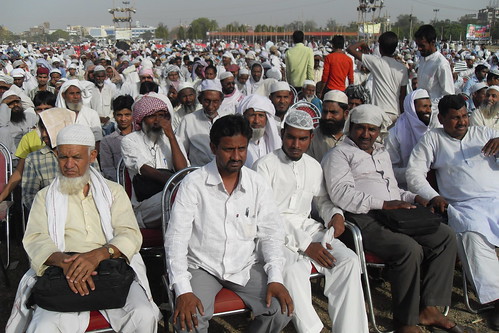
Muslims at Jamiat Ulema conference held in April 2010 in Patna

“India’s vibrant democracy, inclusive culture and growing economy
have made it easier for Muslim youth to find a place in the mainstream,
reduced the pool of potential recruits, and the space in which Islamic
extremist organizations can operate,” Mulford commented about Indian
Muslims.

He also highlighted the problems and backwardness of the Muslim
community in the country. India’s Muslim population suffers from higher
rates of poverty than most other groups in India, and can be the victims
of discrimination and prejudice. Despite this, the vast majority
remains committed to the Indian state and seek to participate in
mainstream political and economic life.

Endorsing secular credential of young Muslim generation he said: Most
Muslims approaching graduation at universities will be prepared to
enter the job market and are not interested in extremism.

Mr Mulford blasted the media propaganda that madrasas and Islamic seminaries in the country are teaching extremism.

The Indian media has published colorful stories implying that
Madrassas are recruiting centers for Islamic terrorism and that many are
funded by Pakistan’s ISI. The accounts are mostly anecdotal, however,
and there has been little or no hard evidence linking Indian Madrassas
to terrorist recruitment, he said.

Islamic extremism is not popular in India and most adults are not
interested. This forces extremists to pitch to young and naive audiences
who may be more amenable.

The US envoy said that at ground level both Muslim and non-Muslims are
facing similar problems as far as social mobility is concerned.

Muslims are facing the same pressures for social mobility as
non-Muslims. Most Indian children are under pressure to get into school,
stay in school, and perform well there, in order to obtain higher
education and access to well-paid jobs. Attempts by extremist groups to
recruit children from Muslim homes are likely to run into a wall of
opposition from parents who would see involvement in extremism as
counterproductive and a threat to future success of their children. This
means that extremism is most attractive to children from families that
are so poor that opportunities for education and advancement are all but
non-existent. As the Indian economy continues to boom, the percentage
of Muslim families who feel there is no hope for their children’s’
future is growing smaller, as is the pool of potential recruits.

The December 2005 commentary on Indian Muslims by Mulford was written at the request of Washington DC.

A Christmas Card From a Muslim Daughter

Amazing

behind the Christmas traditions my family celebrated every year of my
childhood. My mother was able to transform our Southern California home
into a Winter Wonderland as soon as we walked in the door; it may have
been 75 degrees and sunny outside, but inside we felt we were in a
Currier and Ives world of red velvet beribboned pine boughs, twinkling
lights and beautiful music. I loved it. The Christmas season and our
small traditions remained the same no matter how many years passed. My
mother worked extremely hard to build warm, and loving holiday memories,
and I sincerely cherish them.

Like many American homes, there wasn’t much Christ in my family’s

Christmas. There would always be some discussion surrounding the reason
for our celebration, but we didn’t attend church services or talk too
much about what my parents believed. The beautiful nativity on the
mantle, hand-painted by my grandmother, was flanked by tasteful, secular
decorations. This led to a kind of vague confusion between the
miraculous birth of Jesus, and the magical feat of Santa Claus zipping
around the world in one night.

Nostalgia not withstanding, thinking about Christmas is now far more

meaningful to me on a spiritual level than it was when I was young. The
fact that Muslims accept and believe in the virgin birth of Jesus has
been a golden thread that links my childhood Christmas memories to my
very fulfilling adult life as a Muslim.

The world’s more than 1.5 billion Muslims would like their Christian

neighbors to know that we believe in the Annunciation; in the Quran we
read that God sent the angels to Mary:

“When the angels said: O Mary, surely God gives you good news

with a Word from Him of one whose name is the Messiah, Jesus, son of
Mary, worthy of regard in th
is world and the hereafter and of those who
are made near to God. And he shall speak to the people when in the
cradle and when of old age, and he shall be one of the good ones.”
Quran 3:45-46

The Quran has only one chapter named after a woman; Chapter 19 is titled “Mary”, or as it is translated in Arabic — Maryam. The Quran tells us that the infant Jesus, (or Isa as it is translated in Arabic), spoke from Mary’s arms: “…He said: Surely I am a servant of God; He has given me the

Book and made me a prophet; And He has made me blessed wherever I may
be, and He has enjoined on me prayer and charity so long as I live; And
dutiful to my mother, and He has not made me insolent, unblessed; And
peace on me on the day I was born, and on the day I die, and on the day I
am raised to life.'”
Quran 19:30-33*

While Muslims don’t celebrate Christmas, we believe in the awesome

and miraculous birth of Jesus, in the miracles he performed by God’s
Grace, and in the message of love and peace Jesus brought to the world.

I hope my family knows that I am more attached to the account of

Jesus and Mary than I ever was as a child, now that I am a practicing
Muslim. It is a vital part of my faith; a faith that I share with over a
billion and a half people around the world.

This is my Christmas card to my family, and all my Christian friends and neighbors: Peace on earth and goodwill toward men.*Muslims understand this verse in reference to the to death of

Jesus after the second coming and resurrection on the Day of Judgment.
See Quran, 4:157

Follow Kari Ansari on Twitter:


www.twitter.com/KariAnsari

6 Ways to Boost Brain Power

Scientific American Mind 6 Ways to Boost Brain Power
By Emily Anthes

Adapted from the book The Instant Egghead Guide to the Mind, by Emily

Anthes and Scientific American. © 2008 by Scientific American. Published by

arrangement with St. Martin’s Press.

About The Author: Emily Anthes is a freelance science and health writer living

in Brooklyn. Her work has appeared in Seed, Discover, Slate, New York and the

Boston Globe, among other publications.

Amputees sometimes experience phantom limb sensations, feeling pain, itching or other impulses coming from limbs that no longer exist. Neuroscientist Vilayanur S. Ramachandran worked with patients who had so-called phantom limbs, including Tom, a man who had lost one of his arms. Ramachandran discovered that if he stroked Tom’s face, Tom felt like his missing fingers were also being
touched. Each part of the body is represented by a different region of the somatosensory cortex, and, as it happens, the region for the hand is adjacent to the region for the face. The neuroscientist deduced that a remarkable change had taken place in Tom’s somatosensory cortex. Ramachandran concluded that because Tom’s cortex was no longer getting input from his missing hand, the region processing sensation from his face had slowly taken over the hand’s territory. So touching Tom’s face produced sensation in his nonexistent fingers. This kind of rewiring is an example of neuroplasticity, the adult brain’s ability to change and remold itself. Scientists are finding that the adult brain is far more malleable than they once thought. Our behavior and environment can cause substantial rewiring of the brain or a reorganization of its functions and where they are located. Some believe that even our patterns of thinking alone are enough to reshape the brain. Researchers now know that neurogenesis (the birth of new neurons) is a normal
feature of the adult brain. Studies have shown that one of the most active regions for neurogenesis is the hippocampus, a structure that is vitally important for learning and long-term memory. Neurogenesis also takes place in the olfactory bulb, which is involved in processing smells. But not all the neurons that are born survive; in fact, most of them die. To survive, the new cells need nutrients
and connections with other neurons that are already thriving. Scientists are currently identifying the factors that affect the rate of neurogenesis and the survival of new cells. Mental and physical exercise, for instance, both boost neuron survival.
The adult human brain is surprisingly malleable: it can rewire itself and even grow new cells. Here are some habits that can fine-tune your mind.


Secular Nationalism Has Not Delivered Results

Home / Headlines / “Islam is the Solution” – Media Monitors Network (MMN)

“Islam is the Solution”
by Uri Avnery
(Saturday, December 4, 2010)

“In Turkey, the Ataturk revolution is now threatened by the upsurge of a rejuvenated Islam. In Israel, the new Hebrew nation is under siege by a fundamentalist, aggressive Judaism. All over the Arab world, the situation is worse….To put it bluntly: secular nationalism has not delivered. It has brought no real independence, no freedom, no economic and technological breakthrough.”

First, an apology: I am not going to write about the Wikileaks.

I like gossip as much as the next (wo)man. The leaks provide a lot of it, interspersed with some real information.

But there is nothing really new there. The information only confirms what any intelligent person could have worked out already. If there is anything new, it’s exactly this confirmation: the world is really managed the way we thought it was. How depressing.

Four hundred years ago, Sir Henry Wotton, a British diplomat, observed that “An ambassador is an honest man sent to lie abroad for the good of his country.” Since then, nothing has changed except that the ambassador has been joined by the ambassadress. So it is quite refreshing to listen to what they say in secret messages home, when they don’t have to lie.

That said, let’s move on to more important things.

THIS WEEK’S ELECTIONS in Egypt, for example.

Years ago, the story goes that a Soviet citizen went to the polling station on election-day and was handed a sealed envelope to put into the ballot box.

“Aren’t I allowed to see who I am voting for?” he asked.

“Of course not!” the stern-faced official retorted indignantly, “In our Soviet Union, the elections are secret!”

This could not happen in Egypt. First of all, because Egyptians are a very humorous people. If told that their elections were secret, they would burst out laughing.

Second, because they so obviously are not.

On one of my visits to Anwar Sadat’s Cairo, I had the chance to witness an election day. It was a jolly occasion, more a medieval carnival than a solemn fulfillment of democratic duty. Everybody was happy.

Visiting a polling station in a village near the Giza pyramids, I was struck by this atmosphere of jolly cynicism. No one even pretended that it was serious. Good-humored soldiers guarding the locale volunteered to help old women in choosing the right ballot and putting it in the envelope.

I am not sure whether this good humor has been retained under the Mubarak regime, but the results are the same. Media editors, all appointed by the government, prevent any criticism of the government. Opposition activists are arrested well before election day (if they are not in prison already). The government party is a sorry joke. No one seriously pretends that the country is anything but a dictatorship. The upper classes like it that way, not only out of fondness for their privileges but also out of a genuine fear that under democracy, their country would elect a fundamentalist religious regime, with burqas and all.

ALL OVER the Arab world, this is a real dilemma. Free elections would bring fundamentalists to power.

During the last century, secular nationalism was in vogue. In many Arab countries, nationalist movements sprang up. Their model was the great Ataturk – a revolutionary renovator as no other. He suppressed Islam, forbade the fez for men and the hijab for women, replaced the Arabic with the Latin script, fostered Turkish nationalism instead of the Ottoman Islamism.

This, by the way, was a model for many of us, who aspired to replace the Jewish religion and Zionist pseudo-nationalism with a healthy Hebrew territorial secular nationalism. The son of Eliezer Ben-Yehuda, the renovator of the modern Hebrew language, also proposed replacing the Hebrew script with a Latin one.

In Turkey, the Ataturk revolution is now threatened by the upsurge of a rejuvenated Islam. In Israel, the new Hebrew nation is under siege by a fundamentalist, aggressive Judaism. All over the Arab world, the situation is worse.

To put it bluntly: secular nationalism has not delivered. It has brought no real independence, no freedom, no economic and technological breakthrough.

In the economic sphere, no Arab country has succeeded in doing what has been done by Japan, South Korea and even Malaysia, and what is being done now by China and India. The successful Israeli example is near at hand and increases the frustration.

The dream of a secular pan-Arab union, as envisioned by Gamal Abd-al-Nasser and the original Ba’athists, is in tatters. So is the dream of Arab independence. Almost all Arab countries are backward American clients and dance to the American tune. A whole generation of Arab leaders has spectacularly failed.

The most recent example was Yasser Arafat. He created a Palestinian national movement that was proud of its non-sectarianism. Christian Arabs played a significant role in the Palestine Liberation Organization. George Habash was a Christian physician from Ramallah, the Christian Hanan Ashrawi is one of the most articulate Palestinian spokespersons.

Arafat himself was a practicing Muslim. Often, even in private conversations, he would excuse himself, disappear for a few minutes and return unobtrusively, while his assistants would whisper to us that the Ra’is was praying. Yet he never tired of assuring everyone that the future State of Palestine would be free of any religious domination.

As long as he was alive, political Islam remained a minor influence, and not because of any repressive measures.

ALL THIS is history. The Sunni Hamas (“Islamic Resistance Movement”) and the Shiite Hezbollah (“Party of God”) are becoming the models for masses of young people all over the Arab world.

One of the major reasons for this is Palestine.

If Arafat had succeeded in founding the free and sovereign State of Palestine, the texture of Arab politics would have changed, not only in Palestine itself but in all Arab countries.

The rise of Hamas in Palestine is a direct result of this failure. Secular Palestinian nationalism has been given a try, and has failed. The Islamic revolutionaries are appealing to a people deprived of all national and human rights, with no alternative in sight.

As the Wikileaks show (here I go, mentioning them after all) not one single Arab regime gives a damn about the Palestinians. That is nothing new – indeed, Arafat created his movement, Fatah (‘Palestinian Liberation Movement”), in order to liberate the Palestinians, first of all, from the cynical Arab regimes, all of which exploited the “Palestinian Cause” for their own ends.

But the depth of cynicism revealed in these conversations between Arab potentates and their American masters borders on outright betrayal. This will increase the already massive frustration not only in Palestine, but in all Arab countries. Any young Egyptian, Jordanian, Saudi or Bahraini (to mention only a few) must be acutely aware that his country is led by a small group for whom the preservation of their personal power and privileges is vastly more important than the holy cause of Palestine.

This is a deeply humiliating insight. It may not produce immediate results, but when hundreds of millions of people feel humiliated, the effects are foreseeable. The older generation may be used to this situation. But for young people, especially proud Arabs, it is intolerable.

I am very sensitive to this kind of feeling, because at the age of 15 I felt the same and joined the “terrorist” Irgun (“National Military Organization”). I just could not stand the sight of my leaders kowtowing b
efore the British rulers of my country. Putting myself in the shoes of a young Arab of similar age now in Jeddah, Alexandria or Aleppo, I can just imagine what he feels. Even Ehud Barak, that veteran Arab-fighter, once said that if he were a young Palestinian, he would join a terrorist organization.

Sooner or later, the situation will explode – first in one country, then in many. The fate of the Shah of Iran should be remembered by those who speak – in secret documents – about the “Iranian Hitler” who is on the verge of obtaining a nuclear bomb.

THE FRUSTRATION about Palestine is the immediate cause of this humiliation, being manifest for all to see, but the feeling itself goes beyond one single cause.

Secular nationalism has signally failed the Arabs. Communism has never taken root in the Islamic world, being by its very nature inimical to the basic tenets of Islam. Capitalism, while attractive to some, has also failed to solve any of the basic problems of the Arab world.

The Islamic revolutionary movement in its many forms promises a viable alternative. It is no fluke that the Egyptian dictatorship forbids the use of the slogan “Islam is the Solution” – the simple and effective slogan that unites the Islamic opposition in all the countries. There is a gaping vacuum in the Arab world, with no one there to fill it – except Islamism.

FOR THE US, this is a huge challenge. Obama seemed to have perceived it, before he was swallowed – head and body – by the American political routine.

Everybody seems to be talking about the Decline of the American Empire. It’s all the rage. What’s happening in the Arab world may accelerate or slow this process. The creation of a sovereign, free and viable State of Palestine – with the electrifying effect this would have throughout the Arab region, indeed the entire Islamic world – would slow it considerably.

Judging from these leaks, this seems very far from the minds of American statesmen and stateswomen, such as they are.

For Israel, the outlook is even grimmer. The prospect of a fundamentalist Arab world, with a completely new and popular set of leaders, surrounding us on all sides, with the power of America (and its Jewish lobby) declining ever more, is a frightening prospect indeed.

If I were responsible for Israel at this moment, I would worry about this much more than about the Iranian bomb.

Fortunately, this is not an inescapable danger. Israeli policy can do a lot to avert it. Unfortunately, we are doing the exact opposite.

To those who chant “Islam is the Solution”, our answer should be: “A just Peace is the Solution”.

Source:

by courtesy & © 2010 Uri Avnery

U.S. Pressured Saudis to Accept Climate Change Agreement

Leaked Cables Show U.S. Pressured Saudis to Accept Copenhagen Accord

The handful of climate-related cables–among the

hundreds of thousands of secret and unclassified messages released by
the whistle-blower organization Wikileaks–show the United States put
climate change at the center of its foreign policy relationship with the
oil-producing giant

By Lisa Friedman and Climatewire

CLIMATE DIPLOMACY: The
Obama administration leaned heavily on Saudi Arabia to associate itself
with the Copenhagen Accord climate change agreement, confidential State
Department memos show.

Image: Pete Souza, courtesy whitehouse.gov

The Obama administration leaned heavily on Saudi Arabia to
associate itself with the Copenhagen Accord climate change agreement,
confidential State Department memos show.

The handful of climate-related cables — among the hundreds of thousands
of secret and unclassified messages released by the whistle-blower
organization Wikileaks — show the United States put climate change at
the center of its foreign policy relationship with the oil-producing
giant in the months after last year’s blowout U.N. climate summit in
Denmark.

“You have the opportunity to head off a serious clash over climate
change,” James Smith, the U.S. ambassador to Saudi Arabia, wrote to
Secretary of State Hillary Rodham Clinton as she prepared for a February
visit to the kingdom.

“Saudi officials are very concerned that a climate change treaty would
significantly reduce their income just as they face significant costs to
diversify their economy,” Smith wrote. “The King is particularly
sensitive to avoid Saudi Arabia being singled out as the bad actor,
particularly on environmental issues.”

And in a memo summarizing the trip of Assistant Secretary of State for
Near Eastern Affairs Jeffrey Feltman to Saudi Arabia in January, Smith
wrote that Feltman urged the country to send a formal notice to the
United Nations indicating its acceptance of the climate pact.

“A/S Feltman noted the importance that the President places on climate
change, and the Copenhagen Accord,” Smith wrote. “Given that Minister of
Petroleum Al-Naimi was involved in crafting the final agreement, A/S
Feltman noted the United States is counting on Saudi Arabia to associate
itself with the accord by January 31.”

Saudi leaders were noncommittal, according to the cable, noting that the
country’s ministries would need to consult on the topic.

A push for information on key negotiators

The memos come as international climate talks kick off in Cancun,
Mexico. This year, the focus of the United States is to nail down the
agreements that President Obama and other world leaders made in
Copenhagen and to devise a set of formal decisions setting in motion
emission cuts and the mobilization of funding for poor countries that so
far has been agreed to in principle.

The vast majority of the leaked cables deal with Iran’s nuclear program
and other diplomatic issues. But the handful of times that climate
change is raised, it appears as a front-burner Obama administration
issue, a ClimateWire review of the cables found. They provide new
insight into the behind-the-scenes discussions leading up to Copenhagen
and the focus of the administration after the meeting.

In the months before Copenhagen, the summit was listed as a “substantive
issue” about which diplomats were directed to gather information. One
memo getting a lot of attention asks U.S. envoys at the United Nations
and elsewhere to procure credit card and frequent flier numbers as well
as other biographical data. In that same document, diplomats are
instructed to relate “perceptions of key negotiators on U.S. positions
in environmental negotiations” and indications about how cooperative
countries may be.

The document also asks diplomats to be on the lookout for information
about whether countries adhere to their own environmental programs and
laws, and any “efforts by treaty secretariats to influence treaty
negotiations or compliance.”

China makes a brief appearance in the cables. After a meeting of G-5
ambassadors in Beijing in May, acting Deputy Chief of Mission William
Weinstein relayed to Washington that U.K. and Chinese officials
discussed the then-upcoming Copenhagen talks.

“In the lead up to Copenhagen, China would not agree to targets on
emissions, but was willing to be constructive and would come to
Copenhagen with a package of action items related to nuclear power,
renewable energy and reforestation,” Weinstein wrote, adding that the
U.K. diplomat added that “his impression was that China could be induced
to do more on climate change.”

Indeed, by the time nations met in Copenhagen, China had pledged to cut
its carbon intensity about 45 percent below 2005 levels in the next
decade.

Warning signals about skeptics in France
U.S. European envoys sent up warning flares early last year about both
the U.S. political landscape and prospects for Copenhagen. In a memo
called “Scenesetter,” as Secretary Clinton prepared for a trip to France
late last year, U.S. Ambassador to France Charles Rivkin included the
heading, “An urgent focus on climate change.”

In it, he wrote, “The French remain divided on how to respond to the Obama administration’s approaches to climate change.”

At the time, the U.S. House had passed legislation to cut carbon
emissions about 17 percent below 2005 levels in the next decade — a
target that much of Europe considered pitifully low. The Senate later
failed to pass any climate bill, and cap-and-trade legislation is these
days considered dead for the foreseeable future.

According to the November 2009 cable, though, French analysts were early
in recognizing a difficult U.S. political horizon, and American
officials worked hard to stamp out concerns about the strength of the
Obama administration’s commitment to climate action.

“Even sophisticated observers are skeptical that long-term reduction
goals legislated in the United States can be counted on as more than
aspirations, especially if radical cuts are not imposed up front,”
Rivkin wrote. “We have reiterated that U.S. laws are reliably enforced
by the federal government and by U.S. courts, using the Clean Air Act as
an example.”

Rivkin also said that officials in France’s Ministry of Foreign Affairs
took exception to a comment that Environment Minister Jean-Louis Borloo
made criticizing the U.S. House measure, and described the minister’s
comments as “distracting attention from the need for China and India to
reduce their rates of growth of GHG.”

Germans lowered expectations before Copenhagen
And as Clinton arrived in Germany to celebrate the 20th anniversary of
the fall of the Berlin Wall in early December, clim
ate change was also
high on the agenda. According to the Nov. 5, 2009, cable, German
officials wanted “strong U.S. leadership” going into the Copenhagen
summit and advocated for a common position toward major emerging
economies, particularly China and India.

That missive also gave early glimpses of the early efforts to try to
dampen sky-high expectations for that meeting — because of the unlikely
possibility of U.S. action.

“German leaders recognize the challenge of passing climate change
legislation in the U.S. and have lowered their expectations for the
possibility of reaching a legally-binding agreement next month at
Copenhagen,” the cable notes. “They have begun to describe the summit as
one step in a larger process — a politically binding framework — and
may be preparing the German public for a less ambitious outcome.”

Analysts said the Saudi memos, in particular, show the lengths the Obama
administration went to in order to sway a fierce opponent of
international climate action. Saudi Arabia, the world’s largest oil
producer, has a long tradition of blocking movement in the U.N. climate
talks. It and other oil-producing nations have, among other things,
claimed a need for adaptation funding — normally reserved for the poor
nations that have done little to cause climate change but are bearing
the brunt of weather disasters and other problems — because of rising sea levels that threaten offshore oil rigs.

After the Copenhagen summit, Saudi officials expressed “satisfaction”
with the political agreement. But so far, the country has not formally
associated itself with the agreement.

Nevertheless, said World Resources Institute Climate Director Jennifer
Morgan, the cables are “a sign, to me, that the administration is
serious about climate change, and serious about it as a foreign policy
topic if it is raising it with one of its partners who takes a different
position with the U.S.”