Peace Homes Aluva

Simplify Building Your Dream Home

Civil Disobedience: Muslim women flout French ban of veil

Kenza Drider, wearing an Islamic face veil announces in front of Meaux court house, east of Paris that she will be candidate for the 2012 French presidential elections Thursday Sept. 22, 2011. Drider declared her longshot candidacy Thursday, the same day that a French court fined two women who refuse to remove their veils. All three are among a group of women mounting an attack on the law that has banned the garments from the streets of France since April, and prompted similar moves in other European countries. Kenza Drider, wearing an Islamic face veil announces in front of Meaux court house, east of Paris that she will be candidate for the 2012 French presidential elections Thursday Sept. 22, 2011. Drider declared her longshot candidacy Thursday, the same day that a French court fined two women who refuse to remove their veils. All three are among a group of women mounting an attack on the law that has banned the garments from the streets of France since April, and prompted similar moves in other European countries. (AP Photo/Remy de la Mauviniere)

PARIS—Kenza Drider’s posters for the French presidential race are ready to go, months before the official campaign begins. There she is, the “freedom candidate,” pictured standing in front of a line of police — a forbidden veil hiding her face.

Drider declared her longshot candidacy Thursday, the same day that a French court fined two women who refuse to remove their veils. All three are among a group of women mounting an attack on the law that has banned the garments from the streets of France since April, and prompted similar moves in other European countries.

They are bent on proving that the ban contravenes fundamental rights and that women who hide their faces stand for freedom, not submission.

“When a woman wants to maintain her freedom, she must be bold,” Drider told The Associated Press in an interview.

President Nicolas Sarkozy strongly disagrees, and says the veil imprisons women. Polls show that most French people support the ban, which authorities estimate affects fewer than 2,000 women who wore the veil before the ban.

Drider declared her candidacy Thursday in Meaux, the city east of Paris run by top conservative lawmaker and Sarkozy ally Jean-Francois Cope, who championed the ban.

“I have the ambition today to serve all women who are the object of stigmatization or social, economic or political discrimination,” she said. “It is important that we show that we are here, we are French citizens and that we, as well, can bring solutions to French citizens.”

Two other women arrested wearing veils in Meaux — while trying to deliver a birthday cake to Cope — were fined in court Thursday, one euro120, the other euro80.

They want to push their case to the European Court of Human Rights.

“We cannot accept that women be punished because they are openly practicing their religious convictions. We are demanding the application of European rights,” said one of those convicted, Hind Ahmas.

With Islam the second religion in France and numbers of faithful growing, there are worries that veiled Muslim women could compromise the nation’s secular foundations and undermine gender equality and women’s dignity. There are also concerns that practices like wearing full veils could open the door to a radical form of Islam. Lawmakers banned Muslim headscarves in classrooms in 2004.

Few Muslim women in France cover their faces. Most who veil themselves wear the “niqab,” a filmy cloth attached to the headscarf that covers all but the eyes. The law also affects the burqa, with just a mesh covering over the eyes, worn largely in Afghanistan.

Belgium passed a similar face veil ban that took effect in July, and the Netherlands announced Friday it has drawn up legislation to outlaw Muslim face veils. A draft law has been approved in Italy.

In France, the veil ban was also seen as a political maneuver by the unpopular Sarkozy’s conservative UMP party, which Cope chairs, to entice deeply conservative and far-right voters.

Flouting the French measure outlawing face veils in all public places can lead to a fine of euro150 and, in some cases, citizenship classes. However, thus far there have been few legal consequences.

According to the Interior Ministry, 146 women have been given citations by police but only a handful have reportedly been forced to take the next step — appear before a judge for a possible fine. The Justice Ministry says figures are not yet available.

“I tried to understand this law and what I understood is that this is a law which puts us under house arrest,” Drider said, referring to women who choose to stay home rather than remove their face veils, or risk arrest.

What the law has done, she says, is give citizens the right to insult veiled women.

Drider and others say that many women who refuse to remove their veils become shut-ins rather than go outside and risk a citation, or insults. One woman in a long black robe was seen recently in a chic Paris neighborhood wearing a surgical mask on her face — one of several tricks developed to get around the ban.

Drider, 32, who has worn a face veil for 13 years, hasn’t shirked from denouncing the ban in the past. She was the only veiled woman to testify before an information commission of lawmakers studying a potential ban before the law was passed.

With four children, Drider says she goes about the southern city of Avignon, where she lives, facing down insults but left alone by police.

Ahmas, 32, from Aulnay-Sous-Bois, a northeast Paris suburb, looked for trouble when she tried to deliver an almond cake to Cope, the mayor of Meaux, with another veiled woman. The gesture was not without a touch of humor: in French, “almond” sounds like “fine.”

The women, while intent on showing the power behind the veil, have a male backer. Rachid Nekkaz, a wealthy businessman revolted by the street ban, has promised to pay fines for women sanctioned for breaking the law. With his association, Don’t Touch My Constitution, he heads Drider’s support committee for the presidency.

For Nekkaz, the Meaux case will be the first in France in which a conviction for veiled women could stick. He wants to see an a
ppeal eventually go to the highest French court, then on to the European Court of Human Rights and calculates that this could happen in 2014.

Drider has obstacles to overcome, too, like getting 500 mayors to back her candidacy, a requirement for anyone running for the presidential elections in April and May. With more than 36,000 mayors in France, she thinks this is doable — despite her status as a lawbreaker.

Both women insist that neither Drider’s candidacy for the presidential race nor the Meaux court case are a provocation because their aim is to set aright a measure they say has skewed French values and compromised women’s rights.

“My candidacy is to say the real problem in France is not us … The real problem in France is really women’s freedom … whatever their religion,” she said. “So let’s not focus on what I wear. Let’s deal with the real problems. My candidacy is really for that, to say don’t stop at what I wear but go much deeper.”

Islamic cultural center open in N.Y.

Islamic cultural center open in N.Y.

Sep 22, 2011  |  

An NYPD officer keeps watch during the Wednesday grand opening of the Park51 Islamic cultural center in New York City. It's near Ground Zero, and the project has drawn criticism from opponents who say they don't want a Muslim prayer space near the site of the Sept. 11, 2001, terrorist attacks.

An NYPD officer keeps watch during the Wednesday grand opening of the Park51 Islamic cultural center in New York City. It’s near Ground Zero, and the project has drawn criticism from opponents who say they don’t want a Muslim prayer space near the site of the Sept. 11, 2001, terrorist attacks.

NEW YORK — The developer of an Islamic cultural center that

opened Wednesday evening near the site of the terrorist attacks that
leveled the World Trade Center says the biggest error on the project was
not involving the families of 9/11 victims from the start.

People crowded into the center, where a small orchestra played traditional
Middle Eastern instruments and a photo exhibit of New York children of
different ethnicities lined the walls. The enthusiasm at the opening
belied its troubled beginnings.

“We made incredible mistakes,” Sharif El-Gamal told the Associated Press in an earlier interview.

The building at 51 Park Place, two blocks from Ground Zero, includes a
mosque that has been open for two years. El-Gamal said the cultural
center is modeled after the Jewish Community Center on Manhattan’s Upper
West Side, where he lives.

“I wanted my daughter to learn how to
swim, so I took her to the JCC,” said the Brooklyn-born Muslim. “And
when I walked in, I said, ‘Wow. This is great.’ “

The project has drawn criticism from opponents who say they don’t want a Muslim prayer
space near the site of the Sept. 11 terrorist attacks.

The center is open to all faiths and will include a 9/11 memorial, El-Gamal said.
He called opposition to the center — which prompted one of the most
virulent national discussions about Islam and freedom of speech and
religion since Sept. 11 — part of a “campaign against Muslims.”

Last year, street clashes in view of the trade center site pitted supporters against opponents of the center.

When the center was first envisioned, several years ago, activist Daisy Khan
and her husband, Imam Feisal Abdul Rauf, played a major, vocal role.
But they soon left the project because of differences with the
developer. El-Gamal, 38, confirmed Wednesday that they parted ways because “we had a different vision.”

The couple said they had discussed plans for Park51, as the center is
known, with relatives of 9/11 victims, first responders and others. But
El-Gamal said he wishes victims’ families had been involved earlier —
before the center became a point of contention. “The biggest mistake we
made was not to include 9/11 families,” El-Gamal said, noting that the
center’s advisory board now includes at least one 9/11 family member.

El-Gamal also noted that the featured photographer in the “NYChildren” exhibit is Danny Goldfield, who is Jewish.

Goldfield said he didn’t want to pass judgment on the center’s opponents. But he
said he’d like them to see the show “more than anyone.”

El-Gamal said that fund-raising is under way to complete the 15-story building
that also is to include an auditorium, educational programs, a pool, a
restaurant and culinary school, child care services, a sports facility, a
wellness center and artist studios.

The mosque is needed in lower Manhattan, he said, because thousands of Muslims either work or live in the area.

Athletic, Muslim, Fashionable

Athletic, Muslim, Fashionable – a Tale of the Sports Hijab

 Olympic hopeful, 17-year-old Zeinab Hammoud

Olympic hopeful, 17-year-old Zeinab Hammoud

Female Muslim athletes who observe a strict Islamic dress code sometimes face the question of whether they will be allowed to participate in major competitions — with their heads and most of their bodies covered.  Now, one Iranian-Canadian woman is marketing a product to change that.  It complies with the requirements of many major sports, and it’s fashionable, safe and comfortable — while still meeting Islamic requirements.

An Olympic hopeful faces a small obstacle

Seventeen-year-old Zeinab Hammoud has a brown belt in Taekwondo, and dreams of one day making it to the Olympics.  But unlike her sister, Rana, Zeinab chooses to wear the Islamic headscarf, or hijab.  

This became a problem four years ago. The team’s hard work, passion and hopes were dashed when the Taekwondo Federation of Quebec expelled them from a tournament in 2007. The reason: their hijabs were considered unsafe. “I was really disappointed because I trained really hard for that tournament. When I found out we were expelled I lost all my motivation to continue,” Hammoud said.

Civil rights supporters and sports enthusiasts around the world were enraged. Elham Seyed Javad was one of them. “In my opinion every individual, no matter their religion, should have the same rights as anyone else in society,” he stated. “I mean, sports was made to re-unite people.”

Athletic fashion

Javad was an industrial design student at the time, so she decided to take on the problem as one of her school projects. “At the time, in 2008, when I decided to take on this project, the international federation of Taekwondo didn’t allow its athletes to wear anything under the helmet. So my professor didn’t think there was a point of pursuing it.  But my point was, the rule is there because nothing has been invented that is appropriate,” she explained.

Javad spent countless hours with the Hammoud sisters’ taekwondo team and with pattern maker Latifa Boukenda, to make the best product possible. “This was a very exciting project for me. I’ve worked in fashion for many years but this was special because it was beyond fashion,” she said. “It had a more human and social aspect to it. helping young women blossom and follow their athletic dreams.”

Ultimately, they hit upon a design that worked, and a fabric that was stretchy, breathable, and dried quickly.  Called a “ResportOn,” the garment was an immediate hit.

Even Zeinab’s sister Rana, who chooses not to wear the hijab, was impressed. “I just tried the Resport hijab and the hair was inside so it doesn’t come out and it’s very comfortable so you can play without trying to put your hair inside all the time,” she noted.

Rules reconsidered, changed

Javad’s invention came at an opportune time.  A year later, in response to pressure from the taekwondo community, the World Taekwondo Federation changed its rules to allow for head-coverings.

The Montreal Muslim Taekwondo team was able to compete again.

“I was in the stands and got teary-eyed because since the very beginning my goal was to be able to see the girls on the mats again. When it happened it was like someone gave me the world,” Javad stated.

Javad thought she was just helping Zeinab and her teammates.  But when an investor approached her about marketing the product, things changed dramatically.  In January, her sports hijab became available to athletes all over the world.  She has been busy ever since. “My days start at 2am when my phone goes off with an email from an athlete from the other side of the world. I turn it on and read the email, get happy and go back to sleep,” she said.

While there are other sports hijabs on the market, Javad believes hers has some advantages.  Those include a built-in t-shirt that keeps it from pulling loose, and an opening at the back that allows easy access for wearers to adjust their hair.

സകാത്തുല്‍ ഫിത്വ്‌ര്‍

സകാത്തുല്‍ ഫിത്വ്‌ര്‍

റമദാന്‍ മാസത്തില്‍ പ്രത്യേകമായി ശ്രദ്ധപതിപ്പിക്കേണ്ട ഒരു സകാത്ത്‌ ഇസ്‌ലാം നിശ്ചയിച്ചിട്ടുണ്ട്‌. അതാണ്‌ വ്രതസമാപന സകാത്ത്‌ അഥവാ സകാത്തുല്‍ ഫിത്വ്‌ര്‍.
“മുസ്‌ലിംകളിലെ അടിമകള്‍, സ്വതന്ത്രര്‍, പുരുഷന്മാര്‍, സ്‌ത്രീകള്‍, ചെറിയവര്‍, വലിയവര്‍ (എന്നീ വേര്‍തിരിവുകളില്ലാതെ) എല്ലാവരുടെ പേരിലും ഓരോ സ്വാഅ്‌ കാരക്കയോ ബാര്‍ലിയോ ഫിത്വ്‌ര്‍ സകാത്ത്‌ നല്‍കല്‍ ബാധ്യതയായി അല്ലാഹുവിന്റെ ദൂതര്‍(സ) നിര്‍ബന്ധമായി നിശ്ചയിച്ചിരിക്കുന്നു. പെരുന്നാള്‍ നമസ്‌കാരത്തിന്‌ ആളുകള്‍ പുറപ്പെടുന്നതിനു മുമ്പായി അത്‌ നല്‍കണമെന്നും അദ്ദേഹം കല്‌പിച്ചിരിക്കുന്നു.” (ബുഖാരി, മുസ്‌ലിം)
റമദാന്‍ അവസാനിക്കുന്നതോടെയാണ്‌ ഈ സകാത്ത്‌ നിര്‍ബന്ധമായിത്തീരുന്നത്‌. ഈദുല്‍ഫിത്വ്‌ര്‍ (ശവ്വാല്‍ ഒന്ന്‌) നമസ്‌കാരത്തിന്‌ പുറപ്പെടുന്നതോടെ അതിന്റെ സമയം അവസാനിക്കുകയും ചെയ്യുന്നു. ഹ്രസ്വമായ സമയപരിധിക്കുള്ളില്‍ അത്‌ പൂര്‍ണമായി നിര്‍വഹിക്കപ്പെടാന്‍ പ്രയാസമാണെങ്കില്‍ വ്രതസമാപനത്തിന്‌ രണ്ടോ മൂന്നോ ദിവസം മുമ്പായി അത്‌ കൊടുക്കുകയും ചെയ്യാം. ഇബ്‌നു ഉമര്‍(റ) പറയുന്നു: “അവര്‍ (സ്വഹാബികള്‍) ഫിത്വ്‌ര്‍ സകാത്ത്‌ പെരുന്നാളിന്റെ ഒന്നോ രണ്ടോ ദിവസം മുമ്പ്‌ നല്‍കാറുണ്ടായിരുന്നു.” (ബുഖാരി)
സമ്പത്ത്‌ എന്ന അല്ലാഹുവിന്റെ അനുഗ്രഹം ലഭിച്ചവര്‍ക്ക്‌ മാത്രം നിര്‍ബന്ധമാണ്‌ സാധാരണ സകാത്ത്‌. അതിന്‌ നിശ്ചിത പരിധിയും കൃത്യമായ തോതും കണക്കുമെല്ലാം നിശ്ചയിക്കപ്പെട്ടിരിക്കുന്നു. എന്നാല്‍ സകാത്തുല്‍ ഫിത്വ്‌ര്‍ സമ്പത്തിന്റെ മാനദണ്ഡമനുസരിച്ചല്ല നല്‍കേണ്ടത്‌. കണക്കനുസരിച്ച്‌ തന്റെ സമ്പത്തിന്റെ സകാത്ത്‌ കൊടുത്തുതീര്‍ത്തവരും കണക്കനുസരിച്ച്‌ സകാത്ത്‌ കൊടുക്കാന്‍ മാത്രം സമ്പത്തില്ലാത്തവരും സകാത്തുല്‍ ഫിത്വ്‌ര്‍ കൊടുക്കേണ്ടതുണ്ട്‌. നിത്യവൃത്തിക്ക്‌ വകയില്ലാത്തവര്‍ മാത്രമേ ഇതിന്റെ നിര്‍ബന്ധ കല്‌പനയില്‍ നിന്ന്‌ ഒഴിവാക്കപ്പെടുകയുള്ളൂ.
മനുഷ്യസഹജമായ താല്‌പര്യം അംഗീകരിച്ചുകൊണ്ട്‌ അല്ലാഹു നിശ്ചയിച്ച ആഘോഷം എന്ന നിലയില്‍ പെരുന്നാളിന്റെ ആഹ്ലാദം പങ്കിടുവാന്‍ നിത്യവൃത്തിക്ക്‌ കഷ്‌ടപ്പെടുന്നവര്‍ക്കുപോലും സാധിക്കണമെന്നതാണ്‌ സകാത്തുല്‍ ഫിത്വ്‌ര്‍ കൊണ്ട്‌ ലക്ഷ്യമാക്കുന്നത്‌. ജീവിതത്തില്‍ സൂക്ഷ്‌മത കൈവരിക്കാനും വന്നുപോയ പാളിച്ചകള്‍ക്ക്‌ പരിഹാരവും പ്രായശ്ചിത്തവുമായിക്കൊണ്ടുമാണ്‌ സത്യവിശ്വാസി വ്രതമനുഷ്‌ഠിക്കുന്നത്‌. നോമ്പുകാരന്‌ വീണ്ടും വിമലീകരണത്തിനുള്ള അവസരം കൂടിയാണ്‌ സകാതുല്‍ ഫിത്വ്‌ര്‍. “അനാവശ്യമായ വാക്കും പ്രവൃത്തിയും മൂലം നോമ്പുകാരന്‌ വന്നുപോയ പിഴവുകളില്‍ നിന്ന്‌ അവനെ ശുദ്ധീകരിക്കാനും പാവങ്ങള്‍ക്ക്‌ ആഹാരത്തിനുമായി റസൂല്‍(സ) സകാത്തുല്‍ ഫിത്വ്‌ര്‍ നിര്‍ബന്ധമാക്കിയിരിക്കുന്നു.” (അബൂദാവൂദ്‌, ഇബ്‌നുമാജ)
കാരക്കയും ബാര്‍ലിയും മാത്രമല്ല നാട്ടിലെ പ്രധാന ആഹാര സാധനങ്ങളാണ്‌ ഫിത്വ്‌ര്‍ സകാത്തായി നല്‍കേണ്ടത്‌ എന്നാണ്‌ സ്വഹാബിമാരുടെ പ്രവര്‍ത്തനങ്ങളില്‍ നിന്ന്‌ മനസ്സിലാകുന്നത്‌. അബൂസഈദില്‍ ഖുദ്‌രി(റ) പറയുന്നു: “ഒരു സ്വാഅ്‌ ഗോതമ്പ്‌, അല്ലെങ്കില്‍ ഒരു സ്വാഅ്‌ ബാര്‍ലി, അല്ലെങ്കില്‍ ഒരു സ്വാഅ്‌ പാല്‍ക്കട്ടി, അല്ലെങ്കില്‍ ഒരു സ്വാഅ്‌ മുന്തിരി എന്നിങ്ങനെയായിരുന്നു ഞങ്ങള്‍ സകാത്തുല്‍ ഫിത്വ്‌ര്‍ കൊടുത്തുവന്നിരുന്നത്‌.” (ബുഖാരി)
സകാത്തുല്‍ ഫിത്വ്‌ര്‍ അരി കൊടുക്കണമെന്ന്‌ വിശുദ്ധ ഖുര്‍ആനിലോ ഹദീസിലോ പറഞ്ഞിട്ടില്ലെങ്കിലും നമ്മുടെ നാട്ടില്‍ അരിയാണ്‌ സകാത്തുല്‍ ഫിത്വ്‌ര്‍ നല്‍കേണ്ടതെന്ന കാര്യത്തില്‍ മ

Al-Jazari: The Mechanical Genius

Al-Jazari: The Mechanical Genius

Professor Salim T S Al-Hassani *

Al-Jazari was the most outstanding mechanical engineer of his time. His full name was Badi’ al-Zaman Abu-‘l-‘Izz Ibn Isma’il Ibn al-Razzaz al-Jazari. He lived in Diyar-Bakir (in Turkey) during the 6th century H (late 12th century-early 13th century CE).

Large image

Figure 1: Wash-basin in the form of a peacock described by Al-Jazari in Kitab fi Ma’rifat al-Hiyal al-Handisayya. Manuscript copied in Sha’ban 6002/ March 1205. (Source).

Large image

Large image

Figure 2 a-b:

He was called Al-Jazari after the place of his birth, Al-Jazira, the area lying between the Tigris and the Euphrates in Mesopotamia. Like his father before him, he served the Artuqid kings of Diyar-Bakir for several decades (at least between 570 and 597 H/1174-1200 CE) as a mechanical engineer. In 1206, he completed an outstanding book on engineering entitled Al-Jami’ bayn al-‘ilm wa-‘l-‘amal al-nafi’ fi sinat’at al-hiyal in Arabic. It was a compendium of theoretical and practical mechanics. George Sarton writes: "This treatise is the most elaborate of its kind and may be considered the climax of this line of Muslim achievement" (Introduction to the History of Science, 1927, vol. 2, p. 510).

Large image

Figure 3: Model of a blood letting device as described by Al-Jazari and reconstructed in 1977. It measured the blood lost during phlebotomy (blood-letting) sessions, a popular therapy in the Islamic medieval world. Two scribes are seated above the device and their actions describe the amount of blood to be let. Currently on display in The Science and Art of Medicine (inventory number : 1981-1710). (Source).

Al-Jazari’s book is distinctive in its practical aspect because the author was a competent engineer and skilled craftsman. The book describes various devices in minute detail, providing hence an invaluable contribution in the history of engineering. British charter engineer and historian of Islamic technology Donald R. Hill (1974) who held a special interest in Al-Jazari’s achievements wrote:

Large image

Figure 4: Al-Jazari’s water powered scribe clock brought back to life after 800 years by FSTC. The clock stands 1 metre high and half a metre wide; the scribe with his pen is synonymous to the hour hand of a modern clock. Click here to see the animation. (Source).

"It is impossible to over emphasize the importance of Al-Jazari’s work in the history of engineering, it provides a wealth of instructions for design, manufacture and assembly of machines."

Large image

Figure 5: Picture of the internal structure of an automata for dispensating liquids. © JC Heuden at Virtual Worlds. (Source).

Al-Jazari described fifty mechanical devices in six different categories, including water clocks, hand washing device (wudhu’ machine) and machines for raising water, etc. Following the "World of Islam Festival" held in the United Kingdom in 1976, a tribute was paid to Al-Jazari when the London Science Museum showed a successfully reconstructed working model of his famous "Water Clock."

Large image

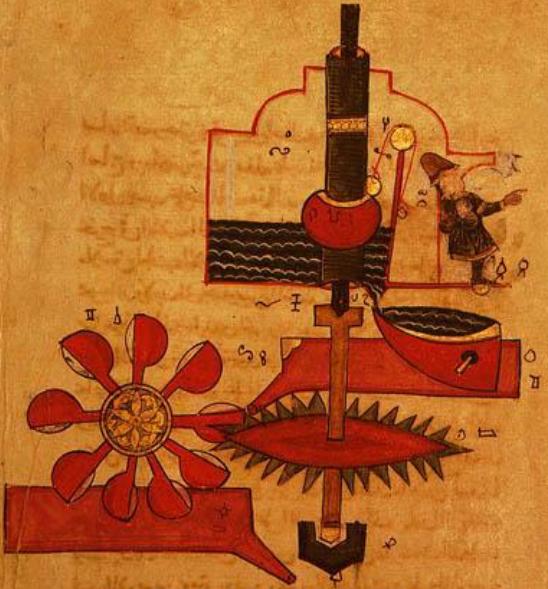
Figure 6: The original drawing of the double action or reciprocating pump from Al-Jazari’s manuscript. Topkapi Palace Museum Library, Ahmet III, MS 3472. (Source).

Donald R. Hill translated into English Al-Jazari’s book in 1974, seven centuries and 68 years after it was completed by its author. Al-Jazari’s encyclopedic treatise includes six main categories of machines and devices. Several of the machines, mechanisms and techniques first appear in this treatise, later entering the vocabulary of European mechanical engineering. Among these innovations, we mention the double acting pumps with suction pipes, the use of a crank shaft in a machine, accurate calibration of orifices, lamination of timber to reduce warping, static balancing of wheels, use of paper models to establish a design, casting of metals in closed mould boxes with green sand, etc. Al-Jazari also describes methods of construction and assembly in scrupulous detail of the fifty machines to enable future craftsmen to reconstruct them.

Large image

Figure 7: 3D model recreated by FSTC of the double action pump of Al-Jazari. Click here to view the animation. ©FSTC 2009.

And he was successful in that, for many of his devices were constructed following his instructions. The work by Al-Jazari is also unique in the way that other writers often fail to give sufficient details, because – amongst other factors – they were not craftsmen themselves, or kept their secrets, or if they were craftsmen, they could have been illiterate. Al-Jazari in this respect was unique, and this gives his work immense value. His book, Hill states, is an absolute wealth of Islamic mechanical engineering.

In their paper on "Mechanical Engineering during the Early Islamic Period" (published in I. Mech. E, The Chartered Mechanical Engineer, 1978, pp. 79-83), C. G. Ludlow and A. S. Bahrani have raised the important point that it is more than likely that there is more on the subject in some of the thousands of Arabic manuscripts in the world libraries which have not yet been inspected closely, and obviously require looking into.

Hill, too, constantly raises the two major issues with respect to the history of engineering in general, and that of fine technology in particular. He first states the fact that the field, which is absolutely immense, is yet largely unexplored.

Large image

Figure 8: View of The Elephant Clock: Leaf from a manuscript of Al-Jazari’s Kitab fi macrifat al-hiyal al-handasiyya dated 715 H/1315 CE. (Source).

The other issue is related to fine technology. One of his concluding points states that "it is hoped that, as research proceeds, firmer evidence for the transmission of Islamic fine technology into Europe can be provided." Hill also offers some hints for such transmission. The most likely route was Spain. Such fine technology could have followed the same route as the astrolabe (itself part of this fine technology.) Apart from Spain, there were other possible lands of transfer: Sicily, Southern France, Italy, Byzantium and Syria during the Crusades. Hill is also right on a further account, that what will be seen in this work is just a fraction of the whole process, which, as with much else has hardly been explored.

The animation presented in figure 7 shows a virtual model of one of Al-Jazari’s water raising pumps. The details of this unique pump were obtained from his manuscript and Hill’s diagrams. We see two suction pumps in synchronous motion driven by a paddle wheel, which is driven by a water stream.

Large image

Figure 9: 3D model recreated by FSTC of the Elephant clock. Click here to view the animation. ©FSTC 2009.

The other animation is for a 3D model recreated from the description of the elephant clock as described by Al-Jazari (see below fig. 9). Full details of this animation are given in the works authored by the author and his collaborators published in the book 1001 Inventions: The Muslim Heritage in Our World (chief editor Salim al-Hassani, Manchester: FSTC, 2006) and in articles that can be consulted online on www.MuslimHeritage.com (see especially the two special folders devoted to Islamic technology: Al-Jazari and Taqi al-Din).

Large image

Figure 10: A table device automaton designed by Al-Jazari. Manuscript dated from the early 14th century (1315), copied in Syria by Farrukh ibn Abd al-Latif. Opaque watercolor, ink and gold on paper. © The Smithsonian Institution, Washington. (Source).

Large image

Figure 11: A large ewer held by a kneeling female attendant in a domed pavilion designed by Al-Jazari: once the bird whistles, water pours into a basin below; a duck then drinks the used water and releases it through its tail into a container hidden under the platform. © The Smithsonian Institution, Washington. (Source).

* Emeritus Professor at the University of Manchester and Chairman of The Foundation for Science, Technology and Civilisation (FSTC), Manchester, UK.

by: Professor Salim Al-Hassani, Fri 09 February, 2001


Related Articles:
The List of Al-jazari Articles Published on MH.com by: FSTC Limited
Some 800 years in the past, in 1206, a brilliant Muslim scholar died : Badi? al-Zaman Abu al-‘Izz ibn Isma?il ibn al-Razzaz al-Jazari. He was one of the most important inventors and mechanical engineers in the history of technology. His magnum opus book of mechanics, the famous Al-Jami? bayn al-?ilm wa ‘l-?amal al-nafi? fi sina?at al-hiyal (A Compendium on the Theory and Useful Practice of the Mechanical Arts) was the most significant treatise of the Islamic tradition of mechanical engineering and a ground breaking work in the history of mechanics.

Al-Jazari: 800 Years After by: FSTC Limited
Some 800 years in the past, in 1206, a brilliant Muslim scholar died : Badi? al-Zaman Abu al-‘Izz ibn Isma?il ibn al-Razzaz al-Jazari. He was one of the most important inventors and mechanical engineers in the history of technology. His magnum opus book of mechanics, the famous Al-Jami? bayn al-?ilm wa ‘l-?amal al-nafi? fi sina?at al-hiyal (A Compendium on the Theory and Useful Practice of the Mechanical Arts) was the most significant treatise of the Islamic tradition of mechanical engineering and a ground breaking work in the history of mechanics.

Al-Jazari’s Castle Water Clock: Analysis of its Components and Functioning by: Professor Salim T. S. Al-Hassani
The first machine described by al-Jazari in his famous treatise of mechanics Al-Jami‘ bayn al-‘ilm wa ‘l-‘amal al-nafi‘ fi sina‘at al-hiyal (A Compendium on the Theory and Useful Practice of the Mechanical Arts) is a monumental water clock known as the castle clock.

Al-Jazari’s Third Water-Raising Device: Analysis of its Mathematical and Mechanical Principles by: FSTC Limited
Five pumps or water-raising machines are described by al-Jazari in his monumental treatise of mechanics Al-Jami’ bayn al-‘ilm wa ‘l-‘amal al-nafi’ fi sina’at al-hiyal (A Compendium on the Theory and Useful Practice of the Mechanical Arts). The following long article is a detailed study of the third of these water-raising devices. The study presents a detailed analysis of the mathematical and mechanical principles of this sophisticated machine and explains its functioning. Further, the various components of the pump are reconstructed via computer assisted design. A profusion of 3D graphics and 3D animations show the device in different angles and helps in viewing it in operational mode.

Al-Muqaddasi and Human Geography: An Early Contribution to Social Sciences by: FSTC Research Team

FSTC Research Team

Recent scholarly interest in the genesis of social sciences in Islamic culture is a noteworthy shift. Until recent times, the development of these fields was credited exclusively to the modern Western tradition, especially to the 19th century birth of humanities. The ground breaking contribution of Ibn Khaldun was recognized; however, the author of the Muqaddima stands as an isolated genius. In the following article, an attempt is made to broaden the field by highlighting the contributions of several other scholars in laying the foundation of social sciences in Islamic culture. After a short survey on Al-Biruni and Al-Raghib al-Isfahani, the focus of the article is dedicated to the 10th-century Palestinian geographer Al-Muqaddasi, who touched on various subjects of interest to the social sciences in his book Ahsan al-taqasim fi ma’rifat al-aqalim.

Resources:
Al-Jazari’s Water Pump, by: FSTC
The animation shows a virtual model of one of al-Jazari’s water raising pumps. The details of this unique pump were obtained from his manuscript and D.Hill diagrams. We see two suction pumps in synchronous motion driven by a paddle wheel.

References:
The Book of Ingenious Mechanical Devices of Al-Jazri by: Donald Hill
Al-Jazri Mechanical Devices, First published in 1974

Sharia is abiding by the law of the land

Muslim explains faith’s Sharia law

BY BARBARA HOBEROCK – Tulsa World

Published: November 14, 2010

The man behind a lawsuit seeking to overturn a controversial ballot measure has a passion for the law and his Islamic faith.
Muneer Awad, executive director of the Oklahoma chapter on the Council
for American-Islamic Relations, filed suit last week in federal court to
overturn State Question 755. The measure bans state courts from the use
of Sharia and international law in deciding cases. It passed Nov. 2
with slightly more than 70 percent of the vote.

http://iqsoft.co.in

Sharia law is not used in state courts, but supporters said SQ 755 was needed as a preventive measure.

U.S. District Judge Vicki Miles-LaGrange granted a temporary restraining
order putting implementation on hold. A hearing for an injunction is
set for Nov. 22.

Awad, who has been on the job with the council’s Oklahoma chapter since
Oct. 14, said Sharia law could never replace federal or state laws.

Adoption of a constitutional amendment referencing Sharia law voices the
state’s official disapproval and condemnation of Islam, he said.

And that raises constitutional issues on its own with respect to the
government being able to approve or disapprove of religion, Awad said.
It involves my standing as a Muslim in the political community.

When news of the lawsuit spread, his organization got a lot of hate mail, but it has also received encouragement, Awad said.

Our organization has gotten more donations from non-Muslims in the past
week than we have from Muslims, he said. This has really been a sign
of Oklahomans, I think, realizing that no matter what disagreement we
have here, there is still a need to remain rational and let the courts
consider what is being presented.

Daily guidance

Sharia law is guidance for Muslims on how to practice and interpret their faith in daily interactions and in society, Awad said.

It touches on things that are even beyond law, he said. Simply me
refraining from eating pork is part of following Sharia. Me not drinking
alcohol is part of following Sharia. Me marrying is part of Sharia. So,
Sharia encompasses so many things beyond the law.

He said Sharia changes and is not applied the same in all countries.

One of the main aspects of Sharia is abiding by the law of the land,
Awad said. As a Muslim, I am mandated to abide by the law of the land I
live in.

He said it is disingenuous for critics to point to how Sharia is
followed in other countries. While polygamy is permissible in his faith,
it is not legal in the United States, he said.

Awad said politicians are profiting from the fear of Islam.

I know this element of hate is definitely a fringe element, he said.
So, I don’t actually live my life in fear of someone attacking me or
misunderstanding me.

History repeats with a twist

By Andrew Wander in on June 2nd, 2010

The Exodus 1947
carried Jewish refugees bound for Palestine
The raid on the Mavi Mamara has
parallels with another chapter of history in the region.

It was a military raid on a civilian ship bound for Palestine,
carried out in the international waters of the Mediterranean to prevent
the boat from reaching its blockaded destination.
When the soldiers boarded they met with stiffer resistance than they
expected, and so they used force, killing some of the passengers and
injuring many others.
The commandeered ship was towed to port and the survivors were
detained, before being deported amid a storm of international
condemnation.
The year was 1947, and the boat – the Exodus
1947
– was carrying Jewish refugees seeking to land without the
permission of the British military force in charge of Palestine.
The incident, which left three dead, is now seen as a key event in
the lead up to the end of the British mandate in Palestine and the
establishment of the state of Israel.
Israeli historians will be hoping that this week’s raid on the
humanitarian flotilla that was bound for Gaza will not be Israel’s own Exodus
moment.
It is too early to tell whether the incident will change the way the
world sees Israel’s strangling blockade of the Gaza Strip. But the
parallels between this week’s events and those of 1947 will be enough to
worry Israeli historians.
In 1947, international sympathy for Holocaust-surviving Jews and
their quest for a homeland crystalised around the treatment of those on
board the Exodus, who were eventually sent, in a move of
stunning insensitivity given recent history, to detention camps in
Germany.
In 2010, it is the residents of Gaza, themselves stateless and
suffering in the aftermath of a brutal conflict, whose plight has been
highlighted by a misjudged military assualt.
The violence on board the Mavi Mamara is being seen as a
symptom of the blockade on Gaza, just as the events of 1947 were seen as
evidence of a deep unfairness in the treatment of refugee Holocaust
survivors.
Then, there was a recognition that the status quo was not tenable,
and a year later, the state of Israel was founded.
As a result of Israel’s raid on the Mavi Mamara, it is
today’s bitter status quo that is now being questioned. It is
unclear whether the incident will, like the Exodus did 63 years
ago, represent a tipping point, or just another sad milestone on a road
to further suffering.
There are as many differences as similarities between the two
situations. It would be wrong to make too much of the parallels.
But it would also be wrong to disregard them. Tipping points tend not
to be visible until they have been crossed.

Duas For This Ramadan

Ramadan Dua: DAY 1

ALLAH, on this day make my fasts the fasts of those who fast (sincerely), and my standing up in prayer of those who stand up in prayer (obediently), awaken me in it from the sleep of the heedless, and forgive me my sins , O God of the worlds, and forgive me, O one who forgives the sinners.

Ramadan Dua: DAY 2

ALLAH, on this day, take me closer towards Your pleasure, keep me away from Your anger and punishment, grant me the opportunity to recite Your verses (of the Qur’an), by Your mercy, O the most Merciful.

Ramadan Dua: DAY 3

ALLAH, on this day, grant me wisdom and awareness, keep me away from foolishness and pretension, grant me a share in every blessing You send down, by You generosity, O the most Generous.

Ramadan Dua: DAY 4

ALLAH, on this day, strengthen me in carrying out Your commands, let me taste the sweetness of Your remembrance, grant me, through Your graciousness, that I give thanks to You. Protect me, with Your protection and cover, O the most discerning of those who see.

Ramadan Dua: DAY 5

ALLAH, on this day, place me among those who seek forgiveness. Place me among Your righteous and obedient servants, and place me among Your close friends, by Your kindness, O the most Merciful.

Ramadan Dua: DAY 6

ALLAH, on this day, do not let me abase myself by incurring Your disobedience, and do not strike me with the whip of Your punishment, keep me away from the causes of Your anger, by and Your power, O the ultimate wish of those who desire.

Ramadan Dua: DAY 7

ALLAH, on this day, help me with its fasts and prayers, and keep me away from mistakes and sins of the day, grant me that I remember You continuously through the day, by Your assistance, O the Guide of those who stray.

Ramadan Dua: DAY 8

ALLAH, on this day, let me have mercy on the orphans, and feed [the hungry], and spread peace, and keep company with the noble-minded, O the shelter of the hopeful.

Ramadan Dua: DAY 9

ALLAH, on this day, grant me a share from Your mercy which is wide, guide me towards Your shining proofs, lead me to Your all encompassing pleasure, by Your love, O the hope of the desirous.

Ramadan Dua: DAY 10

ALLAH, on this day, make me, among those who rely on You, from those who You consider successful, and place me among those who are near to you, by Your favor, O goal of the seekers.

Ramadan Dua: DAY 11

ALLAH, on this day, make me love goodness, and dislike corruption and disobedience, bar me from anger and the fire [of Hell], by Your help, O the helper of those who seek help

Ramadan Dua: DAY 12

ALLAH, on this day, beautify me with covering and chastity, cover me with the clothes of contentment and chastity, let me adhere to justice and fairness, and keep me safe from all that I fear, by Your protection, O the protector of the frightened.

Ramadan Dua: DAY 13

ALLAH, on this day, purify me from un-cleanliness and dirt, make me patient over events that are decreed, grant me the ability to be pious, and keep company with the good, by Your help, O the beloved of the destitute.

Ramadan Dua: DAY 14

ALLAH, on this day, do not condemn me for slips, make me decrease mistakes and errors, do not make me a target for afflictions and troubles, by Your honor, O the honor of the Muslims.

Ramadan Dua: DAY 15

Ramadan Dua: DAY 16

ALLAH, on this day, grant me compatibility with the good, keep me away from patching up with the evil, lead me in it, by Your mercy, to the permanent abode, by Your God ship, O the God of the worlds.

Ramadan Dua: DAY 17

ALLAH, on this day, guide me towards righteous actions, fulfill my needs and hopes, O One who does not need explanations nor questions, O One who knows what is in the chests of the (people of the) world. Bless Muhammad and his family, the Pure.

Ramadan Dua: DAY 18

ALLAH, on this day, make me love goodness, and dislike corruption and disobedience, bar me from anger and the fire [of Hell], by Your help, O the helper of those who seek help.

Ramadan Dua: DAY 19

ALLAH, on this day, multiply for me its blessings, and ease my path towards its bounties, do not deprive me of the acceptance of its good deeds, O the Guide towards the clear truth.

Ramadan Dua: DAY 20

ALLAH, on this day, open for me the doors of the heavens, and lock the doors of Hell from me, help me to recite the Qur’an, O the One who sends down tranquility into the hearts of believers.

Ramadan Dua: DAY 21

ALLAH, on this day, show me the way to win Your pleasure, do not let Shaytan have a means over me, make Paradise an abode and a resting place for me, O the One who fulfills the requests of the needy.

Ramadan Dua: DAY 22

ALLAH, on this day, open for me the doors of Your Grace, send down on me its blessings, help me towards the causes of Your mercy, and give me a place in the comforts of Paradise, O the one who answers the call of the distressed.

Ramadan Dua: DAY 23

ALLAH, on this day, wash away my sins, purify me from all flaws, examine my heart with (for) the piety of the hearts, O One who overlooks the shortcomings of the sinners.

Ramadan Dua: DAY 24

ALLAH, on this day, I ask You for what pleases You, and I seek refuge in You from what displeases You, I ask You to grant me the opportunity to obey You and not disobey You, O One who is generous with those who ask

Ramadan Dua: DAY 25

ALLAH, on this day, make me among those who love Your friends, and hate Your enemies, following the way of Your last Prophet, O the Guardian of the hearts of the Prophets.

Ramadan Dua: DAY 26

ALLAH, on this day, make my efforts worthy of appreciation, and my sins forgiven, my deeds accepted, my flaws concealed, O the best of those who hear.

Ramadan Dua: DAY 27

ALLAH, on this day, bestow on me the blessings of Laylatul Qadr, change my affairs from (being) difficult to (being) easy, accept my apologies, and decrease for me [my] sins and burdens, O the Compassionate with His righteous servants.

Ramadan Dua: DAY 28

ALLAH, on this day, grant me a share in its nawafil (recommended prayers), honor me by attending to my problems, make closer the means to approach You, from all the means, O One who is not preoccupied by the requests of the beseechers.

Ramadan Dua: DAY 29

O ALLAH, on this day, cover me with Your mercy, grant me in it success and protection, purify my heart from the darkness of false accusations, O the Merciful to His believing servants.

Ramadan Dua: DAY 30

O ALLAH, on this day, make my fasts worthy of appreciation and acceptance, according to what pleases You, and pleases the Messenger, the branches being strengthened by the roots, for the sake of our leader, Muhammad, and his purified family. Praise be to ALLAH, the Lord of the worlds.

Vatican offers Islamic finance system to Western Banks

Vatican offers Islamic finance system to Western Banks
The Vatican says Islamic finance system may help Western banks in crisis as alternative to capitalistm.
Friday, 06 March 2009 15:10

World Bulletin / News Desk

The Vatican offered Islamic finance principles to Western banks as a solution for worldwide economic crisis.

Daily Vatican newspaper, ‘L’Osservatore Romano, reported that Islamic banking system may help to overcome global crisis, Turkish media reported.
The Vatican said banks should look at the ethical rules of Islamic finance to restore confidence amongst their clients at a time of global economic crisis.

“The ethical principles on which Islamic finance is based may bring banks closer to their clients and to the true spirit which should mark every financial service,” the Vatican’s official newspaper Osservatore Romano said in an article in its latest issue late yesterday.

Author Loretta Napoleoni and Abaxbank Spa fixed income strategist, Claudia Segre, say in the article that “Western banks could use tools such as the Islamic bonds, known as sukuk, as collateral”. Sukuk may be used to fund the “‘car industry or the next Olympic Games in London,” they said.

They also said that profit share, gained from sukuk, may be an alternative to the interest. They underlined that sukuk system could help automotive sector and support investments in infrastructure area.

Islamic sukuk system is similar to bonos of capitalist system. But in sukuk, money is invested concrete projects and profit share is distributed to clients instead of interest earned.

Pope Benedict XVI in an Oct. 7 speech reflected on crashing financial markets saying that “money vanishes, it is nothing” and concluded that “the only solid reality is the word of God.” The Vatican has been paying attention to the global financial meltdown and ran articles in its official newspaper that criticize the free-market model for having “grown too much and badly in the past two decades.”

The Osservatore’s editor, Giovanni Maria Vian, said that “the great religions have always had a common attention to the human dimension of the economy,” Corriere della Sera reported today

‘s daily bread

The Muslim guardian of Israel’s daily bread

For more than a decade, an Arab hotel manager has helped Orthodox Jews to observe the Passover – by buying up forbidden foods. Ben Lynfield reports

<p